

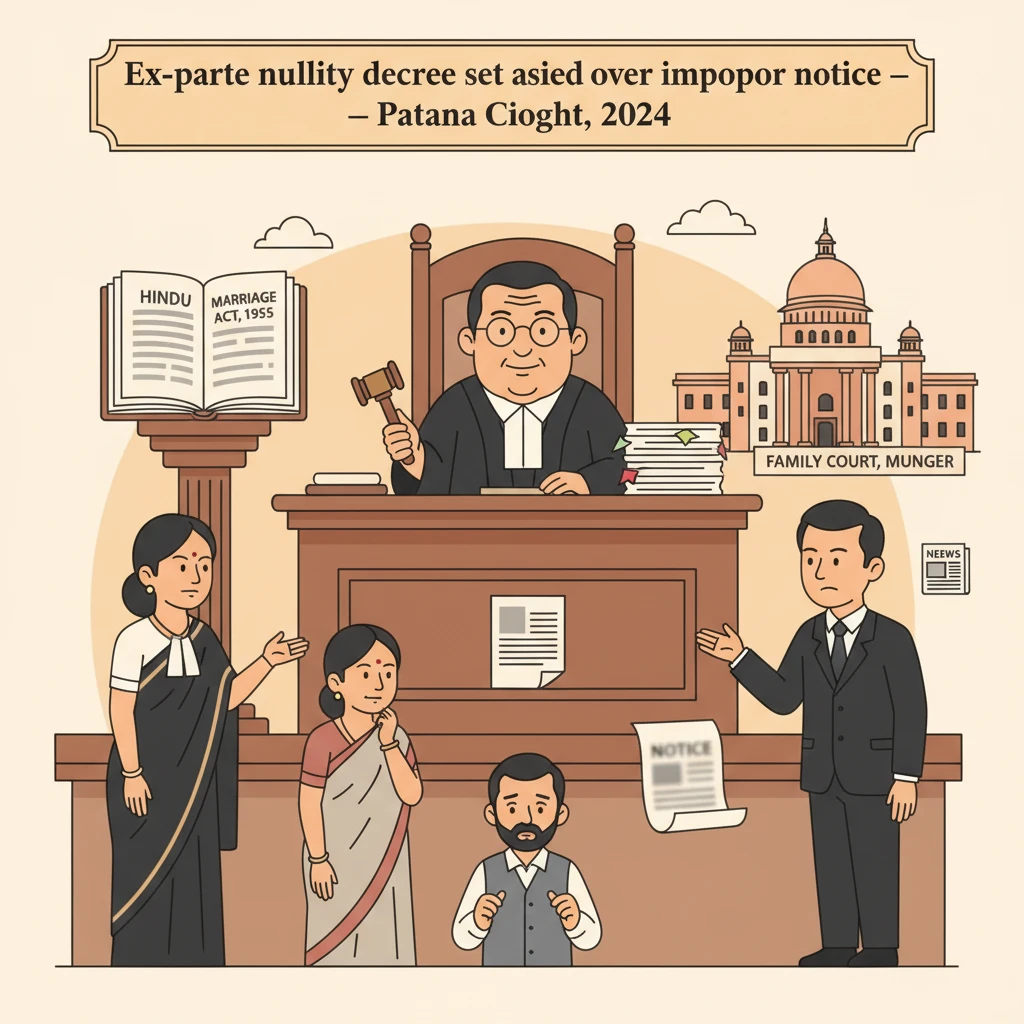
Case Background
The spouses are Hindus who were married on 26.06.1991. After marriage, they began living together as husband and wife.
The husband later claimed that he realised the wife was suffering from some mental disorder. She was taken to a doctor at Naugachiya, then referred to a psychiatrist and taken to Ranchi. There she was diagnosed as suffering from schizophrenia.
The husband stated that she again suffered an attack of schizophrenia on 21.09.1999 and was treated by a doctor. On medical advice she was admitted to the Central Institute of Psychiatry, Kanke, Ranchi, where she was declared as afflicted with schizophrenia. According to the husband, it was also detected that her schizophrenia was influenced by genetics and that she was lunatic at the time of marriage.
The husband further alleged that because of persistent refusal by the wife to have marital relations, the marriage was never consummated. He claimed that she was impotent at the time of marriage.
On 30.01.2003, the wife left the matrimonial home and went to Dumka to stay with her mother. The husband says she did not return despite his efforts. The wife then filed Complaint Case No.343 of 2005 under Section 498A of the Indian Penal Code, which was converted into Town P.S. Case No.215 of 2005.
She also filed a maintenance case under Section 125 of the Code of Criminal Procedure in the Family Court, Dumka in 2005. In that proceeding, the Principal Judge, Family Court, directed the husband to pay her Rs. 2,000 per month as ad-interim relief.
After these criminal and maintenance proceedings, the husband filed Title Suit (Matrimonial) No.97 of 2008 under Section 12(1)(a) and (b) read with Section 5(ii)(b) of the Hindu Marriage Act, 1955, seeking annulment of the marriage on the ground of mental disorder and alleged impotence.
Notice was issued to the wife but she did not appear. Based on this, the Family Court, Munger, proceeded ex-parte against her on 10.11.2009. After recording the husband’s evidence, the court passed an ex-parte judgment on 04.02.2013 and decree on 19.02.2013, declaring the marriage a nullity.
The wife then filed this Miscellaneous Appeal No.764 of 2013 before the Patna High Court challenging the ex-parte judgment and decree of the Family Court.
What the Court Examined and Decided
The appeal was heard by a Division Bench of Hon’ble Mr. Justice P. B. Bajanthri and Hon’ble Mr. Justice Arun Kumar Jha. The judgment was authored by Hon’ble Mr. Justice Arun Kumar Jha and delivered on 01.03.2024.
The core question before the Patna High Court was not whether the husband’s allegations about mental disorder or non-consummation were true. Instead, the Bench focused on a prior and basic issue: whether the wife had been properly served with notice of the husband’s matrimonial case before the Family Court proceeded ex-parte.
The wife’s counsel argued that the Family Court had ignored important facts. The husband had appeared, filed show cause and produced witnesses in the wife’s maintenance case (Cr. Misc. Case No.133 of 2005, proceedings under Section 125(4) and (5) CrPC) before the Family Court at Dumka. Yet, he never informed that court, the wife, or her lawyer there about the pendency of the annulment suit at Munger.
It was argued that the husband “managed the office” so that no notice was ever actually served upon the wife in the matrimonial suit. According to the wife, there was no material on record to prove valid service of summons, as could be seen from the order sheet of Title Suit (Matrimonial) No.97 of 2008. On this basis, counsel submitted that the ex-parte judgment and decree were based on erroneous consideration and should be set aside.
On the other hand, the husband’s counsel supported the Family Court’s decision. He submitted that notice by way of publication in a newspaper was sufficient notice of the proceedings to the wife. Since she did not appear even after publication, the Family Court was justified in proceeding ex-parte. He also argued that the wife and her family members were well aware of the pendency of the matrimonial suit but chose not to attend court for around five years.
After hearing both sides and examining the Family Court record, the Patna High Court concluded that the ex-parte decree was legally unsustainable on the ground of non-service of notice on the wife. The Bench made it clear that, because the matter would go back to the Family Court for full retrial, it would not discuss the detailed pleadings on merits so as not to prejudice either party.
The High Court then carefully traced the steps of service recorded by the Family Court. The suit was filed on 09.07.2008. On 06.08.2008, the Family Court ordered notice to the wife through courier. Requisites were filed, and notice was issued on 14.08.2008.
From the order dated 16.10.2008, it appeared that service of notice was treated as valid on the ground of “refusal.” Thereafter, the case was adjourned for the wife’s appearance on several dates.
On 02.09.2009, at the request of the husband’s lawyer, the court directed substituted service on the wife by paper publication. On 04.09.2009, the format of publication was filed. On 16.09.2009, the husband’s side produced a newspaper cutting showing publication of notice asking the wife to appear on 07.10.2009. She did not appear on that date, and the matter was adjourned to 10.11.2009. When she again did not appear on 10.11.2009, the Family Court proceeded ex-parte and eventually passed the ex-parte judgment and decree.
The High Court then examined whether these steps complied with the Code of Civil Procedure, 1908 (the Code), particularly Order 5, which governs issue and service of summons.
First, the Court noted that under Order 5 Rule 9, when the defendant resides within the court’s jurisdiction or has an authorised agent, summons should be delivered to the proper officer for service or sent to an approved courier service. Under sub-rule (3), service can also be by registered post acknowledgment due, speed post, or approved courier services.
Rule 17 of Order 5 deals with the situation where the defendant refuses to accept service or cannot be found. In such cases, the serving officer must affix a copy of the summons to the outer door or a conspicuous part of the house where the defendant ordinarily resides or works, and then return the original to court with a report saying what he did, why he did it, and naming the person who identified the house and in whose presence the copy was affixed.
Under Rule 19, when a summons is returned under Rule 17, the court must examine the serving officer to satisfy itself about the service.
Only after being satisfied, on examination of the serving officer, that the defendant is avoiding service or that for some other reason service in the ordinary way is not possible, can the court move to substituted service under Rule 20. Under Rule 20(1), this may involve affixing notice in the court house and on the defendant’s last known residence or some other method the court thinks fit. Rule 20(1-A) adds that if the court orders service by advertisement in a newspaper, it must be a daily newspaper circulating in the locality where the defendant last actually and voluntarily resided, carried on business or worked.
Applying these provisions, the Patna High Court found several serious defects:
First, the record showed only a courier report stating “refused to accept the notice.” There was no indication who made this endorsement. No name, initials or signature of the person making this note appeared. There was also no registered post or ordinary process.
Second, although substituted service by publication was ordered, the records did not contain any application under Order 5 Rule 20 of the Code seeking such substituted service. Even in the order dated 02.09.2009, the Family Court did not mention the name of the newspaper where the notice was to be published.
Third, it appeared that the notice was published in the Hindustan newspaper, local edition, Bhagalpur, Bihar, whereas the wife’s address was at Dumka in the State of Jharkhand. This was directly contrary to Rule 20(1-A), which requires publication in a daily newspaper circulating in the locality where the defendant resides.
In support of its analysis, the High Court relied on the decision of the Supreme Court in Yallawwa v. Shantavva, (1997) 11 SCC 159. In that case, the Supreme Court held that a trial court cannot almost automatically grant an application for substituted service without first trying to serve the respondent by ordinary procedure under Order 5 Rules 12, 15 and 17. Substituted service is to be used only as a last resort when the defendant cannot be served in the ordinary way, and the court is satisfied that the defendant is avoiding service or for some other reason cannot be served ordinarily.
The Supreme Court had observed that in Yallawwa the court had almost automatically resorted to substituted service, which was improper. The Patna High Court found that the same pattern was visible here: the Family Court had almost instantly allowed paper publication without recording satisfaction about the pre-conditions required for using Rule 20.
The High Court emphasised that a Family Court should not act mechanically, especially in matrimonial disputes involving divorce or annulment. Service of summons on a wife in such matters is a serious issue because it affects her entire life. Service cannot be presumed lightly.
Considering all these circumstances, the Bench held that the wife had not been duly served. The procedure followed for substituted service was vitiated. Because of this, the wife had shown sufficient cause for not appearing on the date when the Family Court proceeded ex-parte.
Consequently, the Patna High Court set aside the ex-parte judgment dated 04.02.2013 and the ex-parte decree dated 19.02.2013 passed in Title Suit (Matrimonial) No.97 of 2008. The matrimonial suit was restored to the file of the Principal Judge, Family Court, Munger.
The matter was remitted to the Family Court for fresh decision in accordance with law and on its own merits, after giving both parties ample opportunity to lead evidence and be heard. The High Court directed that this exercise be completed within six months from the date of receipt or production of a copy of its judgment.
To avoid further delay, the High Court directed both parties to appear before the Family Court on 15.03.2024 and specifically ordered that the Family Court shall not issue any fresh notice to the parties. The trial court record was ordered to be sent back forthwith. The appeal was allowed, with each party to bear its own costs.
Why This Judgment Matters
This judgment is important for anyone involved in matrimonial disputes, especially wives facing ex-parte divorce or nullity decrees.
The Patna High Court made it clear that before declaring a marriage void or ending it, the Family Court must be fully satisfied that the other spouse has actually received notice in the manner required by law.
Simply sending a courier, accepting an unverified refusal report, or publishing a notice in some distant newspaper is not enough. The court must follow every step laid down in Order 5 of the Code of Civil Procedure, including trying ordinary service, examining the serving officer, and using substituted service only as a last resort and in the correct local newspaper.
The judgment also underscores that ex-parte decrees affecting a spouse’s whole life can be set aside if notice was not properly served. This gives hope to spouses who were unaware of pending matrimonial cases and later discover that a decree was passed behind their back.
Legal Issues and Answers
- Issue: Was the ex-parte decree of nullity passed by the Family Court, Munger, valid when notice to the wife was allegedly served through courier and newspaper publication?
Answer: No. The Patna High Court held that the wife was not duly served. The procedure for service and substituted service under Order 5 of the Code of Civil Procedure was not properly followed, so the ex-parte judgment and decree had to be set aside. - Issue: What consequence follows if substituted service is ordered without complying with the safeguards under Order 5 Rules 9, 17, 19 and 20 CPC?
Answer: Such substituted service is vitiated. Any ex-parte decree based on it becomes legally unsustainable and must be set aside, with the matter remitted for fresh trial after proper opportunity to both sides.
Cases Cited by the Court
- Yallawwa v. Shantavva, (1997) 11 SCC 159
Case Details
Case Number: Miscellaneous Appeal No.764 of 2013
Case Title: Shila Devi v. Milind Kumar Singh
Court: High Court of Judicature at Patna
Coram: Hon’ble Mr. Justice P. B. Bajanthri and Hon’ble Mr. Justice Arun Kumar Jha
Date of Patna High Court Judgment: 01.03.2024
Impugned Judgment and Decree: Judgment dated 04.02.2013 and decree dated 19.02.2013 passed by the Principal Judge, Family Court, Munger in Title Suit (Matrimonial) No.97 of 2008
Citation: 2024(2) PLJR 200
Advocates: For the appellant (wife): Mr. Gyanendra Kumar Singh, Advocate. For the respondent (husband): Mr. Vinay Kirti Singh, Sr. Advocate; Mr. Pramod Kumar Sinha, Advocate; Mr. Akhileshwar Singh, Advocate; Mr. Chaintany Kumar, Advocate.
Nature of the Case: Miscellaneous appeal against an ex-parte decree of nullity in a matrimonial title suit under Section 12(1)(a) and (b) read with Section 5(ii)(b) of the Hindu Marriage Act, 1955.
Link to Judgment: Patna High Court Judgment
If you found this explanation helpful and wish to stay informed about
how legal developments may affect your rights in Bihar,
you may consider following Samvida Law Associates for more updates.







