

Case Background
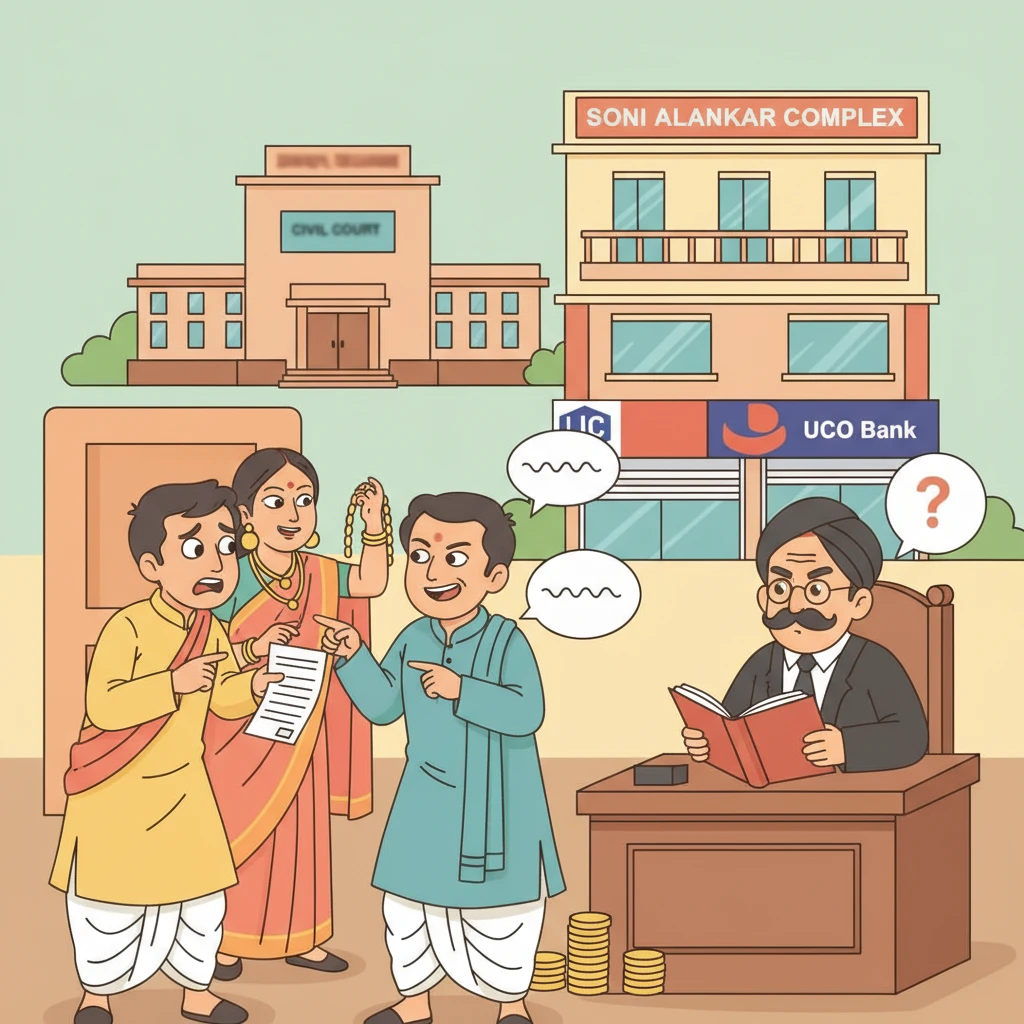
The case arose out of a long-running family dispute over rent from a commercial property known as Soni Alankar Complex at Hajipur, Vaishali.
According to the complaint, the father of the complainant and the petitioner had executed a registered agreement on 18.01.1993 during his lifetime. All brothers and legal heirs were made parties to this agreement.
Under this arrangement, the petitioner was appointed to realise rent and maintain the Soni Alankar Complex. Shops in the complex were to be rented out with consent of all parties, and the rent collected was to be equally distributed among them.
The complainant alleged that, despite this, the petitioner later executed lease agreements with LIC and UCO Bank without the consent of the other co-sharers. It was further alleged that the petitioner had not paid the complainant his share of rent since 1993.
Notices were allegedly issued to LIC’s Branch Manager and to the petitioner in 2009. Even after the deaths of one brother Amod Kumar on 02.04.2006, their father on 12.12.1999, and their mother on 29.12.2007, the petitioner was said to have entered into a fresh lease with LIC without involving the legal heirs of the deceased.
The complainant claimed that more legal notices were sent to the petitioner on 02.12.2014 and 06.01.2015, seeking accounts and payment of rent dues from 1993 onwards.
On 19.02.2015 at about 11 a.m., the complainant went to the complex and demanded his share of realised rent. He alleged that all the accused persons abused him, that petitioner no. 2 forcibly took his signature on a non-judicial stamp paper, and that the petitioner’s wife Neelam Devi snatched his gold chain worth Rs. 60,000/-. The complaint alleged that all accused had a common intention to grab rent money of about one crore rupees.
Based on this complaint (Complaint Case No. 529 of 2015), the Judicial Magistrate, Vaishali at Hajipur, in Tr. No. 163/2015, took cognizance on 19.07.2015/20.07.2015 for offences under Sections 323, 379, 384 and 504 of the Indian Penal Code against the petitioner.
Meanwhile, a separate civil dispute was already pending. One of the co-sharers, namely opposite party no. 2 (the complainant), had filed Partition Suit No. 835/2013 before the Court of Civil Judge-I, Hajipur, Vaishali, concerning the same property.
The petitioner approached the Patna High Court in Criminal Miscellaneous No. 23591 of 2016 seeking quashing of the order of cognizance and the entire criminal proceeding.
What the Court Examined and Decided
The matter was heard by Hon’ble Mr. Justice Chandra Shekhar Jha of the Patna High Court, who delivered an oral judgment on 02.04.2024.
The petitioner’s counsel argued that the criminal case was false and filed with an ulterior motive. According to the petitioner, the complaint was meant to put pressure on him to settle the partition suit pending before the civil court.
The petitioner relied on the registered agreement dated 18.01.1993. He submitted that 11 co-sharers, along with the complainant (opposite party no. 2), had authorised him through this agreement to rent out the specified properties to individuals and offices, collect rent, and distribute it equally among the co-sharers who were parties to that agreement.
It was pointed out that a dispute had arisen when one building was rented to LIC, and that the complainant, being a co-sharer, responded by filing the partition suit. The petitioner further submitted that the allegations of theft and extortion in the complaint also involved his wife, Neelam Devi, who herself was a co-sharer in the property. She died during the pendency of the High Court petition, and her name was deleted from the case on 06.12.2023.
While concluding, the petitioner’s counsel emphasised that other co-sharers who were examined during the enquiry in the complaint case did not support the allegations made by the complainant.
In support of the plea for quashing, the petitioner relied on the Supreme Court decision in Usha Chakraborty and Another v. State of West Bengal and Another, reported in 2023 SCC OnLine SC 90. In that judgment, the Supreme Court surveyed earlier case law on misuse of criminal proceedings in civil disputes and the scope of the High Court’s inherent powers under Section 482 of the Code of Criminal Procedure.
The learned APP, assisted by the complainant’s counsel, opposed the quashing application but fairly conceded that civil cases between the parties were pending.
The Patna High Court then reproduced and relied on key paragraphs from the Usha Chakraborty decision. These paragraphs, in turn, referred to earlier Supreme Court judgments such as Paramjeet Batra v. State of Uttarakhand, Vesa Holdings Private Limited v. State of Kerala, Kapil Aggarwal v. Sanjay Sharma, and the well-known categories laid down in State of Haryana v. Bhajan Lal, as well as guiding principles summarised in Neeharika Infrastructure Pvt. Ltd. v. State of Maharashtra.
From these decisions, the High Court highlighted several important principles:
First, while the High Court’s power under Section 482 CrPC must be used cautiously and sparingly, it exists to prevent abuse of the process of court and secure the ends of justice.
Second, some disputes may involve both civil and criminal aspects. However, where a dispute is essentially civil in nature and is given a “cloak of criminal offence”, and where a civil remedy is already available and adopted, the High Court should not hesitate to quash criminal proceedings that amount to harassment.
Third, the Court must consider whether the complaint, even if taken at face value, discloses the ingredients of any criminal offence, or whether the allegations are so inherently improbable or motivated that proceeding further would be an abuse of process.
Fourth, criminal proceedings that are manifestly attended with mala fide or maliciously instituted with an ulterior motive to wreak vengeance or exert private pressure fall within the recognised grounds for quashing, as laid down in Bhajan Lal.
After reviewing the factual background in light of these principles, the Patna High Court noted some key features.
The Court observed that the criminal complaint had been filed about two years after the partition suit no. 835/2013 was instituted. This timing indicated that the complainant turned to the criminal process after already approaching the civil court over the same property.
The Court also noted that the petitioner and the complainant are full brothers and co-sharers of the property by virtue of the agreement dated 18.01.1993. Under this agreement, opposite party no. 2 himself had authorised the petitioner to rent out the property described in it.
Importantly, the Court recorded that the complainant had already invoked the jurisdiction of the civil court by filing a civil suit, which remained pending. Against this backdrop, the High Court found that the criminal complaint now pursued by opposite party no. 2 appeared prima facie to be a “weapon of harassment” against the petitioner, driven by ulterior and oblique motives.
In other words, the High Court concluded that the criminal case was essentially an extension of the civil property dispute between co-sharers, and not a genuine criminal prosecution based on independent criminal conduct.
Applying the principles from Usha Chakraborty and the line of Supreme Court judgments cited therein, the Patna High Court held that continuation of the criminal proceedings would amount to abuse of the process of the court.
Accordingly, the Court quashed and set aside the impugned order of cognizance dated 19.07.2015/20.07.2015 passed by the Judicial Magistrate, Vaishali at Hajipur, in Tr. No. 163/2015 arising out of Complaint Case No. 529/2015, so far as it related to the petitioner.
With this, the criminal miscellaneous application was allowed. The Court further directed that the trial court records, if any, be returned to the learned trial court along with a copy of the High Court’s judgment.
Why This Judgment Matters
This judgment shows how the Patna High Court responds when criminal law is used in a family property dispute already pending in a civil court.
For co-sharers of property in Bihar and elsewhere, it underlines that disagreements over rent distribution, management of joint property, or accounts are primarily civil matters. Turning such disputes into criminal cases simply to exert pressure on a relative can be treated as misuse of the criminal justice system.
The decision reassures accused persons that the High Court can step in under Section 482 CrPC when criminal complaints appear to be weapons of harassment, particularly where a civil suit is already in progress on the same subject.
At the same time, it reminds complainants that criminal law is meant for genuine offences such as assault, theft or extortion, not as an additional bargaining tool in property or partition disputes.
Legal Issues and Answers
- Issue: Whether the criminal complaint alleging offences under Sections 323, 379, 384 and 504 IPC, arising out of a dispute between co-sharers over rent from a family property, should continue when a partition suit on the same property is already pending.
Answer: No. The Patna High Court held that the complaint appeared to be a weapon of harassment in an essentially civil dispute and quashed the order taking cognizance and all consequential proceedings against the petitioner. - Issue: When can the High Court exercise its power under Section 482 CrPC to interfere with criminal proceedings?
Answer: Relying on Usha Chakraborty and earlier Supreme Court cases, the Court held that this power is to prevent abuse of process and secure the ends of justice, including where a criminal case is mala fide, based on a civil dispute already taken to civil court, or used as a tool of harassment.
Cases Cited by the Court
- Usha Chakraborty and Another v. State of West Bengal and Another, 2023 SCC OnLine SC 90
- Paramjeet Batra v. State of Uttarakhand & Ors.
- Vesa Holdings Private Limited and Anr. v. State of Kerala and Ors.
- Kapil Aggarwal and Ors. v. Sanjay Sharma and Ors.
- State of Haryana v. Bhajan Lal
- Neeharika Infrastructure Pvt. Ltd. v. State of Maharashtra and Others
Case Details
Case Number: Criminal Miscellaneous No. 23591 of 2016 (arising out of Complaint Case No. 529 of 2015, Tr. No. 163/2015, P.S. Hajipur Town, District Vaishali)
Case Title: Binod Kumar v. The State of Bihar & Anr.
Citation: 2024 (2) PLJR 577
Coram: Hon’ble Mr. Justice Chandra Shekhar Jha
Date of Judgment: 02.04.2024
Advocates:
- For the Petitioner: Mr. Rakesh Kumar Soni, Advocate
- For Opposite Party No. 2: Mr. Kumar Ajit Singh, Advocate; Mr. Akash Kumar Mishra, Advocate
- For the State: Mr. Harendra Prasad, APP
Nature of the Case: Petition under Section 482 CrPC seeking quashing of order taking cognizance in a complaint case (criminal miscellaneous application)
Link to Judgment: View full judgment on Patna High Court website
If you found this explanation helpful and wish to stay informed about
how legal developments may affect your rights in Bihar,
you may consider following Samvida Law Associates for more updates.







