

Case Background
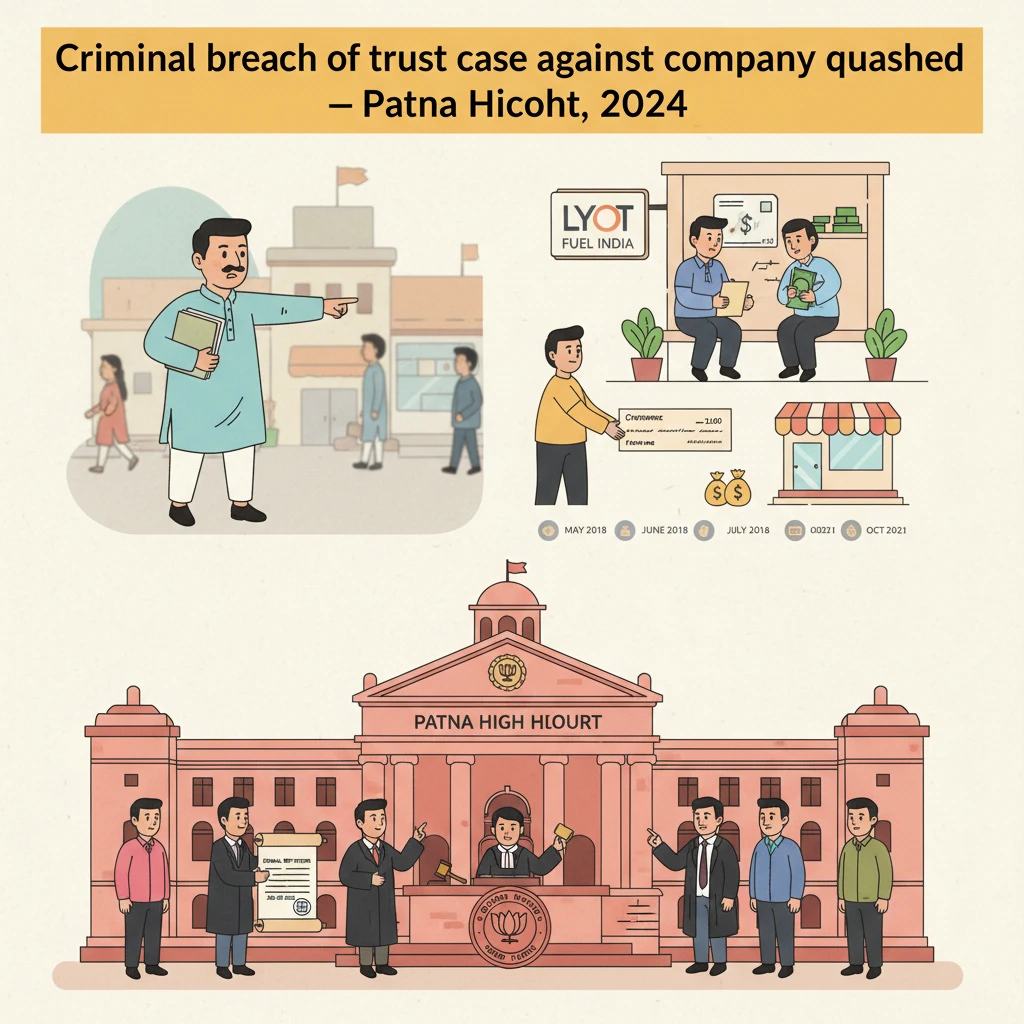
This case started with a complaint filed in Patna in 2019. The complainant alleged that he had entered into a business arrangement connected with Jet Knitwears Ltd., a Kanpur-based private company manufacturing and distributing LYCOT brand undergarments.
On 29 May 2018, an agreement was executed between the complainant and one M/s Fuel India, a proprietorship concern of Vikash Kumar Soni. Fuel India claimed to be authorized by Jet Knitwears Ltd. to sell and market its products. The agreement was for opening FOFO (Franchise Owned Franchise Operated) stores in a specific territory, to sell the company’s products.
Under this agreement, Fuel India was to open FOFO stores as per the guidelines of Jet Knitwears Ltd. The complainant was to function as an exclusive stock point (referred to as “FS”) for the company in that territory. The FS was supposed to raise bills in face-to-face transactions for physical retail outlets and could not sell through online or digital modes without written permission from Jet Knitwears Ltd.
The agreement further provided that the complainant would deposit Rs. 10,00,000 in favour of Jet Knitwears Ltd. All billings to the complainant (second party) would be done by Fuel India, and all payments by the complainant would be deposited with Fuel India. Goods from Jet Knitwears Ltd. were to be supplied on instructions of Fuel India. Both the complainant and Fuel India were to earn a 3% commission on sales to FOFO stores.
According to the complaint, after signing the agreement, the complainant paid Rs. 5,00,000 to Jet Knitwears Ltd. on 30 May 2018 and 06 June 2018 through two cheques. He also claimed to have spent Rs. 4,00,000 for advertisements of Jet Knitwears Ltd.’s business, allegedly on the instructions of the accused persons, and paid a total of Rs. 2,40,000 to Fuel India on different dates starting from 28 June 2018. Further transfers of Rs. 40,000 on 20 July 2018 and Rs. 50,000 on 30 July 2018 were allegedly made by NEFT in favour of the accused.
In all, the complainant alleged that he had paid or spent a total of Rs. 11,41,000, but no FOFO shop or store was established. He accused the company, its directors and officers, and Fuel India and its proprietor of misappropriating his money and filed a complaint case in Patna for offences under Section 406/34 of the Indian Penal Code (IPC).
On 6 October 2021, the Judicial Magistrate 1st Class, Patna, took cognizance under Sections 406/34 IPC against the petitioners (Jet Knitwears Ltd. and its directors/CEO) and issued process. Challenging this, the petitioners approached the Patna High Court by a criminal writ petition under Article 226 of the Constitution.
What the Court Examined and Decided
The main question before the Patna High Court was whether the complaint and materials on record showed a basic, prima facie case of criminal breach of trust under Section 406 IPC against Jet Knitwears Ltd. and its directors/CEO, so as to justify continuation of criminal proceedings against them.
The petitioners argued that they were not signatories to the FOFO agreement dated 29 May 2018. That agreement was between Fuel India (proprietor Vikash Kumar Soni, later arrayed as accused no. 6) and the complainant. They submitted that the obligations under the agreement, including opening FOFO stores, dealing with billing, delivery of products and collection of payments, were all the responsibility of Fuel India, not Jet Knitwears Ltd.
The petitioners pointed out that Clause 3 of the agreement made it the duty of Fuel India to open FOFO stores as per the guidelines of Jet Knitwears Ltd. and to act as FOFO stores for the LYCOT brand. The FS (exclusive stock point) was only to raise bills for face-to-face transactions with physical stores and was barred from online sales without written authorization.
Clause 5 of the agreement, as noted by the Court, stated that sales of Jet Knitwears Ltd. products to FOFO stores would be made under the agreement at prices and on terms decided by the petitioner company but implemented by Fuel India. Clause 6 clearly provided that Jet Knitwears Ltd. would not be responsible for billing; billing and delivery of products were to be handled by Fuel India. Fuel India was also to open FOFO stores on an advance basis, collect payments (through cheques, RTGS, DD, NEFT) and have such payments made in its own name.
On facts, the petitioners accepted that they had received Rs. 5,00,000 by bank transfer from the complainant. However, they maintained that the complainant had never deposited the full Rs. 10,00,000 security amount contemplated in the agreement. They said that the dispute actually arose between the complainant and accused nos. 5 and 6 (Fuel India and its proprietor) over non-establishment of FOFO stores.
Most importantly, they repeatedly stated before the High Court that they were ready and willing to refund Rs. 5,00,000 to the complainant, which had been deposited in favour of Jet Knitwears Ltd.
From this foundation, the petitioners argued that the complaint, even if accepted at face value, disclosed at best a case of breach of contract — a civil dispute — and not criminal breach of trust. They relied on the Supreme Court judgment in Vijay Kumar Ghai v. State of W.B., (2022) 7 SCC 124. That decision explains that, for an offence under Section 406 IPC, entrustment of property is a basic and essential ingredient, and there must be dishonest use or disposal of that property in violation of law or legal contract.
The petitioners submitted that there was no entrustment of property in favour of Jet Knitwears Ltd. in a manner that created a criminal breach of trust. They also relied on Anand Kumar Mohatta v. State (NCT of Delhi), (2019) 11 SCC 706, where the Supreme Court held that in business transactions involving security deposits, failure to return or disputes over such deposits normally give rise to civil disputes rather than criminal proceedings under Section 406 IPC.
On the other side, counsel for the complainant (opposite party no. 2) argued that the writ petition itself under Article 227 was not maintainable, as the order taking cognizance could be challenged either by criminal revision or under Section 482 CrPC. They contended that the High Court should not exercise writ jurisdiction in this situation.
Substantively, they argued that Fuel India had been authorized by Jet Knitwears Ltd. to carry out business and sign agreements, through a letter of authorization dated 1 May 2018. They pointed to Clauses 3, 5 and 6 of the FOFO agreement to show that Fuel India was acting as an agent of Jet Knitwears Ltd., and that the entire scheme was designed for mutual benefit.
The complainant’s side emphasised that he had paid Rs. 2,40,000 to Fuel India and spent Rs. 4,00,000 on advertisements for Jet Knitwears Ltd. They relied on Section 24 IPC (definition of “dishonestly”) to argue that all these actions, including the company receiving Rs. 5,00,000, amounted to a dishonest scheme causing wrongful loss to the complainant and wrongful gain to the accused, in collusion with each other. In their view, both the company and Fuel India were liable under Section 406 IPC.
Justice Bibek Chaudhuri first addressed the question of jurisdiction. He noted that the Code of Criminal Procedure gives the High Court inherent power under Section 482 to prevent miscarriage of justice. These powers, as well as those under Articles 226 and 227 of the Constitution, are to be used sparingly and cautiously, but the relief available under Section 482 can also be claimed under Articles 226 or 227. Under Article 227, the High Court has power of superintendence over all subordinate courts.
After examining the pleadings and materials, the Court found that Jet Knitwears Ltd. and its directors/CEO were “not in the picture” when the agreement was executed between the complainant and accused nos. 5 and 6. The company and its officers were not parties to that contract.
The Court rejected the complainant’s argument that the principal (the company) is automatically liable for all acts of the agent (Fuel India) in a criminal case of this nature. It noted that the petitioners were in no way connected with the agreement executed between the complainant and Fuel India, and that they had consistently remained ready and willing to refund Rs. 5,00,000 to the complainant.
In these circumstances, the Court held that the complainant had failed to make out any case under Sections 406/34 IPC against the petitioners. The key ingredient of entrustment, followed by dishonest misappropriation contrary to law or contract, was not established on the face of the record in respect of Jet Knitwears Ltd. or its directors/CEO.
Accordingly, the Court declared that the order of cognizance taken against the petitioners was bad in law, inoperative and liable to be quashed. However, the Court also took note of the petitioners’ repeated offer to refund the amount they had received.
Therefore, the High Court quashed the criminal proceedings in Complaint Case No. 5518 of 2019 as against the petitioners, subject to their paying or depositing Rs. 5,00,000 along with interest at 8% per annum from the date of bank transfer till the date of repayment. The criminal proceedings were left untouched as against accused nos. 5 and 6, who had not approached the High Court.
Why This Judgment Matters
This judgment is important for businesspeople, small investors and franchise partners who often get trapped in disputes where criminal cases are used as pressure tactics.
The Patna High Court made it clear that not every failed business arrangement or non-performance of a contract amounts to a criminal offence like criminal breach of trust. For such a criminal case to continue, there must be a clear entrustment of property and dishonest misappropriation in violation of law or contract.
Here, the Court saw that the core disagreement was between the complainant and Fuel India, with whom he had signed the agreement. The company and its directors were not parties to that agreement and had even offered to refund the amount they had received.
By quashing the proceedings against the company and its officers but keeping the case alive against the intermediary (who did not challenge the case), the Court carefully separated civil disputes from criminal liability. This helps prevent misuse of criminal law to settle civil or commercial disputes, while still allowing genuine criminal allegations to proceed against the concerned parties.
Legal Issues and Answers
- Issue: Did the complaint and materials disclose a prima facie case of criminal breach of trust under Sections 406/34 IPC against Jet Knitwears Ltd. and its directors/CEO?
Answer: No. The Patna High Court held that there was no entrustment of property to the petitioners under any contract with the complainant, and no dishonest misappropriation was made out. The order taking cognizance against them was quashed. - Issue: Could the High Court exercise its powers under Articles 226/227 of the Constitution to quash the cognizance order in a criminal case?
Answer: Yes. The Court held that the inherent power under Section 482 CrPC to prevent miscarriage of justice can also be claimed under Articles 226/227, though such power must be used sparingly and cautiously. - Issue: What condition, if any, was attached to quashing the criminal proceedings against the petitioners?
Answer: The proceedings were quashed against the petitioners on the condition that they pay or deposit Rs. 5,00,000 (the amount received from the complainant) along with 8% annual interest from the date of bank transfer till repayment.
Cases Cited by the Court
- Vijay Kumar Ghai v. State of W.B., (2022) 7 SCC 124
- Anand Kumar Mohatta v. State (NCT of Delhi), (2019) 11 SCC 706
Case Details
Case Number: Criminal Writ Jurisdiction Case No. 265 of 2022 (arising out of Complaint Case No. 5518(c) of 2019, P.S. Patna Complaint Case, District Patna)
Case Title: JET KNITEARS LTD Manufacturers of Exports Quality Undergarments & Ors. v. The State of Bihar & Anr.
Coram: Hon’ble Mr. Justice Bibek Chaudhuri
Citation: 2024 (2) PLJR 528
Advocates:
- For the petitioners: Mrs. Archana Sinha @ Archana Shahi, Advocate; Mr. Alok Kumar, Advocate
- For opposite party no. 2 (complainant): Mr. Rajnandan Prasad, Advocate; Mr. Vishesh Kumar Singh, Advocate
- For the State of Bihar: Mr. Deepak Kumar, AC to GP 4
Nature of the Case: Criminal writ petition under Article 226/227 of the Constitution seeking quashing of cognizance order in a complaint case under Sections 406/34 IPC.
Link to Judgment: Patna High Court Judgment – CR. WJC No. 265 of 2022
If you found this explanation helpful and wish to stay informed about
how legal developments may affect your rights in Bihar,
you may consider following Samvida Law Associates for more updates.







