

Case Background
The dispute arises out of a land ownership case in Supaul district. The petitioner before the Patna High Court is the plaintiff in Title Suit No. 81 of 2012. She claims title, ownership and possession over land described as Schedule-2 of the plaint.
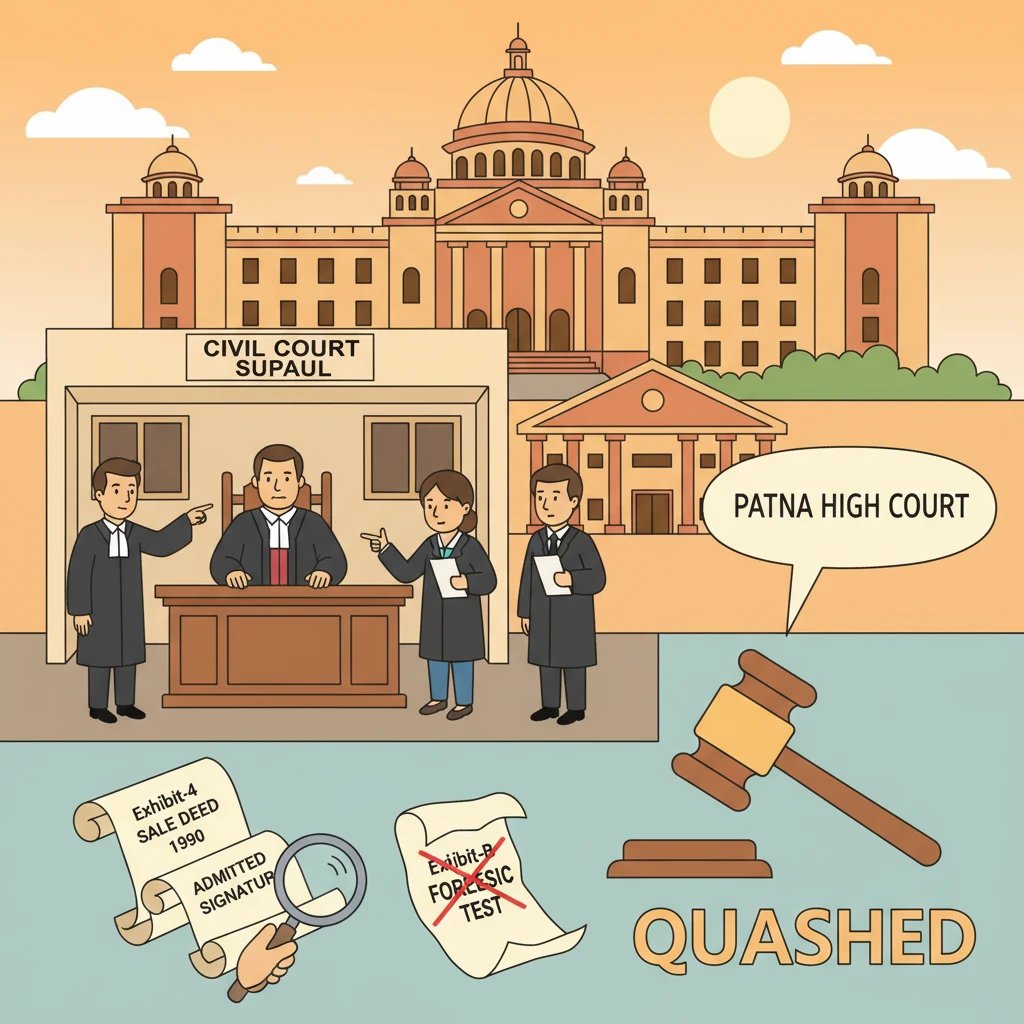
Her case is based on a sale deed dated 17.08.1990 (marked as Exhibit-4 in the suit), allegedly executed in her favour by defendant no.2. On the strength of this sale deed, she sought declaration of her title and confirmation of her possession over the suit land.
The plaintiff also challenged a gift deed and some sale deeds said to have been executed in favour of defendant no.3 and defendant no.1. She asked the civil court to declare those documents void, illegal and not binding on her.
According to the plaint, defendant no.1 claimed part of the suit land through two sale deeds dated 07.04.1994 executed by defendant no.2 in favour of defendant no.1, who was acting as guardian of his minor son, defendant no.3. Defendant no.3 is said to have obtained the suit land by a gift deed dated 25.11.1993 executed by Laxmi Devi, the first wife of his grandfather.
Defendant no.1 entered appearance and filed a written statement, denying the plaintiff’s claims. The suit proceeded ex parte against defendants no.2 and 3.
Evidence in the title suit was completed. Arguments of both sides were heard. After this, the trial court fixed 30.11.2016 for delivery of judgment.
Two days before the scheduled date of judgment, on 28.11.2016, a petition was filed on behalf of the son of defendant no.1. He requested that the signature of defendant no.2 on Exhibit-4 (sale deed dated 17.08.1990) be verified and compared with the admitted signature on Exhibit-B, by sending the documents to the Forensic Science Laboratory. The cost was to be borne by the defendant.
The plaintiff opposed that petition. She argued that it was not maintainable because it had been filed by a person who was a stranger to the suit. After some adjournments, that petition was dismissed on 28.11.2016 as not pressed.
Later, on 06.04.2017, defendant no.1 herself filed an application with the same prayer, seeking forensic examination of the signature of defendant no.2 on the sale deed dated 17.08.1990. The plaintiff filed her rejoinder on 25.04.2017, opposing this move.
After hearing the parties, the Subordinate Judge 3rd, Supaul allowed the petition dated 07.04.2017 by order dated 23.08.2017. He directed that the sale deed dated 17.08.1990 be sent for examination of the signature of defendant no.2 by the Forensic Science Laboratory.
This order, passed when the suit had already been heard and fixed for judgment, was challenged before the Patna High Court through the present civil miscellaneous petition under Article 227 of the Constitution of India.
What the Court Examined and Decided
The Patna High Court, through Hon’ble Mr. Justice Arun Kumar Jha, heard the matter at the stage of admission and decided to dispose of it finally.
The core question before the Court was whether the trial court could, after completion of evidence and arguments and after fixing a date for pronouncement of judgment, entertain an application to send a key sale deed for forensic examination of signatures.
The petitioner’s counsel argued that the trial court’s order was passed without application of judicial mind and beyond its jurisdiction. He stressed that once the hearing in a suit is completed and the case is reserved for judgment, the parties do not have any right to file fresh applications to introduce new steps in evidence.
He relied heavily on the Supreme Court decision in Arjun Singh vs. Mohindra Kumar & Ors., AIR 1963 SC 993. In that case, the Supreme Court held that the Code of Civil Procedure recognises only two stages during trial:
First, where the hearing is adjourned. Second, where the hearing is completed.
Once the hearing is completed, the Supreme Court observed, the parties have no further rights or privileges in the matter. Order XX Rule 1 of the Code simply allows the Court to deliver judgment after an interval for its own convenience. This convenience does not give any party a right to file further petitions, and the court has no jurisdiction to entertain such petitions at that stage.
Applying this principle, the petitioner’s counsel submitted that, in this case, the title suit had already been fully heard and a date fixed for judgment. The application filed by defendant no.1 on 06.04.2017 (treated as petition dated 07.04.2017) for forensic examination of the signature on Exhibit-4 could not legally be entertained.
The petitioner’s counsel also drew attention to the written statement of defendant no.1. In that written statement, defendant no.1 did not deny the execution of the sale deed dated 17.08.1990 by defendant no.2 in favour of the plaintiff. Nor did she allege that the signature of defendant no.2 was forged or obtained by impersonation.
On the contrary, defendant no.1 had stated that the husband of the plaintiff and defendant no.2, acting together, got the sale deed of 17.08.1990 executed in favour of the plaintiff without consideration, to grab the share of Laxmi Devi. She described it as a sham transaction, not as a forged or fabricated document.
According to the petitioner, this meant that defendant no.1 had taken a completely new stand at a very late stage by alleging that the signature of defendant no.2 on the sale deed was forged as a result of impersonation. This new stand, it was argued, was clearly an attempt to delay the pronouncement of judgment and to avoid the existing presiding officer.
The petitioner also pointed out the sequence of events. First, the son of defendant no.1 filed a similar petition just before the date of judgment. When that petition was not entertained and ultimately dismissed as not pressed, defendant no.1 herself filed another petition with the same prayer. This, the petitioner said, showed a deliberate strategy to stall the case.
On the other side, the counsel for respondent first set (defendant no.1 and others) defended the trial court’s order. He argued that the plaintiff’s claim was based on a forged and fabricated document. A forged document, he submitted, can be challenged at any stage because it never confers any legal right on anyone.
He further argued that if the trial court felt it necessary to get a document examined to reach a correct conclusion, it was within its power to send the document to a forensic expert. He described it as the primary duty of any court to clear doubts and verify facts before giving a judgment, especially when there were doubts about the genuineness of signatures.
The respondent’s counsel claimed that defendant no.1 noticed the doubtful nature of the document during inspection and promptly brought this to the court’s notice. He submitted that the trial court had not committed any illegality in sending a suspicious document for scientific examination.
To support his stand, he relied on two Supreme Court decisions. First, Damara Venkata Murali Krishna Rao vs. Gurujupalli Satvathamma, (2008) 12 SCC 170, where the Supreme Court allowed an appeal and restored an order permitting comparison of signatures by a Government expert. Second, Gurdev Singh & Ors. vs. Mehnga Ram & Anr., AIR 1997 SC 3572, where the Supreme Court held that the High Court should not have interfered with an order of the first appellate court under Order XLI Rule 27(b) of the Code concerning additional evidence, at an interim stage.
In reply, the petitioner’s counsel argued that both these Supreme Court decisions were distinguishable on facts and did not help the respondents. In Damara Venkata Murali Krishna Rao, the matter was still at the stage of arguments after closure of evidence and had not been fixed for judgment. In Gurdev Singh, the issue related to the powers of the first appellate court to admit additional evidence; the case did not concern a situation where the suit was already reserved for judgment.
After considering the rival submissions, the Patna High Court focused on the legal position laid down in Arjun Singh. The Court observed that once the hearing has been completed, the parties cease to have any rights or privileges in relation to further applications. The only thing left is for the court to deliver its judgment, even if the date is some time later, under Order XX Rule 1 CPC.
The High Court stressed that the “clock could not be set back”. Issues that ought to have been raised during the hearing cannot be allowed to be raised after the hearing is concluded and the case is fixed for pronouncement of judgment. As per Arjun Singh, there is no gap or “hiatus” between reservation of judgment and its pronouncement that would reopen the trial stage.
Applying this principle, the Court held that the trial court was not correct in entertaining the application dated 07.04.2017 filed by defendant no.1, and in passing the order dated 23.08.2017 directing forensic examination of the sale deed. That order was therefore without jurisdiction.
The Court also noted that the authorities cited by the respondents did not assist them, because the factual situation in those cases was different from the present case where the matter had already been heard and fixed for judgment.
On this reasoning, the Patna High Court concluded that the impugned order dated 23.08.2017 passed by the Subordinate Judge 3rd, Supaul in Title Suit No. 81 of 2012 suffered from an error of jurisdiction and had to be set aside.
The civil miscellaneous petition under Article 227 was accordingly allowed. The High Court clarified that it had made no comment on the merits of the underlying title suit. The trial court was directed to proceed with the matter uninfluenced by any of the observations of the High Court.
Why This Judgment Matters
This judgment is important for anyone involved in civil suits, especially land and property disputes. It clarifies that once a trial court has closed evidence, heard arguments and fixed a date for judgment, parties cannot keep filing new applications to delay the decision.
The Patna High Court has reaffirmed that there is no legal “third stage” between hearing and judgment where fresh petitions can be entertained. This protects litigants from tactics aimed at dragging cases indefinitely after they are ready for decision.
The ruling also sends a message to trial courts that they must be careful not to reopen matters after reserving judgment, unless clearly permitted by law. Entertaining such late-stage applications can be treated as an error of jurisdiction and corrected under Article 227.
For ordinary litigants, the case shows that if the other side suddenly changes their stand at the last moment and seeks fresh enquiries after arguments are over, such tactics can be challenged before the High Court.
Legal Issues and Answers
- Issue: Can a civil trial court, after completion of hearing and after fixing a date for judgment, entertain an application to send a disputed document for forensic examination of signatures?
Answer: No. Following Arjun Singh vs. Mohindra Kumar, once hearing is completed and the matter is fixed for judgment, parties have no right to file fresh applications, and the court has no jurisdiction to entertain them. The trial court’s order allowing such an application was set aside as suffering from error of jurisdiction.
Cases Cited by the Court
- Arjun Singh vs. Mohindra Kumar & Ors., AIR 1963 SC 993.
- Damara Venkata Murali Krishna Rao vs. Gurujupalli Satvathamma, (2008) 12 SCC 170 (cited by respondents, distinguished).
- Gurdev Singh & Ors. vs. Mehnga Ram & Anr., AIR 1997 SC 3572 (cited by respondents, distinguished).
Case Details
Case Number: Civil Miscellaneous Jurisdiction No. 1678 of 2017
Case Title: Mina Devi vs. Ajay Kumar Singh @ Lallu Singh & Ors.
Court: High Court of Judicature at Patna
Coram: Hon’ble Mr. Justice Arun Kumar Jha
Date of Judgment: 16.04.2024
Citation: 2024 (2) PLJR 479
Nature of the Case: Civil miscellaneous petition under Article 227 of the Constitution of India challenging an interlocutory order in a title suit (Title Suit No. 81 of 2012)
Trial Court Order Challenged: Order dated 23.08.2017 passed by Subordinate Judge 3rd, Supaul in Title Suit No. 81 of 2012
Advocates:
For the Petitioner: Mr. S.S. Dwivedi, Senior Advocate; Mr. Parth Gaurav, Advocate; Mr. Ashutosh Kr. Pandey, Advocate; Mr. Kunal Aryan, Advocate.
For the Respondents: Mr. R.K. Shukla, Advocate; Mr. Pratyush Pratap Singh, Advocate; Mr. Ritu Raj Shukla, Advocate.
Link to Judgment: Official Patna High Court judgment
If you found this explanation helpful and wish to stay informed about how legal developments may affect your rights in Bihar, you may consider following Samvida Law Associates for more updates.







