

Case Background
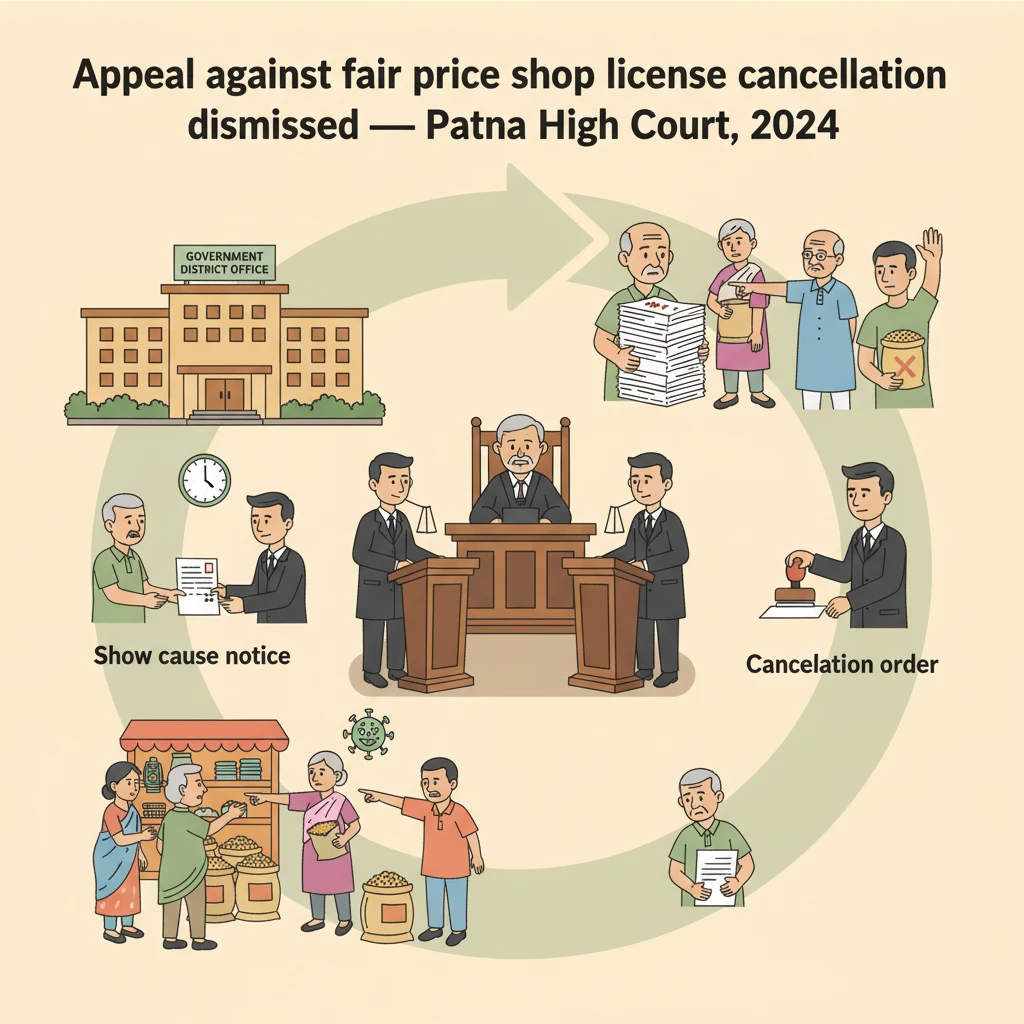
The matter arose from cancellation of a fair price shop licence bearing no. 68/2018 under the Bihar Targeted Public Distribution System (Control) Order, 2016.
The dealer was distributing essential foodgrains and other items under the Public Distribution System in Konch Block of Gaya district. Complaints were made to the licensing authority about his functioning during the Covid-19 pandemic period.
On receiving these complaints, the licensing authority conducted an enquiry. The enquiry revealed irregularities and corrupt practices. Based on the enquiry report, a show cause notice was issued to the dealer, calling upon him to explain why his licence should not be cancelled.
The dealer submitted a detailed written reply to the show cause notice. After considering the enquiry report and his reply, the licensing authority passed an order cancelling the fair price shop licence.
Aggrieved, the dealer filed Civil Writ Jurisdiction Case No. 8159 of 2020 before a learned Single Judge of the Patna High Court, challenging the cancellation order. By judgment dated 07.04.2021, the learned Single Judge dismissed the writ petition and upheld the cancellation.
The dealer then filed Letters Patent Appeal No. 167 of 2022 before a Division Bench of the Patna High Court against the Single Judge’s decision. There was a delay of 338 days in filing this appeal.
On 03.04.2024, the Division Bench (the Chief Justice and Hon’ble Mr. Justice Harish Kumar) delivered an oral judgment dismissing the Letters Patent Appeal.
What the Court Examined and Decided
The Division Bench heard arguments from both sides. The appellant was represented by his advocate, and the State was represented by the Additional Advocate General.
The appellant’s main complaint was that he was not given proper opportunity to defend himself before his licence was cancelled. According to him, only three days were given to respond to the show cause notice. He argued that this short time amounted to violation of natural justice.
He further claimed that the authorities did not show any clear violation of the licence conditions, the Control Order, or any relevant Act. He suggested that there was no proper basis for invoking the power to cancel his licence.
It was also argued that no personal hearing was granted to him before passing the cancellation order, and therefore the order should have been set aside. The appellant complained that the learned Single Judge had failed to consider these aspects and wrongly rejected his writ petition.
On the other side, the State relied on the detailed judgment of the learned Single Judge. The State’s counsel submitted that each of the contentions raised by the dealer had been carefully examined and rejected. The State also pointed out that there was a delay of 338 days in filing the Letters Patent Appeal, and apart from referring to the Covid-19 pandemic, no convincing explanation for this delay had been offered.
After considering the rival submissions, the Division Bench turned to the factual background recorded by the learned Single Judge.
The Court noted that complaints were received against the dealer, who was responsible for distribution of essential foodgrains under the Public Distribution System at a time when the entire country was suffering from the Covid-19 pandemic.
On those complaints, an enquiry was conducted by the licensing authority. The enquiry report, which formed part of the show cause notice, showed that beneficiaries had been spoken to.
According to the beneficiaries, the dealer was not supplying foodgrains properly. Many of them had reportedly not received foodgrains for a certain period. Some beneficiaries also alleged that the dealer was indulging in corrupt practices by charging more than the fixed price for kerosene oil and other items.
These findings of irregularities and overcharging formed the basis of the show cause notice. The notice called upon the dealer to submit his reply within three days.
The Division Bench emphasised that the appellant actually did file a reply within this time. At no point did he ask for additional time to prepare his defence. His reply did not contain any request for more time to collect documents or respond in detail.
The learned Single Judge had examined the show cause reply in detail. It was recorded that the reply ran into 52 pages and was accompanied by several enclosures. The reply dealt with each charge in the show cause notice point by point.
In these circumstances, the Division Bench agreed with the learned Single Judge that the dealer could not claim to have suffered prejudice merely because the notice mentioned three days. The crucial aspects were that he actually responded at length, annexed documents, and never sought extension of time.
The Division Bench further noted the findings of the learned Single Judge that the cancellation order was based on substantial material. The licensing authority had considered the enquiry report and then examined the dealer’s 52-page reply, dealing with his points in detail.
The order cancelling the licence was found to be a speaking and reasoned order that complied with the principles of natural justice. On this basis, the learned Single Judge held that there was no perversity or illegality in the cancellation to justify interference under Article 226 of the Constitution of India.
The Division Bench agreed with this approach. It reminded that judicial review under Article 226 is not a fresh appeal on facts. The High Court’s role is limited to reviewing how the decision was made, not to re-evaluate the evidence as if the Court were the licensing authority.
The Court explained that judicial review is meant to ensure fair treatment. The questions it must examine are whether the proper rules were followed, whether relevant material was considered, whether any extraneous material influenced the decision, and whether the authority acted within its jurisdiction and respected the principles of natural justice.
Applying these tests, the Division Bench stated that there was no material to show any error in the cancellation order or in the Single Judge’s decision. The enquiry was properly conducted, the dealer was given opportunity to reply, his detailed reply was considered, and a reasoned order was passed.
The Court also took note of the long delay of 338 days in filing the appeal, which was only sought to be excused on the general ground of the Covid-19 pandemic. Although the judgment does not elaborate further on condonation of delay, the Bench clearly treated the appeal as lacking merit on the substantive grounds.
Since no illegality, perversity, or violation of natural justice was found, the Division Bench held that there was no reason to interfere with the Single Judge’s decision. Consequently, the Letters Patent Appeal was dismissed.
Why This Judgment Matters
This judgment is significant for fair price shop dealers and beneficiaries of the Public Distribution System in Bihar.
First, it shows that when serious complaints of non-supply and overcharging are supported by an enquiry report, the licensing authority is justified in cancelling a licence, especially when essential food items are involved during a crisis like the Covid-19 pandemic.
Second, it clarifies that a dealer cannot later claim lack of opportunity if he has already submitted a lengthy, detailed reply to a show cause notice without seeking more time. Courts will look at actual prejudice, not just the number of days mentioned in the notice.
Third, the Patna High Court reiterates that its power in writ jurisdiction is limited. It will not sit as an appellate court to re-assess evidence if the authority has followed the law, considered relevant materials, and passed a reasoned order.
For ordinary citizens, especially ration card holders, the decision underlines that complaints made to authorities about irregularities in fair price shops can lead to action. For licence holders, it is a warning that misuse of the Public Distribution System and corrupt practices can result in cancellation that courts are reluctant to interfere with, if proper procedure has been followed.
Legal Issues and Answers
- Issue: Whether the fair price shop dealer was denied sufficient opportunity to defend himself because only three days were given to reply to the show cause notice and no personal hearing was granted.
Answer: No. The Court held that the dealer filed a 52-page detailed reply with enclosures, never sought additional time, and his reply was duly considered in a reasoned cancellation order, satisfying the principles of natural justice. - Issue: Whether the Patna High Court, in exercise of writ jurisdiction, should interfere with the licensing authority’s order cancelling the fair price shop licence and the Single Judge’s judgment upholding it.
Answer: No. The Division Bench held that judicial review under Article 226 is confined to examining the decision-making process. As the authority acted on an enquiry report, considered the dealer’s reply, and passed a speaking order without jurisdictional error or procedural unfairness, no interference was warranted. - Issue: Whether any error or perversity was shown in the cancellation order or the Single Judge’s judgment to justify allowing the Letters Patent Appeal.
Answer: No. The Court found no material suggesting any such error and dismissed the appeal as devoid of merit.
Cases Cited by the Court
- The judgment does not mention or rely on any specific prior case citations.
Case Details
Case Number: Letters Patent Appeal No. 167 of 2022 in Civil Writ Jurisdiction Case No. 8159 of 2020
Case Title: Shiv Shankar Singh @ Shankar Singh v. The State of Bihar and Others
Coram: Hon’ble the Chief Justice; Hon’ble Mr. Justice Harish Kumar
Citation: 2024 (2) PLJR 439
Advocates: For the appellant: Mr. Bhaskar Shankar, Advocate; For the respondents (State): Mr. S. Raza Ahmad, AAG-5
Nature of the Case: Letters Patent Appeal against dismissal of writ petition challenging cancellation of fair price shop licence under the Bihar Targeted Public Distribution System (Control) Order, 2016
Date of Judgment: 03.04.2024
Link to Judgment: https://patnahighcourt.gov.in/viewjudgment/MyMxNjcjMjAyMiMxI04=-OpkPeb0SNug=
If you found this explanation helpful and wish to stay informed about
how legal developments may affect your rights in Bihar,
you may consider following Samvida Law Associates for more updates.







