

Case Background
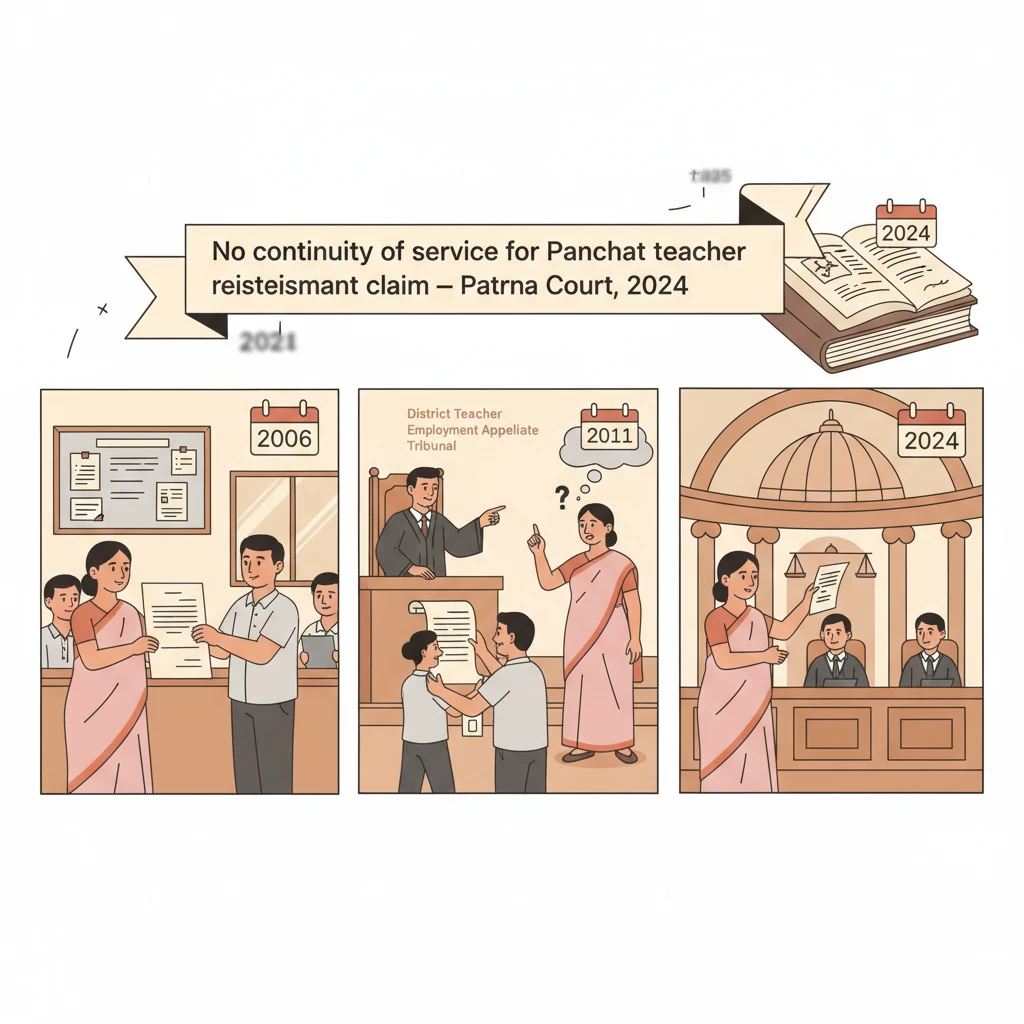
The petitioner was selected as a Panchayat Teacher in Gram Panchayat Isiyan, Block Chainpur, District Kaimur at Bhabua, under an advertisement published in 2006.
There were 16 advertised posts of Panchayat Teacher. Out of these, 8 posts were reserved for female candidates: 4 for General (female), 1 for BC-II (female), 1 for SC (female) and 2 for EBC (female). The petitioner applied under the BC-II (female) category, having 59.22% marks in Intermediate.
In the merit list for BC-II (female), the petitioner was placed at Serial No. 1. She participated in counselling, was selected without objection, and was appointed as Panchayat Teacher vide letter no. 13 dated 30.11.2006.
She joined duty on 02.12.2006 at Urdu Prathmik Makhtab Darwan, Panchayat Isiyan, Block Chainpur, District Kaimur at Bhabua, and worked for about one year, receiving her honorarium regularly.
During the selection process, an unsuccessful candidate complained to the District Superintendent of Education, alleging that candidates with fewer marks had been appointed. On that basis, the District Superintendent of Education ordered fresh counselling on 14.09.2007.
Fresh counselling was held on 30.10.2007 and 05.11.2007. The petitioner again appeared, was once more found successful, and rejoined on 27.11.2007.
Later, the same unsuccessful candidate filed C.W.J.C. No. 13410 of 2008 before the Patna High Court challenging the selection of the petitioner and others. The petitioner was not made a party to that writ. The writ petition was ultimately withdrawn, with liberty to file an appeal before the District Teacher Employment Appellate Tribunal.
Subsequently, the District Teacher Employment Appellate Tribunal, Kaimur at Bhabua, in Appeal No. 235/2010, passed an order on 06.09.2011 holding the petitioner’s appointment as Panchayat Teacher to be bad in law. Her appointment was cancelled behind her back, and the Tribunal directed that the appellant be appointed in her place.
The petitioner challenged this order in C.W.J.C. No. 19760 of 2011 before the Patna High Court. By order dated 25.07.2013, the High Court quashed the Tribunal’s order dated 06.09.2011 and remitted the matter back to the Tribunal for passing a fresh order in accordance with law.
On the basis of the High Court’s remand, the petitioner filed an application along with a copy of the judgment before the District Teacher Employment Appellate Tribunal, Bhabhua, on 21.08.2013. The matter was registered as Appeal No. 08 of 2013.
On 19.02.2014, the District Teacher Employment Appellate Tribunal, Kaimur, again passed an order adverse to the petitioner. Following this, the Panchayat Employment Unit terminated the petitioner vide letter no. 03 dated 11.03.2014.
The petitioner challenged the order dated 19.02.2014 in C.W.J.C. No. 5371 of 2014 before the Patna High Court. On 06.11.2017, the High Court disposed of that writ petition, granting liberty to the petitioner to file an appeal before the State Appellate Authority.
Acting on this liberty, the petitioner filed Appeal No. 18 of 2018 before the State Appellate Authority, Bihar. After hearing the matter on different dates, the State Appellate Authority allowed the appeal on 04.12.2018, setting aside the order dated 19.02.2014 and remanding the matter to the District Appellate Authority, Kaimur, for fresh consideration.
Thereafter, the District Appellate Authority, Kaimur, passed a fresh order on 27.03.2019 in Case No. 27/2019 in favour of the petitioner. Pursuant to this order, the Panchayat Employment Unit issued a joining letter vide letter no. 20 dated 11.05.2019, and the petitioner rejoined on 13.05.2019.
The District Programme Officer (Establishment), Kaimur at Bhabua, thereafter issued letter no. 1947 dated 15.11.2019 to the Block Education Officer, Chainpur. The letter recorded that in terms of the order dated 27.03.2019, the employment unit, Gram Panchayat Isiya, had issued a joining letter to the petitioner, she had joined on 13.05.2019, and directions were given to ensure regular payment of her honorarium.
The petitioner has since been working and receiving her monthly honorarium. However, she did not receive honorarium for the period between termination and reinstatement, and she did not receive continuity of service for that period. Her representation dated 02.06.2020 to the District Programme Officer (Establishment), Kaimur, seeking salary and continuity of service for this gap period, remained unresolved, leading to the present writ petition.
What the Court Examined and Decided
In the writ petition, the petitioner originally sought two main reliefs: first, payment of salary/honorarium from 11.03.2014 to 13.05.2019; and second, regularisation of her service for that period with continuity of service from her initial appointment on 02.12.2006 to 13.05.2019, along with all consequential benefits.
However, at the hearing, learned counsel for the petitioner stated that she was not pressing the claim for salary for the period 11.03.2014 to 13.05.2019. She pressed only for regularisation of service for that period and for the benefit of continuity of service from 02.12.2006 to 13.05.2019.
The petitioner’s side argued that she had been duly selected and appointed against the BC-II (female) seat and had worked to the utmost satisfaction of the authorities, without any objection to her candidature.
It was submitted that her removal resulted from acts of the employment committee and appellate authorities, not from any fault on her part. She did not misrepresent or commit fraud at the time of appointment.
The petitioner’s counsel emphasised that she was wrongly removed and later reinstated, and therefore she was entitled to be compensated. In their view, this compensation should take the form of back wages and, crucially for this case, continuity in service so that her service record showed no break between 02.12.2006 and 13.05.2019.
The petitioner’s counsel relied on two judgments of the Supreme Court of India. First, a decision reported in Civil Appeal Nos. 201-202 of 2020 (arising out of SLP (C) Nos. 30469-30470 of 2015), where the Supreme Court observed that once the Labour Court awards reinstatement, continuity of service follows as a matter of law unless specifically denied.
Second, counsel cited Gurpreet Singh vs. State of Punjab and Ors., reported in (2002) 9 SCC 492. In that case, the Supreme Court held that when a termination order is set aside and reinstatement is ordered, continuity of service should ordinarily follow, and refusal of continuity, while denying arrears of salary, was unsustainable on the facts of that case.
On the other hand, the State authorities in their counter affidavit narrated the sequence of orders, highlighting that the petitioner had been terminated by letter no. 03 dated 11.03.2014 and rejoined only on 13.05.2019, meaning that she was not on duty and did not work during 11.03.2014 to 12.05.2019.
The respondents further submitted that a Panchayat Teacher is not a government servant. They relied on a judgment of the Patna High Court in L.P.A. No. 1467 of 2014, reported in 2017 (4) PLJR 792. On the strength of this judgment, they asserted that Panchayat Teachers are not entitled to payment of remuneration for periods during which they did not work and that principles applicable to regular government servants regarding back wages and continuity of service do not apply.
Justice Anjani Kumar Sharan first recorded that the petitioner was no longer claiming salary for the disputed period, and was confining her plea to continuity and regularisation of service from 02.12.2006 to 13.05.2019.
The Court then examined the legal position laid down in L.P.A. No. 1467 of 2014. Drawing from that judgment, the Court noted that a Panchayat Teacher is not a government servant. Appointment of Panchayat Teachers is on a contractual basis, and they are paid a fixed honorarium per month for the period of work performed.
The Court treated the engagement of Panchayat Teachers as a “contract for service” rather than a regular “contract of service” that typically governs government servants. This distinction was central to the Court’s reasoning.
Justice Sharan observed that, in the earlier L.P.A., it had been recognised that Panchayat Teachers may face removal under controversial circumstances and, after litigation, may be reinstated. However, because of their contractual status and fixed honorarium, the legal principles applicable to regular employees or government servants regarding continuity of service and back wages do not automatically extend to them.
The Court held that principles laid down in decisions on reinstatement and continuity of service in the context of regular government employment, including those cited from the Supreme Court, cannot be applied mutatis mutandis to Panchayat Teachers.
It was reiterated that Panchayat Teachers, by virtue of their position, are entitled only to the fixed honorarium for the period during which they actually work. Since their arrangement is a contract for service, there is “no question of continuity of service” in the same manner as for permanent or regular government employees.
The Court also noted that it was not a case where the Panchayat Samiti had independently decided to terminate the petitioner; rather, the termination was carried out on the basis of orders passed by the District Appellate Authority. Nevertheless, this context did not alter the contractual character of the post or confer a right to continuity of service for the gap period.
Considering these factors, Justice Sharan held that the expectation of the petitioner to be treated at par with a government servant, and to rely on case law concerning back wages and continuity of service applicable to such servants, was misplaced.
On this reasoning, the Court concluded that, as the petitioner was appointed on a contractual post of Panchayat Teacher, she was not entitled to the relief of regularisation of the period between termination and reinstatement, nor to continuity of service across that period.
Accordingly, the writ petition was dismissed, and no directions were issued regarding continuity of service or regularisation for the gap period from 11.03.2014 to 13.05.2019.
Why This Judgment Matters
This decision clarifies that Panchayat Teachers in Bihar are treated as contractual workers who receive a fixed honorarium only for the period they actually work.
Even if such a teacher is removed due to contested proceedings and later reinstated after winning appeals, the gap period will not automatically be treated as part of continuous service.
The Patna High Court has reinforced that legal principles relating to continuity of service and back wages for regular government servants do not directly apply to Panchayat Teachers.
For teachers in similar positions, this means that while they can challenge illegal termination and seek reinstatement, they cannot easily claim that the non-working period should be counted as service for seniority or other service-related benefits.
Legal Issues and Answers
- Issue: Is a Panchayat Teacher, whose termination was set aside and who was reinstated, entitled to regularisation and continuity of service for the period during which she was out of employment?
Answer: No. The Court held that Panchayat Teachers are contractual workers paid fixed honorarium for work actually done, and the concept of continuity of service applicable to government servants does not apply to them. - Issue: Can principles from Supreme Court judgments granting continuity of service on reinstatement of regular employees be applied to Panchayat Teachers in Bihar?
Answer: No. The Court held that such principles do not apply mutatis mutandis to Panchayat Teachers because their engagement is a contract for service, not regular government service.
Cases Cited by the Court
- L.P.A. No. 1467 of 2014, reported in 2017 (4) PLJR 792.
- Gurpreet Singh vs. State of Punjab and Ors., (2002) 9 SCC 492 (relied upon by petitioner).
- Civil Appeal Nos. 201-202 of 2020 (Arising out of SLP (C) Nos. 30469-30470 of 2015) (relied upon by petitioner).
Case Details
Case Number: Civil Writ Jurisdiction Case No. 575 of 2021
Case Title: Mamta Kumari vs. The State of Bihar & Ors.
Citation: 2024 (2) PLJR 423
Coram: Hon’ble Mr. Justice Anjani Kumar Sharan
Advocates:
- For the petitioner: Mr. Sanjay Kumar, Advocate; Mr. Jay Prakash Singh, Advocate; Mr. Kumar Harsh, Advocate
- For the respondents (State): Mr. Lalit Kishore, Advocate General
Nature of the case: Writ petition (Civil) seeking mandamus for salary and continuity of service for a Panchayat Teacher.
Date of Judgment: 10.04.2024
Link to Judgment: Patna High Court Judgment in CWJC No. 575 of 2021
If you found this explanation helpful and wish to stay informed about how legal developments may affect your rights in Bihar, you may consider following Samvida Law Associates for more updates.







