

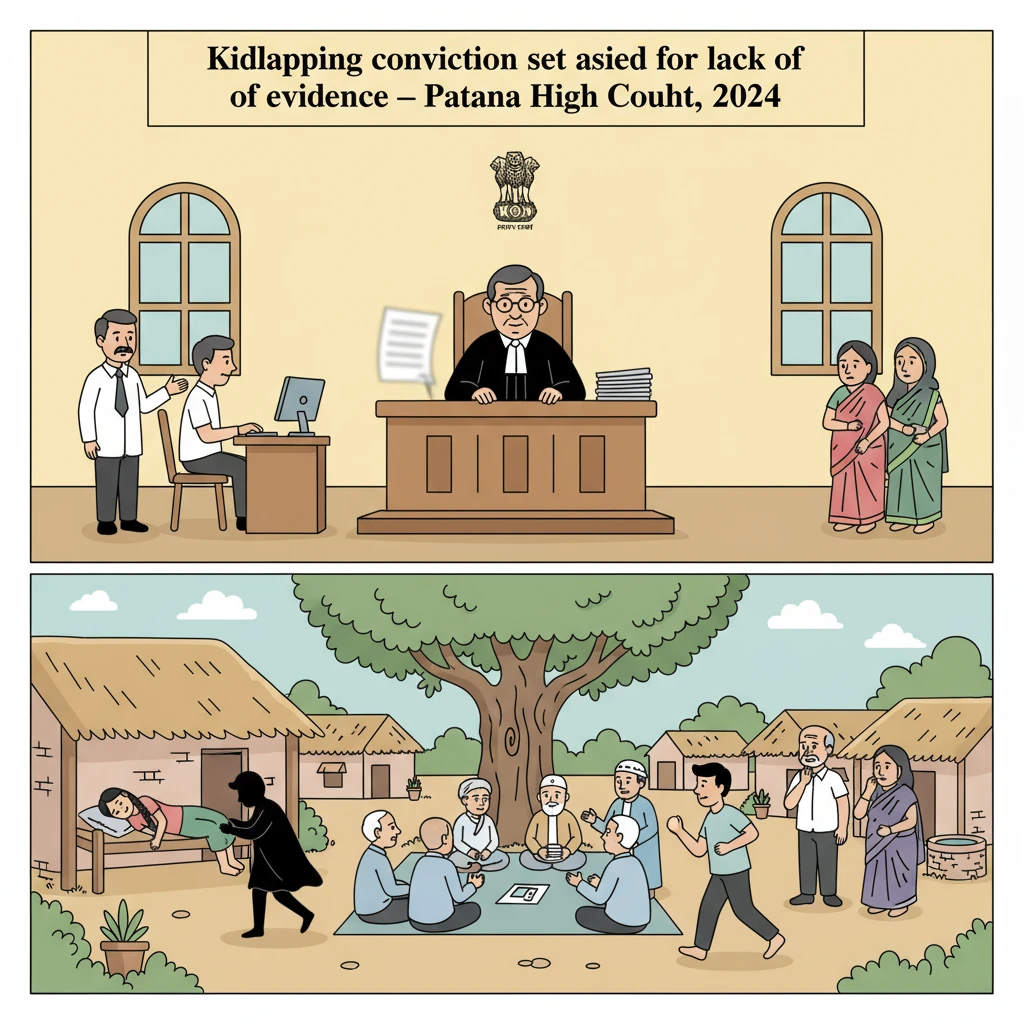
Case Background
The criminal case started with a complaint petition filed by the father of the victim girl before the Chief Judicial Magistrate, Gaya. He alleged that his minor daughter had been kidnapped in the night from their house on 23.07.1991.
The complaint was sent to the police station under Section 156(3) of the Code of Criminal Procedure. On that basis, Sherghati P.S. Case No. 141 of 1991 was registered.
After investigation, the police submitted a chargesheet against the appellant and others for offences under Sections 120B, 354, 406 and 366A of the Indian Penal Code. The Chief Judicial Magistrate took cognizance and summoned the accused.
The case was then committed to the Court of Sessions for trial. The learned Additional Sessions Judge, FTC No. IV, Gaya, conducted Sessions Trial No. 52/2005 and 190/1999.
On 19.05.2006, the trial court convicted the appellant for the offence under Section 366A IPC. On 20.05.2006, the court sentenced him to rigorous imprisonment for five years and a fine of Rs. 5,000, with six months’ further rigorous imprisonment in default.
The appellant challenged this judgment of conviction and sentence before the Patna High Court in Criminal Appeal (SJ) No. 395 of 2006. The appeal was heard by Hon’ble Mr. Justice Sunil Kumar Panwar and decided on 01.04.2024.
What the Court Examined and Decided
The Patna High Court examined the entire record of the sessions trial, including the oral evidence of prosecution witnesses and the exhibits. The key allegation was that the appellant had kidnapped the informant’s daughter, allegedly 14 years old at the time, in the night of 23.07.1991 and taken her away along with gold ornaments worth about Rs. 35,000.
According to the prosecution story, as summarised by the High Court, the girl was sleeping at home when she went missing. Her mother (P.W. 1) noticed her absence the next morning. During search, she went to the house of the appellant, who was also missing.
The informant (P.W. 4), father of the girl, was working away from the village at Sambalpur/Rourkela in Orissa. He claimed to have received information about the kidnapping on 26.07.1991 and reached the village on 27.07.1991.
It was further alleged that after three days, on 26.07.1991, the appellant returned to the village with the girl. Instead of sending her back home, the accused persons allegedly kept her confined in their house. The mother of the girl then approached village elders and a panchayati was convened.
From the evidence of P.W. 1 and P.W. 4, the Court noted that in this panchayati, the appellant allegedly admitted that he had taken the girl along with her ornaments. The panchayati decided that the girl should be married to the appellant. Both sides accepted this decision and a date for marriage was fixed as 04.08.1991.
On the fixed date, a kazi (P.W. 6) came for solemnising the nikah. The evidence of P.W. 1, P.W. 4, P.W. 5, P.W. 6 and P.W. 7 shows that the girl expressed her willingness and accepted the nikah. However, at that time, the appellant allegedly fled away to avoid the marriage. The panchayat then advised the father to take legal steps, and a formal complaint was filed on 23.08.1991.
During trial, the prosecution examined eight witnesses. These included the girl’s mother (P.W. 1), her father and informant (P.W. 4), some co-villagers (P.W. 3, P.W. 5, P.W. 7, P.W. 8), a formal witness (P.W. 2) and the kazi (P.W. 6). The victim girl herself and the Investigating Officer were not examined.
Evidence of P.W. 1, the mother, described the girl as minor, but she admitted that after the incident they waited for about two years for the marriage with the appellant and then got the girl married to another person in Orissa. She also said the girl had taken ornaments worth around Rs. 35,000 from the house.
P.W. 4, the father, supported the broad prosecution story. He proved the panchayati decision (Ext. 2) and the complaint petition (Ext. 3). P.W. 2, a formal witness, proved the formal FIR. P.W. 3, an independent witness, turned hostile and did not support the prosecution version about the kidnapping.
P.W. 5, a co-villager, stated that at the time of occurrence the girl was about 15–16 years old and “at the verge of majority”. He confirmed that the panchayati decided the marriage, that many people were present, and that on the date fixed for nikah the girl accepted the marriage but the appellant fled.
P.W. 6, the kazi, deposed that he went for nikah as per the panchayati decision. The girl accepted the nikah, but the appellant was absent as he had fled. In cross-examination, he admitted that he did not know the girl’s date of birth.
P.W. 7, another co-villager, said the appellant had gone out with the girl and they returned after three days. A panchayati then decided that both should marry. He estimated the girl’s age as 14–15 years and, in cross-examination, said she was major and of marriageable age.
P.W. 8 stated that the appellant had taken the girl with him, and he came to know of the incident the next day. He did not participate in the panchayati.
The defence argued before the High Court that the entire prosecution case suffered from serious legal and factual defects:
- The victim girl, the most important witness, was never examined and her statement was not recorded under Section 164 CrPC, so her version was completely missing from the record.
- No documentary proof of age was produced, and witnesses only gave approximate ages like 14–15 or 15–16 years and even suggested she was at the verge of majority and marriageable.
- The girl was not medically examined to determine her age.
- No witness had actually seen the appellant kidnapping or forcibly taking away the girl; even the parents did not witness any such act.
- The Investigating Officer’s evidence was not brought on record, so the investigation steps, recovery, and manner of occurrence could not be tested.
- There was no signature of the accused on the panchayati decision, weakening the claim of any admission.
- The essential ingredients of Section 366A IPC, especially inducement of a minor girl for illicit intercourse, were not made out on the evidence.
The State, on the other hand, supported the conviction. The Additional Public Prosecutor submitted that non-examination of the girl should not lead to adverse inference, because from P.W. 1 and P.W. 4 it was clear that she had married another person in Orissa, and calling her to court might disturb her conjugal life. It was contended that married women are often reluctant to speak openly about past events, and that the remaining witnesses were enough to prove the case beyond reasonable doubt.
After analysing the evidence, the Patna High Court found major gaps in the prosecution case.
First, the Court held that the victim girl was the “prime and star witness” who could have disclosed the true facts of the occurrence, but she was not examined. This absence itself created a serious doubt about the prosecution’s version.
Secondly, regarding age, the Court noted that no documentary evidence like school records or birth certificate was filed. All witnesses claimed that she was about 14–15 years and “at the verge of majority”. The Court observed that, according to Muslim law, a girl becomes major on attaining puberty. On the basis of the witnesses’ statements, the Court held that she was major at the time of occurrence.
Thirdly, the Investigating Officer was not examined. The Court held that his evidence was “vital for determination of the case”, and without it, the manner of occurrence could not be established. This made the prosecution version weak.
Fourthly, the Court highlighted that no witness, including the parents, had seen the appellant actually taking away the girl. Thus, the prosecution failed to prove the act of kidnapping by direct evidence.
In these circumstances, the Court concluded that the essential ingredients of Section 366A IPC were not proved. There was no clear evidence of inducement of a minor girl for sexual or illicit purposes, and even her minority was not established.
The Court held that the trial court’s findings lacked “material evidences, reasoning and merit”. The gaps in evidence created reasonable doubt, which must go in favour of the accused.
Accordingly, the High Court set aside the judgment of conviction and order of sentence passed by the trial court. The appellant was acquitted by giving him the benefit of doubt. As he was already on bail, he was discharged from his bail bond obligations.
The Court also recorded its appreciation for the assistance given by the amicus curiae, Ms. Sarandha Suman, and directed the Patna High Court Legal Services Committee to pay her Rs. 6,000 as honorarium.
Why This Judgment Matters
This decision of the Patna High Court is important for criminal trials involving allegations of kidnapping and forced marriage or sexual exploitation.
First, it shows that courts will not uphold convictions if key witnesses are not examined. When the alleged victim is alive and available, her statement is usually crucial. Without it, especially in a case turning on consent, age and conduct, the prosecution case becomes weak.
Second, the judgment underlines that age cannot be presumed. If a case depends on the girl being a minor, the prosecution must prove her age with reliable evidence, such as documents or medical examination. Vague statements like “about 14–15 years” or “verge of majority” are not enough when the standard is proof beyond reasonable doubt.
Third, it stresses the importance of examining the Investigating Officer. His evidence connects the dots between complaint, investigation and trial. Without it, the defence can legitimately argue that the case has not been properly proved.
For families and accused persons in similar situations, this judgment shows that:
- Courts check whether each legal requirement of the offence is proved.
- Benefit of doubt goes to the accused if serious gaps remain in evidence.
- Village panchayats and informal settlements cannot replace proper proof in a criminal trial.
Legal Issues and Answers
- Issue: Whether the prosecution proved beyond reasonable doubt that the appellant kidnapped or induced a minor girl for the purpose stated in Section 366A IPC.
Answer: No. The Patna High Court held that the prosecution failed to prove the girl’s minority, failed to examine the victim and the Investigating Officer, and produced no eyewitness to the act of taking away. Essential ingredients of Section 366A IPC were not established. - Issue: Whether non-examination of the victim and Investigating Officer fatally affected the prosecution case.
Answer: Yes. The Court held that the victim was the prime witness and the I.O.’s evidence was vital. Their absence created major gaps and reasonable doubt, entitling the appellant to acquittal. - Issue: Whether the trial court’s conviction could stand on the remaining evidence of interested and partly hostile witnesses.
Answer: No. The High Court found that the trial court’s findings lacked necessary material evidence and sound reasoning, and therefore quashed the conviction and sentence.
Cases Cited by the Court
- The judgment does not mention or rely on any other reported cases.
Case Details
Case Number: Criminal Appeal (SJ) No. 395 of 2006
Case Title: Zafar Imam @ Md. Zafar Imam v. State of Bihar
Citation: 2024 (2) PLJR 371
Court: High Court of Judicature at Patna
Coram: Hon’ble Mr. Justice Sunil Kumar Panwar
Date of Judgment: 01.04.2024
Trial Court Details: Judgment of conviction dated 19.05.2006 and order of sentence dated 20.05.2006 passed by the learned Additional Sessions Judge, FTC No. IV, Gaya, in Sessions Trial No. 52/2005 and 190/1999 arising out of Sherghati P.S. Case No. 141 of 1991.
Advocates: For the appellant: Ms. Sarandha Suman (Amicus Curiae); For the State: Mr. Z. Hoda, Additional Public Prosecutor.
Nature of the Case: Criminal appeal (against conviction under Section 366A IPC).
Final Outcome: Appeal allowed; conviction and sentence set aside; appellant acquitted by giving benefit of doubt and discharged from bail bond.
Link to Judgment: Read full judgment on Patna High Court website
If you found this explanation helpful and wish to stay informed about how legal developments may affect your rights in Bihar, you may consider following Samvida Law Associates for more updates.







