

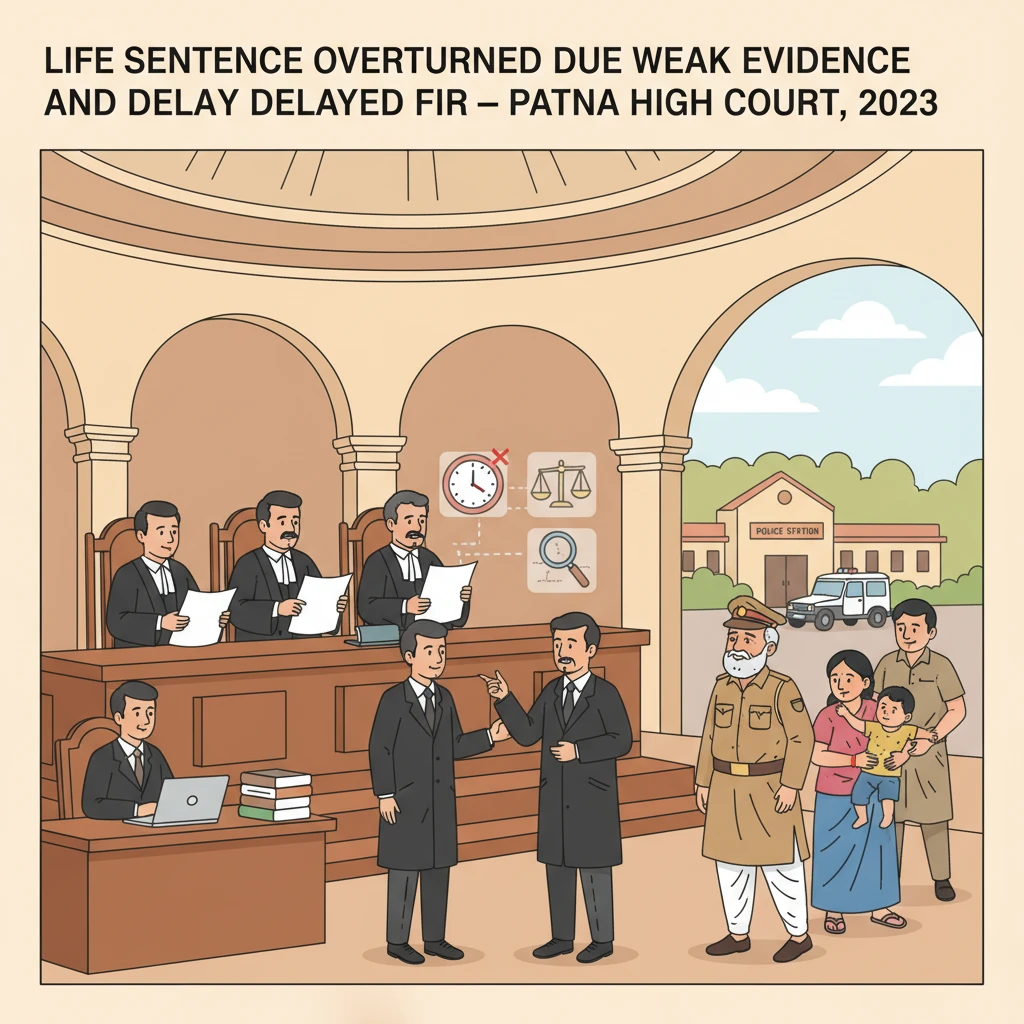
Case Background
This criminal appeal was filed against the judgment of conviction dated 17.06.2017 and order of sentence dated 20.06.2017 passed by the 8th Additional District and Sessions Judge, Muzaffarpur in Sessions Trial No. 128 of 2017. The case arose out of Ahiyapur P.S. Case No. 118 of 2015, District Muzaffarpur.
The trial court had convicted the appellant under Sections 341, 323, 448 and 302 of the Indian Penal Code. For the offence under Section 302 IPC, he was sentenced to life imprisonment with a fine of Rs. 50,000/‑, and one year’s additional imprisonment in default of payment of fine. Simple imprisonment for one month under Section 341 IPC and six months each under Sections 323 and 448 IPC were also imposed. All sentences were to run concurrently.
The prosecution case was based on the written report (fardbeyan) of Madhu Devi (PW 10), recorded on 16.02.2015 at 6:15 p.m. in the emergency ward of S.K.M.C.H. hospital by the Officer‑in‑Charge, Ahiyapur Police Station.
According to this report, Madhu Devi’s sister‑in‑law Rinku Devi (PW 1) had been living at her parental home in Shekhpur for 5–6 months due to assault by her husband. On 16.02.2015 at about 7:00 a.m., Rinku Devi’s husband, father‑in‑law (the present appellant) and two others, Suresh Rai and Pawan Rai, allegedly came to Madhu Devi’s house and started assaulting Rinku Devi.
Madhu Devi stated that to save her sister‑in‑law, she put her own infant son on a cot and went to intervene. At that time, Rinku Devi’s husband allegedly ordered that the son of Santosh (Madhu’s husband) be killed. On this, the appellant was said to have picked up the two‑month‑old child from the cot and thrown him on the floor. The child cried, became unconscious, and was taken to S.K.M.C.H., where doctors declared him dead. The accused persons were also alleged to have been searching for Madhu Devi’s husband to kill him, and it was claimed that Rinku Devi and her daughter Priyanshu Kumari were also injured.
On the basis of this fardbeyan, Ahiyapur P.S. Case No. 118 of 2015 was registered. After investigation, charge‑sheet was submitted. Cognizance was taken by the Jurisdictional Magistrate, and the case was committed to the Court of Session. Charges were framed against the appellant, who pleaded not guilty and claimed trial.
During trial, the prosecution examined thirteen witnesses, including family members, the investigating officer and the doctor who conducted the post‑mortem. Three documents were exhibited: the post‑mortem report (Ext. 1), the inquest report (Ext. 2), and the fardbeyan (Ext. 3). The defence examined two witnesses. The trial court ultimately convicted the appellant on all counts.
What the Court Examined and Decided
The Division Bench of the Patna High Court, speaking through Hon’ble Mr. Justice Sudhir Singh, examined the entire record and the arguments of both sides. Three key questions were framed:
(I) Whether the manner of occurrence, as narrated by the prosecution, was consistent with the medical evidence?
(II) Whether, in the absence of any motive, the prosecution story could be safely relied upon?
(III) Whether delay in lodging the FIR and delay in sending it to the Magistrate caused prejudice to the appellant?
Conflict between medical evidence and prosecution story
Eyewitnesses PW 1, PW 2, PW 3 and PW 10 consistently deposed that on exhortation of his younger brother, the appellant lifted the baby from a small cot (chowki) and forcefully threw him onto the ground, resulting in his death. The child was taken to S.K.M.C.H., where he was declared dead.
The Court then looked closely at the post‑mortem report (Ext. 1). The doctor (PW 12) noted only two external injuries, both abrasions on the right upper abdomen. Internally, there was bruising of the right lobe of the liver with blood in the abdominal cavity. The cause of death was haemorrhage and shock due to these injuries, caused by impact with a hard and blunt object. Time since death was estimated at 12–24 hours.
In cross‑examination, PW 12 stated that such injuries could occur if a two‑month‑old baby fell from a height. This opened an alternative possible explanation for the injuries. The Court examined whether this explanation matched the prosecution story of the child being picked up and thrown.
The Bench considered the “inherent vulnerability of newborn babies” and observed that a two‑month‑old infant has very limited control over its body. In such a situation, if the child had actually fallen, it would be highly implausible that injuries would be confined only to the stomach.
The Court noted that the post‑mortem report showed no injuries on the head, face, chest, shoulders or other exposed areas, which would normally be expected if a baby fell face‑down. The injuries were limited to the abdomen. The inquest report (Ext. 2) also did not mention any injuries on the body. PW 3 further stated in evidence that the child had no cuts or tears and there was no bleeding.
In this background, the Court found itself unable to accept the State’s suggestion that the injuries could have been caused by a fall in the manner alleged. At the same time, the prosecution had not alleged or proved that the appellant had assaulted the child with any hard and blunt object, even though the doctor’s opinion spoke of such impact.
The Bench relied on Supreme Court judgments, including Ram Narain Singh v. State of Punjab and Ama Singh & Ors. v. State of Punjab, (1975) 4 SCC 497, where it was held that inconsistency between ocular (eyewitness) and medical evidence is a fundamental defect in the prosecution case and, unless explained, can discredit the entire case.
Reference was also made to Abdul Sayeed v. State of M.P., (2010) 10 SCC 259, which reiterated that though ocular testimony usually has greater evidentiary value, when medical evidence makes the eyewitness version improbable or completely rules it out, the court can disbelieve the ocular version.
Applying these principles, the Patna High Court concluded that the prosecution’s account of the manner of occurrence did not fit the medical evidence on record. Issue I was therefore decided in the negative, i.e., against the prosecution.
Absence of clear motive
On the second issue, the Court noted that throughout the trial the prosecution did not establish any motive for the appellant to murder the child. No evidence was brought to show any previous enmity or grudge of the appellant against the informant or her husband.
The witnesses themselves admitted that the appellant and other accused had not assaulted the informant (PW 10), PW 2 or PW 3. In such circumstances, the Court questioned why the appellant or any co‑accused would suddenly attack a helpless two‑month‑old child of the informant, especially when there was no prior animosity shown towards the parents.
The Court held that this complete absence of motive weighs in favour of the accused and adds to the doubt already created by the medical evidence. Issue II was also decided in the negative.
Delay in FIR and sending it to Magistrate
For the third issue, the Court examined the timing of the complaint and registration of the FIR. The incident was said to have taken place at around 7:00 a.m. on 16.02.2015. The fardbeyan was recorded at 6:15 p.m. that evening, and the formal FIR was registered at 7:30 p.m.
The FIR itself showed that the distance between the place of occurrence and the police station was only one kilometre. The child had been immediately taken to hospital and declared dead. Yet there was an unexplained delay of around eleven hours in lodging the FIR. No reason for this delay was given by the prosecution.
The Court held that such unexplained delay raises doubts about the authenticity and spontaneity of the FIR, suggesting the possibility of afterthought or embellishment.
Further, there was a delay of two days in sending the FIR to the Magistrate. This went against the requirement of Section 157 of the Code of Criminal Procedure, 1973, which mandates that the report be sent “forthwith”. The Court explained that prompt forwarding is important to prevent improvements in the prosecution story and to enable the Magistrate to supervise the investigation.
The Bench relied on Meharaj Singh & Ors. v. State of U.P. & Ors., (1994) 5 SCC 188, where it was held that delay in lodging and forwarding an FIR can lead to embellishment and coloured versions. It also cited Arjun Marik & Ors. v. State of Bihar, 1994 Supp (2) SCC 372, which stressed that forwarding the occurrence report “with earliest dispatch” is indispensable to avoid distortion and to allow the Magistrate to monitor investigation.
In light of these principles, the Court held that the delays in lodging the FIR and its dispatch to the Magistrate caused serious doubt and were detrimental to the prosecution case. Issue III was therefore decided in the affirmative, i.e., in favour of the appellant.
Final conclusion and result
Considering its findings on all three issues — conflict between medical and ocular evidence, lack of motive, and unexplained delay in FIR and its forwarding — the Patna High Court held that the prosecution had failed to prove the charges beyond reasonable doubt.
The conviction of the appellant under Sections 341, 323, 448 and 302 IPC, and the sentences imposed by the trial court, were set aside. The criminal appeal was allowed.
Since the appellant was in jail, the Court directed that he be released forthwith, if not wanted in any other case. Any pending applications were also disposed of.
Why This Judgment Matters
This judgment shows how closely the Patna High Court scrutinises evidence in serious criminal cases, especially where a person has been sentenced to life imprisonment.
First, it highlights that medical evidence must match the eyewitness version. If injuries on the body do not support the story of how the incident happened, the court can reject the prosecution’s case.
Second, it underlines that where there is no clear motive for such a grave act as killing a small child, and other evidence is weak, benefit of doubt must go to the accused.
Third, it reinforces that delay in lodging the FIR and delay in sending it to the Magistrate can seriously damage the prosecution case, particularly when the police station is nearby and no explanation is given.
For ordinary people, especially in Bihar, this decision signals that courts will not uphold a conviction merely because an allegation is serious. The prosecution must prove the case with consistent, timely and reliable evidence.
Legal Issues and Answers
- Issue: Was the prosecution’s version of the manner of occurrence consistent with the medical evidence on record?
Answer: No. The injuries found in the post‑mortem did not match the alleged act of throwing the baby, and the medical evidence created serious doubt about the prosecution story. - Issue: Could the prosecution’s case be relied upon in the absence of any established motive for the appellant to kill the child?
Answer: No. No motive or prior enmity was proved, and this absence of motive weighed in favour of the accused. - Issue: Did the delay in lodging the FIR and in its dispatch to the Magistrate prejudice the appellant?
Answer: Yes. The unexplained delay of about 11 hours in lodging the FIR and two days in sending it to the Magistrate raised doubts about its authenticity and harmed the prosecution case.
Cases Cited by the Court
- Ram Narain Singh v. State of Punjab and Ama Singh & Ors. v. State of Punjab, (1975) 4 SCC 497
- Abdul Sayeed v. State of M.P., (2010) 10 SCC 259
- State of Haryana v. Bhagirath, (1999) 5 SCC 96 : 1999 SCC (Cri) 658 (quoted in Abdul Sayeed)
- Meharaj Singh & Ors. v. State of U.P. & Ors., (1994) 5 SCC 188
- Arjun Marik & Ors. v. State of Bihar, 1994 Supp (2) SCC 372
Case Details
Case Number: Criminal Appeal (DB) No. 1017 of 2017; arising out of Ahiyapur P.S. Case No. 118 of 2015; Sessions Trial No. 128 of 2017
Case Title: Ram Daresh Ray @ Ramdresh Ray @ Tunna Ray v. The State of Bihar
Citation: 2024 (2) PLJR 321
Court: High Court of Judicature at Patna
Coram: Hon’ble Mr. Justice Sudhir Singh; Hon’ble Mr. Justice Chandra Prakash Singh
Date of High Court Judgment: 09.10.2023
C.A.V. Date: 22.09.2023
Advocates:
- For the Appellant: Mr. Harsh Singh, Advocate; Mr. Avneesh Pradhan, Advocate; Mr. Kamal Kishor Singh, Advocate
- For the State (Respondent): Mr. Bipin Kumar, APP
Nature of Case: Criminal appeal (Division Bench) against conviction and sentence in a sessions trial for offences under Sections 341, 323, 448 and 302 IPC
Link to Judgment: Click here to view the official Patna High Court judgment
If you found this explanation helpful and wish to stay informed about
how legal developments may affect your rights in Bihar,
you may consider following Samvida Law Associates for more updates.







