

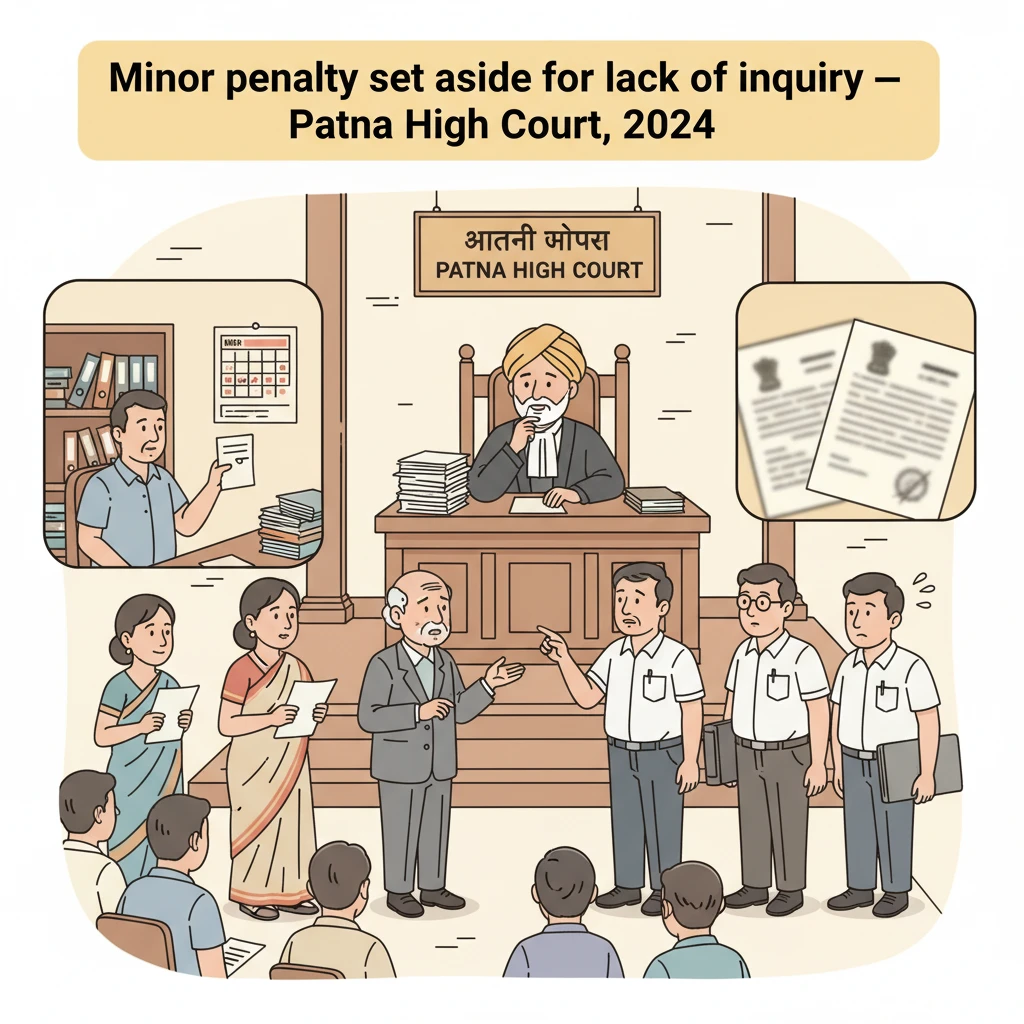
Case Background
The appellant was an Executive Engineer in the Rural Works Department, Government of Bihar. While in service, he was proceeded against under Rule 19 of the Bihar Government Servants (Classification, Control & Appeal) Rules, 2005, which deals with procedure for imposing minor penalties.
On 26.07.2011, the department issued a show cause notice with charges, alleging delay in supplying certain records demanded by the Special Secretary through the Engineer-in-Chief. The appellant submitted his written explanation on 01.08.2011.
Despite this explanation, the disciplinary authority, on 09.05.2013, imposed the minor penalties of censure and withholding of two increments without cumulative effect. The appellant challenged this by filing a revision/review, but the revisional authority rejected it on 28.05.2015.
Aggrieved, the appellant filed Civil Writ Jurisdiction Case No.7348 of 2015 before a learned Single Judge of the Patna High Court. On 14.05.2019, the learned Single Judge dismissed the writ petition and upheld the departmental orders.
The appellant then filed the present Letters Patent Appeal (L.P.A. No.861 of 2019), which came before a Division Bench of the Patna High Court. The judgment in the appeal was delivered on 01.03.2024.
What the Court Examined and Decided
The Division Bench, speaking through Hon’ble Mr. Justice P. B. Bajanthri, examined the entire sequence: the disciplinary proceedings, the appellant’s explanation, the orders of the disciplinary and revisional authorities, and the order of the learned Single Judge.
The appellant’s main grievance in the appeal was that both the disciplinary authority and the revisional authority had ignored his specific defence, and the learned Single Judge also failed to appreciate it. He argued that there was a clear non-application of mind and that, because there were disputed facts, the department should have held a proper inquiry under Rule 19(1)(b) of the Rules 2005.
The appellant pointed out that the documents demanded by the Special Secretary through the Engineer-in-Chief were not in his physical custody. He stated that the concerned employee, who was the custodian of those records, had been deputed for Panchayat election duty, and therefore the records could not be produced immediately. This, according to him, was beyond his control, and he had promptly informed the higher authorities about the situation.
The State, on the other hand, supported the orders of punishment and the dismissal of the writ petition. The State’s counsel argued that the proceedings were only for a minor penalty under Rule 19 of the Rules 2005. For such minor penalties, according to the State, it was enough that a show cause notice with charges was issued and the explanation was considered before passing the punishment order. Therefore, there was no requirement of a full-fledged inquiry, and Rule 19(1)(b) need not have been invoked.
Before dealing with these rival contentions, the Court reproduced Rule 19 of the Rules 2005, which lays down the procedure for imposing minor penalties. Under Rule 19(1)(a), the government servant must be informed in writing of the proposal to take action and of the imputations of misconduct or misbehaviour, and must be given reasonable opportunity to make a representation. Under Rule 19(1)(b), an inquiry in the manner laid down in sub-rules (3) to (23) of Rule 17 is to be held “in every case in which the disciplinary authority is of the opinion that such inquiry is necessary.”
The Court noted that, in this case, the disciplinary authority had undoubtedly invoked Rule 19 for imposing minor penalties. A show cause notice dated 26.07.2011 was issued, followed by the appellant’s explanation dated 01.08.2011, and then the penalty order dated 09.05.2013. The question was whether, on the facts of this case, an inquiry under Rule 19(1)(b) ought to have been held before imposing the penalty.
The Bench focused on the specific contents of the appellant’s explanation, which had been filed in response to the show cause notice. He had explained that the case related to work on “Haridas Bigha Khushrupur Road Katauna Dharamshala Chamartoli Path under Work Division, Patna” for the year 2006-07, with Agreement No.46F2/2006-2007. He referred to office letter no.1949 dated 20.05.2011 issued in response to the Engineer-in-Chief’s letter no.6615 dated 19.05.2011, wherein it was mentioned that the concerned employee was on deputation for Panchayat elections, and that the documents would be made available soon after his return.
The appellant further stated that on 19.05.2011 itself he had telephoned the Engineer-in-Chief in the evening and apprised him of the complete facts, and that the Engineer-in-Chief had responded that he was getting the relevant file searched. Subsequently, by office letter no.1984 dated 26.05.2011, the Engineer-in-Chief was again informed about the actual situation. The appellant also referred to an earlier communication: Engineer-in-Chief’s letter no.II/Pra.-01-178/08 4496 dated 16.12.2008, for which a complete report had been submitted through office letter no.4315 dated 18.12.2008 to the Engineer-in-Chief and the Superintending Engineer.
After reading paragraph 1 of the explanation, the Court found that the appellant had clearly taken the stand that he was not in a position to furnish the demanded documents because they were with the concerned worker or clerk who was the custodian of the records, and that this person was on deputation to election duty. Thus, there was a real dispute about why the documents could not be supplied within the time limit fixed by the Special Secretary and the Engineer-in-Chief.
The Bench emphasised that this was not a simple case of undisputed delay. The appellant had asserted that the records were not in his hands, that he had informed the higher authorities in writing and telephonically, and that the delay was due to the deputation of the custodian of the records to election duty—something beyond his control.
According to the Court, this raised a disputed issue of fact that required verification. Specifically, it needed to be examined whether the appellant was indeed not the custodian of the record, whether the real custodian was on election duty, and whether, therefore, the delay in supplying documents could genuinely be attributed to circumstances beyond the appellant’s control.
In such a situation, the Bench held, Rule 19(1)(b) of the Rules 2005 became relevant. Once a disputed factual issue arises in proceedings for imposition of even a minor penalty, the disciplinary authority must resort to holding an inquiry under Rule 19(1)(b), following the procedure under Rule 17(3) to 17(23). Without such an inquiry, the authority could not have lightly brushed aside the appellant’s explanation and straightaway imposed the penalty.
The Court found that the disciplinary authority had not appreciated this requirement of the Rules. It had proceeded to impose the penalty without holding any inquiry into the disputed facts. The revisional authority had also failed to correct this error, and the learned Single Judge, while dismissing the writ petition, did not notice the impact of Rule 19(1)(b) read with the appellant’s explanation.
To support its reasoning, the Division Bench referred to the decision of the Hon’ble Supreme Court in O.K. Bhardwaj versus Union of India and others, reported in (2001) 9 SCC 180. In that case, the Supreme Court had held that where departmental action for imposition of penalty involves disputed facts, a departmental inquiry becomes mandatory.
By taking note of both the statutory rule and the principle laid down in the O.K. Bhardwaj judgment, the Patna High Court concluded that the appellant had indeed made out a case for interference. The penalty order dated 09.05.2013, the revisional/review order dated 28.05.2015, and the learned Single Judge’s order dated 14.05.2019 were all found to be unsustainable.
Accordingly, the Division Bench set aside all these three orders. The writ petition (C.W.J.C. No.7348 of 2015) was allowed, and, as a result, the Letters Patent Appeal was also allowed.
The Court then issued a clear direction to the respondent State authorities. They were ordered to restore the two withheld increments, to refix the appellant’s pay and pension, and to disburse the difference of amounts due to him within a period of three months from the date of the judgment.
Why This Judgment Matters
This judgment is significant for government employees in Bihar, especially those facing departmental proceedings for so-called minor penalties. It makes clear that the label “minor penalty” does not give the department a free hand to ignore disputed facts.
Where an officer puts forward a specific and plausible explanation, and that explanation creates a real dispute about the facts—for example, over who had custody of records or whether a delay was beyond the officer’s control—the department cannot punish the employee without first verifying those facts through an inquiry under Rule 19(1)(b).
The Patna High Court’s decision also shows that even after retirement, a government servant can get relief if a departmental penalty was imposed without following the rules. The direction to restore increments and refix pension underlines that such penalties have a direct impact on post-retirement benefits, and illegal orders will not be allowed to stand.
For officers in line departments who often depend on clerical staff or record-keepers, the ruling is an assurance that they cannot automatically be blamed for delays when they are not the custodian of records and have informed higher authorities about practical difficulties.
Legal Issues and Answers
- Issue: Can a minor penalty be imposed under Rule 19 of the Bihar Government Servants (Classification, Control & Appeal) Rules, 2005 without holding an inquiry, when the government servant’s explanation raises disputed questions of fact?
Answer: No. When the explanation discloses disputed facts—such as who had custody of records and whether delay was beyond the officer’s control—an inquiry under Rule 19(1)(b) read with Rule 17(3)-(23) is required before imposing even a minor penalty. - Issue: Did the disciplinary authority, revisional authority, and learned Single Judge correctly apply Rule 19(1)(b) to the appellant’s case?
Answer: No. All three failed to appreciate that the appellant’s explanation raised disputed factual issues that triggered the requirement of an inquiry. Their orders were therefore set aside. - Issue: What consequential relief was the appellant entitled to after the penalty orders were quashed?
Answer: The appellant was entitled to restoration of the two withheld increments, refixation of pay and pension, and payment of the consequential monetary difference within three months.
Cases Cited by the Court
- O.K. Bhardwaj versus Union of India and others, (2001) 9 SCC 180 – cited for the principle that where departmental proceedings involve disputed facts, holding a departmental inquiry is mandatory even for imposition of penalty.
Case Details
Case Number: Letters Patent Appeal No.861 of 2019 in Civil Writ Jurisdiction Case No.7348 of 2015
Case Title: Ashok Kumar Singh v. The State of Bihar & Ors.
Citation: 2024 (2) PLJR 306
Court: High Court of Judicature at Patna
Coram: Hon’ble Mr. Justice P. B. Bajanthri and Hon’ble Mr. Justice Alok Kumar Pandey
Date of Judgment: 01.03.2024
Advocates:
- For the Appellant: Mr. Amit Shrivastava, Senior Advocate; Mr. Girish Pandey, Advocate; Mr. Uma Shankar Sharma, Advocate; Mr. Shiv Kumar Prabhakar, Advocate.
- For the State: Mr. Manish Kumar, AC to AAG-6 (Ex.) / In-charge AAG-5.
Nature of the Case: Letters Patent Appeal against the dismissal of a writ petition challenging departmental minor penalty and consequential orders.
Link to Judgment: Click here to access the official judgment of the Patna High Court
If you found this explanation helpful and wish to stay informed about how legal developments may affect your rights in Bihar, you may consider following Samvida Law Associates for more updates.







