

Case Background
The case arises from Criminal Writ Jurisdiction Case No. 17 of 2023 before the Patna High Court.
The petitioner is a 1998 batch Indian Police Service officer of the Bihar cadre. At the time of the judgment, he was posted as Inspector General, State Crime Records Bureau, Bihar, Patna.
On 7 December 2022, the Special Vigilance Unit (SVU), Patna registered SVU P.S. Case No. 17 of 2022. The case was registered under Sections 13(1)(b) read with 13(2) read with Section 12 of the Prevention of Corruption Act, 1988 (as amended in 2018) and Sections 120B and 168 of the Indian Penal Code. The FIR has been registered as Special Case No. 80 of 2022 and is pending before the learned Special Judge, Vigilance, Patna.
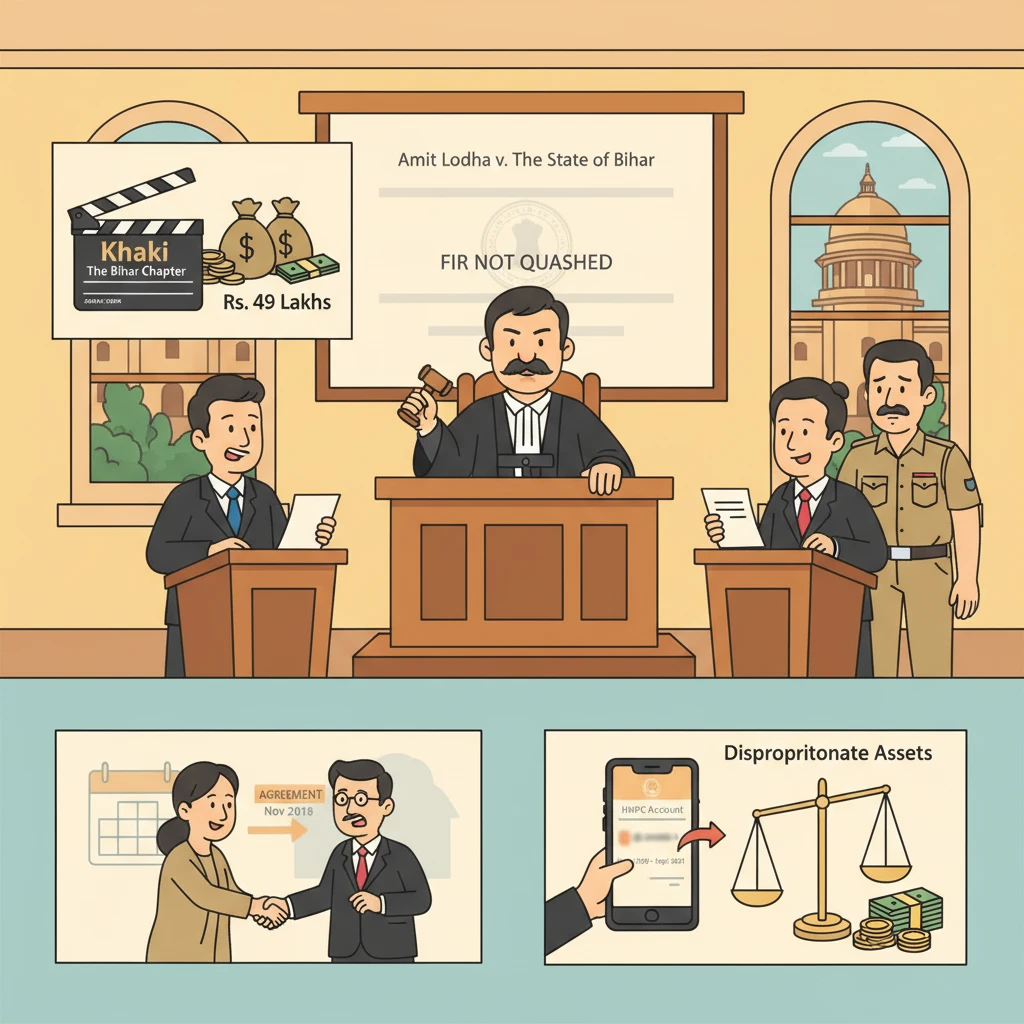
The FIR alleges that, ever since his posting as Inspector General of Police, Magadh Range, Gaya, the petitioner has been earning illicitly in connivance with a production company, Friday Story Teller (also described as Friday Story Teller Pvt. Ltd.), and others by indulging in private trade and acquiring assets disproportionate to his known sources of income. It also alleges that the petitioner used his book “Bihar Diary” for commercial exploitation through a web series titled “Khaki The Bihar Chapter” without proper permission, and that payments routed through his wife’s bank account were, in substance, his ill-gotten wealth.
To challenge this, the petitioner approached the Patna High Court under its criminal writ jurisdiction seeking three main reliefs: quashing of the FIR; quashing of the investigation; and any other appropriate relief.
What the Court Examined and Decided
The petitioner’s senior counsel attacked the FIR and investigation on three principal grounds.
First, he argued that the allegations in the FIR, even if taken at face value, did not disclose any cognizable offence. According to him, the entire genesis of the case related to a web series “Khakee: The Bihar Chapter”, said to be based on a fictionalised script inspired by the petitioner’s book, and this could not amount to criminal misconduct.
It was submitted that the core allegation was of indulging in “private trade” with Friday Story Teller LLP so as to attract Section 168 IPC, and of allegedly having income not commensurate with legal earnings so as to attract Section 13(1)(b) of the Prevention of Corruption Act.
The petitioner argued that Explanation 1 to Section 13(1)(b) of the P.C. Act would not apply. He maintained that he was never shown in the FIR to be in possession of pecuniary resources or property disproportionate to his known sources of income which he could not satisfactorily account for.
He further submitted that his wife received money from Friday Story Tellers under valid contracts for her own services and in her own independent right. According to him, the FIR itself (particularly paragraph 5) showed that she received about Rs. 49,50,000/- through banking channels under agreements with the company. Her income was reflected in her income tax returns and declared in the petitioner’s annual assets statement submitted to the Bihar Government. On this basis, it was urged that such money could not be treated as his “disproportionate assets”.
Relying on Supreme Court judgments including DSP Chennai v. K. Inbasagaran and the order in Akhilesh Yadav v. Vishwanath Chaturvedi, he argued that assets and income of a public servant’s wife cannot automatically be attributed to the public servant for the purpose of a disproportionate assets case.
On Section 168 IPC (public servant unlawfully engaging in trade), the petitioner argued that he had only signed an assignment agreement on 2 November 2018 with Friday Movies & T.V. Private Limited, granting adaptation rights of his book for a token sum of Re. 1/-. He claimed that since he did not derive any real consideration, he had not “engaged in trade”. He relied on State of Gujarat v. Maheshkumar Dhirajlal Thakkar and Kanwarjit Singh Kakkar v. State of Punjab to contend that even if there was some breach of service conduct rules in entering into the assignment, that would not itself amount to a criminal offence under Section 168 IPC or under the Prevention of Corruption Act.
Second, the petitioner alleged mala fide. He contended that the FIR and investigation were malicious and that the SVU had exaggerated asset values, wrongly alleged a foreign trip, and even suggested construction of a house in Jaipur without material. He stressed that even after more than a year of investigation, the SVU had not clearly quantified any disproportionate assets.
He relied on judgments such as Surendra Singh Rathod v. State of Rajasthan, Satish Mehra v. State of NCT of Delhi, and State of Haryana v. Bhajan Lal to argue that allowing such a vague and allegedly biased FIR to continue would amount to abuse of process and a “fishing and roving enquiry”.
Third, the petitioner argued that the FIR was bad for want of prior approval under Section 17A of the Prevention of Corruption Act. He placed reliance on parliamentary debates and on the Government of India’s circular dated 3 September 2021 laying down Standard Operating Procedures under Section 17A.
He also cited decisions such as Yashwant Sinha v. CBI (review order), Anil Vasantrao Deshmukh v. State of Maharashtra, State of Punjab v. Davinder Pal Singh Bhullar, and a Karnataka High Court decision in Dr. Ashok V. v. State by Lokayukta of Karnataka to submit that, without such mandatory approval for registration of the case, the FIR and all subsequent investigation were void and non est. He further argued that a preliminary inquiry was essential in this case, placing reliance on Lalita Kumari v. Government of U.P. and P. Sirajuddin v. State of Madras.
On the other side, counsel for the SVU and the State strongly opposed the writ petition.
They argued that the FIR disclosed serious cognizable offences involving alleged disproportionate assets and illegal private commercial engagement by a serving IPS officer. They asserted that the investigation was at a crucial stage and that the High Court should not interfere.
According to the SVU, the petitioner had permission from the Director General, BSF only to publish his book through Penguin. He had no permission to enter into agreements with film or web-series producers. The SVU emphasised that the petitioner’s wife had signed a “Right Assignment Agreement” for Rs. 25 lakhs after he agreed to grant rights for making a film based on his story, and later another agreement as a “story consultant” for which she was allegedly paid an additional Rs. 27 lakhs. They said she had not been professionally engaged earlier, and the large payments to a newcomer indicated that the money was in fact meant for the petitioner, routed through her.
They also pointed to multiple bank accounts of the petitioner and his family members with substantial balances and claimed that the petitioner had shown income from “business” and “speculative business” in addition to his salary, raising questions under Rule 13(1)(a) and Rule 14 of the All India Services (Conduct) Rules, 1968 and Section 168 IPC. According to the SVU, the check period for assessing disproportionate assets ran from 1998, the start of his service, up to 7 December 2022.
On the preliminary inquiry issue, the State relied on State of Telangana v. Managipet and CBI v. T.H. Vijayalakshmi to say that a preliminary inquiry is not mandatory in every corruption case. If the information already available credibly discloses a cognizable offence, an FIR can directly be registered.
Regarding Section 17A, the SVU argued that this protection applies only where the alleged offence relates to any recommendation made or decision taken by the public servant in discharge of his official functions. They submitted that where the act is ex facie criminal, such as accumulation of disproportionate assets or acting in private trade, prior approval is not required. They relied on authorities such as Hori Ram Singh v. Emperor, Matajog Dubey v. H.C. Bhari, S.B. Saha v. M.S. Kochar, and High Court decisions including T.O. Suraj v. State of Kerala, Satish Pandey v. Union of India, Shankar Bhat v. State of Kerala, and Rajendra Prasad v. State of Bihar.
The SVU further referred to Supreme Court decisions such as Dr. Subramanian Swamy v. Dr. Manmohan Singh, Subramanian Swamy v. Director, CBI, Superintendent of Police, CBI v. Tapan Kumar Singh, Neeharika Infrastructure Pvt. Ltd. v. State of Maharashtra, State of Chhattisgarh v. Aman Kumar Singh, and State of Karnataka v. J. Jayalalitha, stressing that courts should adopt a “hands-off” approach towards quashing FIRs in corruption and disproportionate assets cases at the investigation stage.
After hearing both sides, the Patna High Court examined the FIR carefully. It noted that, without adding or subtracting anything, the information contained in the FIR showed allegations that the petitioner, as a public servant, had illicitly acquired wealth and that there were regular money transfers from Friday Story Tellers to his wife’s account linked to film production, with him, his wife, and associates being the ultimate beneficiaries.
The Court held that these allegations, taken at face value, disclosed cognizable offences and therefore an investigation was clearly warranted. It further noted another allegation that the petitioner had illegally entered into a private trade with a production house and illicitly earned around Rs. 49,62,372/-. The Court considered the State’s statement that scrutiny of publicly available government records suggested acquisition of huge movable and immovable properties beyond the petitioner’s legitimate income, which could not be tested in a writ proceeding without effectively holding a premature trial.
The Court declined to accept the petitioner’s factual explanations at this stage, such as his justification of the transactions, the nature of his wife’s contracts, or alleged errors in the SVU’s calculations. It held that such matters were squarely within the domain of investigation and could not be assessed in a petition seeking quashing of the FIR. The SVU had also stated in its report that it required at least six more months to reach a logical conclusion.
On the issue of preliminary inquiry, the Court relied on the Supreme Court’s analysis in Managipet and T.H. Vijayalakshmi. It held that where credible source information is available and discloses a cognizable offence, an FIR can be registered without a preliminary inquiry, and the absence of such an inquiry does not by itself show mala fide. It reproduced key paragraphs from Managipet to reinforce that preliminary inquiry is not compulsory in all corruption cases.
On Section 17A of the P.C. Act, the Court held that, where credible information is received against a public servant about accumulation of disproportionate assets, normally no interference is justified on the ground of Section 17A unless the case rests on very special features. It distinguished P. Sirajuddin on facts and referred to the Supreme Court’s observations in Devendra Kumar Singh v. CBI that when the act of a public servant is ex facie criminal or constitutes a cognizable offence, prior approval is not necessary.
The Court also quoted in detail from State of Chhattisgarh v. Aman Kumar Singh, where the Supreme Court advised High Courts to maintain a hands-off approach and not quash FIRs in corruption cases at the investigation stage, even where political overtones or alleged mala fides are present, provided the FIR discloses a prima facie offence.
Referring to the material placed by the SVU, the Court recorded that, as per allegations and evidence collected, the petitioner had allegedly accumulated assets valued at more than Rs. 7 crores during his service period, while his total income from legal sources was not more than about Rs. 2 crores gross. In that backdrop, the Court found no merit in the plea to quash the FIR or halt the investigation.
However, the Court also recognised the importance of a speedy and fair investigation, as part of the fundamental right under Article 21 of the Constitution. It cited Hussainara Khatoon v. Home Secretary, State of Bihar and A.R. Antulay v. R.S. Nayak to emphasise that the right to speedy trial includes the investigation stage. It also referred to Amar Nath Chaubey v. Union of India and Mohammed Zubair v. State of NCT of Delhi, reiterating that courts must ensure that investigations are neither lax nor used as tools for targeted harassment.
In the final directions, while dismissing the writ petition, the Court ordered the Special Vigilance Unit to complete the investigation and take it to its logical end within six months from the date of the judgment, in a proper, fair, and lawful manner. The Court cautioned that the pending investigation should not be allowed to be used as a ruse for targeted harassment. It noted that the petitioner is obliged to cooperate with the investigating agency whenever required. It also clarified that none of the observations in the judgment should prejudice the petitioner during the investigation and that he remains free to take all legal pleas at an appropriate stage.
Why This Judgment Matters
This judgment is important for public servants and ordinary citizens alike.
For public servants, the Patna High Court makes it clear that if there are specific allegations of unexplained wealth or secret commercial dealings, the Court will normally not stop a vigilance investigation at an early stage. Even claims that the money stands in a spouse’s name, or that the officer only breached service rules and not criminal law, will generally be tested by investigators, not in a writ petition for quashing.
At the same time, the Court has reminded the Special Vigilance Unit that investigations cannot drag on indefinitely. The right to speedy trial includes the right to speedy investigation. By fixing a six-month outer limit and insisting on a fair and lawful process, the Court tries to balance society’s interest in anti-corruption action with the individual’s right not to face endless, open-ended scrutiny.
For readers who may feel targeted by long-running criminal inquiries, this case shows that the High Court may not cancel the case outright but can still monitor time and fairness. For those who complain of corruption, it signals that an FIR supported by credible information is likely to be allowed to run its full course.
Legal Issues and Answers
-
Issue: Does the FIR in SVU P.S. Case No. 17 of 2022 fail to disclose any cognizable offence so that it must be quashed at the threshold?
Answer: No. The Court held that the FIR, taken as it is, alleges illicit accumulation of wealth and illegal private trade by a public servant and therefore clearly discloses cognizable offences under the Prevention of Corruption Act and the IPC. -
Issue: Is prior approval under Section 17A of the Prevention of Corruption Act mandatory in this case so that failure to obtain it makes the FIR and investigation illegal?
Answer: No. The Court held that, where the allegations relate to ex facie criminal acts like accumulating disproportionate assets, prior approval under Section 17A is not required, and interference on this ground is not warranted. -
Issue: Was the registration of the FIR without a preliminary inquiry and alleged delay in investigation sufficient to prove mala fide and justify quashing?
Answer: No. The Court held that preliminary inquiry is not mandatory in all corruption cases and that credible source information justified immediate registration of FIR. However, the Court directed the SVU to complete a fair investigation within six months to protect the petitioner’s right to speedy investigation.
Cases Cited by the Court
- State of Haryana v. Bhajan Lal, 1992 Supp (1) SCC 335
- Lalita Kumari v. Govt. of U.P., (2014) 2 SCC 1
- State of Telangana v. Managipet, (2019) 19 SCC 87
- CBI v. T.H. Vijayalakshmi, AIR 2021 SC 5041
- State of Chhattisgarh v. Aman Kumar Singh, (2023) 6 SCC 559
- Devendra Kumar Singh v. CBI, 2019 (1) Crimes 726
- Superintendent of Police, CBI v. Tapan Kumar Singh, AIR 2003 SC 4140
- Neeharika Infrastructure Pvt. Ltd. v. State of Maharashtra, AIR 2021 SC 1918
- Hussainara Khatoon v. Home Secretary, State of Bihar, AIR 1979 SC 1360
- A.R. Antulay v. R.S. Nayak, (1992) 1 SCC 225
- Amar Nath Chaubey v. Union of India, (2021) 11 SCC 804
- Mohammed Zubair v. State of NCT of Delhi, AIR 2022 SC 3649
- Arnab Ranjan Goswami v. Union of India, (2020) 14 SCC 12
- Dr. Subramanian Swamy v. Dr. Manmohan Singh, (2012) 3 SCC 64
- Subramanian Swamy v. Director, CBI, AIR 2014 SC 2140
- Hori Ram Singh v. Emperor, AIR 1939 PC 43
- Matajog Dubey v. H.C. Bhari, AIR 1956 SC 44
- S.B. Saha v. M.S. Kochar, AIR 1979 SC 1841
- T.O. Suraj v. State of Kerala, 2021 SCC Online Ker 2896
- Rajendra Prasad v. State of Bihar, 2022(4) BLJ 189
Case Details
Case Number: Criminal Writ Jurisdiction Case No. 17 of 2023
Case Title: Amit Lodha v. The State of Bihar & Ors.
Coram: Hon’ble Mr. Justice Rajeev Ranjan Prasad
Date of Judgment: 22.01.2024
Citation: 2024(1) PLJR 557
Arising out of: SVU Patna P.S. Case No. 17 of 2022; Special Case No. 80 of 2022 pending before the Special Judge, Vigilance, Patna
Advocates:
- For the Petitioner: Mr. P.N. Shahi, Senior Advocate; Mr. Shekhar Singh, Advocate; Mr. Sumit Kumar, Advocate
- For the Special Vigilance Unit: Mr. Rana Vikram Singh, Advocate
- For the State: Mr. Prabhu Narayan Sharma, AC to AG
Nature of the Case: Criminal writ petition seeking quashing of FIR and investigation in a vigilance case alleging offences under the Prevention of Corruption Act and the Indian Penal Code.
Final Outcome: Writ petition dismissed. FIR and investigation upheld. SVU directed to complete a fair investigation within six months, with the petitioner required to cooperate.
Link to Judgment: Patna High Court Judgment
If you found this explanation helpful and wish to stay informed about
how legal developments may affect your rights in Bihar,
you may consider following Samvida Law Associates for more updates.







