

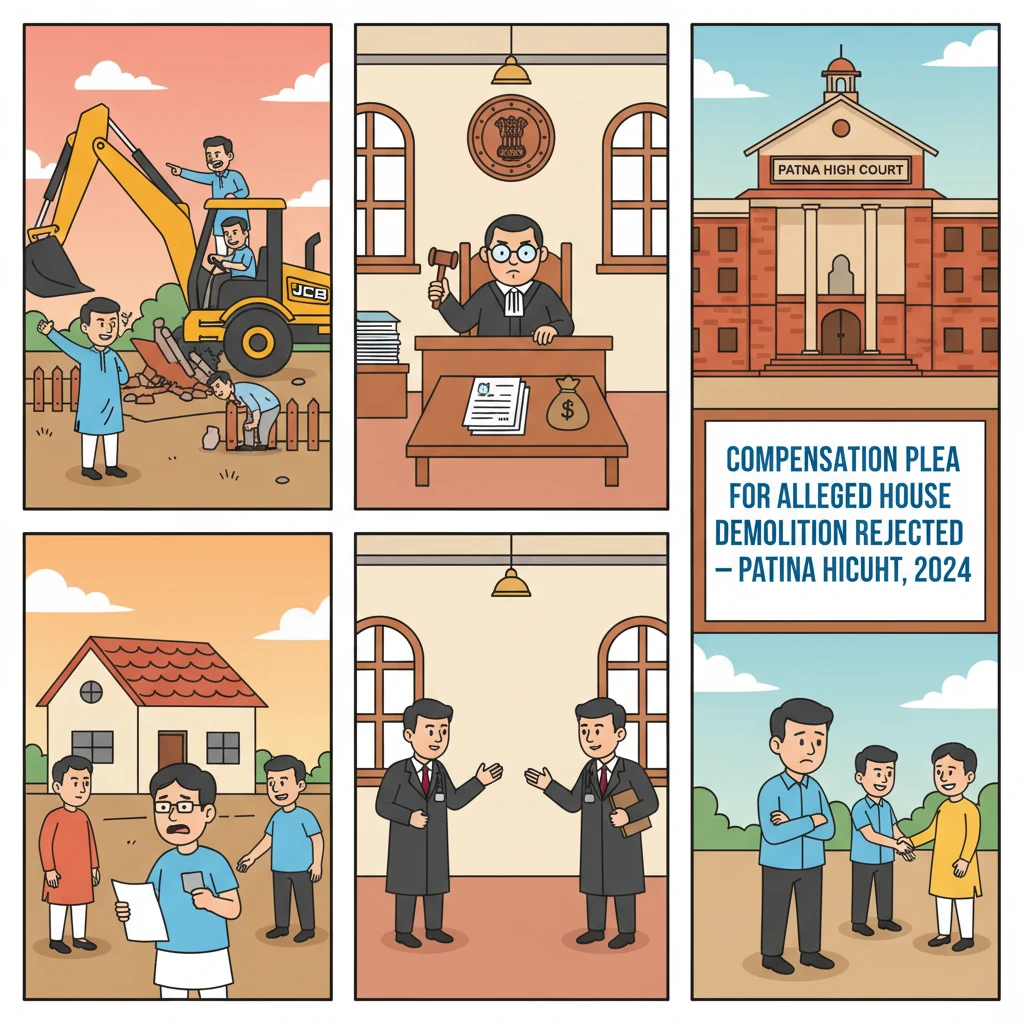
Case Background
This case arose out of a long-running land dispute in District Gopalganj, Bihar. A title suit, numbered Title Suit No.596 of 2007, was pending before the Civil Judge, Senior Division (Sub Judge)-X, Gopalganj.
The defendant in that title suit became the petitioner before the Patna High Court in Civil Miscellaneous Jurisdiction No.604 of 2017. He alleged that on a portion of the disputed land, his father had constructed a five-room house on 1 katha of land of Plot No.533, Khata No.65 under Mauza-Neharua Khurd, Circle-Panchdewari, P.S.-Kateya, District-Gopalganj.
According to him, another plot in the same mauza, Khesra No.407, Area 6 Katha 14 Dhur, had been left vacant. He claimed that the plaintiffs in the title suit, acting through one of the respondents, demolished his house and raised illegal constructions on Plot No.407 while the civil dispute over the land was still pending in court.
When this alleged demolition took place, the petitioner says he approached the police and applied for lodging an FIR, but no investigation was carried out. Later, on his application in the title suit, the trial court ordered status quo on 12.04.2016 regarding the property.
The petitioner then took further steps in the trial court. On his application dated 27.01.2016 under Order 26 Rule 9 of the Code of Civil Procedure (CPC), a Commissioner was appointed and a local inspection report was obtained. The Commissioner’s report stated that there was a house on the disputed plot.
On 30.08.2016, relying on this Commissioner’s report and on a claimed statement of the owner of the JCB machine allegedly used in the demolition, the petitioner moved an application under Section 19 CPC before the trial court, claiming compensation of Rs. 5 lakhs.
By order dated 21.01.2017, the Civil Judge, Senior Division (Sub Judge)-X, Gopalganj, rejected this compensation application and also imposed a cost of Rs. 1,500 on the petitioner. Challenging that order, the petitioner filed the present civil miscellaneous petition before the Patna High Court.
What the Court Examined and Decided
The Patna High Court, presided over by Hon’ble Mr. Justice Arun Kumar Jha, heard the matter at the admission stage itself. After hearing the learned counsel for the petitioner, the Court decided to dispose of the case without issuing notice or calling for a more detailed hearing.
The core question before the High Court was whether the trial court was wrong in rejecting the petitioner’s application under Section 19 CPC and whether the cost of Rs. 1,500 imposed on him was unjustified.
The petitioner’s case, as recorded by the High Court, was that his five-room house was demolished by the plaintiffs in the title suit with the help of a JCB machine operated through one of the respondents. He claimed that this act was done while the civil dispute regarding the land was pending, and that the land was “sub judice”.
He asserted that:
- His father had constructed the five-room house on Plot No.533, Khata No.65.
- The respondents had filed a partition suit and wanted to dispossess him from Khata No.65.
- On 15.09.2015, the respondents broke and destroyed his house using a JCB.
- He had a recording of conversation with the JCB owner, where the owner allegedly admitted to demolishing the house.
- Despite his application to lodge an FIR, no proper investigation was carried out by the police.
- The Commissioner’s local inspection report and the JCB owner’s statement supported his story, and based on these, he sought Rs. 5 lakh compensation under Section 19 CPC.
The petitioner, therefore, argued before the High Court that the trial court had:
- Failed to consider the real facts and instead accepted “false” statements of the respondents.
- Ignored its duty to assess damages when an illegal act is alleged during the pendency of a case.
- Wrongly relied on a police report that, according to him, was false.
- Did not properly appreciate the Commissioner’s report and the statement of the JCB owner.
The High Court first looked into the trial court’s order in detail. It noted that the trial court had examined the material before it and recorded clear factual findings.
The trial court had observed that:
- The petitioner’s application under Section 19 CPC contained only general allegations.
- These allegations were not supported by any affidavit.
- The application did not clearly disclose the date of demolition.
- The petitioner did not mention what steps, if any, he had taken before local authorities after the alleged demolition took place.
The trial court had also taken into account a police report dated 23.02.2016, submitted before the Superintendent of Police, Gopalganj, vide D.R. No.1306/2016. According to this report, the “dilapidated house” present on Plot No.407, Khata No.65, Mauza-Neharua Khurd had collapsed during the rainy season and the ruins of the house were lying on the spot.
On this basis, the trial court concluded that the house had not been demolished by any external human action, but had collapsed naturally due to its dilapidated condition. It further remarked that the petitioner had treated this natural collapse as a “blessing in disguise” and used it as a ground to file a false case and misuse the process of law by claiming compensation.
The High Court also examined how the trial court had dealt with the Commissioner’s report and the alleged statement of the JCB owner. The High Court pointed out that, from what the petitioner himself had mentioned about the Commissioner’s report in paragraph 11 of his present petition, it appeared that:
- The Commissioner’s report simply said that there was a house on the disputed plot no.533.
- On excavation, foundation stone was found and the residue of the broken house was lying on the plot at that time.
- The report was silent on any demolition by an external manual agency.
Therefore, the High Court held that this report could not be used to infer that manual demolition had been carried out by the respondents. It only showed that there had been a house, and that the remains were present on the plot, which was fully consistent with the police version of a natural collapse.
Regarding the alleged statement of the JCB owner, the High Court observed that this purported statement would not carry much weight in the face of the specific police report concluding that the house had fallen due to natural causes. In other words, the High Court agreed with the trial court that the Commissioner’s report and the alleged JCB owner’s statement did not prove an intentional demolition.
After reviewing all the material and the reasoning of the trial court, the High Court concluded that the trial court had considered all aspects of the matter. It found no infirmity or error in the trial court’s approach or its conclusions.
The High Court, therefore, affirmed the order of the Civil Judge, Senior Division (Sub Judge)-X, Gopalganj dated 21.01.2017. It held that there was no merit in the civil miscellaneous petition filed by the petitioner.
As a result, the Patna High Court dismissed the petition at the admission stage itself, leaving the trial court’s rejection of the Section 19 CPC compensation claim, along with the cost of Rs. 1,500, fully intact.
Why This Judgment Matters
This judgment is important for parties involved in civil land disputes where construction or demolition happens during the pendency of the case.
First, it shows that merely alleging that the other side demolished a house or structure is not enough. Courts expect specific details, supporting affidavits, and clear proof. General statements, without dates and without showing what action was taken before authorities, are likely to be rejected.
Second, the judgment shows that courts can rely on neutral material such as police reports and local inspection reports. Where those documents suggest that a structure collapsed naturally, compensation for “illegal demolition” will not be granted unless there is strong evidence to the contrary.
Third, the decision underlines that misuse of the court process, by turning a natural incident into a false claim for money, can lead to costs being imposed. This serves as a warning for litigants not to exaggerate or fabricate events during pending civil cases.
Overall, the Patna High Court’s decision reinforces that compensation under provisions like Section 19 CPC will be granted only when wrongful acts are clearly proved, not on suspicion or weak material.
Legal Issues and Answers
- Issue: Did the trial court wrongly reject the petitioner’s application under Section 19 CPC seeking Rs. 5 lakh compensation for alleged demolition of his house during the pendency of a title suit?
Answer: No. The Patna High Court held that the trial court had correctly rejected the application after considering the police report and other materials, which showed that the house had collapsed due to natural causes and not because of any illegal demolition by the respondents. - Issue: Was there any legal infirmity in the trial court imposing a cost of Rs. 1,500 on the petitioner for filing the compensation application?
Answer: No. The High Court found no infirmity in the order, noting that the trial court had concluded that the petitioner had misused the process of law by making a false claim.
Cases Cited by the Court
- No previous judicial decisions or case law have been cited or relied upon in the text of this judgment.
Case Details
Case Number: Civil Miscellaneous Jurisdiction No.604 of 2017; arising out of Title Suit No.596 of 2007, Gopalganj.
Case Title: Yogendra Kumar Srivastava vs. Chitranjan Kumar & Anr.
Coram: Hon’ble Mr. Justice Arun Kumar Jha
Citation: 2024(1) PLJR 570
Advocates: For the petitioner – Mr. Anirudh Kumar Sinha, Advocate; For the respondents – Not recorded in the judgment.
Nature of the Case: Civil miscellaneous petition challenging an order of the Civil Judge, Senior Division (Sub Judge)-X, Gopalganj, rejecting an application under Section 19 of the Code of Civil Procedure for compensation and imposing costs.
Date of Patna High Court Judgment: 16.01.2024
Link to the Judgment: View full Patna High Court judgment
If you found this explanation helpful and wish to stay informed about
how legal developments may affect your rights in Bihar,
you may consider following Samvida Law Associates for more updates.







