

Case Background
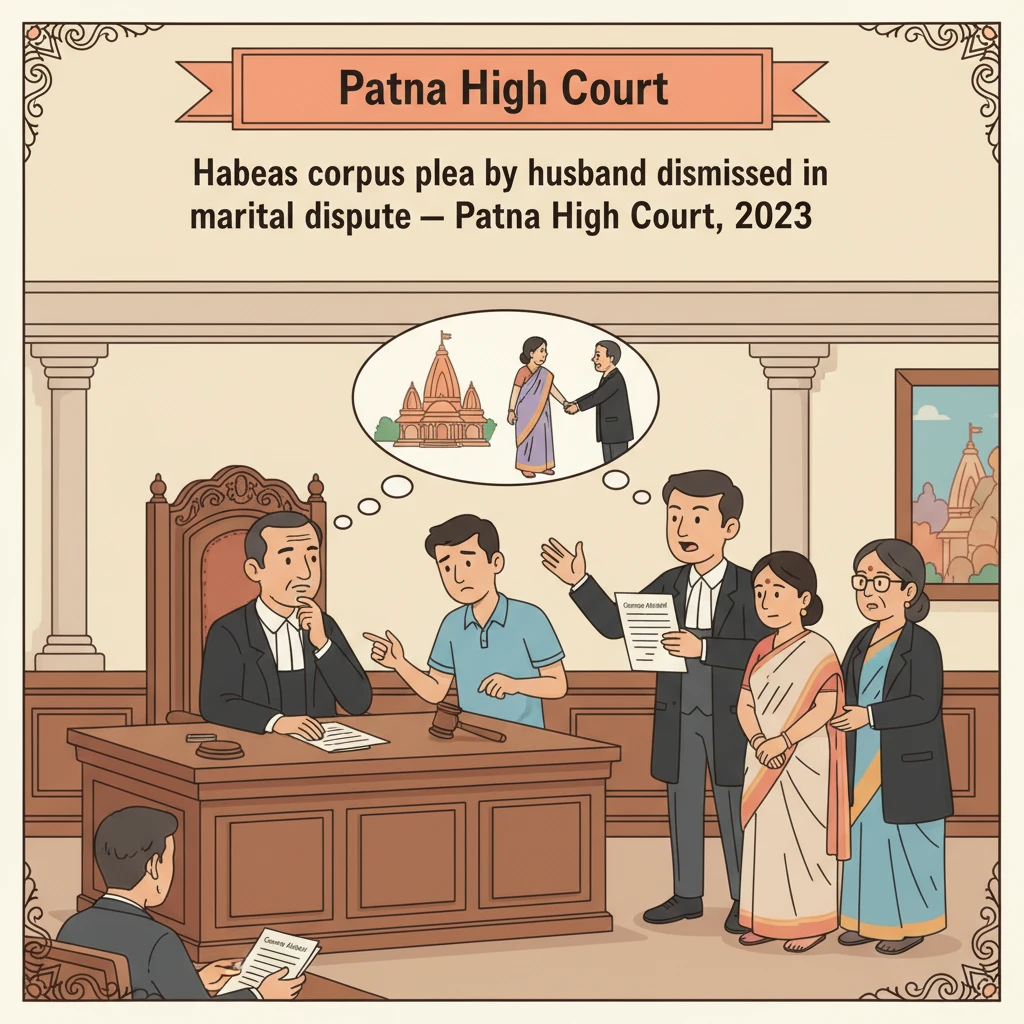
This case arose from a marital dispute that turned into a criminal writ petition before the Patna High Court. The petitioner is the husband. Respondent No. 8, Rani Kumari, is described as the “corpus” whose custody was sought.
The petitioner claimed that his marriage with respondent No. 8 was solemnised at a temple. To support this, he relied on a certificate issued by the concerned priest. After the marriage, according to him, both husband and wife went to Ludhiana.
The petitioner stated that they stayed in Ludhiana for more than two and a half months. Later, they came to know that the father of respondent No. 8 had lodged a First Information Report (FIR) against the petitioner.
After learning about the FIR, they returned voluntarily. Respondent No. 8 was then produced before the police authorities. From there, she was produced before the Judicial Magistrate at Rosera.
The Judicial Magistrate, Rosera, recorded her statement under Section 164 of the Code of Criminal Procedure, 1973. At that time, she stated that she wanted to go with the petitioner. On this basis, she was permitted to go with him.
Later, according to the petitioner, the parents of respondent No. 8 forcibly took her away from his custody. A private complaint was also filed before the concerned court by her side, alleging that the petitioner and his relatives were demanding dowry from respondent No. 8.
The petitioner then approached the Patna High Court by filing Criminal Writ Jurisdiction Case No. 1626 of 2023. He sought a writ of habeas corpus, claiming that his wife was being illegally detained by her parents and was not being allowed to meet him.
What the Court Examined and Decided
The Division Bench of the Patna High Court, comprising Hon’ble Mr. Justice Vipul M. Pancholi and Hon’ble Mr. Justice Rudra Prakash Mishra, heard the matter. The oral judgment was delivered by Hon’ble Mr. Justice Vipul M. Pancholi on 08-11-2023.
Counsel for the petitioner, Mr. Piyush Kumar Pandey, argued that the marriage between the petitioner and respondent No. 8 was validly performed. He placed reliance on the certificate of marriage issued by the temple priest.
He further submitted that after the marriage, both spouses lived together in Ludhiana for more than two and a half months. When they came to know that an FIR had been lodged by the woman’s father, they returned voluntarily and she was produced before the police authorities.
From there, she was presented before the Judicial Magistrate, Rosera. Her statement under Section 164 CrPC was recorded. In that statement, she allegedly said she wanted to go with the petitioner. On this basis, she was permitted to accompany him.
According to the petitioner’s side, the situation changed later. The parents of respondent No. 8 allegedly took her away forcibly from the petitioner. It was also alleged that they filed a private complaint before the concerned court accusing the petitioner and his relatives of demanding dowry from her.
The petitioner claimed before the High Court that respondent No. 8 was being illegally detained by her parents against her wishes. He asserted that she was not permitted to meet him. On these grounds, he requested issuance of a writ of habeas corpus so that the custody of respondent No. 8 could be handed back to him.
On the other hand, counsel for the State and the respondent authorities, Mr. Prabhu Narayan Sharma, AC to AG, opposed the petition. He referred to the counter affidavit and the documents filed with it. The stand taken by the State was that respondent No. 8 was not in illegal custody of her parents, contrary to what the petitioner had alleged.
The Court had earlier given an oral direction that respondent No. 8, the corpus, should be produced before it. In compliance with that direction, she was present in Court on the date of hearing.
The Bench then personally interacted with respondent No. 8, Rani Kumari. This interaction was held in the presence of the learned counsel appearing for the State who were present in Court.
During this interaction, respondent No. 8 stated certain key facts. She said her age was twenty-two years. She informed the Court that she had come along with her father, who is a teacher in the concerned school.
Most importantly, the Court recorded her clear statement about her custody and her wishes. She stated that she was not being illegally detained by her parents, as alleged by the petitioner. Instead, she expressed that she wanted to go with her father and not with the petitioner.
Thus, there was a direct contradiction between the petitioner’s claim and the statement of respondent No. 8. While the petitioner alleged illegal detention, the adult woman herself informed the Court that no such illegal detention existed and that she preferred to live with her father.
The Court considered that respondent No. 8 was a major, being 22 years old. It relied on her present, voluntary statement made before the Bench. In view of this statement, the Bench held that there was no question of illegal custody with the parents.
Once the Court was satisfied that respondent No. 8 was a major and was staying with her father out of her own choice, the basis for a writ of habeas corpus disappeared. Habeas corpus is a remedy against illegal detention. If the person concerned says they are living where they wish to live, there is no illegal detention for the Court to correct.
Accordingly, in paragraph 9 of the judgment, the Court recorded that in view of the statement of the major corpus, she was permitted to go with her father. No direction was issued for her custody to be given to the petitioner.
Having reached this conclusion on the core question of custody and alleged illegal detention, the Court stated that it was not inclined to entertain the writ petition. It therefore dismissed the petition.
The judgment thus turned almost entirely on the in-person statement of the woman whose custody was in dispute. Her present wishes, as a major, prevailed over the husband’s plea for habeas corpus based on earlier events and earlier statements.
Why This Judgment Matters
This judgment is important for couples and families involved in similar disputes where a husband claims that his wife is being kept by her parents against her will.
The Patna High Court made it clear that when the woman is an adult and appears before the Court, her present statement carries decisive weight. The Court will directly ask her where she wants to live.
If the adult woman clearly says she is not under illegal pressure and wants to remain with her parents, the Court will not treat that as illegal detention. In such a situation, the husband cannot use habeas corpus to force her to live with him.
The decision also shows that earlier statements, such as one made before a Magistrate under Section 164 CrPC, can be overtaken by the later, clear wish of the person at the time of hearing. What matters is her free choice on the date of decision.
For ordinary readers, especially those in Bihar facing similar marital tensions, the message is straightforward: habeas corpus is not a tool to compel an adult spouse to return. The Court will respect the independent choice of a major woman about where and with whom she wants to stay.
Legal Issues and Answers
- Issue: Whether a writ of habeas corpus should be issued in favour of the husband on the ground that his 22-year-old wife was being illegally detained by her parents.
Answer: No. After the Court interacted with the wife and she clearly stated she was not illegally detained and wished to go with her father, the Patna High Court refused to issue habeas corpus and dismissed the petition.
Cases Cited by the Court
- No prior judicial precedents or case law are cited in the text of this judgment.
Case Details
Case Number: Criminal Writ Jurisdiction Case No. 1626 of 2023
Case Title: Chandan Kumar v. The State of Bihar & Ors.
Citation: 2024 (1) PLJR 343
Coram: Hon’ble Mr. Justice Vipul M. Pancholi and Hon’ble Mr. Justice Rudra Prakash Mishra
Advocates: For the petitioner: Mr. Piyush Kumar Pandey, Advocate. For the respondents: Mr. P.K. Shahi, Advocate General and Mr. Prabhu Narayan Sharma, AC to AG.
Nature of the case: Criminal writ petition seeking a writ of habeas corpus regarding custody of an adult woman.
Date of Judgment: 08-11-2023
Link to Judgment: https://patnahighcourt.gov.in/viewjudgment/MTYjMTYyNiMyMDIzIzEjTg==-T0nhYNSkFlM=
If you found this explanation helpful and wish to stay informed about
how legal developments may affect your rights in Bihar,
you may consider following Samvida Law Associates for more updates.







