

Case Background
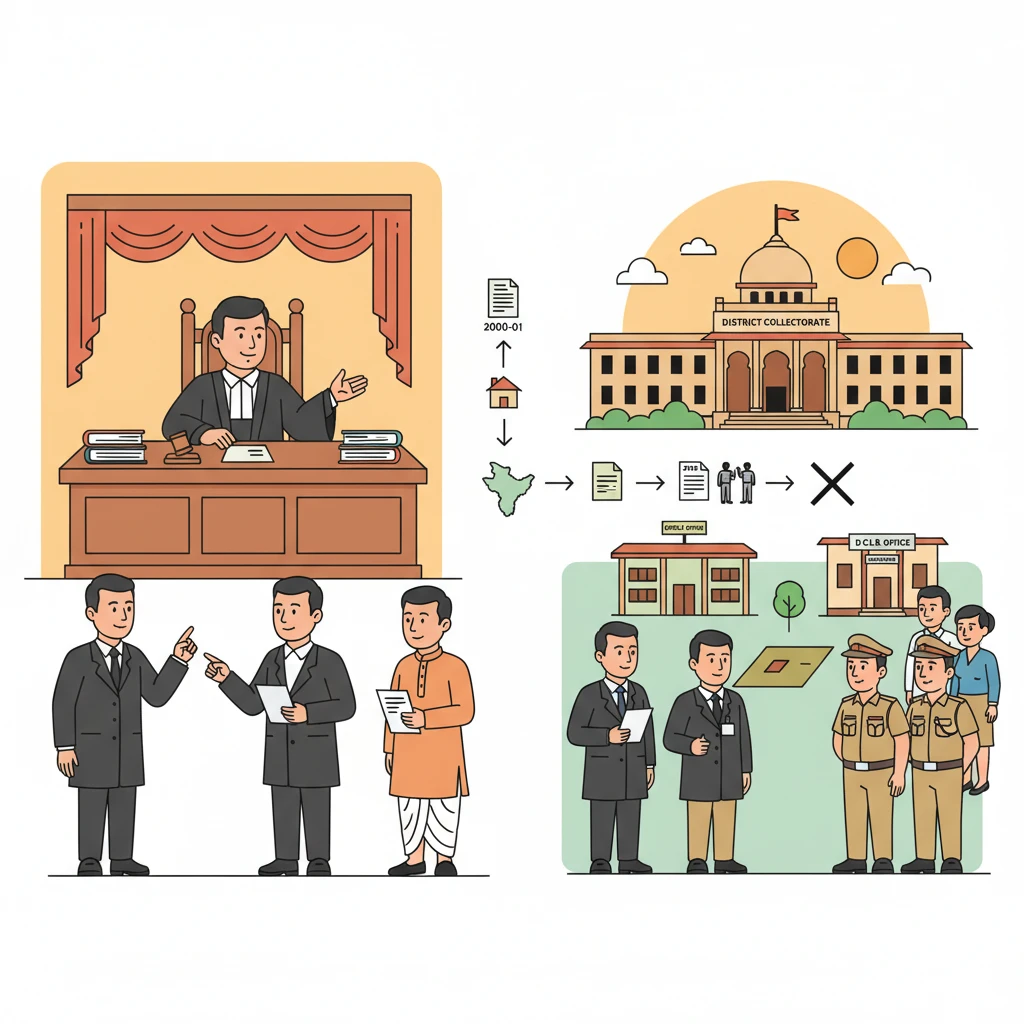
The petitioner was granted a parcha for 10 decimals of land in Mauza-Rahimpur, Thana No.373, Khata No.01, Khesra No.18, Tauzi No.525 in the year 2000-01. The parcha was issued by the Circle Officer, Parbatta in Case No.04 of 2000-01 under the Bihar Privileged Persons Homestead Tenancy Act, 1947.
After issuance of the parcha, the petitioner’s name was mutated in the land records. Rent receipts were also issued in his name, and this position continued for several years.
According to the writ petition, trouble started in 2009-10 when neighbouring private respondents allegedly created obstacles, forcibly evicted the petitioner from the land and took possession.
The petitioner then approached the Circle Officer, Parbatta seeking restoration of possession. By letter dated 10.01.2011, the Circle Officer referred the matter to the D.C.L.R., Gogri. On this reference, Land Dispute Case No.26 of 2010-11 was instituted.
After hearing the matter, the D.C.L.R., Gogri dismissed the petitioner’s claim by order dated 13.07.2011, holding that he was not a resident of Parbatta but of Gram Panchayat Agarpur Machipur, Block-Goradih, District Bhagalpur. On this basis, the D.C.L.R. refused to support the petitioner’s claim for restoration.
Aggrieved, the petitioner approached the Sub-Divisional Public Grievance Redressal Officer, Gogari, seeking possession of his parcha land. By order dated 12.08.2017, that authority directed the Circle Officer, Parbatta to enquire into the matter and verify the plot.
When no effective action followed, the petitioner filed a First Appeal before the Additional District Magistrate, Khagaria acting as the first appellate authority. By order dated 16.11.2017, the A.D.M., Khagaria directed the Circle Officer, Parbatta to restore possession of the petitioner’s land, observing that the parcha had been legally granted.
Even after this order, the petitioner remained without possession. He therefore approached the District Magistrate, Khagaria acting as the second appellate authority under the Public Grievance Redressal framework.
By order dated 17.01.2018, the District Magistrate dismissed the petitioner’s claim, holding that he was an inhabitant of another district on the basis of a report from the Circle Officer, Parbatta. This second appellate order effectively rejected the petitioner’s plea for restoration of possession.
The petitioner then filed Civil Writ Jurisdiction Case No.8684 of 2018 before the Patna High Court. He challenged the District Magistrate’s order and sought directions for recognition as a local resident of Parbatta and restoration of possession over the parcha land.
What the Court Examined and Decided
The writ petition came before Hon’ble Mr. Justice Sandeep Kumar. The petitioner sought four main reliefs. First, quashing of the Collector, Khagaria-cum-Second Appellate Authority’s order dated 17.01.2018. Second, a direction to the Circle Officer, Parbatta to declare him as a local resident of Parbatta on the basis of materials on record. Third, a direction to restore his possession over 10 decimals of land in Mauza-Rahimpur by verifying the parcha, rent receipts and allied documents. Fourth, any other just and equitable relief.
The petitioner’s counsel argued that the parcha for the land in question had been issued long back by the competent authority and that no official respondent had ever denied its issuance. The parcha had led to mutation and continuous issuance of rent receipts in the petitioner’s name.
It was submitted that the District Magistrate, Khagaria had wrongly relied solely on the report of the Circle Officer, Parbatta regarding the petitioner’s residence. According to the petitioner, the Collector ignored several documents that showed his address at Parbatta and also disregarded earlier orders of the Sub-Divisional Public Grievance Appellate Authority and the first appellate authority, Gogri, which had clearly held that the parcha was legally issued.
The petitioner also filed a supplementary affidavit enclosing a 1966 voter list. At serial no.1091 of that voter list, the petitioner’s father, Ghoogly Rai, was shown, which according to the petitioner supported his local connection with the area.
On the other hand, the State filed a counter affidavit. The principal stand taken by the State was that the petitioner was a resident of Bhagalpur district and, therefore, his parcha in Khagaria district was not valid. This residence-based objection formed the sole plank of the State’s defence.
The High Court examined the submissions and focused on the legal framework governing homestead parchas under the Bihar Privileged Persons Homestead Tenancy Act, 1947. The Court noted that the only ground actually used by the respondent authorities to cancel or disregard the petitioner’s parcha was that he was a resident of Bhagalpur district and hence could not be granted a parcha in Khagaria district.
The Court first referred to Section 4 of the 1947 Act. This provision deals with the conditions for granting a parcha. It states that a person must have a permanent tenancy in the homestead held by him at any time continuously for a period of one year.
The Court then looked at Section 2(i) of the Act, which defines a “privileged person”. A privileged person is one who is not a proprietor, tenure holder, under-tenure holder or Mahajan and who, apart from his homestead, holds no other land or holds such land not exceeding one acre.
Next, the Court referred to Section 8 of the Act, which sets out the only grounds on which a privileged tenant may be ejected. Under Section 8(1), a privileged tenant can be ejected only if he has used the holding in a manner that renders it unfit for the purposes of the tenancy, or if he has failed to pay rent for two years.
After setting out these provisions, the Patna High Court emphasised that Section 8 does not mention residence in any particular district as a ground for cancellation of a parcha or ejectment of a privileged tenant. There is no statutory basis to cancel a parcha merely because the holder is said to be a resident of another district.
The Court held that in such circumstances the petitioner could not be denied his right as a parcha holder only on the State’s assertion that he resided in Bhagalpur district, especially when the documents produced indicated otherwise. Further, applying Section 4 and the definition of “privileged person”, the Court observed that the petitioner fell within the category of a privileged person and had therefore been rightly granted the parcha.
The Court also made it clear that this right is not confined to residents of any particular district. The statutory requirement is that the person be a privileged person; there is no condition that he must be a resident of the same district where the parcha land is situated.
On this reasoning, the Court concluded that the petitioner was a genuine parcha holder. His parcha could be cancelled only on the limited grounds mentioned in Section 8 of the 1947 Act, namely misuse of the land or non-payment of rent for two years. Since residence in another district is not a prescribed ground, the cancellation or disregard of his parcha on that basis was unsustainable in law.
Accordingly, the Court allowed the writ application. It quashed the impugned order dated 17.01.2018 passed by the Collector, Khagaria-cum-Second Appellate Authority. The Court directed the respondents to treat the petitioner’s parcha as valid and to ensure that he is not disturbed from the land for which the parcha has been granted.
The Court went a step further to protect the petitioner’s possession. It recorded that, if the petitioner had already been evicted from the parcha land, the Collector, Khagaria must take steps to restore his possession over the land in question. The possession was to be restored within one month from the date of communication or production of a copy of the High Court’s order.
Why This Judgment Matters
This judgment is important for landless and small landholders in Bihar who hold homestead parchas under the Bihar Privileged Persons Homestead Tenancy Act, 1947.
The Patna High Court has made it clear that a parcha cannot be cancelled simply because the holder is alleged to belong to another district. What matters is whether the person qualifies as a “privileged person” and has satisfied the statutory conditions, not where exactly his permanent residence is recorded.
The Court has also reinforced that a privileged tenant can be evicted only on two specific grounds under Section 8: misuse of the land or non-payment of rent for two years. Administrative authorities cannot invent new grounds, such as residence, to cancel parchas or deny restoration of possession.
For parcha holders facing eviction or dispossession through local disputes or adverse administrative orders, this decision provides strong protection. It confirms that long-standing parchas, once legally granted and followed by mutation and rent receipts, cannot be lightly discarded on technical pleas about address or district of residence.
The direction to restore possession within one month, if eviction has occurred, also shows that courts can issue practical, time-bound relief where a genuine parcha holder has been kept away from his homestead land despite clear legal rights.
Legal Issues and Answers
-
Issue: Can a homestead parcha granted under the Bihar Privileged Persons Homestead Tenancy Act, 1947 be cancelled or disregarded solely on the ground that the parcha holder is a resident of another district?
Answer: No. The Patna High Court held that residence in another district is not a ground under the Act for cancellation of parcha or ejectment of a privileged tenant. A parcha can be interfered with only on the grounds specified in Section 8, such as misuse of the land or non-payment of rent for two years. -
Issue: Is the right of a privileged person to a parcha restricted to residents of the same district where the land is situated?
Answer: No. The Court held that the statute does not confine the right to any particular district. The key requirement is that the person must satisfy the definition of “privileged person” and conditions under Section 4; district-wise residence is irrelevant.
Cases Cited by the Court
- No earlier judicial precedents or case laws are cited or relied upon in the judgment.
Case Details
Case Number: Civil Writ Jurisdiction Case No.8684 of 2018
Case Title: Africa Rai @ Ashok Rai v. The State of Bihar and Ors.
Citation: 2024(1) PLJR 470
Coram: Hon’ble Mr. Justice Sandeep Kumar
Date of Judgment: 22.11.2022
Advocates:
- For the petitioner: Mr. Rakesh Narayansingh
- For the respondents: Mr. Rishi Raj Sinha, SC-19
Nature of the Case: Writ petition challenging the order of the Collector, Khagaria-cum-Second Appellate Authority under the Public Grievance Redressal mechanism, relating to cancellation of parcha and denial of restoration of possession under the Bihar Privileged Persons Homestead Tenancy Act, 1947.
Link to the Judgment: Patna High Court Judgment in CWJC No.8684 of 2018
If you found this explanation helpful and wish to stay informed about how legal developments may affect your rights in Bihar, you may consider following Samvida Law Associates for more updates.







