

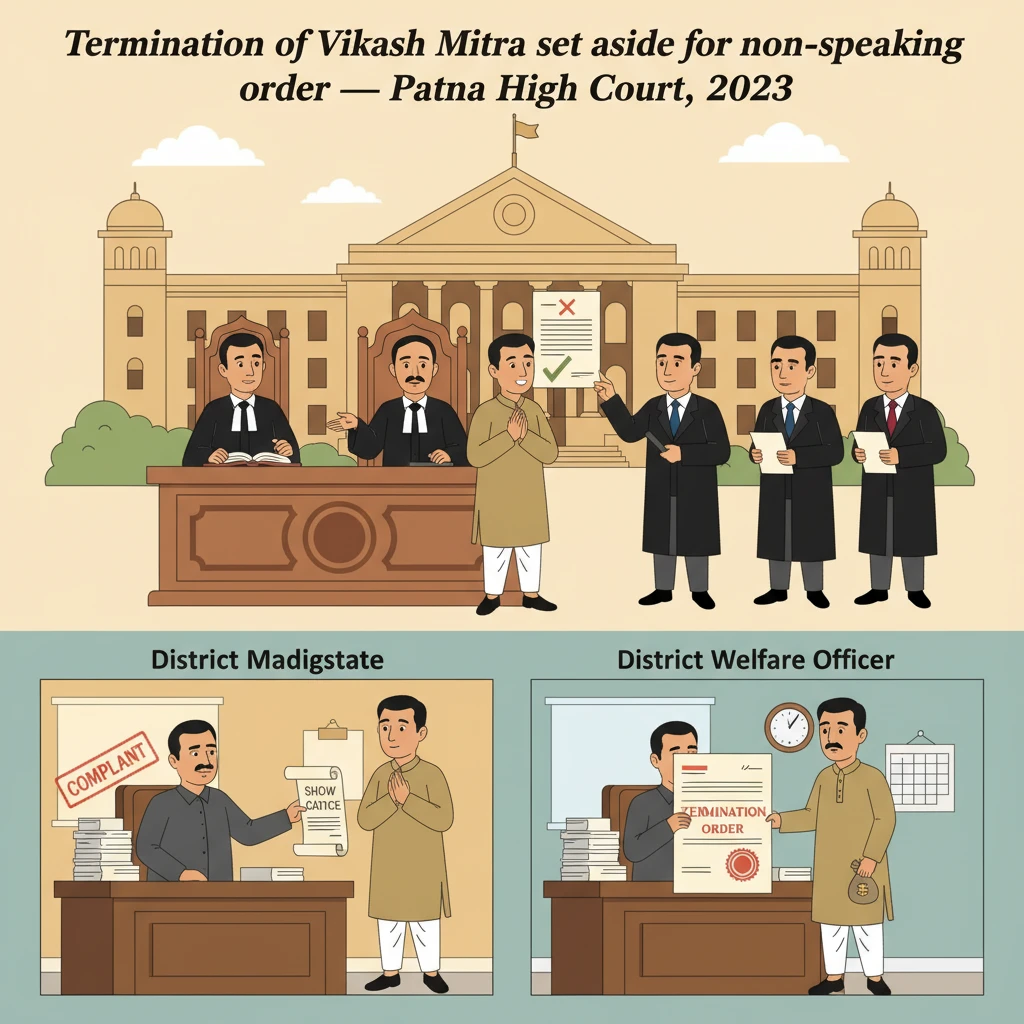
Case Background
The appellant was appointed as a Vikash Mitra under guidelines issued by the State Government for Bihar Mahadalit Vikas Mission. These guidelines, reproduced in part before the Court, govern how Vikash Mitras are appointed, their status, and how their services can be ended.
While working as Vikash Mitra in Panchayat Phulkahan, Block Dumri Katsari, District Seohar, complaints were made against the appellant. On the basis of these complaints, a show-cause notice is stated to have been issued to him. His explanation was obtained, and an inquiry was said to have been held.
After considering this material, the District Welfare Officer, Seohar, with the consent and approval of the District Magistrate, passed an order dated 13.07.2016 terminating the appellant’s engagement as Vikash Mitra. The order of termination was issued under the letter number mentioned in the record and referred to earlier correspondence and scrutiny of the complaints.
The appellant challenged this termination by filing Civil Writ Jurisdiction Case No. 5174 of 2019 before a learned Single Judge of the Patna High Court. He argued that proper procedure had not been followed and that the District Welfare Officer was not the competent authority to remove a Vikash Mitra. The learned Single Judge, by order dated 02.04.2019, dismissed the writ petition, mainly on the ground that Vikash Mitras are not government servants and that removal had been carried out in line with the guidelines, with the approval of the District Magistrate.
Aggrieved by the dismissal of his writ petition, the appellant preferred Letters Patent Appeal No. 948 of 2019 before the Patna High Court. This appeal came up before a Division Bench consisting of Hon’ble Mr. Justice P. B. Bajanthri and Hon’ble Mr. Justice Ramesh Chand Malviya, which delivered an oral judgment on 01.12.2023.
What the Court Examined and Decided
The Division Bench first noted that the appellant’s engagement and removal were governed by specific guidelines issued by the State Government for Bihar Mahadalit Vikas Mission. Two clauses of these guidelines were especially important in this case: Clause VI, dealing with the period of engagement and method of termination, and Clause IX(6), stating the responsibility to receive and decide objections under the selection process.
Clause VI clearly records that Vikash Mitras are not to be treated as government servants. It also provides that their engagement can be terminated if their conduct or work is found unsatisfactory, based on the recommendation of the Mission Director or District Programme Officer, with the consent of the District Magistrate. It further states that, upon termination, only the work period actually completed will be paid for.
Clause IX(6) lays down that the Mission Director and Mission Welfare Officer are responsible for receiving and disposing of objections raised during the selection process. This clause was referred to in the termination order while citing the relevant sub-clause of the guidelines.
Before the learned Single Judge, the appellant had argued that the termination was illegal because:
1. The procedure laid down in the guidelines was not followed properly.
2. The District Welfare Officer was not the competent authority to terminate his engagement; instead, this power lay with the District Project Officer (District Programme Officer).
The learned Single Judge rejected these arguments. The Single Judge held that since the guidelines themselves say Vikash Mitras are not government servants, they do not enjoy the same protection as regular government employees. The Single Judge further observed that the removal had been carried out in line with the guidelines, and that the sufficiency of the reasons for removal and the sanction by the District Magistrate could not be examined in the writ petition.
The Division Bench, while hearing the Letters Patent Appeal, closely examined the termination order annexed to the writ petition. The order (issued by the District Welfare Officer, Seohar) referred to:
• The complaints regarding irregularities in Indira Awas Yojana allotments for the financial year 2012–13.
• A direction for inquiry from the then District Magistrate.
• A show-cause notice and the appellant’s explanation.
• A scrutiny by the relevant authorities, after which it was concluded that the appellant’s work as Vikash Mitra was not found satisfactory.
Based on this, the District Welfare Officer recommended termination under Clause IX(VI) of the guidelines, and the District Magistrate approved termination of the appellant’s engagement with effect from 13.07.2016.
However, the Division Bench found a basic legal defect in this termination order. At paragraph 8 of the judgment, the Court observed that the order was not a “speaking order”. A speaking order is one which clearly records the material considered and the reasons for the decision, especially when such order is open to judicial review.
The Court noted that the termination order lacked:
• Any reference to the contents of the show-cause notice.
• Any discussion of the explanation submitted by the appellant.
• Any findings recorded by the inquiry authority.
• Any analysis of how the material on record led to the conclusion that the appellant’s work was unsatisfactory.
According to the Division Bench, all these materials should have been reflected and analysed in the termination order itself, because the decision affected the livelihood of the Vikash Mitra and was liable to be examined by the Court. The absence of these reasons meant that the order was non-speaking and therefore unsustainable in judicial review.
The Court therefore held that the learned Single Judge had committed an error in not noticing these serious infirmities in the termination order. On this ground, the Division Bench decided to interfere with the Single Judge’s order.
The appellant had also repeated his second contention in the appeal: that the District Welfare Officer was not the competent authority to terminate his engagement. The Division Bench examined this argument in the light of Clause VI and Clause IX(6) of the guidelines. It also took into account the fact, recorded in the judgment, that the District Magistrate had approved the termination and that the District Welfare Officer was also holding the post of District Programme Officer in addition to his duties as District Welfare Officer.
In view of this, the Court rejected the appellant’s contention on competence. It held that the impugned order of termination could not be faulted on the ground that it was passed by an incompetent authority, as the officer who issued it was also the District Programme Officer and had the approval of the District Magistrate in terms of the guidelines.
Ultimately, the Division Bench allowed the appeal to the limited extent that it found the termination order to be legally defective for want of reasons. It set aside the termination order and also the Single Judge’s order dated 02.04.2019 in CWJC No. 5174 of 2019. Consequently, the writ petition stood allowed and the Letters Patent Appeal stood disposed of.
In the operative directions, the Court ordered the concerned authority to reinstate the appellant. It also directed that he be given all service and monetary benefits from the date of termination till reinstatement. At the same time, the Court balanced the interests of the administration by granting liberty to the Disciplinary Authority or Appointing Authority to proceed afresh from the “defective stage” if there were serious complaints against the appellant.
For any such fresh proceedings, the Court laid down minimum procedural safeguards. It directed that the appellant must be supplied copies of the entire inquiry officer’s report and given an opportunity to submit his explanation. Thereafter, the Disciplinary Authority must consider both the inquiry report and the appellant’s explanation and pass a fresh order strictly in accordance with the guidelines. A clear time-frame was fixed: such an exercise must be completed within six months from the date of receipt of the Court’s order.
Why This Judgment Matters
This judgment is important for Vikash Mitras and other similarly placed workers engaged under government schemes in Bihar. The Patna High Court has made it clear that even if they are not treated as government servants, their services cannot be ended through vague or unexplained orders.
The Court has insisted that when authorities act on complaints and inquiries, they must record the basic facts, refer to the show-cause notice, consider the reply, and indicate the findings. Only then can a court properly check whether the decision was fair.
The judgment also clarifies that where guidelines specify who is competent to remove a person, and that officer actually holds the required post and acts with District Magistrate’s approval, the termination will not fail on the ground of lack of authority. Instead, the focus shifts to whether the order gives reasons and follows basic fairness.
For workers, the decision shows that a non-speaking termination order can be challenged. For administrators, it serves as a reminder that reasoned orders and proper documentation are essential, even in contractual or scheme-based engagements like Vikash Mitra.
Legal Issues and Answers
- Issue: Whether the termination of the Vikash Mitra, based on complaints and inquiry, could stand when the termination order did not record reasons or discuss the material considered.
Answer: No. The Patna High Court held that the termination order was not a speaking order as it lacked reference to the show-cause notice, the appellant’s explanation, and the inquiry findings. Such an order, being subject to judicial review, was unsustainable and had to be set aside. - Issue: Whether the District Welfare Officer was a competent authority to terminate the services of the Vikash Mitra under the applicable guidelines.
Answer: Yes. The Court held that, considering Clause VI and Clause IX(6) of the guidelines, the approval of the District Magistrate, and the fact that the District Welfare Officer was also functioning as District Programme Officer, the termination could not be invalidated on the ground of incompetence of the authority. - Issue: What relief should follow from the finding that the termination order suffered from legal infirmities.
Answer: The Court directed reinstatement of the appellant with all service and monetary benefits from the date of termination till reinstatement, but permitted the authorities to restart disciplinary proceedings from the defective stage, following the guidelines and completing the process within six months.
Cases Cited by the Court
- No earlier judgments are cited or relied upon in the text of this decision.
Case Details
Case Number: Letters Patent Appeal No. 948 of 2019 in Civil Writ Jurisdiction Case No. 5174 of 2019
Case Title: Dasharath Ram v. The State of Bihar & Ors.
Citation: 2024(1) PLJR 467
Court: High Court of Judicature at Patna
Coram: Hon’ble Mr. Justice P. B. Bajanthri and Hon’ble Mr. Justice Ramesh Chand Malviya
Date of Judgment: 01.12.2023
Advocates: Mr. Rakesh Kumar Singh, Advocate for the appellant; Mr. Gyan Prakash Ojha (GA 7) for the respondents
Nature of the Case: Letters Patent Appeal against dismissal of writ petition challenging termination of Vikash Mitra engagement
Link to Judgment: Click here to read the full judgment of the Patna High Court
If you found this explanation helpful and wish to stay informed about how legal developments may affect your rights in Bihar, you may consider following Samvida Law Associates for more updates.







