

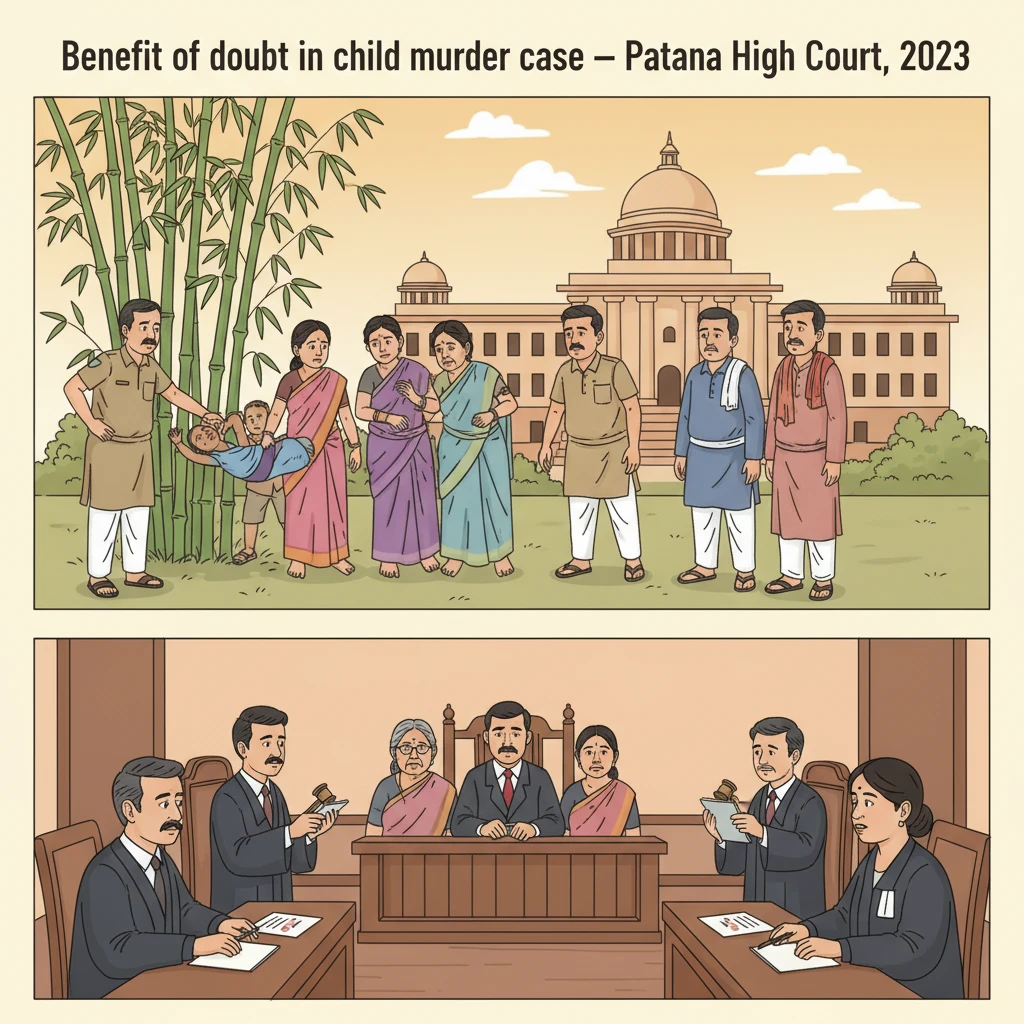
Case Background
The case started with the disappearance of a three‑year‑old boy, Jyoti Kumar, from village Narhandih, P.S. Sikraul, District Buxar.
According to the prosecution, on 27.03.2013 at about 2.00 p.m., the child went out to play near his house and did not return. His father, Mangal Choudhary, and other villagers searched for him that day and the next, including in the village pond and nearby places, but could not find him. No information was given to the police on the first two days.
There was already old dispute between the informant and one neighbour, Tunna Choudhary, and his family. Because of this enmity, suspicion in the village turned towards Tunna and his relatives.
On 29.03.2013, according to the fardbeyan of Mangal Choudhary, villagers called Tunna and questioned him. Some villagers allegedly assaulted him. It was claimed that under this pressure he said that the child had been killed and the body hidden in a bamboo clump belonging to a villager named Hiralal Choudhary.
The villagers went to the bamboo clump and, as per the fardbeyan, found the child’s dead body there. It was further alleged that when the body was found, Tunna’s father, Baban Choudhary, tried to run away but was caught and beaten by the villagers. The wife of Tunna had supposedly already fled earlier. In the meantime, police from Sikraul Police Station arrived, took custody of the injured accused and seized the body.
On the basis of the fardbeyan recorded by S.I. Ravikant (P.W. 6) on 29.03.2013 at 17:15 hours at village Narhandih, Sikraul P.S. Case No. 18 of 2013 was registered under Sections 302, 201 and 34 of the Indian Penal Code.
The Investigating Officer initially filed charge‑sheet against two accused, Tunna Choudhary and Baban Choudhary. The Chief Judicial Magistrate, Buxar, however, took cognizance against three persons: Tunna, Baban and Sunita Devi (wife of Tunna), and committed the case to the Court of Session on 25.11.2013.
On 06.01.2014, charges under Sections 302/34 and 201 IPC were framed against these three original accused, and the sessions trial commenced. The prosecution began examining its witnesses.
After four witnesses had been examined, the prosecution filed a petition on 10.04.2015 under Section 319 of the Code of Criminal Procedure to summon three more persons—Rajendra Choudhary, Ashok Choudhary and Sukari Devi—as additional accused. The petition was allowed, charges were framed against them on 04.01.2016, and a de novo trial was ordered. Evidence was recorded afresh against all six accused together.
By judgment and order dated 18.11.2017 in Sessions Trial No. 388 of 2013, the Additional Sessions Judge VI, Buxar, convicted:
- Tunna Choudhary and Baban Choudhary under Section 302 IPC and Section 201 IPC; and
- All six accused under Section 201 IPC.
On 24.11.2017, the trial court sentenced Tunna and Baban to life imprisonment and fine of Rs. 25,000 each under Section 302 IPC, and seven years’ rigorous imprisonment with Rs. 5,000 fine each under Section 201 IPC, the sentences to run concurrently. The others received varying terms of imprisonment under Section 201 IPC.
Aggrieved, Tunna and Baban filed Criminal Appeal (DB) No. 108 of 2018, and Sukari Devi, Sunita Devi, Rajendra Choudhary and Ashok Choudhary filed Criminal Appeal (DB) No. 11 of 2018 before the Patna High Court. Both appeals were heard together and decided by a common judgment dated 08.12.2023 by a Division Bench.
What the Court Examined and Decided
The Patna High Court carefully re‑evaluated the entire record: witness testimonies, documents, medical evidence and the reasoning of the trial court.
It began by noting that there was no eye‑witness to the actual killing of the child. The case rested wholly on circumstantial evidence, especially alleged extra‑judicial confessions by some accused and recovery of the dead body.
The Court summarized the key prosecution witnesses.
P.W. 1, Mangal Choudhary (informant and father of the deceased), stated that on 27.03.2013 his son was playing on the village chavar when he disappeared. During the search, Tunna told him that someone had taken the child on a bicycle towards the west. That night at about 8.00 p.m., Tunna, Baban, Rajendra and Ashok came to the informant’s house and offered to search for the child.
According to P.W. 1, a village panchayati was held on 28.03.2013 where these accused were called, but Rajendra and Ashok did not come. Tunna and Baban allegedly assured that they would produce the child by evening, but failed. Another panchayati was held on 29.03.2013 where, P.W. 1 claimed, Tunna and Baban admitted that all six accused had killed the child.
P.W. 1 further stated that when the police arrived, Tunna and Baban tried to run but were caught. They thereupon told the police that the dead body had been kept in paddy powder at the house of Ashok Choudhary. The police, along with them, went there and found blood but no body. Then, according to him, the accused said that Sukari Devi might have hidden the body. Sukari allegedly disclosed that the body was concealed in the bamboo clump of Hiralal Choudhary, from where the police recovered it.
In cross‑examination, P.W. 1 admitted long‑standing enmity: since 2009 he had a dispute with Tunna and Baban because, according to him, they had once kidnapped his wife. No criminal case was lodged then, as the matter was compromised and his wife was recovered within 12 hours.
The High Court noted that P.W. 1 claimed in evidence that he had named Ashok, Rajendra and Sukari even in his fardbeyan, and denied suggestions that he had omitted them earlier. The Court later compared this to the Investigating Officer’s testimony to check consistency.
P.W. 2, Dinesh Singh, deposed that he learnt about the boy’s disappearance and joined the search. He said that on 28.03.2013 suspicion was raised against Tunna, but he did not say anything. On 29.03.2013, when the Police Station Incharge came, Tunna stated that his mother knew about the matter, and on being asked, Sukari said that the dead body was in the bamboo clump, from where it was found.
In cross‑examination, P.W. 2 admitted that the police had not recorded his statement and that no panchayati paper was prepared.
P.W. 3, Vijay Choudhary, stated that Tunna and Baban told villagers that the boy had been killed and, when police arrived, Tunna said that his mother would tell where the body was. Sukari allegedly then pointed out the bamboo clump where the body was recovered. He also mentioned that a panchnama (Exhibit 2) was prepared by one Krishna Yadav 20‑25 days after the incident.
P.W. 4, Manoj Choudhary, turned hostile. He said police had not taken his statement and he did not know how Jyoti died.
P.W. 5, Dr. Ram Kumar Gupta, conducted the post‑mortem on 30.03.2013. He opined that the cause of death was asphyxia due to throttling, with time since death between 6 to 24 hours. The defence did not dispute the cause of death.
P.W. 6, S.I. Ravi Kant, the Investigating Officer, stated that on 29.03.2013 he heard a rumour that a child had been killed and the body thrown in village Narhandih. He reached the spot with armed force and recovered the dead body of a child from the bamboo clump of Hiralal Choudhary. He recorded the fardbeyan of P.W. 1, prepared the inquest report, and took over investigation.
He testified that during investigation he recorded statements of several villagers, and finding the occurrence true, filed charge‑sheet under Sections 302 and 201/34 IPC against only Baban and Tunna. In cross‑examination he clearly stated that in the fardbeyan only three names appeared: Tunna, Baban and the wife of Tunna. In his case diary also, only these three were named; no other accused was mentioned.
From this evidence, the High Court drew important conclusions.
First, the prosecution case was purely circumstantial. The Bench referred to the Supreme Court decision in Ramanand @ Nandlal Bharti v. State of Uttar Pradesh (2022 SCC OnLine SC 1396), which lays down that, in a case based on circumstantial evidence, the circumstances must be firmly established, must point only to the guilt of the accused, and must form a complete chain leaving no reasonable doubt or alternative hypothesis.
The Court also cited Sarwan Singh Rattan Singh v. State of Punjab (AIR 1957 SC 637) to emphasise that between “may be true” and “must be true” there is a long distance, which must be covered by reliable evidence before convicting an accused.
Second, on motive, the Division Bench referred to Inderjit Das v. State of Bihar (2023 LiveLaw (SC) 152), Kuna @ Sanjaya Behera v. State of Odisha (2018) 1 SCC 296 and Ranganayaki v. State (2004) 12 SCC 521. It held that, especially in circumstantial cases, motive is an important link. Here, apart from previous quarrels and an old allegation of kidnapping of the informant’s wife, there was no clear motive for the accused to kill a three‑year‑old child. The past enmity, the Court remarked, could equally be a reason for false implication.
Third, on common intention under Section 34 IPC, the Court found no reliable material to show that all accused shared a common plan or participated in the offence. Without clear evidence of common intention and participation, conviction with the aid of Section 34 was unsustainable.
Fourth, the alleged extra‑judicial confession was closely scrutinised. The Court explained the law on judicial and extra‑judicial confessions, and cited again Ramanand @ Nandlal Bharti, where the Supreme Court held that extra‑judicial confession is a weak piece of evidence, to be accepted only if voluntary, trustworthy and corroborated.
Here, the circumstances were troubling. P.W. 1’s own version was that villagers had assaulted Tunna and Baban before they supposedly confessed in the panchayati. The number of people present, the pressure put on the accused, and the inconsistencies between witnesses all raised doubts about voluntariness. Moreover, the I.O. stated that before him the appellants made no confession at all.
Fifth, the link between alleged confessions and recovery of the body was unclear. As per P.W. 1, Tunna and Baban first said the body was kept in paddy powder at Ashok’s house, but no body was found there. The I.O., however, deposed that when he reached the village on 29.03.2013, the dead body was already lying in the bamboo clump of Hiralal Choudhary. He did not support the prosecution story that Sukari’s disclosure led to recovery.
The Court highlighted these contradictions: if the body was already in the bamboo clump when the I.O. arrived, the claim that it was earlier in paddy powder and shifted later remained unproved. Also, no blood‑stained paddy powder or earth was seized from Ashok’s house.
Because of this, the Bench held that the so‑called disclosure by Sukari did not qualify as a “fact discovered” under Section 27 of the Evidence Act. The prosecution had not clearly proved what exactly the accused stated in police custody and how that statement led to discovery of a new, relevant fact.
Sixth, the Court examined the panchnama (Exhibit 2) relied on by the trial court. P.W. 3 said it was prepared 20‑25 days after the incident by Krishna Yadav, who was never examined. P.W. 2 had even admitted that no panchayati paper was prepared. The High Court clarified that a panchnama is not a substantive piece of evidence; at best it can corroborate oral evidence if properly proved. Here, its contents could not be treated as proof of the alleged confessions or involvement of the accused.
Seventh, the Court found that the examination of the accused under Section 313 Cr.P.C. by the trial court was perfunctory. The questions put were general and omnibus, not pointing out specific incriminating circumstances to each accused. Relying on the Supreme Court’s judgment in Jai Prakash Tiwary v. State of Madhya Pradesh (2022 SCC OnLine SC 966), the Bench held that this deprived the accused of a fair opportunity to explain the circumstances against them.
After going through all materials, the High Court concluded that:
- The basic links in the chain of circumstantial evidence—motive, last seen, recovery, credible confession—were either missing or seriously doubtful.
- There were material improvements and inconsistencies in the informant’s testimony, particularly regarding who disclosed what and where the body was found.
- The investigation itself initially proceeded only against two accused, and the later attempt to rope in the whole family appeared to be based on improved statements during trial.
In such a situation, the Court held that it was unsafe to uphold the conviction. Criminal law does not allow conviction on suspicion, however strong, without clear, cogent and clinching evidence.
Therefore, giving the benefit of doubt, the Division Bench allowed both appeals, set aside the conviction and sentences dated 18.11.2017 and 24.11.2017, and acquitted all six appellants of the charges under Sections 302 and 201/34 IPC. Tunna Choudhary, who was in custody, was ordered to be released if not wanted in any other case. The others, who were on bail, were discharged from their bail bonds and their fine amounts were directed to be refunded.
Why This Judgment Matters
This judgment is significant for villagers and families in Bihar and beyond who may face criminal accusations in emotionally charged situations.
First, it shows that even in a tragic case involving the death of a small child, the Patna High Court insists on strict proof. Emotional anger in a village, earlier quarrels, or rumours cannot replace proper legal evidence.
Second, it underlines that extra‑judicial confessions made under pressure of beating or mob anger are viewed with great caution. Courts will not accept such alleged confessions unless they are clearly voluntary and supported by other reliable facts.
Third, the decision clarifies that entire families cannot be convicted only because of old enmity or because their names appear later during trial. The prosecution must show, with concrete evidence, what role each person played.
Fourth, it reminds trial courts to conduct proper examination of accused under Section 313 Cr.P.C., question by question, so that the accused understand and can reply to each allegation. A casual exercise on this point can harm the fairness of the trial.
Overall, the judgment reinforces a basic protection in criminal law: when there is doubt, the accused must get the benefit. This acts as a safeguard against wrongful convictions based on suspicion, community pressure or imperfect investigation.
Legal Issues and Answers
Issue: Could the conviction for murder and causing disappearance of evidence be sustained on circumstantial evidence, alleged extra‑judicial confession, and recovery of the body?
Answer: No. The Patna High Court held that the chain of circumstances was incomplete and inconsistent, the extra‑judicial confession was weak and doubtful, and the alleged recovery did not meet the legal test under Section 27 of the Evidence Act. Hence, conviction was unsafe.
Issue: Was there sufficient proof of common intention among all six accused to attract liability under Sections 302/34 and 201/34 IPC?
Answer: No. The Court found no clear evidence that all accused shared a common intention or participated in the crime. Conviction with the aid of Section 34 IPC could not stand.
Issue: Did the trial court’s handling of the accused’s examination under Section 313 Cr.P.C. meet legal standards?
Answer: No. The High Court found the questioning to be general and perfunctory, failing to put specific incriminating circumstances to each accused. This was another factor against sustaining the conviction.
Cases Cited by the Court
- Ramanand @ Nandlal Bharti v. State of Uttar Pradesh, 2022 SCC OnLine SC 1396.
- Sarwan Singh Rattan Singh v. State of Punjab, AIR 1957 SC 637.
- Inderjit Das v. State of Bihar, (2023) LiveLaw (SC) 152.
- Kuna @ Sanjaya Behera v. State of Odisha, (2018) 1 SCC 296.
- Ranganayaki v. State by Inspector of Police, (2004) 12 SCC 521.
- Jai Prakash Tiwary v. State of Madhya Pradesh, 2022 SCC OnLine SC 966.
- Ramashish Rai v. Jagdish Singh, (2005) 10 SCC 498.
Case Details
Case Number: Criminal Appeal (DB) No. 108 of 2018 with Criminal Appeal (DB) No. 11 of 2018; arising out of Sikraul P.S. Case No. 18 of 2013, District Buxar.
Case Title: Tunna Choudhary & Anr v. State of Bihar; Sukari Devi & Ors v. State of Bihar.
Citation: 2024 (1) PLJR 437.
Court: High Court of Judicature at Patna.
Coram: Hon’ble Mr. Justice Arvind Srivastava and Hon’ble Mr. Justice Sunil Dutta Mishra.
Date of Judgment: 08.12.2023.
Advocates:
- For the appellants (in both appeals): Mr. Bachan Jee Ojha, Advocate.
- For the informant: Mr. Anil Kumar Roy, Advocate.
- For the State (Cr. Appeal (DB) No. 108 of 2018): Mrs. Shashi Bala Verma, APP.
- For the State (Cr. Appeal (DB) No. 11 of 2018): Mr. Ashwani Kumar Sinha, APP.
Nature of the Case: Criminal appeals (Division Bench) against conviction and sentence in a sessions trial for offences under Sections 302 and 201/34 of the Indian Penal Code.
Link to Full Judgment: Patna High Court Judgment
If you found this explanation helpful and wish to stay informed about
how legal developments may affect your rights in Bihar,
you may consider following Samvida Law Associates for more updates.







