

Case Background
The dispute arose from the functioning of a teachers’ training institution in Bihar, Mithila Hanumant National College of Health and Physical Education, Darbhanga. The institution has been running since 1987 with recognition from the State Government.
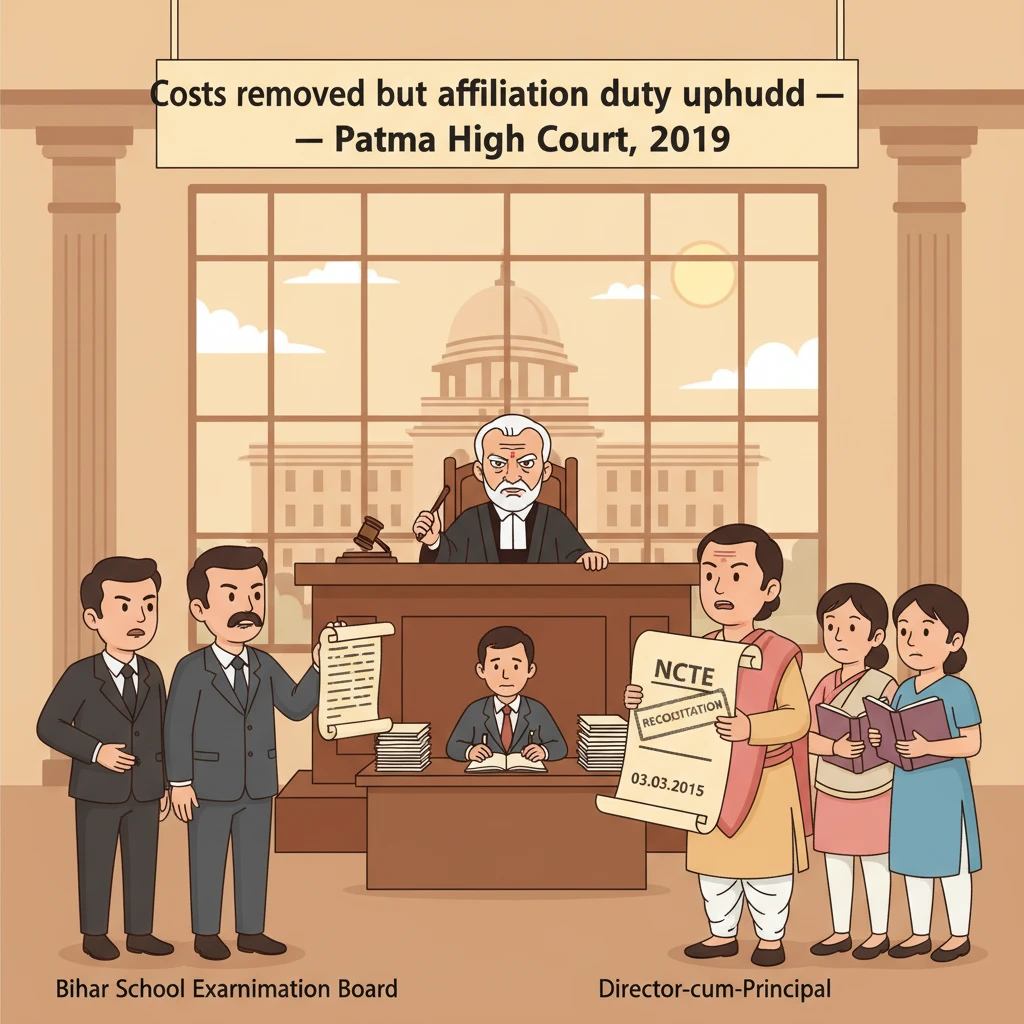
After the National Council for Teacher Education Act, 1993 came into force, the National Council for Teacher Education (NCTE) became the statutory authority to grant recognition to teacher training institutions. On completion of the required formalities, the NCTE, Eastern Regional Committee, granted recognition to this institution by order dated 03.03.2015.
This recognition order clearly stipulated that the institution would admit students only after obtaining affiliation from the examining body, namely the Bihar School Examination Board, Patna. A copy of the recognition order was endorsed to the Secretary of the Board so that necessary follow-up action for affiliation could be taken in terms of Section 14(6) read with Section 16 of the NCTE Act.
Despite this, the Board did not grant affiliation. The Board took the stand that regulations regarding grant of affiliation were still under preparation. As a result, students of the institution could not appear in the teachers’ training examinations conducted by the Board.
Feeling aggrieved by this inaction and the resulting hardship to students, the Director-cum-Principal of the institution filed Civil Writ Jurisdiction Case No. 4035 of 2017 before a learned Single Judge of the Patna High Court. However, in that writ petition, the main prayer was only to allow the students of the institution to appear in the examination. The writ petitioner did not specifically ask for a direction to the Board to grant affiliation.
The learned Single Judge, strongly criticising the conduct of the Board and noting that it was hiding behind the “preparation” of affiliation regulations despite the clear mandate of the NCTE Act, allowed the writ petition by order dated 12.10.2017. The Single Judge imposed costs of Rs. 5,00,000 on the Board, to be used for the welfare of the students of the college. The judgment also contained a direction (referred to in paragraph 10) requiring the Board to complete the formality of grant of affiliation.
The Bihar School Examination Board and its Secretary then filed the present Letters Patent Appeal No. 1640 of 2017 before a Division Bench of the Patna High Court, challenging the Single Judge’s order, particularly the imposition of costs and the grant of relief not specifically prayed for.
What the Court Examined and Decided
The Division Bench comprising Hon’ble Mr. Justice Jyoti Saran and Hon’ble Mr. Justice Arvind Srivastava heard the appeal. The core question before the Bench was whether the Single Judge was justified in imposing heavy costs on the Board, and whether the direction relating to affiliation could stand when no specific prayer for affiliation had been made in the writ petition.
The Court began by noting the broad factual position. The institution had lawful recognition from the State Government since 1987 and, after the NCTE Act came into force, obtained due recognition from the NCTE on 03.03.2015. The NCTE’s recognition order was shared with the Bihar School Examination Board to enable it to take consequential steps.
The Bench emphasised the statutory scheme under Section 14(6) read with Section 16 of the NCTE Act. These provisions oblige the examining body, here the Bihar School Examination Board, to grant affiliation to an institution once NCTE recognition has been granted. The Court described this as a “command” in the Act, leaving no discretion with the examining body to refuse affiliation. Affiliation, in such a situation, has to be granted as a matter of course.
Against this backdrop, the Bench expressed strong displeasure at the way the institution had been treated. The institution had been running under lawful recognition since 1987, and NCTE recognition in 2015 had reinforced its status. Yet, despite the NCTE order being endorsed to the Board, the Board failed to act promptly. The matter dragged on, students suffered, and the institution was forced to repeatedly approach the Board seeking affiliation.
The only justification offered by the Board was that a regulation regarding grant of affiliation was under preparation. The Division Bench found this excuse unacceptable. It held that, in view of the clear mandate of the Parliamentary enactment (the NCTE Act), the Board had no discretion to delay affiliation once NCTE had granted recognition. The Court clearly stated that the grant of affiliation must follow “no sooner” than recognition is granted.
The Court observed that the institution faced such harassment at the hands of the examining body that it had no option but to come to the High Court. However, it also pointed out a critical mistake on the part of the institution: in the writ petition, the petitioner did not ask for a direct order to grant affiliation. Instead, the petitioner sought permission for its students to appear in examinations, despite paragraph 3 of the NCTE recognition order, dated 03.03.2015, which prohibited the institution from admitting students unless affiliation was first obtained from the Board under Regulation 8(10) of the NCTE (Recognition Norms and Procedure) Regulations, 2014.
The Division Bench accepted that, in substance, the petitioner’s grievance arose from non-grant of affiliation, since without affiliation the students could not appear in exams. Nevertheless, the Court recognised that the specific relief sought in the writ petition was only to permit students to appear in the examination, with some ancillary prayers, and not an explicit prayer for grant of affiliation.
Counsel for the Board argued that, as there was no prayer for affiliation, the Single Judge could not have granted such a relief, and, consequently, could not have imposed costs on the Board on that basis. He did, however, fairly acknowledge the legal position under the NCTE Act regarding the Board’s obligation to grant affiliation.
The Division Bench then examined the legal principle relating to the Court’s power under Article 226 of the Constitution of India to mould relief. It noted that it is well settled that even if a particular relief is not clearly prayed for, courts can grant consequential reliefs flowing from the main relief, especially when these are necessary to do complete justice.
Applying this principle, the Bench held that, in the present case, the prayer to allow students of the petitioner institution to appear in the teachers’ training examination essentially required prior affiliation. Since the NCTE had already granted recognition, and Sections 14(6) and 16 of the Act mandated the Board to grant affiliation, the Single Judge’s direction in paragraph 10 of the judgment, asking the Board to complete the formality of affiliation, was fully justified and in line with the statute.
However, the Bench carefully distinguished this from the question of imposing costs. Even though the Board’s conduct in delaying affiliation showed a lack of appreciation of the legal position, the imposition of heavy costs of Rs. 5,00,000 was based on the assumption that the writ petition had sought affiliation and that the Board had failed to respond to that specific claim.
The Division Bench pointed out that the writ petition had, in fact, not contained a direct prayer for affiliation. Therefore, while the Single Judge could mould the relief to direct the Board to grant affiliation in terms of statutory obligation, the foundation for imposing costs was weak, because the Board was not resisting a specific relief expressly sought in the writ petition.
The Court therefore disagreed, “with respect”, with the Single Judge’s decision only to the limited extent of costs. It held that, had there been a clear prayer for affiliation, there might have been a different situation regarding costs. But given the limited reliefs actually asked for, the imposition of Rs. 5,00,000 as costs was unwarranted.
Accordingly, the Division Bench modified the Single Judge’s judgment. It set aside the order imposing costs on the Bihar School Examination Board but maintained the direction contained in paragraph 10 of the Single Judge’s judgment, which required the Board to complete the process of granting affiliation.
The Bench clarified that the direction to grant affiliation was merely a reminder to the Board to discharge its legal obligation under Section 14(6) read with Section 16 of the NCTE Act. It directed that the process of affiliation be completed positively within four weeks from the date of the appellate judgment.
In the result, the Letters Patent Appeal was allowed only to the limited extent of removing the costs, while the substantive direction for affiliation remained intact.
Why This Judgment Matters
This judgment is important for teacher training colleges and their students across Bihar. It clearly states that once NCTE grants recognition, the Bihar School Examination Board cannot delay or deny affiliation on grounds like pending regulations.
For institutions, this means that if they have NCTE recognition, they are entitled to affiliation from the Board as a matter of legal right. Students are protected from being kept out of examinations due to bureaucratic delays between authorities.
At the same time, the judgment shows that while courts can mould reliefs to give effective justice, they are careful about imposing heavy costs when the pleadings do not clearly seek a particular relief. This underlines the importance of properly drafted petitions.
Overall, the Patna High Court has reaffirmed that statutory commands under the NCTE Act must be obeyed promptly, while also ensuring that penalties like costs are imposed only on a sound legal basis.
Legal Issues and Answers
Issue: Can the Bihar School Examination Board delay or refuse affiliation to an institution after NCTE has granted recognition, on the ground that its own affiliation regulations are under preparation?
Answer: No. The Court held that Sections 14(6) and 16 of the NCTE Act command the examining body to grant affiliation as a matter of course once recognition is granted.
Issue: Was the learned Single Judge justified in imposing costs of Rs. 5,00,000 on the Board when the writ petition did not contain a specific prayer for grant of affiliation?
Answer: No. While the direction to grant affiliation was upheld as consistent with statutory obligations and as a moulding of relief, the Division Bench set aside the costs as unwarranted in the absence of a specific prayer for affiliation.
Issue: Can the High Court, in a writ petition, grant relief that has not been expressly prayed for if it is consequential to the main relief sought?
Answer: Yes. The Court reiterated that under Article 226 it can mould relief where a consequential direction flows from the main relief, as in directing affiliation so that students can lawfully appear in examinations.
Cases Cited by the Court
- No earlier judgments are cited or relied upon in the text of this decision.
Case Details
Case Number: Letters Patent Appeal No. 1640 of 2017 in Civil Writ Jurisdiction Case No. 4035 of 2017
Case Title: The Bihar School Examination Board & Anr. v. The State of Bihar & Ors.
Coram: Hon’ble Mr. Justice Jyoti Saran and Hon’ble Mr. Justice Arvind Srivastava
Citation: 2024 (1) PLJR 690
Date of Judgment: 09.04.2019
Advocates: Mr. Manish Kumar, Advocate for the appellants (Bihar School Examination Board); Mr. Ravi Kumar, AC to AAG-13 for the State; Mr. Sunil Kumar Singh, Advocate for the National Council for Teacher Education; Mr. Tej Bahadur Singh, Senior Advocate with Mr. Kripa Nand Jha, Advocate for respondent no. 5 (writ petitioner institution)
Nature of the Case: Letters Patent Appeal (intra-court appeal) against a Single Judge’s order in a writ petition under Article 226 of the Constitution of India
Link to Judgment: Patna High Court Judgment
If you found this explanation helpful and wish to stay informed about
how legal developments may affect your rights in Bihar,
you may consider following Samvida Law Associates for more updates.







