

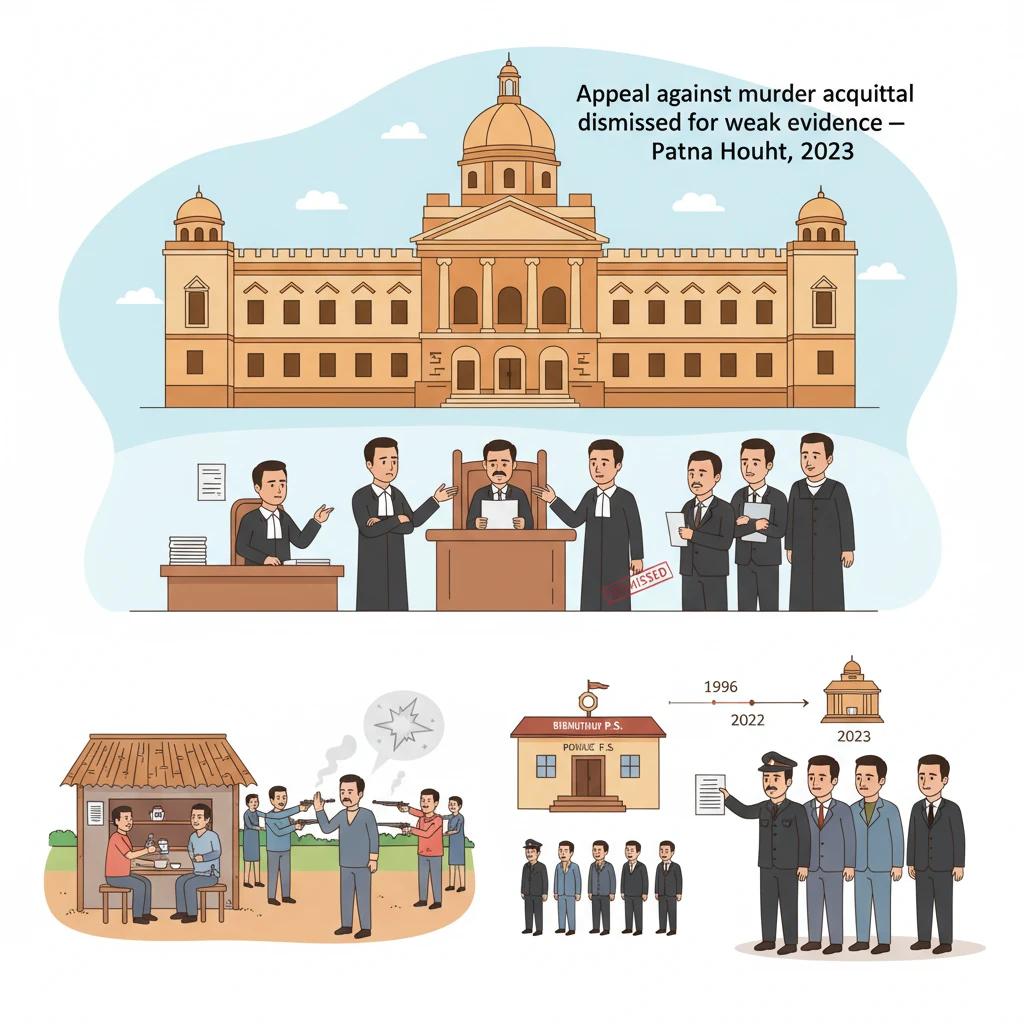
Case Background
The case arises from Bibhutipur P.S. Case No. 124 of 1996, relating to the murder of one Baij Nath Singh. According to the prosecution, he was shot dead on 03.10.1996 while having tea at a tea shop.
An FIR was lodged by his brother, Yogi Singh, who later deposed in trial as P.W. 8. In the FIR, he named all the eight private respondents as accused. The criminal case was committed to the Court of Session and registered as Sessions Trial No. 368 of 1998 before the learned Additional Sessions Judge-II, Rosera, Samastipur.
After investigation, the police submitted charge-sheet only against four persons, namely respondent nos. 2 to 5: Sikil Singh, Chote Singh @ Chotka, Shiv Kalyan Singh and Raj Nandan Singh @ Raj Ranjan Prasad Singh. No charge-sheet was initially submitted against respondent nos. 6 to 8, namely, Ram Kishun Singh, Vinay Singh and Murari Singh.
Later, during the course of trial, respondent nos. 6 to 8 were summoned to face trial under Section 319 of the Code of Criminal Procedure. In total, the trial court examined twelve prosecution witnesses and five defence witnesses.
By judgment dated 16.09.2022, the learned Additional Sessions Judge-II, Rosera, Samastipur acquitted all eight respondents of all charges relating to the murder.
The present criminal appeal (DB) No. 886 of 2022 was filed before the Patna High Court by P.W. 9, Ram Chhawila Singh, another brother of the deceased and a prosecution witness. He challenged the judgment of acquittal passed by the trial court.
What the Court Examined and Decided
The Division Bench of the Patna High Court, comprising Hon’ble Mr. Justice Ashutosh Kumar and Hon’ble Mr. Justice Nani Tagia, heard the appeal. The oral judgment was delivered on 05.12.2023 by Hon’ble Mr. Justice Ashutosh Kumar.
The High Court first noted that the respondents had been acquitted of the charge of murdering the deceased, who was allegedly fired upon on 03.10.1996 while sitting at a tea shop. The central question before the Court was whether the trial court’s acquittal was so erroneous that it should be overturned in appeal.
The Court observed that the trial court had, in effect, discarded the depositions of three brothers of the deceased, namely P.W. 5, P.W. 8 (informant) and P.W. 9 (the present appellant), on the ground that their statements were discrepant. The trial court had also ignored the deposition of P.W. 8 because he had been discharged before completion of his cross-examination.
The High Court specifically pointed out that there was nothing on record to show that P.W. 8 refused to face further cross-examination or that the prosecution chose not to produce him further. In such circumstances, the law required that whatever statement he had already given should have been analysed, instead of being treated as wholly unreliable merely because cross-examination was incomplete.
However, the High Court proceeded to assess the overall evidence to see whether the acquittal was still justified on facts.
According to the version of P.W. 8, the informant, on the date of the incident he, the deceased and another brother were sitting at the tea shop of P.W. 10, Madan Sah, and were talking to P.W. 7, Munni Lal Sahani. As per this account, the respondents arrived from two different directions and, on the order of respondent no. 8, Murari Singh, all of them started firing, which resulted in the death of the deceased.
The Court then compared this version with the statement of P.W. 9, who had filed the appeal. During the trial, P.W. 9 presented a significantly different story. He stated that the respondents first threw a bomb at P.W. 8 and others. According to him, they somehow escaped unhurt and only thereafter the main occurrence took place.
The Investigating Officer, however, did not find or confirm any bomb splinters at the place of occurrence. This absence of physical evidence to support the bomb allegation, combined with the difference between the versions of P.W. 8 and P.W. 9, created a serious inconsistency in the prosecution case.
The respondents also relied upon the fact that P.Ws. 5, 8 and 9 had made inaccurate statements before the trial court about their own “clean antecedents”. The High Court noted that, although this alone would not be a valid ground for acquittal, giving wrong statements of fact in court does reduce the credibility of those witnesses.
The High Court then turned to the evidence of P.W. 2, who, if believed, suggested a completely different background to the murder. P.W. 2 deposed that the deceased had a business association with one Ram Swarath Singh in the coal business. According to him, there was no reference to this person in the investigation papers or other trial proceedings, apart from his own testimony.
P.W. 2 stated that the deceased and Ram Swarath Singh had fallen out. Ram Swarath allegedly removed the deceased from the business and made the appellant (P.W. 9 and brother of the deceased) a partner instead. It appeared from this account that business interests had taken priority over brotherly relations for the appellant.
P.W. 2 further stated that both Ram Swarath and the appellant had been threatening the deceased. He also said that, for this reason, the deceased did not live in the same house as his brothers and had taken a rented house at Dalsingsarai. This narrative introduced a separate angle of intra-family and business conflict, which was not part of the prosecution’s original story.
In addition to this, the High Court considered the evidence of P.W. 10, Madan Sah, and P.W. 7, Munni Lal Sahani, the two persons who were present at the tea shop and could have been the most natural eye-witnesses. The trial court had noted, and the High Court agreed, that both these witnesses expressed complete ignorance about the participation of the respondents in the occurrence.
While P.W. 7 and P.W. 10 supported the broad prosecution claim that the deceased was killed by firing carried out by miscreants, they did not identify or name the respondents as the shooters. Their silence on the identity of the assailants made the prosecution case doubtful, especially when set against the inconsistent versions offered by P.W. 5, P.W. 8 and P.W. 9.
The High Court held that the depositions of P.Ws. 5, 8 and 9, who claimed to be eye-witnesses, were “highly discrepant” and could not safely be the basis for convicting the respondents of murder. When such discrepancies are combined with the non-supportive evidence from independent witnesses at the scene, the standard required for a criminal conviction—proof beyond reasonable doubt—was clearly not met.
The Bench observed that, even though it did not agree with all the legal reasoning given by the trial court for acquittal, the final conclusion reached by the trial court—that the evidence against the respondents was sketchy and doubtful—was justified on the facts emerging from the record.
Therefore, exercising its appellate jurisdiction, the Patna High Court decided not to interfere with the acquittal. It affirmed that when two views are possible on the evidence, and the trial court has taken a view favouring the accused, an appellate court should be slow to overturn that view unless there is a clear perversity or a gross misreading of the evidence. In this case, the Court found no such perversity.
Accordingly, the criminal appeal filed by P.W. 9 was dismissed, and the acquittal of respondent nos. 2 to 8 in Sessions Trial No. 368 of 1998, arising out of Bibhutipur P.S. Case No. 124 of 1996, was confirmed.
Why This Judgment Matters
This judgment shows how the Patna High Court treats appeals against acquittal in serious cases like murder. Even when the crime is grave, the Court insists that conviction must rest on reliable and consistent evidence.
For families of victims, it underlines that contradictions between different witnesses, especially close relatives, and lack of support from independent witnesses can fatally weaken a case. Courts will not convict merely on suspicion or family statements if these are not trustworthy.
For accused persons, the ruling reinforces that once a trial court has acquitted them, the appellate court will interfere only if the acquittal is plainly wrong or unreasonable. Where evidence is shaky and two views are reasonably possible, the view favouring the accused is allowed to stand.
For lawyers and investigators, the judgment highlights the importance of:
- maintaining consistency in witness statements,
- ensuring that physical evidence (like bomb splinters) supports the oral narrative, and
- presenting independent witnesses who can confidently identify the accused.
Without these, even long-running cases may end in acquittal being confirmed.
Legal Issues and Answers
Issue: Should the Patna High Court set aside the trial court’s acquittal of eight accused in a 1996 murder case?
Answer: No. Due to highly discrepant testimonies of key witnesses, lack of corroboration by independent witnesses, and absence of physical support for certain allegations, the evidence was too doubtful to justify conviction, and the acquittal was allowed to stand.
Issue: Can incomplete cross-examination of an informant-witness (P.W. 8) alone make his entire deposition unusable?
Answer: No. The High Court noted that there was nothing to show that P.W. 8 avoided cross-examination or was withheld by the prosecution, and therefore his statement ought to have been analysed instead of being wholly discarded, though the overall evidence still remained insufficient for conviction.
Cases Cited by the Court
- No previous case law is cited or relied upon in the text of this judgment.
Case Details
Case Number: Criminal Appeal (DB) No. 886 of 2022; arising out of Bibhutipur P.S. Case No. 124 of 1996; Sessions Trial No. 368 of 1998.
Case Title: Ram Chhawila Singh v. The State of Bihar & Ors.
Coram: Hon’ble Mr. Justice Ashutosh Kumar and Hon’ble Mr. Justice Nani Tagia.
Citation: 2024 (1) PLJR 662.
Advocates: For the appellant – Ms. Vaishnavi Singh, Advocate. For the State – Mr. Sujit Kumar Singh, APP. For the respondents – Mr. Mritunjay Kumar, Advocate; Ms. Shilpa Kumari, Advocate; Md. Salauddin Khan, Advocate; Mr. Brajesh Kumar Singh, Advocate; Mr. Kumar Praveen, Advocate.
Nature of the Case: Criminal appeal (Division Bench) against a judgment of acquittal in a murder case.
Link to judgement; https://patnahighcourt.gov.in/viewjudgment/NSM4ODYjMjAyMiMxI04=-pf3lMn1k0cA=
If you found this explanation helpful and wish to stay informed about
how legal developments may affect your rights in Bihar,
you may consider following Samvida Law Associates for more updates.







