

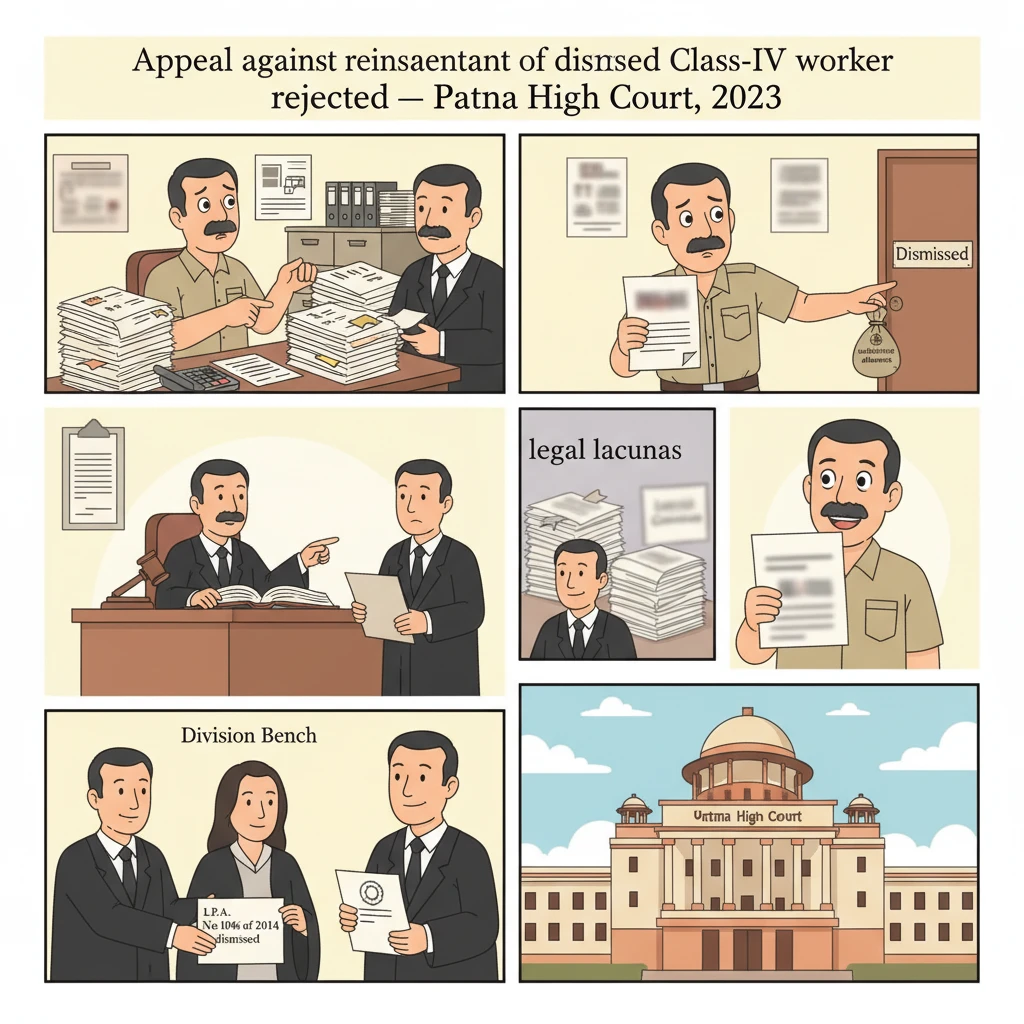
Case Background
The case arose from disciplinary action taken by Bihar State Food and Civil Supplies Corporation Limited against one of its Class-IV employees posted at Bettiah in West Champaran district.
The employee was originally appointed as a Class-IV worker. However, the corporation directed him to perform the duties of a Class-III post. While discharging those higher responsibilities, he was entrusted with preparation of certain bills.
In that capacity, he prepared bills relating to 22 Class-IV workers and forwarded them to the next higher authority. These bills ultimately reached the corporation’s head office.
The corporation took the view that the bills prepared and forwarded by him were not in accordance with law. Treating this as misconduct, it initiated departmental proceedings against him. After completion of the internal inquiry, the disciplinary authority imposed the major penalty of dismissal from service.
The dismissed employee challenged the order before the Patna High Court by filing Civil Writ Jurisdiction Case No.10974 of 2005. On 22.03.2018, a learned Single Judge allowed his writ petition, holding that there were serious legal defects in the departmental proceedings and setting aside both the dismissal order and its affirmation by the reviewing authority.
The Single Judge further directed the corporation to pay him full salary for the period between his dismissal and his superannuation, salary for the suspension period, and all post-retirement benefits. The amounts were to be paid within three months of receipt of the order.
Aggrieved by this relief in favour of the employee, the corporation filed the present Letters Patent Appeal (L.P.A. No.1391 of 2018) before a Division Bench of the Patna High Court.
What the Court Examined and Decided
The Division Bench, comprising Hon’ble Mr. Justice P. B. Bajanthri and Hon’ble Mr. Justice Ramesh Chand Malviya, heard the corporation’s appeal against the Single Judge’s judgment dated 22.03.2018.
The central question before the Bench was whether the Single Judge was right in setting aside the dismissal order and directing payment of full salary and retirement benefits, or whether the matter should instead be sent back to the disciplinary authority to cure the defects in the departmental enquiry.
The respondent employee had been working in a Class-IV post but was ordered to perform duties of a Class-III post, including preparation of bills. The corporation alleged that the bills he submitted for 22 workers were not legally proper. This alleged irregularity became the foundation of disciplinary proceedings ending in dismissal.
While deciding the writ petition, the Single Judge had noticed “various legal lacunas” in the departmental proceedings. The Single Judge also relied on an earlier case of another employee, Jageshwar Chaudhary, who faced a similar disciplinary proceeding by the same corporation.
In that earlier writ petition, C.W.J.C. No.23405 of 2012, the Court had called for the original disciplinary records. On examining them, the Court recorded serious procedural defects, particularly in paragraphs 5 and 6 of that judgment, which are quoted in the present Division Bench judgment.
From those quoted observations, it appears that in Jageshwar Chaudhary’s case, no presenting officer was appointed to prove the charges. Though the attendance of the charged employee and some officers on a particular date was marked, no witness statements were recorded by the enquiry officer. An Assistant Accounts Officer had written a statement in his own handwriting, but it did not appear to have been recorded at the instance of the enquiry officer or supplied to the employee.
The Court in that earlier case found that no witness had been examined and no documents had been exhibited or produced in the presence of the employee to support the charges. The enquiry report was found perfunctory and without any basis or evidence. As a result, the entire proceeding was held vitiated.
The Single Judge in the present case drew support from that earlier decision, noting the similarity of the procedural flaws. The Division Bench records that the Letter Patent Appeal No.1096 of 2014 filed by the corporation against that earlier decision in favour of Jageshwar Chaudhary was dismissed by a Division Bench on 20.02.2018.
In the impugned order in C.W.J.C. No.10974 of 2005, the Single Judge therefore not only set aside the dismissal of the present respondent but also directed:
First, full salary for the period from the date of dismissal till the date of superannuation.
Second, salary for the period of suspension, during which only subsistence allowance had been paid.
Third, all post-retirement benefits, to be sanctioned and paid within three months from receipt of the order.
Before the Division Bench, learned counsel for the corporation argued that even if the departmental enquiry suffered from legal defects, the proper course would be to remand the matter to the disciplinary authority. According to him, the enquiry could then be recommenced from the defective stage, after curing the procedural problems.
To support this plea for remand, the corporation cited three coordinate Bench decisions: L.P.A. No.1392 of 2018 (Bihar State Food and Civil Supplies Corporation Limited and others versus Mahmudul Haque), L.P.A. No.1393 of 2018 (Bihar State Food and Civil Supplies Corporation Limited and others versus Amardev Hazra), and L.P.A. No.1096 of 2014 (The Bihar State Food & Civil Supplies Corporation Limited and others versus Jageshwar Choudhary and another).
The Division Bench carefully considered this argument and the cited decisions. It held that the earlier judgments relied upon by the corporation were distinguishable on facts.
The Court specifically noted that in those earlier decisions there were certain financial implications arising from the alleged misconduct. In contrast, in the present case, the respondent was not found to have caused any financial loss to the corporation. There was no material to show that the bills prepared and forwarded by him had actually resulted in any loss.
The Bench emphasised that the respondent was only a Class-IV employee who had been directed by the corporation itself to handle a Class-III post. Even assuming that he had committed some irregularities in forwarding certain bills, the Court observed that it was the bounden duty of the next higher authorities—such as Class-II and Class-III officials and the Accounts Section—to scrutinise and check those bills.
The Court recorded that there was “no iota of material evidence” to show any financial loss to the corporation due to the respondent’s actions. Moreover, the corporation had not taken any disciplinary action against the officers superior to the respondent, who had a responsibility to supervise and verify the bills.
Another important factor considered by the Bench was the age of the respondent. The Court noted that he was already about 73 years old by the time the appeal was being decided in December 2023. Considering his advanced age and the time elapsed since the alleged misconduct and dismissal, the Bench found that it would not be appropriate to remand the matter to restart the enquiry from the defective stage.
Taking all these circumstances together—the absence of financial loss, the low rank of the employee, the lack of action against supervisory officers, the serious legal defects in the enquiry, and the respondent’s age—the Division Bench concluded that the corporation had not made out any case for interference with the Single Judge’s order.
Accordingly, the appeal was dismissed. The Division Bench also directed that if the corporation had not yet settled the respondent’s dues in terms of the Single Judge’s order, it must do so within three months from the date of receipt of the Division Bench judgment.
Why This Judgment Matters
This judgment of the Patna High Court is significant for employees, especially those in lower posts like Class-IV workers, who are often asked to perform higher duties without formal promotion or proper training.
The Court reinforced that when such workers are given extra responsibilities, the real duty to check and verify sensitive work like bill preparation lies with higher officers and the accounts department. A low-level worker cannot be made a scapegoat when supervision fails.
The judgment also highlights that a departmental enquiry must be conducted fairly and properly. Where there are serious legal defects and no evidence of actual loss, courts can uphold reinstatement and monetary benefits rather than send the matter back for a fresh enquiry, particularly when the employee has already reached old age or retirement.
For public sector corporations, this case sends a reminder that they must not only follow due process in disciplinary proceedings but also act even-handedly against all responsible officials, not just the lowest-ranked staff.
Legal Issues and Answers
Issue: Whether the Patna High Court should interfere with the Single Judge’s order quashing the dismissal of a Class-IV employee and directing payment of salary and retirement benefits, or remand the case to the disciplinary authority to cure defects in the enquiry.
Answer: The Division Bench refused to interfere and dismissed the appeal, holding that the enquiry suffered from serious legal defects, there was no material showing financial loss, the employee was a low-ranked Class-IV worker made to perform higher duties, no action was taken against supervising officers, and given the employee’s age, remand was inappropriate.
Cases Cited by the Court
- The judgment refers to C.W.J.C. No.23405 of 2012 (Jageshwar Chaudhary’s case), in which the Court found that no proper enquiry was held, no witnesses were examined, and no documents were produced before the enquiry officer. The enquiry report was held perfunctory and without evidence.
- The Division Bench notes that L.P.A. No.1096 of 2014 filed by the corporation against the decision in Jageshwar Chaudhary’s case was dismissed by a Division Bench on 20.02.2018.
- The judgment also mentions L.P.A. No.1392 of 2018 (Mahmudul Haque) and L.P.A. No.1393 of 2018 (Amardev Hazra) as coordinate Bench decisions cited by the appellants, but holds that they are distinguishable on facts due to financial implications in those matters.
Case Details
Case Number: Letters Patent Appeal No.1391 of 2018 in Civil Writ Jurisdiction Case No.10974 of 2005
Case Title: Bihar State Food and Civil Supplies Corporation Limited and others versus Dhrupan Rout
Coram: Hon’ble Mr. Justice P. B. Bajanthri and Hon’ble Mr. Justice Ramesh Chand Malviya
Citation: 2024 (1) PLJR 655
Advocates: For the appellants: Mr. Shailendra Kumar Singh, Advocate. For the respondent: Mr. Pramod Kumar, Advocate.
Nature of the Case: Letters Patent Appeal against the order of a learned Single Judge in a writ petition challenging dismissal from service and denial of consequential monetary and retirement benefits arising out of departmental proceedings.
Link to Judgment: Patna High Court Judgment – L.P.A. No.1391 of 2018
If you found this explanation helpful and wish to stay informed about how legal developments may affect your rights in Bihar, you may consider following Samvida Law Associates for more updates.







