

Case Background
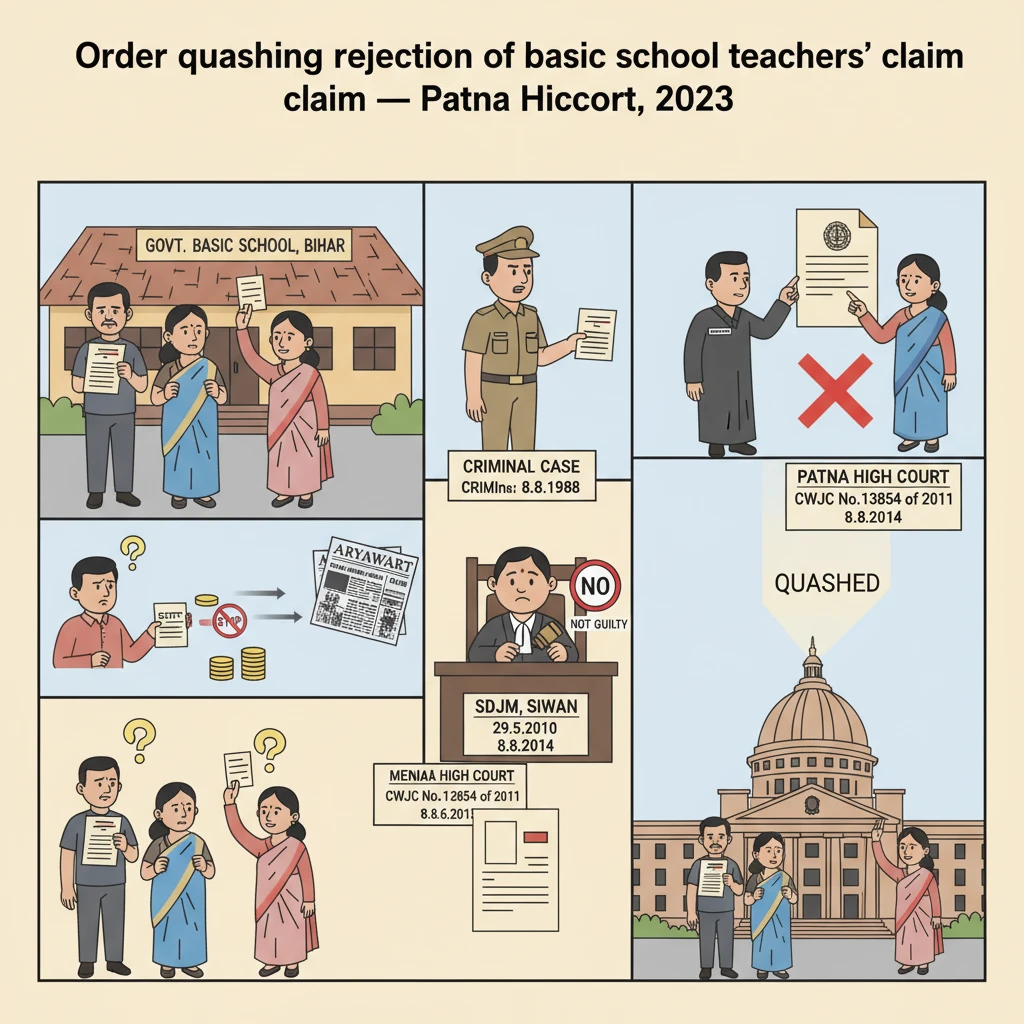
The dispute concerns four petitioners who claimed to have been appointed as assistant teachers in Government Basic Schools in Bihar, pursuant to an advertisement published in the daily newspaper “Aryawart” on 8.8.1988. According to them, they were duly qualified, applied in response to the advertisement, appeared in interview, and were appointed by the competent authority. Their appointment letters were placed on record in the writ proceedings.
They say they joined the Government Basic Schools and started working as teachers. However, at some stage their salary payments were stopped. The judgment records that this stoppage was, according to the petitioners, “for no good reason”. They made representations to the authorities, seeking restoration of salary and permission to continue work.
During this period, based on an allegedly incorrect report, an FIR was lodged against them as Mairwa Police Station Case No.126 of 1992. They faced criminal prosecution, but by judgment dated 29.5.2010, the Sub-Divisional Judicial Magistrate, Siwan, acquitted them of the charges in G.R. No.2880 of 1992, Trial No.1001 of 2010.
After their acquittal, the petitioners again submitted representations for reinstatement, acceptance of their joining, and payment of salary for the period they claimed to have been forced out of duty. When these representations were not decided, they approached the Patna High Court in CWJC No.13854 of 2011.
By order dated 8.8.2014 in that earlier writ case, the Patna High Court directed the Regional Deputy Director of Education (RDDE), Saran Division at Chapra, to consider their representation dated 16.05.2011. The Court laid down a specific procedure for examining the validity of their appointment and deciding their claim, including giving them a personal hearing and issuing notice if any adverse finding was proposed.
The RDDE later passed an order contained in memo no.484 dated 19.6.2015 rejecting the petitioners’ claim for reinstatement, joining and salary. As this order was not communicated or not acted upon in accordance with the High Court’s earlier directions, the petitioners moved a contempt application (MJC No.683 of 2015). In that backdrop, they also filed the present writ petition (CWJC No.19593 of 2015) challenging the RDDE’s order and seeking multiple reliefs including reinstatement with consequential benefits.
What the Court Examined and Decided
The petitioners asked the Patna High Court to quash memo no.484 dated 19.6.2015 issued by the RDDE, Saran Division, Chapra. Through this memo, the RDDE had rejected their claim for reinstatement, joining and payment of salary.
They also sought mandamus directing the authorities to reinstate them as assistant teachers in Government Basic Schools with all consequential benefits. They emphasised that their selection had been made after following the legal procedure and that they possessed the required teachers’ training qualification.
Another important limb of their prayer was linked to their earlier criminal case. They pointed out that the FIR in Mairwa P.S. Case No.126 of 1992 had led to their being prevented from discharging duty from 18.5.1992 onwards, although they had already worked as teachers from 7.2.1991 to 18.5.1992. After their acquittal on 29.5.2010, they argued they were entitled to rejoin and be paid.
On behalf of the petitioners, learned senior counsel attacked the RDDE’s order dated 19.6.2015. He argued that:
There was no real consideration of their case.
The authority did not apply its mind to the facts and documents placed before it.
Their specific contentions were not dealt with.
As a result, the order was arbitrary and unsustainable in law.
The State respondents defended the RDDE’s action. Their counsel submitted that several complaints had been received in the office of the Lokayukta, Bihar, Patna, alleging that a large number of persons had joined Government Basic Schools as teachers on the basis of forged appointment letters. An enquiry was conducted, during which many such teachers allegedly did not even defend themselves. Several FIRs were registered.
With particular reference to the district of Siwan, it was stated that on enquiry it was found that only 12 teachers had validly been appointed in that district, and the petitioners’ names did not appear in that list. The respondents contended that:
The petitioners failed to produce evidence before the Vigilance Investigation Bureau to show that their appointments were valid.
Consequently, their appointments were treated as obtained by forged appointment letters.
On this basis, the RDDE had rightly rejected their plea for reinstatement, joining and payment of salary by the impugned order dated 19.6.2015.
The State relied on earlier similar cases. In a matter involving one Phoolandeo Dwivedi (CWJC No.9787 of 2003), the writ petition had been dismissed. In the cases of two other teachers, Bhagwan Singh and Kashi Nath Singh, writ petitions (CWJC No.8942 of 2001 and CWJC No.10212 of 2011) had also not resulted in any order directing their retention in service; instead, steps had been taken for lodging FIRs.
Justice Partha Sarthy examined the record, including the earlier order dated 8.8.2014 in CWJC No.13854 of 2011. That order is central to the present decision. In it, the High Court had:
Noted the petitioners’ specific case that they were validly appointed after following due procedure and that their appointment letters had not been cancelled.
Observed that denial of permission to discharge duties, in such circumstances, appeared “highly arbitrary and illegal”.
Directed the RDDE, Saran Division, Chapra to consider their representation dated 16.05.2011.
Required the RDDE to give them an opportunity of personal hearing.
Instructed the RDDE to examine the validity and legality of their appointment letters if they produced their interview and appointment letters before him, and then pass a “reasoned and speaking order”.
Specifically directed that if any adverse finding was reached, the RDDE must issue notices to the petitioners asking for their response.
Provided that if no illegality was found, the RDDE should issue orders allowing them to join and ensure payment of salary, with liberty to them to claim back wages.
The key question before the Court in the present writ was whether the RDDE had complied with these directions when passing the impugned order dated 19.6.2015.
On perusing the RDDE’s order, the Court found serious deficiencies. Justice Partha Sarthy held that the directions issued in CWJC No.13854 of 2011 had not been followed:
There was no mention of notice being issued to the petitioners inviting their response before recording any adverse finding.
The order did not demonstrate that their case had been considered independently. Instead, it mainly referred to earlier cases of other individuals, namely Dwivedi (CWJC No.9787 of 2003), Bhagwan Singh (CWJC No.8942 of 2001), and Kashi Nath Singh (CWJC No.10212 of 2011), as well as an order dated 10.3.2015 of the Director, Primary Education concerning Dwivedi.
Regarding the petitioners themselves, the order merely recorded a conclusion that during Vigilance investigation they had not produced evidence of legal appointments, and therefore their appointments were treated as forged. On that basis alone, their representation was rejected.
The Court observed that this approach showed “no consideration whatsoever” of the petitioners’ own case. There was also no compliance, in letter and spirit, with the earlier High Court directions requiring personal hearing, examination of appointment documents, and a speaking order after seeking their response to any proposed adverse finding.
In such circumstances, the Court held that the impugned order of the RDDE dated 19.6.2015 was not sustainable in law. On this ground alone, it was set aside.
However, the Court did not itself decide the validity of the petitioners’ appointments or direct their reinstatement. Instead, Justice Partha Sarthy remitted the matter back to the same authority, the RDDE, Saran Division, Chapra, to pass a fresh, reasoned order strictly in line with the directions earlier laid down on 8.8.2014 in CWJC No.13854 of 2011.
The RDDE was directed to complete this exercise within four months from the date of receipt of a copy of the present judgment. With these directions, the writ application was allowed.
Why This Judgment Matters
The judgment is significant for government employees and aspirants, especially contractual and lower-level staff, who often face sudden stoppage of salary or rejection of service claims without proper hearing.
The Patna High Court has underlined that when a court has already directed a specific procedure—personal hearing, examination of documents, and a speaking order—administrative authorities must follow it faithfully. They cannot rely on general vigilance enquiries or cases of other persons to dispose of an individual’s representation.
For teachers and employees accused of forged appointments, the judgment clarifies that:
Authorities must look at their particular appointment letters and evidence.
If an adverse view is proposed, they are entitled to notice and a chance to explain.
An order that merely cites vigilance findings, without addressing the individual’s documents and arguments, can be struck down.
At the same time, the judgment does not declare that the petitioners’ appointments were valid or that they must be reinstated. It only restores the process, leaving it open for the RDDE to again examine their case, this time following due procedure.
Legal Issues and Answers
Issue: Whether the Regional Deputy Director of Education’s order dated 19.6.2015 rejecting the petitioners’ claim for reinstatement and salary complied with the Patna High Court’s earlier directions and principles of fair hearing.
Answer: No. The Patna High Court held that the RDDE did not consider the petitioners’ case, did not issue notice seeking their response to adverse findings, and largely relied on other cases and vigilance investigation. The order was therefore unsustainable and was set aside, with the matter remitted for fresh decision.
Cases Cited by the Court
- The judgment refers to earlier writ proceedings involving other individuals: CWJC No.9787 of 2003 (Phoolandeo Dwivedi), CWJC No.8942 of 2001 (Bhagwan Singh), and CWJC No.10212 of 2011 (Kashi Nath Singh). These are mentioned in describing the RDDE’s reasoning, not as binding precedents analysed by the Court in this case.
- No reported judgments are substantively cited or relied upon as legal precedents in the reasoning.
Case Details
Case Number: Civil Writ Jurisdiction Case No.19593 of 2015
Case Title: Birendra Pandey & Ors. v. The State of Bihar & Ors.
Coram: Hon’ble Mr. Justice Partha Sarthy
Date of Judgment: 5-12-2023
Citation: 2024 (1) PLJR 660
Advocates: For the petitioners – Mr. Chitranjan Sinha, Senior Advocate; Mr. Bajarangi Lal, Advocate. For the respondents – Mr. Manish Kumar, G.P.4; Mr. Manoj Kumar, A.C. to G.P.4.
Nature of the Case: Writ petition (Civil) seeking certiorari to quash administrative rejection of reinstatement and mandamus for reinstatement and salary regarding appointment as assistant teachers in Government Basic Schools.
Link to Judgment: Full text of Patna High Court judgment
If you found this explanation helpful and wish to stay informed about
how legal developments may affect your rights in Bihar,
you may consider following Samvida Law Associates for more updates.







