

Case Background
The petitioner was appointed as a Driver Constable in the Bihar Police on 22.09.2017 in the district of Begusarai. After joining, he was sent for training at the Constable Training Centre, Nathnagar, Bhagalpur.
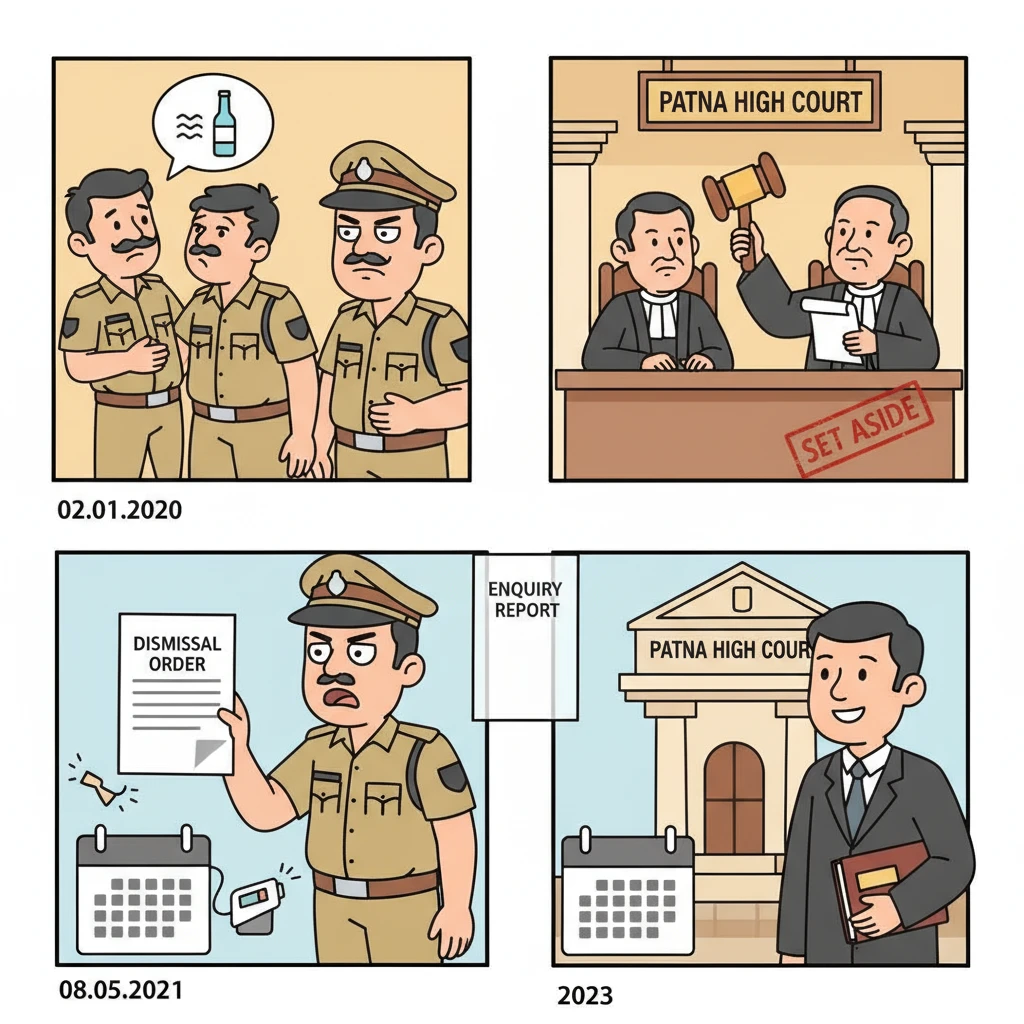
According to the charge sheet dated 17.03.2020, an incident took place on 02.01.2020 at about 8:00 P.M. It was alleged that the petitioner, while in an inebriated condition, created a ruckus in the mess with other trainees in the training centre.
The Nathnagar Police reached the spot. A breath analyser test was conducted on the petitioner. The test allegedly showed that alcohol was present in his body, with Blood Alcohol Content mentioned as 145ml/100gm.
On that basis, Nathnagar P.S. Case No. 06 of 2020 dated 02.01.2020 was registered under Section 37 (C) of the Bihar Prohibition and Excise Act, 2016. The petitioner was sent to jail in connection with this criminal case.
Later, he was granted bail by order dated 13.01.2020 passed by the Court of Additional Sessions Judge-II-cum-Special (Excise Act) Judge, Bhagalpur.
After the criminal case was lodged and bail granted, a departmental proceeding was initiated against the petitioner in the police department. An Enquiry Officer was appointed, who conducted an enquiry into the charges and submitted a report holding the charges proved.
Based on this, the disciplinary authority, namely the Superintendent of Police, Begusarai, decided to move towards punishment. A second show cause notice dated 12.04.2021 was issued to the petitioner calling upon him to explain why he should not be dismissed from service in view of the proved charges.
The petitioner replied to this second show cause notice. Thereafter, by order dated 08.05.2021, the Superintendent of Police, Begusarai, imposed the punishment of dismissal from service.
The petitioner filed an appeal before the Deputy Inspector General, Begusarai Range, Begusarai. By order dated 26.04.2022, the appellate authority rejected his appeal and affirmed the punishment of dismissal. Aggrieved, the petitioner approached the Patna High Court under its civil writ jurisdiction.
What the Court Examined and Decided
The writ petition challenged two orders: the dismissal order dated 08.05.2021 passed by the Superintendent of Police, Begusarai, and the appellate order dated 26.04.2022 passed by the Deputy Inspector General, Begusarai Range, Begusarai.
The heart of the petitioner’s challenge was procedural. Through counsel, he raised a single, focused point. He argued that the enquiry report of the Enquiry Officer, which found the charges proved, was never supplied to him along with the second show cause notice dated 12.04.2021.
Because of this, he claimed he did not get a reasonable opportunity to defend himself against the findings of the Enquiry Officer. He contended that this failure to give the enquiry report amounted to a breach of the principles of natural justice and was also a violation of Article 311(2) of the Constitution of India.
Article 311(2) protects civil servants, including police personnel, from dismissal, removal, or reduction in rank without being given a reasonable opportunity of being heard in respect of the charges against them. The petitioner argued that an important part of this opportunity is the right to know what the Enquiry Officer has concluded and why.
The argument was that, without seeing the enquiry report, the petitioner could not point out errors or defend himself against the conclusions reached. Therefore, the entire departmental proceeding, from the stage of second show cause notice to the final punishment, stood vitiated.
On the other hand, counsel for the State opposed the writ petition and tried to defend the dismissal. However, while refuting the legal contention, the State’s counsel could not deny one crucial fact: the enquiry report submitted by the Enquiry Officer had indeed not been supplied to the petitioner along with the second show cause notice dated 12.04.2021, or even thereafter.
Recognising this serious procedural lapse, the State’s counsel submitted that, in such a situation, the matter may be remanded to the disciplinary authority from the stage of submission of the enquiry report by the Enquiry Officer.
The Court, presided over by Hon’ble Mr. Justice Mohit Kumar Shah, heard both sides and examined the materials on record. The Court recorded a clear factual finding that the enquiry report indicting the petitioner was not served on him along with the second show cause notice.
From this, the Court concluded that the petitioner had been denied a reasonable opportunity to put forth his defence. This denial, in the Court’s view, resulted in a breach of the principles of natural justice and a violation of Article 311(2) of the Constitution of India.
The Court held that the entire enquiry proceedings, from the stage of issuance of the second show cause notice, had become unfair, unjust, and illegal. As a result, they stood vitiated in the eyes of law.
To support this conclusion, the Patna High Court relied on two important Supreme Court judgments. First, it referred to Union of India vs. Mohd. Ramzan Khan, reported in (1991) 1 SCC 588. In that case, the Supreme Court had held that a copy of the enquiry report must be supplied to the delinquent employee before the disciplinary authority takes a decision on punishment, as part of reasonable opportunity.
Second, the Court referred to the Constitution Bench judgment in Managing Director, ECIL Hyderabad vs. B. Karunakar and others, reported in (1993) 4 SCC 727. This judgment clarified the law laid down in Ramzan Khan and emphasised that non-supply of the enquiry report before imposing punishment is a violation of the principles of natural justice.
Applying these precedents, the Patna High Court held that, since the enquiry report had admittedly not been served on the petitioner before the dismissal order, the process was defective.
Consequently, the Court found it fit and proper to quash both the impugned orders: the punishment order dated 08.05.2021 passed by the Superintendent of Police, Begusarai, and the appellate order dated 26.04.2022 passed by the Deputy Inspector General, Begusarai Range, Begusarai.
However, the Court did not stop at quashing. It also decided what should happen next. The Court remitted the matter back to the disciplinary authority with liberty to proceed afresh from the stage of issuance of the second show cause notice.
This means the departmental proceeding is not completely closed. Instead, it must be redone properly from the point where the defect occurred, that is, from the stage after the Enquiry Officer submitted his report. The disciplinary authority is expected to now supply the enquiry report to the petitioner and then move forward in accordance with law.
The Court further clarified the immediate service consequences. As a result of quashing the order of dismissal dated 08.05.2021 and the appellate order dated 26.04.2022, the petitioner is entitled to be reinstated in service forthwith.
At the same time, the Court put an important condition on monetary and other consequential benefits. It held that the payment of consequential benefits will depend on the final outcome of the fresh disciplinary proceedings to be conducted by the disciplinary authority.
In simple terms, the petitioner must be taken back into service now. But whether he will receive back wages or other related benefits for the period of his dismissal will be decided later, after the fresh enquiry is completed and a lawful decision is taken.
With these directions, the writ petition was allowed to the extent described by the Court.
Why This Judgment Matters
This judgment is significant for government servants and disciplined forces personnel, including police trainees in Bihar. It shows that even if serious charges are levelled, the employer must strictly follow the rules of fair hearing.
The Patna High Court has made it clear that authorities cannot impose major punishments like dismissal without first giving the employee a copy of the enquiry report that goes against him. Without this, an employee cannot properly defend himself.
For ordinary employees, the decision reinforces that natural justice is not a mere formality. If the process is unfair, the Court can set aside even a dismissal and order reinstatement, though it may still permit the department to conduct a fresh, lawful enquiry.
For departments, especially the Bihar Police and other State authorities, the judgment serves as a reminder that their disciplinary actions must comply with Article 311(2) and the guidelines laid down by the Supreme Court in Ramzan Khan and B. Karunakar.
Legal Issues and Answers
- Issue: Whether non-supply of the Enquiry Officer’s report to the petitioner before issuing the dismissal order vitiated the departmental proceedings under Article 311(2) of the Constitution of India.
Answer: Yes. Since the enquiry report was admittedly not served on the petitioner along with the second show cause notice or thereafter, he was denied reasonable opportunity to defend himself. This breach of natural justice and violation of Article 311(2) rendered the enquiry proceedings from the stage of second show cause notice unfair, unjust, illegal, and liable to be quashed. - Issue: What consequential directions should follow from the finding of procedural illegality in the departmental enquiry.
Answer: The Patna High Court quashed the dismissal order dated 08.05.2021 and the appellate order dated 26.04.2022, directed reinstatement of the petitioner forthwith, and remitted the matter to the disciplinary authority to proceed afresh from the stage of issuance of second show cause notice. The grant of consequential benefits was left to depend on the final outcome of the fresh disciplinary proceedings.
Cases Cited by the Court
- Union of India vs. Mohd. Ramzan Khan, (1991) 1 SCC 588.
- Managing Director, ECIL Hyderabad vs. B. Karunakar and others, (1993) 4 SCC 727.
Case Details
Case Number: Civil Writ Jurisdiction Case No. 7851 of 2023
Case Title: Chandan Kumar vs. The State of Bihar & Ors.
Coram: Hon’ble Mr. Justice Mohit Kumar Shah
Date of Judgment: 05.12.2023
Citation: 2024(1) PLJR 747
Advocates: For the petitioner – Mrs. Shruti Sinha, Advocate; For the respondents – Mr. Md. Nadim Seraj (GP-5)
Nature of the Case: Writ petition under civil writ jurisdiction challenging dismissal from service and appellate order in a departmental proceeding.
Link to the Judgment: Click here to read the full Patna High Court judgment
If you found this explanation helpful and wish to stay informed about how legal developments may affect your rights in Bihar, you may consider following Samvida Law Associates for more updates.







