

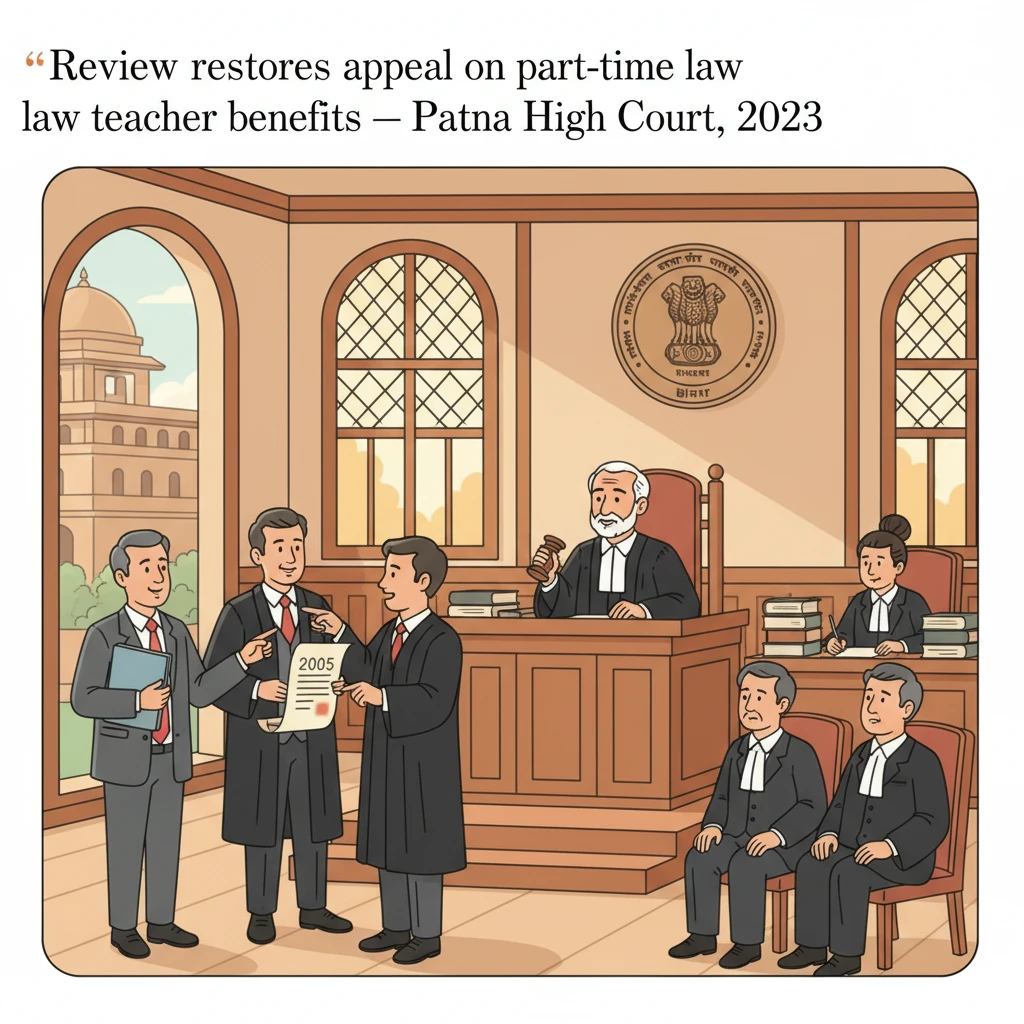
Case Background
The case arises from a long-running service dispute between a law teacher of C.M. Law College, Darbhanga and Lalit Narayan Mithila University. The teacher had approached the High Court earlier, and his grievance eventually reached in appeal as Letters Patent Appeal No. 666 of 2018, arising out of CWJC No. 6838 of 2017.
On 20.06.2019, an order was passed in that Letters Patent Appeal. The teacher, feeling that the order did not correctly consider his legal position and the relevant university notifications, filed Civil Review No. 253 of 2019 before the Patna High Court.
The review petition was heard by a Division Bench comprising Hon’ble Mr. Justice P. B. Bajanthri and Hon’ble Mr. Justice Ramesh Chand Malviya. During the hearing, the Court also directed the presence of the Registrar of Lalit Narayan Mithila University, who remained present in Court on 07.12.2023.
The core question in the review was narrow but important: whether the review petitioner, as a permanent part-time lecturer in law, was entitled to the benefits flowing from Letter No. BSU-8/2005–1614/GS(1), dated 29.06.2005, which forms Item No. 49 of the Manual of Bihar Universities Laws Part II, relating to appointment and benefits of part-time teachers.
What the Court Examined and Decided
The Division Bench first identified the precise issue: whether the petitioner could claim the benefit of the 29.06.2005 letter on part-time teachers, in light of his appointment history and the University Grants Commission (UGC) Regulations, 1991.
The Court reproduced Item No. 49 of the Manual of Bihar Universities Laws Part II. This provision lays down that part-time teachers must have the same minimum qualification as regular teachers and that the selection process must be the same as for regular teachers. It also permits appointment of part-time teachers by the Vice-Chancellor, on recommendation of a duly constituted selection committee, for up to six months or till the end of the academic session, whichever is earlier, and in exceptional circumstances related to workload or subject requirement.
Item No. 49 further clarifies that such teachers can be appointed on contract for short periods, or as permanent half-time/proportionate-time employees on half/proportionate salary of the scale. In such cases, they are to receive proportionate increments, dearness allowance and other permissible benefits. Importantly, these permanent part-time teachers are also entitled to the Career Advancement Scheme from Lecturer to higher grades like Reader and Professor, again on a half/proportionate basis.
The respondents, i.e., the University and its authorities, had consistently argued that the petitioner was appointed as a permanent part-time lecturer only after the UGC Regulations, 1991 came into force on 19.09.1991. On that basis, they contended that the petitioner must meet the educational qualifications laid down in Regulation No. 2 of the Regulations, 1991 for the post of Lecturer.
The Court considered Regulation No. 2 of the Regulations, 1991, which provides that no person shall be appointed to a teaching post in a university or affiliated college if he or she does not fulfil the prescribed qualifications in Schedule 1. The first proviso allows relaxation of qualifications only with prior approval of the UGC. The second proviso, however, states that the regulations shall not apply where selections through duly constituted selection committees had been made before enforcement of the regulations.
The Bench then examined the petitioner’s appointment history in detail. The petitioner had been appointed as a permanent part-time lecturer in C.M. Law College, Darbhanga on 14.11.1989, on the prescribed scale of Rs. 700 per month, subject to concurrence of the Bihar State University (Constituent College) Service Commission, Patna. This appointment was notified on 19.02.1992, but it clearly recorded that the appointment took effect from 14.11.1989.
Because the effective date of appointment was 14.11.1989, which is before the UGC Regulations, 1991 were notified on 19.09.1991, the Court treated the petitioner’s entry into service as pre-regulation. The remaining question then was whether and when the statutory Service Commission granted concurrence to this appointment.
The Court noted that the Bihar State University (Constituent Colleges) Service Commission, Patna gave concurrence on 28.05.1998. The communication from the Commission to the Registrar of L.N. Mithila University stated that, relying on the University’s letter, the Commission concurred in the appointment of the petitioner as part-time lecturer in law, subject to the condition that the appointment was approved by the State Government. It also carried a rider that the concurrence could be withdrawn if any inconsistency was detected in course of time.
Thereafter, the University issued another notification on 30.07.1998. In that notification, the Vice-Chancellor, in anticipation of approval of the Syndicate, appointed the petitioner as part-time lecturer in law on a fixed salary of Rs. 2200 per month in C.M. Law College, Darbhanga, on the basis of the Service Commission’s concurrence letter dated 28.05.1998.
The Bench carefully read the 19.02.1992 and 30.07.1998 notifications together. It concluded that the 30.07.1998 notification was effectively a fresh appointment order but with retrospective effect from 14.11.1989, as clearly indicated. There was no reference in the 1998 notification suggesting that the earlier notification of 19.02.1992 had been cancelled, superseded or modified.
On this basis, the Court held that the 19.02.1992 notification continued to operate and that the petitioner’s appointment as a permanent part-time lecturer stood effective from 14.11.1989. The Court emphasized that the University had never issued any order withdrawing, cancelling or modifying the 19.02.1992 notification, nor had it invoked the rider in the Commission’s concurrence letter about possible withdrawal in case of inconsistency.
From this factual position, the Bench concluded that the petitioner had a vested right to claim service conditions and monetary benefits linked to his appointment from 14.11.1989. Since his appointment was effectively before the UGC Regulations, 1991 came into force, he was entitled to the protection of the second proviso to Regulation No. 2.
In simple terms, because the petitioner’s appointment dates back to 14.11.1989, and the Service Commission later concurred with that appointment, the 1991 Regulations could not be used to say that he did not possess the required qualifications at the time of appointment. Therefore, the respondents could not rely on Regulation No. 2 of the Regulations, 1991 to deny him the benefits under the 29.06.2005 letter on part-time teachers.
The Court also discussed the limited scope of review under Order XLVII Rule 1 of the Code of Civil Procedure. Normally, courts do not interfere with their earlier orders in review unless there is an error apparent on the face of the record. Here, the Division Bench found such an error: in the earlier order dated 20.06.2019 in the Letters Patent Appeal, the Court had failed to properly notice and appreciate the legal effect of the 19.02.1992 notification granting retrospective appointment from 14.11.1989.
This error had allowed the respondents to insist upon the qualifications prescribed under the 1991 Regulations and to deny the petitioner the benefits under Letter dated 29.06.2005, including fixation of half/proportionate income, dearness allowance and other permissible benefits for permanent part-time teachers.
To correct this mistake, the Division Bench allowed the review petition. It recalled the earlier order dated 20.06.2019 passed in Letters Patent Appeal No. 616 of 2018 (the order text uses this number while also referring to LPA No. 666 of 2018 in the title) arising out of CWJC No. 6838 of 2017. The Court restored the Letters Patent Appeal to its original file and number.
The Court further directed the Registry to re-list the Letters Patent Appeal before the appropriate Roster Bench in the second week of February 2024 for fresh consideration in light of the clarified legal position. The personal appearance of the Registrar of L.N. Mithila University, who was present in Court, was dispensed with.
Why This Judgment Matters
This judgment is important for university and college teachers, especially those working as permanent part-time lecturers in Bihar’s universities. It shows that the effective date of appointment and the wording of appointment notifications can decide whether later regulations will apply.
For teachers appointed before the UGC Regulations, 1991, this decision indicates that universities cannot later deny them benefits by retroactively applying new qualification rules, if their appointments were properly made and later concurred by the Service Commission. The Patna High Court made it clear that such teachers can claim the protection of the second proviso to Regulation No. 2.
The judgment also underlines that review jurisdiction, though narrow, can be used to correct clear errors where an earlier order failed to consider important documents like notifications that change the legal position. This helps ensure that long-serving teachers are not unfairly deprived of monetary and service benefits that flow from their status as permanent part-time teachers.
Practically, the decision reopens the appeal for full hearing, where the petitioner will be able to press his claim for the benefits mentioned in Letter No. BSU-8/2005–1614/GS(1), such as proportionate increments, dearness allowance and career advancement, based on his appointment from 14.11.1989.
Legal Issues and Answers
Issue: Whether the review petitioner, a permanent part-time law lecturer, was entitled to the benefit of Letter No. BSU-8/2005–1614/GS(1) dated 29.06.2005, in view of the UGC Regulations, 1991 and his appointment history.
Answer: The Court held that since the petitioner’s appointment as a permanent part-time lecturer was effective from 14.11.1989, prior to the UGC Regulations, 1991, and the appointment had not been withdrawn or modified, he was protected by the second proviso to Regulation No. 2 and could not be denied the benefits of the 29.06.2005 letter on the ground of non-fulfilment of the 1991 qualification norms.
Issue: Whether there was an error apparent on the face of the record justifying review of the earlier order dated 20.06.2019 in the Letters Patent Appeal.
Answer: Yes. The Court found an apparent error in the earlier failure to properly notice and appreciate the retrospective effect of the 19.02.1992 notification appointing the petitioner as a permanent part-time lecturer with effect from 14.11.1989, which had a direct impact on the applicability of the UGC Regulations, 1991.
Issue: What consequence should follow from correcting that error in review.
Answer: The Court allowed the civil review petition, recalled the order dated 20.06.2019 passed in the Letters Patent Appeal, restored the appeal to its original file and number, and directed that it be re-listed before the Roster Bench in the second week of February 2024.
Cases Cited by the Court
- The judgment text does not mention or rely on any other reported cases by name or citation.
Case Details
Case Number: Civil Review No. 253 of 2019 in Letters Patent Appeal No. 666 of 2018 (also referred to as LPA No. 616 of 2018 in the body), arising out of CWJC No. 6838 of 2017
Case Title: Dharmeshwar Mishra v. The Vice Chancellor, L.N. Mithila University, Darbhanga & Ors.
Citation: 2024(1) PLJR 718
Court: High Court of Judicature at Patna
Coram: Hon’ble Mr. Justice P. B. Bajanthri and Hon’ble Mr. Justice Ramesh Chand Malviya
Date of Judgment: 07.12.2023
Advocates:
- For the Petitioner: Mr. Amrendera Narayan, Advocate; Mr. Sanjay Kumar Srivastava, Advocate
- For Lalit Narayan Mithila University: Mr. Nadim Seraj, Advocate; Mr. Shailesh Kumar, Advocate
- For the State of Bihar: Mr. Shashi Shekhar Tiwary, AC to AG
Nature of the Case: Civil review petition seeking review of an order passed in Letters Patent Appeal arising out of a writ petition (service and monetary benefits claim of a permanent part-time lecturer).
Link to Judgment: Full text of judgment on Patna High Court website
If you found this explanation helpful and wish to stay informed about
how legal developments may affect your rights in Bihar,
you may consider following Samvida Law Associates for more updates.







