

Case Background
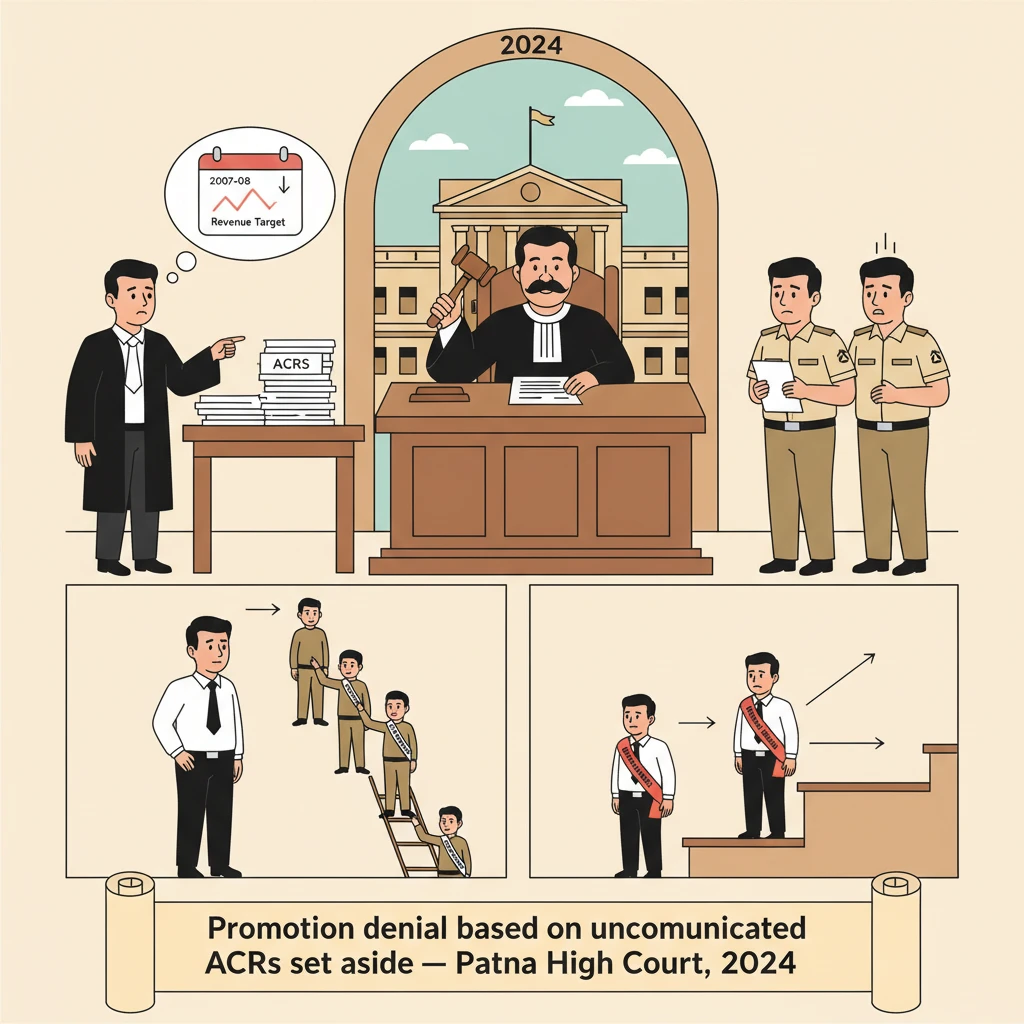
The case arose from Civil Writ Jurisdiction Case No. 4882 of 2018 before the Patna High Court. The petitioner was an officer in the Commercial Taxes Department, Government of Bihar.
He joined government service on 18.07.1989 as Commercial Taxes Officer after selection through the Bihar Public Service Commission. On the basis of his performance and fulfilment of other requirements, he was promoted as Assistant Commissioner, Commercial Taxes with effect from 11.05.2006.
While working as Assistant Commissioner, Commercial Taxes, Patna City East, the department issued a letter dated 11.05.2009 calling for his explanation for not achieving the target of revenue collection for the financial year 2007-08. The petitioner submitted his explanation.
Despite this, by notification dated 05.10.2009 issued by the Principal Secretary-cum-Commissioner, Commercial Taxes Department, Bihar, Patna, a punishment of censure was imposed on him for failure to achieve the revenue target and for alleged dereliction of duty.
The petitioner challenged this punishment before the Patna High Court in CWJC No. 292 of 2010. By order dated 26.08.2010, the Court set aside the notification dated 05.10.2009 which had imposed the punishment of censure.
Later, by Letter No. 922 dated 30.03.2011, the State of Bihar decided that promotions of its employees would be considered on the basis of entries in their Annual Confidential Reports and the prescribed benchmarks.
The petitioner claimed that despite his long service and clearance of the earlier punishment by the Court, he was not given the benefit of the Modified Assured Career Progression (MACP) Scheme, nor was he granted timely promotions. He made several representations to the authorities, but his grievances remained unresolved.
He then filed CWJC No. 786 of 2018. By order dated 16.01.2018, the Patna High Court directed the Principal Secretary-cum-Commissioner, Commercial Taxes Department, Bihar, Patna, to dispose of his representation within five weeks by a reasoned and speaking order.
In compliance, the petitioner submitted a detailed representation on 23.01.2018. The department passed Memo No. 450 dated 15.02.2018, rejecting his request for promotion and for grant of second financial progression under the MACP Scheme. Aggrieved, the petitioner filed the present writ petition challenging Memo No. 450 dated 15.02.2018.
What the Court Examined and Decided
The petitioner’s main grievance was that his claim for financial progression under the Modified Assured Career Progression Scheme from 18.07.2009, and his claim for promotions to higher posts, were rejected unfairly.
He sought quashing of Memo No. 450 dated 15.02.2018 issued by the Principal Secretary, Commercial Taxes Department, Bihar, Patna. Under this memo, his claim for MACP benefits and promotion to the ranks of Deputy Commissioner, Joint Commissioner and thereafter Additional Commissioner, Commercial Taxes, was rejected.
The petitioner argued that he had completed 20 years of regular service in 2009 and therefore became entitled to the second financial progression under the MACP Scheme from that year. According to him, once the punishment of censure dated 05.10.2009 was set aside by the Patna High Court on 26.08.2010, there was no surviving ground to deny him MACP or promotion.
He also asserted that persons junior to him had been promoted to the posts of Deputy Commissioner and Joint Commissioner, Commercial Taxes with effect from earlier dates, while he was denied similar benefits. He sought shifting of the dates of his own promotion as Deputy Commissioner from 22.02.2012 to the dates when his juniors were promoted, and further promotion as Joint Commissioner from 04.06.2014, the date when several juniors were promoted.
The core basis for rejection, as recorded in the impugned Memo No. 450 dated 15.02.2018, was that the petitioner’s ACR gradings were not up to the benchmark prescribed by Letter No. 922 dated 30.03.2011 issued by the General Administration Department of the State Government. The department treated his ACR entries as “below benchmark” and declined MACP and promotion.
The petitioner contended that these alleged “below benchmark” entries in his ACR were never communicated to him at any time before the impugned order. He stated that he had no prior information that his ACR contained such entries, nor was he given an opportunity to object or seek upgradation.
To support his case, the petitioner relied on two Supreme Court decisions. First, in Dev Dutt v. Union of India & Ors., reported in (2008) 8 SCC 725, the Supreme Court held in paragraph 17 that every entry in the ACR of a public servant must be communicated within a reasonable period, whether it is poor, fair, average, good or very good. Non-communication was held to be arbitrary and violative of Article 14, because it deprives the employee of a chance to improve and a chance to represent against an adverse assessment.
Secondly, he relied on Rukhsana Shaheen Khan v. Union of India & Ors., reported in (2018) 18 SCC 640. In paragraph 3 of that judgment, the Supreme Court directed that uncommunicated adverse ACRs should be ignored, and that a fresh decision should be taken after giving the employee an opportunity of hearing. The Court further observed that the employee could raise all available submissions and referred to the earlier decision in Prabhu Dayal Khandelwal v. UPSC.
The petitioner argued that in light of these authoritative pronouncements, the department could not legally rely on uncommunicated below-benchmark ACR entries to deny him promotion or MACP. Therefore, Memo No. 450 dated 15.02.2018 deserved to be set aside.
On behalf of the State, learned counsel did not dispute that the below-benchmark entries in the petitioner’s ACR had not been communicated to him prior to passing of the impugned order. The State’s stand was that, given the law laid down by the Supreme Court, the proper course would be to allow the petitioner to file a fresh representation and to direct the authorities to pass a new order in accordance with those judgments.
The Patna High Court carefully examined the record. It found that the decision to link promotion with ACR benchmarks was taken for the first time on 30.03.2011 by Letter No. 922. Prior to this date, there was no such restriction based on ACR benchmarks.
The Court noted that as per the pleadings, the petitioner became eligible for promotion and MACP in 2009. However, his case was not considered earlier because of the punishment of censure. Once that punishment was set aside by the Court on 26.08.2010 in CWJC No. 292 of 2010, his entitlement under the MACP Scheme revived.
Referring to Dev Dutt and Rukhsana Shaheen Khan, the High Court reiterated that every entry in the ACR must be communicated. Non-communication may harm the employee in two ways: first, it deprives him of knowledge about his performance assessment, which could help him improve; second, it denies him the opportunity to challenge an unjust entry and seek its upgradation.
From the pleadings, the Court found that no such ACR entries were ever communicated to the petitioner before passing the impugned Memo No. 450. Despite this, the authorities had used those uncommunicated entries—recorded as “not up to the benchmarks”—as the main ground for denying him MACP and promotion.
In view of the clear Supreme Court mandate, the High Court held that this course adopted by the department was legally unsustainable. It also relied on the principle from Rukhsana Shaheen Khan that uncommunicated adverse ACRs must be ignored and that a fresh decision should be taken after giving the concerned employee an opportunity of hearing.
Accordingly, the Court concluded that Memo No. 450 dated 15.02.2018 was vitiated, as it was based on ACR entries that had never been communicated. The order was therefore set aside.
The Court then issued directions to safeguard the petitioner’s rights while leaving the final decision on MACP and promotion to the competent authority. It directed the respondent authorities to pass a fresh order in the petitioner’s case after giving him adequate opportunity of hearing. In doing so, they must ignore all uncommunicated adverse ACRs, in line with the law laid down by the Supreme Court.
The Court fixed a time limit for this exercise. It directed that all steps should be completed within 90 days from the date the petitioner produces a copy of the High Court’s order before the authorities. With these directions, the writ petition was allowed.
Why This Judgment Matters
This judgment is important for government employees in Bihar and beyond, especially those in the Commercial Taxes Department and other departments where promotions depend on ACR benchmarks.
The Patna High Court has reinforced that no department can quietly use negative or below-benchmark ACR entries to block promotion or financial upgradation if those entries were never communicated to the employee. Such secrecy is unfair and illegal.
For employees, this means that if promotion or MACP is denied citing ACR issues, they are entitled to know what exactly is written in their ACRs and must be given a chance to respond. If this basic step is skipped, the decision can be challenged.
The judgment also ensures that when earlier punishments are set aside by a court, departments must re-examine service benefits like MACP and promotion in that light. They cannot continue to deny these benefits on the strength of penalties which no longer exist.
Legal Issues and Answers
Issue: Can the State rely on “below benchmark” ACR entries, which were never communicated to the employee, to deny MACP benefits and promotion?
Answer: No. The Court held that uncommunicated adverse or below-benchmark ACR entries cannot be used to deny promotion or MACP. Relying on such entries is arbitrary and contrary to the law laid down by the Supreme Court. The impugned order based on such entries was set aside.
Issue: What directions should be given when such an illegal order affects an employee’s promotion and financial progression?
Answer: The Court directed the authorities to pass a fresh order after giving the petitioner adequate opportunity of hearing and to ignore all uncommunicated adverse ACRs, completing this exercise within 90 days of receiving the Court’s order.
Cases Cited by the Court
- Dev Dutt v. Union of India & Ors., (2008) 8 SCC 725
- Rukhsana Shaheen Khan v. Union of India & Ors., (2018) 18 SCC 640
- Maneka Gandhi v. Union of India, (1978) 1 SCC 248 : AIR 1978 SC 597 (referred to within the quotation from Dev Dutt)
- Prabhu Dayal Khandelwal v. UPSC (referred to in Rukhsana Shaheen Khan)
Case Details
Case Number: Civil Writ Jurisdiction Case No. 4882 of 2018
Case Title: Gupteshwar Prasad v. The State of Bihar & Ors.
Citation: 2024 (1) PLJR 778
Court: High Court of Judicature at Patna
Coram: Hon’ble Mr. Justice Dr. Anshuman
Date of Judgment: 16.01.2024
Advocates for Petitioner: Mr. Abhinav Srivastava, Advocate; Mr. Arpit Anand, Advocate; Mr. Pushkar Bharadwaj, Advocate; Mr. Raushan, Advocate
Advocate for the State: Mr. Krishna, AC to SC-11
Nature of the Case: Writ petition under civil writ jurisdiction challenging rejection of MACP benefits and promotion in the Commercial Taxes Department
Impugned Order: Memo No. 450 dated 15.02.2018 issued by the Principal Secretary, Commercial Taxes Department, Bihar, Patna
Link to Judgment: Patna High Court Judgment in CWJC No. 4882 of 2018
If you found this explanation helpful and wish to stay informed about
how legal developments may affect your rights in Bihar,
you may consider following Samvida Law Associates for more updates.







