

Case Background
The petitioner is a resident of Patna who purchased a small piece of land in Mauza Manpur Bairiya, Thana Code No. 174, Tauzi No. 360.
The land relates to Khata No. 616, Survey Plot No. 314 (part), measuring 10 dhur, which is equal to 1.5625 decimal. She bought this land through an absolute registered sale deed dated 11.03.2015 from two vendors, Ranjan Kumar and Chandan Kumar, both sons of Sri Surendra Prasad Sinha.
After the purchase, she applied for mutation before the Circle Officer, who is respondent no. 3 in the case. Her application was registered as Mutation Case No. 2338/04/2014-15. After verification, her name was mutated and a jamabandi was created in her favour.
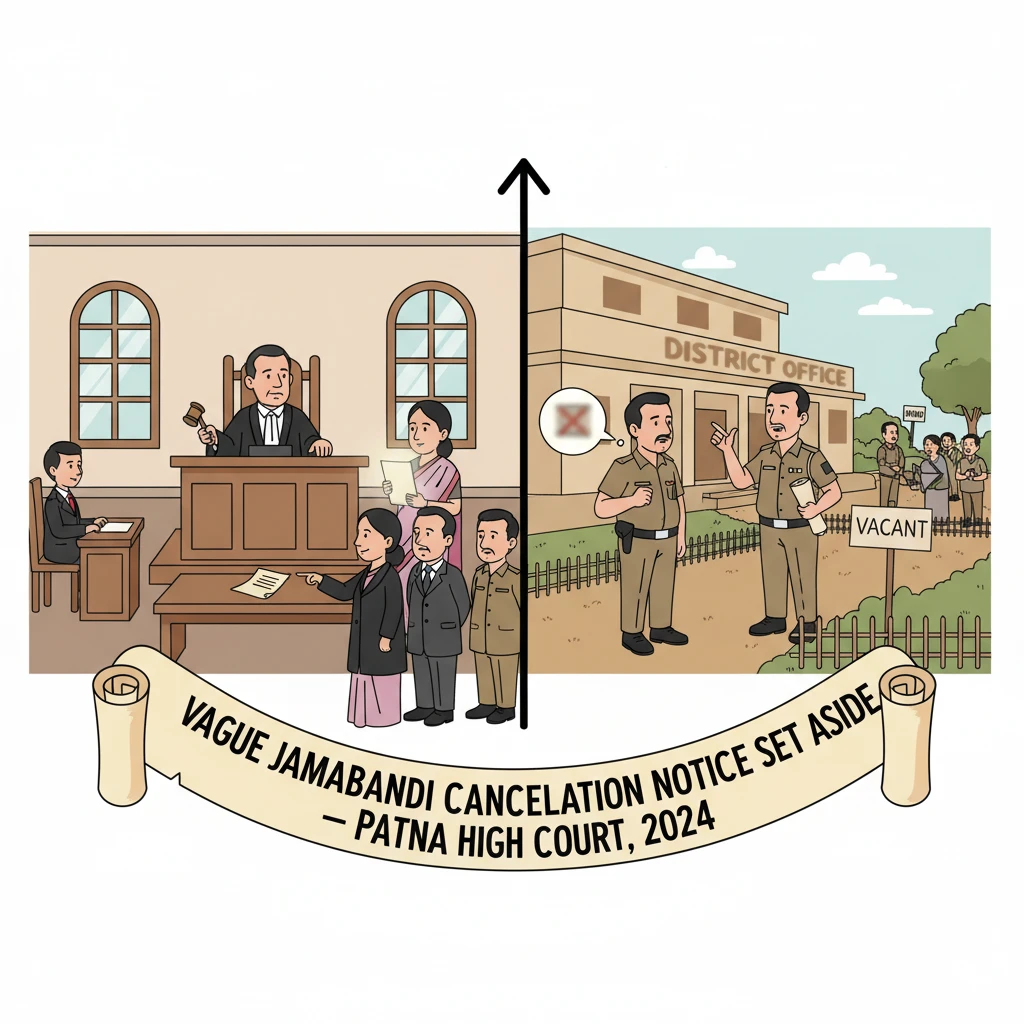
Some years later, without any prior warning recorded in the judgment, the petitioner received a one-page notice from the court of the Additional Collector, Patna, who is respondent no. 2. This notice informed her that Jamabandi Cancellation Case No. 25/2021-22 had been initiated against her.
The notice, dated 13.07.2021, only fixed a date of hearing on 02.09.2021 and asked her to appear with necessary documents, failing which ex parte orders could be passed. It did not explain why the jamabandi was under threat or what law was said to be violated.
Feeling that this was not fair or legal, the petitioner approached the Patna High Court under Article 226 of the Constitution. She sought quashing of both the jamabandi cancellation proceeding and the impugned notice, and asked for any other suitable reliefs including costs.
What the Court Examined and Decided
The core complaint of the petitioner was about the legality of the notice issued under Section 9 of the Bihar Land Mutation Act, 2011.
According to the petitioner, Section 9 requires that before starting a jamabandi cancellation, the Additional Collector must have some clear reasons showing that the jamabandi was created in violation of law or against government instructions. She argued that the notice served on her did not mention any such grounds and therefore was beyond jurisdiction.
Her counsel submitted that the notice was vague and cryptic. It showed no application of mind and gave her no idea on what she had to defend. No basis for starting the cancellation proceeding was mentioned, making it impossible for her to give an effective reply.
On the other side, the State, through its counsel, placed a different picture. Referring to the counter affidavit, the State explained how the matter arose at the local level.
In a weekly meeting meant to redress public grievances, held jointly by the concerned police station and Circle Officer, one person named Vijay Kumar Sinha made a complaint. He alleged that certain individuals, namely Ranjan Kumar, Anil Mehta, Sunil Kumar Sinha and Bali Rai, were creating dispute over his land.
To verify the complaint, the Revenue Karmachari was asked to submit a report about the land. He submitted details relating to land at Mauza-Bairiya, Thana No. 122, Khata No. 616, Plot No. 314 (area 13 dismil) and Plot No. 350 (area 17 dismil), including the names of raiyats and the jamabandi numbers created over these lands.
Thereafter, notices were issued to all concerned persons. On inquiry it was found that Plot Nos. 314 and 350 were vacant lands and there was a dispute between parties regarding possession.
The Circle Officer, Sampatchak, after considering the material before him, observed that there was a serious dispute about the claims over the land. He also observed that jamabandis had been created in favour of certain persons without proper verification and without them being in actual possession.
On this basis, the Circle Officer passed an order dated 26.03.2021 recommending cancellation of such jamabandis created without any basis. The matter was then referred to the Additional Collector, Patna, “for needful in the matter”.
Building on these facts, the State argued that the petitioner should have joined the proceedings before the Additional Collector instead of rushing to the High Court. According to the State, she had an effective opportunity to file her show cause with documents and, therefore, the writ petition against a mere notice should not be entertained.
The State also argued that since the petitioner had an alternative or statutory remedy in the jamabandi cancellation proceedings, the High Court should not interfere under Article 226.
In reply, the petitioner pointed out that she had in fact appeared before the Additional Collector on 02.09.2021 through her counsel, as mentioned in I.A. No. 1 of 2022. She had asked for the papers and the reasons behind the initiation of the cancellation proceeding.
She was merely informed that the proceedings were started on the recommendation of the Anchal Adhikari, but no documents or papers were provided to her. Thus, she was kept in the dark regarding the actual allegations or the material against her.
Justice Prabhat Kumar Singh considered the rival submissions and scrutinised the impugned notice dated 13.07.2021.
The Court noted that the notice simply fixed a date of hearing and directed the petitioner to appear with necessary documents. It did not record any reason or even a hint of what was alleged. There was nothing to show the prima facie opinion of the Additional Collector that the jamabandi in the petitioner’s name violated any law or government instruction.
The Court then examined Section 9(1) of the Bihar Land Mutation Act, 2011. Under this section, the Additional Collector, either on his own or on an application, can make inquiry into any jamabandi that appears to have been created in violation of law or executive instructions.
The section further provides that the Additional Collector, after giving a reasonable opportunity to the parties to appear, adduce evidence and be heard, may cancel such jamabandi, dispossess the person claiming under it, and deliver possession to the legitimate owner or custodian on fair and equitable terms.
The Court stressed that a notice issued under Section 9 must, at the very least, convey the basic reasons. There must be some indication that, in the opinion of the Additional Collector, the jamabandi was created contrary to law or instructions.
In this case, the notice did not specify which law had been violated, which executive instruction had been breached, or what facts had led to such a conclusion. The Court characterised the notice as “completely vague, cryptic and [not disclosing] any application of mind”.
On the preliminary objection about alternative remedy, the Court relied on the well-known Supreme Court judgment in Whirlpool Corporation vs. Registrar of Trade Marks, Mumbai and Others, reported in (1998) 8 SCC 1.
Referring to this authority, the Court held that existence of an alternative remedy is not an absolute bar to a writ petition. If an order is absolutely beyond jurisdiction, the High Court can and should interfere even at the stage of notice, especially when it may cause serious prejudice.
Applying this principle, the Court held that the impugned notice could not be treated as a valid notice under Section 9(1). Since it did not meet the statutory requirements, it was beyond jurisdiction.
Consequently, the Court set aside the impugned notice dated 13.07.2021 and held that it did not conform with Section 9(1) of the Bihar Land Mutation Act, 2011.
However, the High Court did not bar the authorities from taking lawful action. Recognising the underlying land dispute and the prior recommendation of the Circle Officer, the Court gave liberty to proceed afresh in accordance with law.
The Court directed the Additional Collector, Patna to issue a fresh show cause notice to the petitioner. This new notice must clearly disclose the materials on which he forms an opinion that the jamabandi created in the petitioner’s name deserves to be cancelled.
The Court fixed a time frame: such notice must be issued within two months from 11.01.2024. After issuing a proper notice, the Additional Collector has been asked to proceed further strictly as per law.
With these observations and directions, the writ petition was allowed.
Why This Judgment Matters
This judgment is important for landowners and buyers across Bihar who hold jamabandi entries in their names.
It makes clear that the government cannot start jamabandi cancellation proceedings on the basis of a blank or one-line notice. The notice must state the basic reasons and material that led the officer to doubt the jamabandi.
For ordinary citizens, this means that if they receive a notice that does not mention any specific grounds, they can question its legality. They are not required to defend themselves blindly without knowing the allegations.
The decision also shows that the Patna High Court will step in even at the notice stage when the authority acts beyond its legal power, despite the availability of alternative remedies.
At the same time, the Court has balanced the rights of citizens with the power of the administration. It has not stopped the authorities from acting altogether. Instead, it has required them to follow due process and issue a proper, reasoned show cause notice.
For revenue authorities, this serves as a reminder to carefully record why they believe a jamabandi is illegal before calling a person to defend it.
Legal Issues and Answers
- Issue: Can the Additional Collector start a jamabandi cancellation proceeding under Section 9 of the Bihar Land Mutation Act, 2011 by issuing a notice that does not disclose any reasons or grounds?
Answer: No. The Patna High Court held that a notice under Section 9 must disclose the prima facie opinion of the Additional Collector, including which law or executive instruction is allegedly violated. A vague, reason-less notice is beyond jurisdiction and liable to be set aside. - Issue: Does the availability of an alternative or statutory remedy bar the High Court from interfering at the stage of issuance of such a notice?
Answer: No. Relying on Whirlpool Corporation vs. Registrar of Trade Marks, the Court held that when an order or notice is absolutely beyond jurisdiction, the High Court can interfere under Article 226 even at the notice stage, despite alternative remedies. - Issue: What directions can the Court give after quashing an invalid notice in a jamabandi cancellation matter?
Answer: The Court directed the Additional Collector to issue a fresh show cause notice within two months, clearly disclosing the materials forming the basis for his opinion, and then proceed in accordance with law.
Cases Cited by the Court
- (1998) 8 SCC 1, Whirlpool Corporation vs. Registrar of Trade Marks, Mumbai and Others.
Case Details
Case Number: Civil Writ Jurisdiction Case No. 19368 of 2021
Case Title: Rina Devi vs. The State of Bihar & Ors.
Citation: 2024(1) PLJR 929
Coram: Hon’ble Mr. Justice Prabhat Kumar Singh
Advocates: Mr. Nitesh Kumar, Advocate for the petitioner; Mr. Md. Khurshid Alam, AAG-12 for the respondents; Mrs. Nutan Sahay, AC to AAG-12 for the respondents.
Nature of the Case: Writ petition under Article 226 of the Constitution of India challenging initiation of jamabandi cancellation proceedings and related notice under Section 9 of the Bihar Land Mutation Act, 2011.
Date of Judgment: 11.01.2024
Link to the Judgment: Click here to read the full judgment of the Patna High Court
If you found this explanation helpful and wish to stay informed about how legal developments may affect your rights in Bihar, you may consider following Samvida Law Associates for more updates.







