

Case Background
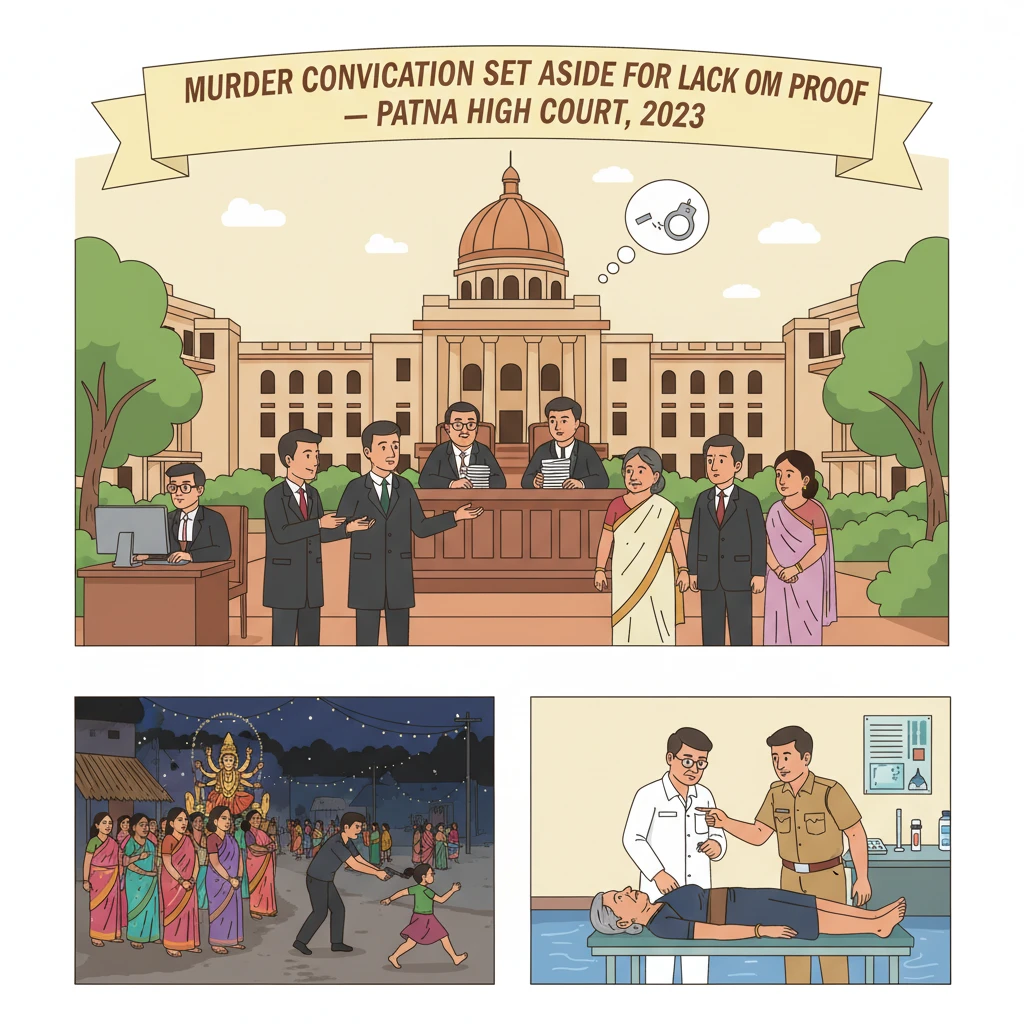
This case arises from Bakhri P.S. Case No. 82 of 2001, Begusarai, relating to the alleged kidnapping and murder of a woman, Rampari Devi, during the Durga Puja fair.
According to the prosecution, on the night of 25.10.2001, the deceased had gone to see Durga Puja at Bakhri Bazar along with other women of the family. While returning, near Bakhri bus stand at about 11:00 p.m., she was allegedly kidnapped at gunpoint.
On 26.10.2001 the police recorded the fardbeyan of her daughter, Ruby Devi. On this basis, an FIR was registered under Section 364 of the Indian Penal Code for kidnapping. The informant named two accused and also referred to two unknown persons. She linked the incident to an earlier murder case of her brother-in-law, in which members of her family had named one of the present appellants as accused.
During investigation, the police recovered the dead body of the kidnapped woman, identified as Rampari Devi. The investigating officer then added Sections 302 and 201 of the Indian Penal Code, alleging that she had been murdered and her body concealed. After recording statements of witnesses and collecting documents, the police filed charge-sheet against both appellants and another accused.
The case being exclusively triable by the Court of Sessions, it was committed by the Magistrate and registered as Sessions Trial No. 124 of 2002 before the 1st Additional Sessions Judge, Begusarai.
After full trial, in which the prosecution examined 15 witnesses and the defence one witness, the trial court acquitted one co-accused, Ramphal Tanti, but convicted the two present appellants under Sections 364, 302, 201 read with Section 34 of the Indian Penal Code. They were sentenced to life imprisonment and fine for murder, and seven years’ imprisonment and fine for causing disappearance of evidence, with sentences to run concurrently. Aggrieved, both appellants filed criminal appeals under Section 374(2) of the Code of Criminal Procedure, 1973 before the Patna High Court.
What the Court Examined and Decided
The Division Bench of the Patna High Court, comprising Hon’ble Mr. Justice Vipul M. Pancholi and Hon’ble Mr. Justice Rudra Prakash Mishra, heard Criminal Appeal (DB) No. 263 of 2004 and Criminal Appeal (DB) No. 381 of 2004 together, as both challenged the same judgment in Sessions Trial No. 124 of 2002.
On behalf of the appellants, counsel argued that almost all the key witnesses had turned hostile and did not support the prosecution story. The conviction, according to them, rested essentially on the evidence of two alleged eye-witnesses to the kidnapping. It was contended that there were major contradictions in their statements, that important independent witnesses were either not believed or not examined, and that there was no eye-witness to the killing itself.
The defence stressed that this was a case purely based on circumstantial evidence. For such a case, the prosecution must establish a complete chain of circumstances that points only to the guilt of the accused. They argued that the prosecution had not linked the alleged kidnapping with the later recovery of the body in a legally acceptable way.
It was further submitted that Section 106 of the Evidence Act, which permits a court to expect an explanation from the accused about facts specially within their knowledge, could not be invoked unless the prosecution first discharged its own burden of proof. In their view, that basic burden had not been met.
The State and the informant opposed the appeals. They pointed out that the FIR was lodged promptly by the daughter of the deceased, narrating the incident in detail. They argued that two witnesses present at the time of kidnapping had supported the prosecution and identified the appellants. Once the dead body was recovered, medical evidence showed homicidal death by throttling. The State also claimed that a motive existed because of the earlier murder case involving the family.
The High Court carefully analysed the oral and documentary evidence of the 15 prosecution witnesses, as well as the one defence witness.
First, the Court noted that P.Ws. 1, 3, 4, 5 and 7 were declared hostile and did not support the prosecution version. Significantly, P.W.1 and P.W.7 were independent witnesses while P.Ws.3, 4 and 5 were close relatives of the deceased and were projected as eye-witnesses to the kidnapping. Their refusal to support the case seriously weakened the prosecution.
Next, the Court considered the evidence regarding inquest and seizure. P.W.2 and P.W.11, shown as witnesses to the inquest report, admitted in cross-examination that they had only put thumb impressions or signatures on blank papers. P.W.12 and P.W.13, witnesses to seizure and search, also stated that lists were not prepared in their presence and they had signed blank papers. This cast doubt on the reliability of the procedural documents.
The main prosecution reliance was on P.W.6 Sushila Devi and P.W.8 Janakmani Devi, projected as eye-witnesses to the kidnapping.
P.W.6 stated that while returning from Durga Puja, near Bakhri bus stop, the appellants along with one co-accused caught hold of the deceased and took her towards the west on foot, and that the dead body was recovered 2–3 days later. She also referred to an earlier murder case in which her father had named the accused, leading to alleged threats.
However, in cross-examination P.W.6 admitted several facts that weakened her version. She stated that Bakhri bus stop was in a busy market with many shops, that there was a big crowd due to the fair, and that the police station was nearby. She further stated that the deceased was her mother and that the accused had no earlier enmity with her personally. Most importantly, she contradicted her own version by saying during cross-examination that the accused took her mother away on a tractor, not on foot, and that two chowkidars and 20–25 women were present in the tractor. She also stated that they raised alarm but nobody helped, and that information was later given to the police. These inconsistencies on key points such as the manner of kidnapping and presence of others made her evidence unreliable.
P.W.8, the mother of the deceased, stated initially that the appellants took her daughter away on foot from near the bus stand while they were returning from the Dusshera fair at about 11:00 p.m. She claimed that Ruby was also there and that they later went to the police station where Ruby gave the fardbeyan. She admitted that there was a large crowd, many shops and a nearby police station, and that both chowkidars and police were present at the fair.
But the investigating officer, P.W.15, stated in cross-examination that during investigation P.W.8 had actually told him that she came to know of the incident from Pinki Kumari. Thus, before the police she was not an eye-witness but only a hearsay witness. Yet in court she claimed to have been present at the scene. This contradiction was treated by the High Court as a serious infirmity.
P.W.9, the husband of the deceased, and P.W.10, the informant Ruby Devi, both admitted in cross-examination that they were not eye-witnesses to the kidnapping. Ruby clearly stated that she had received information about the kidnapping from other women—Usha, Pinki, Meena, Sunita and Sushila. Out of these, Usha, Sunita and Pinki turned hostile and Meena was not examined. Sushila’s own evidence, as seen, was contradictory. The Court found that this chain of information was not trustworthy.
The medical evidence, through P.W.14 Dr. Akhilesh Kumar, established that the death was homicidal, caused by throttling. The doctor found injuries on the front of the neck, fracture of laryngeal cartilage, and congested lungs. He clearly stated that it was not a case of drowning. The time since death was estimated at 48–72 hours, and the body showed signs of decomposition after apparently being under water.
While accepting that the deceased had died by homicidal violence, the Court held that this alone could not fasten guilt on the appellants without a complete chain of connecting circumstances.
The Court then turned to the legal position on circumstantial evidence and the “last seen together” theory. It relied on several Supreme Court decisions, particularly Reena Hazarika v. State of Assam, R. Sreenivasa v. State of Karnataka, Nizam v. State of Rajasthan, Jabir and Others v. State of Uttarakhand, and classic authorities like Sharad Birdhichand Sarda.
From these decisions, the Bench extracted the principles that in cases based on circumstantial evidence, the prosecution must prove each circumstance and the links between them beyond reasonable doubt. The chain must be so complete that it leads to only one conclusion—that the accused and no one else committed the crime—and must be inconsistent with any hypothesis of innocence.
The judgments also caution that the “last seen” theory can be applied only where the prosecution proves, by definite evidence, that the deceased was last seen alive in the company of the accused and the time gap between that point and the discovery of the body is small. Where there is a long gap, or where the evidence of last seen is itself shaky, it is unsafe to base conviction solely on that theory, and Section 106 of the Evidence Act cannot be used to shift the burden onto the accused.
Applying these principles, the Patna High Court observed that in the present case, the alleged eye-witnesses were unreliable due to internal contradictions and conflict with the investigating officer’s testimony. Many prosecution witnesses, including those who should have been key witnesses, turned hostile or were not examined. The occurrence of kidnapping itself was therefore not proved beyond reasonable doubt.
Even assuming for argument that the appellants had kidnapped the deceased, there was a gap of about 2–3 days between the alleged kidnapping and the recovery of the dead body. Following the Supreme Court’s decisions, such a long time gap meant that the “last seen” theory could not be safely invoked. In the absence of other strong corroborative evidence connecting the appellants to the murder, the chain of circumstances remained incomplete.
The Court concluded that the prosecution failed to prove the case beyond reasonable doubt. Consequently, the burden could not be shifted to the accused under Section 106 of the Evidence Act, and they were entitled to the benefit of doubt.
On this reasoning, the Bench held that the trial court had erred in convicting the appellants. The common judgment of conviction dated 17.03.2004 and order of sentence dated 19.03.2004 were quashed and set aside.
The appeals were allowed. Appellant in Criminal Appeal (DB) No. 381 of 2004, who was already on bail, was discharged from his bail bond. The appellant in Criminal Appeal (DB) No. 263 of 2004, who was in custody, was directed to be released forthwith if not required in any other case.
Why This Judgment Matters
This judgment is important for families and accused persons in serious criminal cases based mainly on circumstantial evidence.
The Patna High Court made it clear that even in grave offences like kidnapping and murder, a conviction cannot be sustained unless the prosecution proves every link in the chain of circumstances beyond reasonable doubt.
Witnesses turning hostile, contradictions between statements, and failure to examine material witnesses can break that chain. When this happens, the court must give the benefit of doubt to the accused, even if the death is clearly homicidal and morally disturbing.
The decision also warns against overuse of the “last seen together” theory. If there is a significant time gap between the last seen point and the discovery of the dead body, or if the last-seen evidence itself is unreliable, courts cannot simply presume guilt and force the accused to explain what happened.
For ordinary readers, this case shows that quick FIRs and serious allegations are not enough. The quality and consistency of evidence—especially testimony of eye-witnesses and independent witnesses—decides whether a conviction will stand on appeal.
Legal Issues and Answers
- Issue: Whether the prosecution proved, beyond reasonable doubt, that the appellants kidnapped and murdered the deceased, justifying their conviction under Sections 364, 302 and 201 read with Section 34 IPC.
Answer: No. The Patna High Court held that due to hostile witnesses, major contradictions in key testimonies, lack of reliable last-seen evidence, and a time gap of 2–3 days between alleged kidnapping and recovery of the body, the chain of circumstances was incomplete and the prosecution failed to prove guilt beyond reasonable doubt. - Issue: Whether Section 106 of the Evidence Act and the “last seen together” theory could be invoked to shift the burden of proof to the appellants in this case of circumstantial evidence.
Answer: No. The Court held that since the prosecution had not first established a firm prima facie case of the appellants being last seen with the deceased and the time gap was long, the last-seen theory could not be safely applied and the burden under Section 106 could not be shifted to the accused.
Cases Cited by the Court
- Shambu Nath Mehra v. State of Ajmer, 1956 SCC OnLine SC 27
- Nizam v. State of Rajasthan, (2016) 1 SCC 550
- State of Karnataka v. Chand Basha, Criminal Appeal No. 1547 of 2011 (Supreme Court)
- Reena Hazarika v. State of Assam, (2019) 13 SCC 289
- Nandu Singh v. State of Madhya Pradesh, 2022 SCC OnLine SC 1454
- Chandrapal v. State of Chhattisgarh, Criminal Appeal No. 378 of 2015 (Supreme Court)
- Jabir and Others v. State of Uttarakhand, 2023 SCC OnLine SC 32
- R. Sreenivasa v. State of Karnataka, 2023 SCC OnLine SC 1132
Case Details
Case Number: Criminal Appeal (DB) No. 263 of 2004 with Criminal Appeal (DB) No. 381 of 2004; arising out of Sessions Trial No. 124 of 2002; Bakhri P.S. Case No. 82 of 2001 dated 26.10.2001.
Case Title: Ram Pravesh Mahto v. The State of Bihar; with Pappu Sah v. The State of Bihar.
Coram: Hon’ble Mr. Justice Vipul M. Pancholi and Hon’ble Mr. Justice Rudra Prakash Mishra.
Date of Patna High Court Judgment: 13.12.2023.
Citation: 2024(1) PLJR 932.
Advocates:
For the appellants in both appeals: Mr. Ansul, Advocate; Mrs. Sagrika, Advocate; Mr. Shiw Kumar Prabhakar, Advocate; Mr. Gautam, Advocate; Mr. Aditya Pandey, Advocate.
For the State: Mr. Sujit Kumar Singh, APP.
For the informant: Mr. Amrendra Kumar Singha, Advocate; Mr. Bijendra Kumar Singh, Advocate.
Nature of the case: Criminal appeals under Section 374(2) of the Code of Criminal Procedure, 1973, challenging conviction and sentence for offences under Sections 364, 302, 201 read with Section 34 of the Indian Penal Code.
Link to full judgment: Patna High Court Judgment
If you found this explanation helpful and wish to stay informed about
how legal developments may affect your rights in Bihar,
you may consider following Samvida Law Associates for more updates.







