

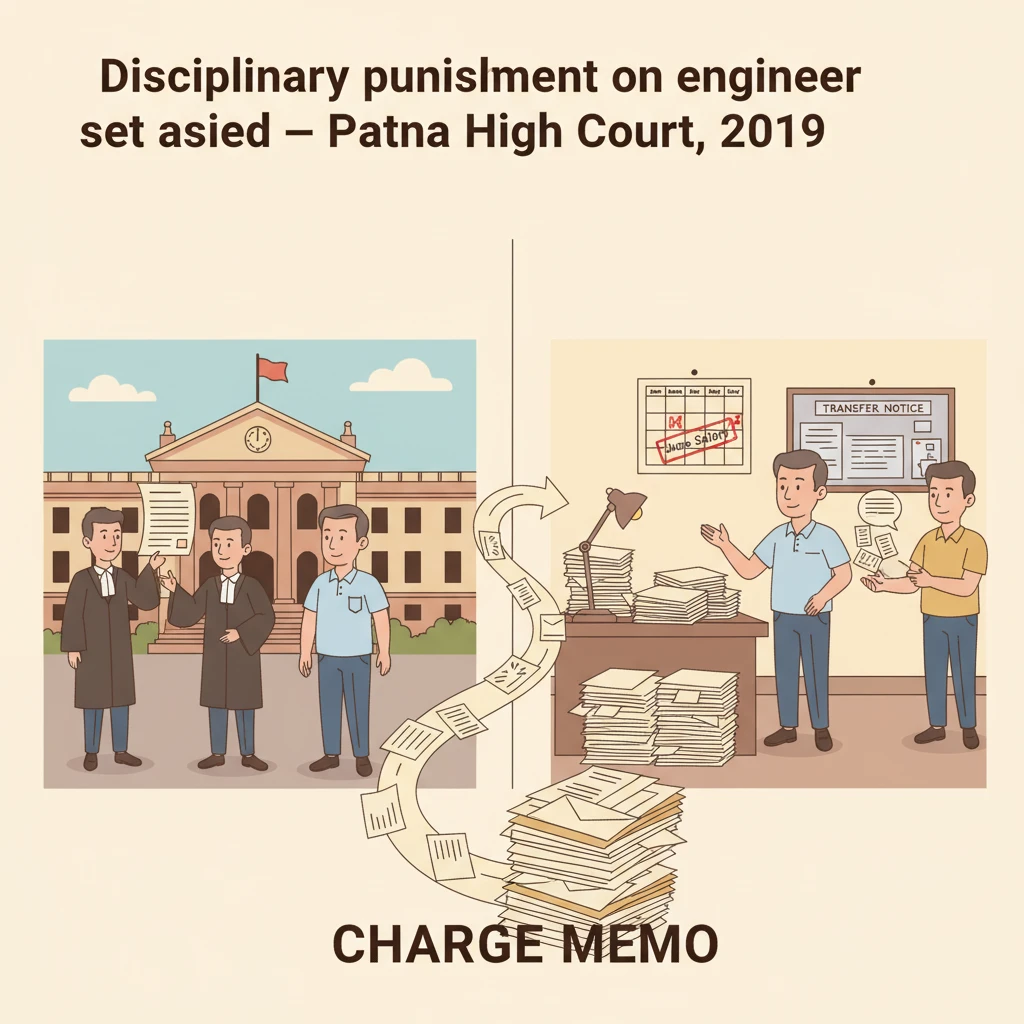
Case Background
The appellant was an Assistant Engineer in the Water Resources Department of the State of Bihar. He was appointed in 1979 and later given current charge of the post of Executive Engineer by Notification No. 4750 dated 29.06.2002. His services were placed with the Flood Control Division, Naugachhia.
While posted as Executive Engineer (current charge), proceedings were initiated against him under Rule 55(a) of the Civil Services (Classification, Control and Appeal) Rules, 1956. The proceeding started with a charge memorandum issued vide Letter No. 34 dated 03.02.2005.
The core allegation was that he failed to relieve a transferred Junior Engineer, namely Harendra Narain, for about four months after the transfer order of that Junior Engineer. On this basis, the Department alleged violation of departmental instructions.
The engineer submitted detailed written explanations responding to successive show cause notices. Despite these replies, the Department ultimately punished him by Memo No. 1467 dated 09.12.2009, imposing censure for the year 2004-05 and withholding two increments with non-cumulative effect.
He filed a departmental appeal before the Water Resources Department, Government of Bihar. This appeal was rejected vide Letter No. 1465 dated 28.09.2010 by the Deputy Secretary, who simply affirmed the punishment without assigning reasons.
Aggrieved, the officer filed Civil Writ Jurisdiction Case No. 2209 of 2011 before the Patna High Court seeking quashing of the punishment and the appellate order. He also pointed out that due to the punishment and pending proceedings, his promotion to the regular post of Executive Engineer had been stalled, while similarly situated officers were promoted.
The learned Single Judge dismissed the writ petition on 03.01.2018. The Single Judge accepted the view of the Disciplinary Authority that the engineer’s explanations were contradictory and held that in a case of minor punishment the Court would not sit as an appellate authority.
The present Letters Patent Appeal No. 175 of 2018 was filed against that Single Judge order. The Division Bench, consisting of Hon’ble the Chief Justice and Hon’ble Justice Smt. Anjana Mishra, delivered its oral judgment on 30.04.2019.
What the Court Examined and Decided
The Patna High Court, in this appeal, closely examined the sequence of show cause notices and replies exchanged between the Department and the appellant. The Bench focused on whether the disciplinary findings had any real basis and whether the authorities had applied their mind to the explanations offered.
The first charge, issued on 03.02.2005 by Letter No. 34, was straightforward. The Department alleged that the appellant had not relieved the transferred Junior Engineer for about four months.
In his reply dated 04.03.2005 (Letter No. 163), the appellant explained that the transfer order dated 11.02.2004 (Memo No. 546) reached his office only on 23.02.2004. Soon thereafter, he directed the Sub-Divisional Officer (S.D.O.), Flood Control Sub Division No.1, Naugachhia Camp Bihpur, by Letter No. 239 dated 27.02.2004, to relieve the Junior Engineer.
The S.D.O. in turn issued several letters — No. 16 dated 01.04.2004, No. 61 dated 25.04.2004, No. 64 dated 17.05.2004, No. 60 dated 22.05.2004 and No. 69 dated 15.06.2004 — directing the Junior Engineer to hand over charge to another Junior Engineer, Subhash Chandra Singh, so that he could be relieved. Despite these directions, Harendra Narain did not hand over charge.
Faced with this non-cooperation, the appellant issued his own letters — No. 610 dated 28.05.2004 and No. 731 dated 15.06.2004 — ordering that the transferred Junior Engineer be relieved and warning that if he did not hand over charge, his salary for June 2004 would be withheld. The salary was in fact withheld for the month of June 2004.
The S.D.O. later reported by Letter No. 79 dated 30.06.2004 that the Junior Engineer had finally been relieved vide his letter dated 03.07.2004.
In his explanation, the appellant stressed that he wanted the Junior Engineer to properly hand over charge before being relieved. He argued that, in the absence of such handing over, government materials could become unaccounted for, causing financial loss and future complications for officers. He even mentioned that in some situations charge had to be taken in presence of a Magistrate after obtaining higher permission, highlighting how serious such transitions could be.
Despite this background, the Department issued a supplementary show cause notice by Letter No. 716 dated 08.07.2006. This time, it went beyond the first allegation and suggested that the four-month delay in handing over charge showed that the records must not have been properly maintained or updated. The appellant was called upon to answer this new angle as well.
The appellant replied vide Letter No. 719 dated 21.07.2006. He clarified that the materials under the Junior Engineer’s charge — described as coal, drums and bricks — were all found to be in order. There was no irregularity in records. According to him, the only reason for delay was the Junior Engineer’s own delaying tendency, despite several reminders and the stopping of his salary.
Yet another show cause was issued by the Department through Letter No. 1081 dated 26.10.2006. The Department alleged there was a contradiction in the appellant’s second show cause and asked for further clarification.
The appellant again responded at length by Letter No. 1125 dated 24.12.2006. He reiterated that the delay was entirely due to the Junior Engineer’s non-cooperative attitude, and that he and the S.D.O. had repeatedly instructed the Junior Engineer to hand over charge. Ultimately, he had to resort to stopping the Junior Engineer’s salary to compel him to comply. He clearly stated that he wished to ensure that the Junior Engineer personally handed over charge before relief, so as to avoid future complications.
He also specifically requested sympathetic consideration, pointing out that he had not violated any departmental instruction or rule.
Despite these repeated explanations, the Department remained silent for more than two years. Finally, by Memo No. 1467 dated 09.12.2009, it imposed the punishment of censure for 2004-05 and withholding of two increments with non-cumulative effect. The disciplinary order held that the appellant was responsible for not relieving the Junior Engineer and had openly violated departmental instructions.
On appeal, the Deputy Secretary, Water Resources Department, simply affirmed the punishment through Letter No. 1465 dated 28.09.2010. The appellate order did not give any independent reasons, as is evident from its bare reading.
Before the Single Judge, the Department argued that there were contradictions in the appellant’s explanations. The Single Judge accepted this view and concluded that the appellant had tried to place the entire blame on the Junior Engineer. The Single Judge declined to interfere, observing that in matters of minor punishment the Court should not act as an appellate authority.
In the Letters Patent Appeal, counsel for the appellant argued that the disciplinary and appellate orders did not state what contradictions had been found in his statements. He maintained that there was no inconsistency in his replies and that he had acted bona fide to safeguard departmental interests by insisting on a proper handing over of charge.
The Division Bench closely examined all the show cause notices and replies. It noted that the first notice dealt only with non-relieving of the Junior Engineer. The subsequent notice added a new allegation that the delay showed that records were not updated, which was merely an assumption.
The Bench found that the appellant’s replies consistently stated that he had instructed the S.D.O. to ensure handing over of charge, and that the delay was caused by the Junior Engineer’s own conduct. Because of the lack of cooperation, the appellant had even stopped the Junior Engineer’s salary.
In this background, the Court held that the disciplinary findings, as well as the Single Judge’s endorsement, were “hypothetical” and could not legally form the basis of punishment. The Court observed that there was no material to justify the conclusion that the appellant had violated departmental instructions.
The Bench also referred to the Civil Services (Classification, Control and Appeal) Rules, 1930 and emphasised that when passing an order under these Rules, the authority must give a conscious and objective consideration to the employee’s representation. Mechanical orders based on conjectures and surmises are not acceptable, especially because such punishments can harm an employee’s future prospects.
For this principle, the Court relied on the earlier Division Bench judgment in Md. Mahmudul Hasan vs. The State of Bihar & Ors, reported in 1997 (2) PLJR 953. That decision, itself following Dr. Rabindra Nath Singh vs. The State of Bihar and others, 1983 PLJR 92, held that while passing an order under Rule 55-A, the authority must consider the employee’s explanation with conscious application of mind and give reasons if the explanation is found unsatisfactory. Giving reasons is a basic requirement of natural justice.
Applying these principles, the Court held that the impugned disciplinary and appellate orders were mechanical, unsupported by material and excessive in their effect. The punishment had not only taken away increments for two years but also, due to the censure entry, had affected the appellant’s promotional prospects.
In the result, the Division Bench allowed the appeal. It set aside the Single Judge’s order dated 03.01.2018 in C.W.J.C. No. 2209 of 2011, as well as Memo No. 1467 dated 09.12.2009 (imposing punishment) and Letter No. 1465 dated 28.09.2010 (rejecting appeal). The Court directed the Department to take necessary steps regarding the appellant’s claim for promotion and to pass appropriate orders in accordance with law.
Why This Judgment Matters
This judgment is important for government employees in Bihar and beyond, especially those facing disciplinary cases. It shows that even so-called “minor” punishments like censure and withholding of increments can seriously affect an officer’s career, including promotion.
The Patna High Court has made it clear that disciplinary authorities cannot punish an employee merely on assumptions. They must read and consider the employee’s reply carefully and give clear reasons for not accepting it. Mechanical orders, even in minor penalty cases, will not be allowed to stand.
The decision also reinforces that when an official takes steps to protect government property and ensure proper handing over of charge, such actions should not be twisted into allegations of misconduct without evidence.
For employees in the Water Resources Department and other government departments, this case underlines the right to fair treatment in departmental proceedings and the requirement that higher authorities act with a conscious and objective mind.
Legal Issues and Answers
Issue: Whether the disciplinary punishment of censure and withholding two increments, based on alleged delay in relieving a transferred Junior Engineer, was valid when the employee had given detailed explanations.
Answer: No. The Patna High Court held that the findings of misconduct were hypothetical, not supported by material, and passed without proper consideration of the explanations. The punishment and appellate orders were quashed.
Issue: Whether courts can interfere with “minor” penalties in writ jurisdiction when disciplinary authorities act mechanically without reasons.
Answer: Yes. The Court held that even for minor punishments, authorities must apply their mind, consider the employee’s representation objectively and give reasons. Mechanical, conjectural orders that affect an employee’s rights can be set aside.
Issue: Whether a later inference that records were not updated could be drawn solely from delay in handing over charge.
Answer: No. The Court treated this as a mere presumption unsupported by evidence, especially in light of the appellant’s consistent explanation and steps taken to ensure proper handing over of charge.
Cases Cited by the Court
- Md. Mahmudul Hasan vs. The State of Bihar & Ors, 1997 (2) PLJR 953.
- Dr. Rabindra Nath Singh vs. The State of Bihar and others, 1983 PLJR 92.
Case Details
Case Number: Letters Patent Appeal No. 175 of 2018 in Civil Writ Jurisdiction Case No. 2209 of 2011
Case Title: Niranjan Kumar Dutta v. The State of Bihar & Others
Citation: 2019 (2) PLJR 983
Court: High Court of Judicature at Patna
Date of Judgment: 30.04.2019
Coram: Hon’ble the Chief Justice Amreshwar Pratap Sahi and Hon’ble Justice Smt. Anjana Mishra
Advocates: Mr. Shailesh Kumar Sharma, Advocate for the appellant; Mr. Anjani Kumar, AAG-4 for the respondents; Mr. Shailendra Kumar Singh, Advocate for the respondents
Nature of the Case: Letters Patent Appeal against dismissal of writ petition challenging departmental punishment (censure and withholding of increments) and appellate order
Key Department / Authority Involved: Water Resources Department, Government of Bihar
Link to Judgment: Click here to view the official Patna High Court judgment
If you found this explanation helpful and wish to stay informed about
how legal developments may affect your rights in Bihar,
you may consider following Samvida Law Associates for more updates.







