

Case Background
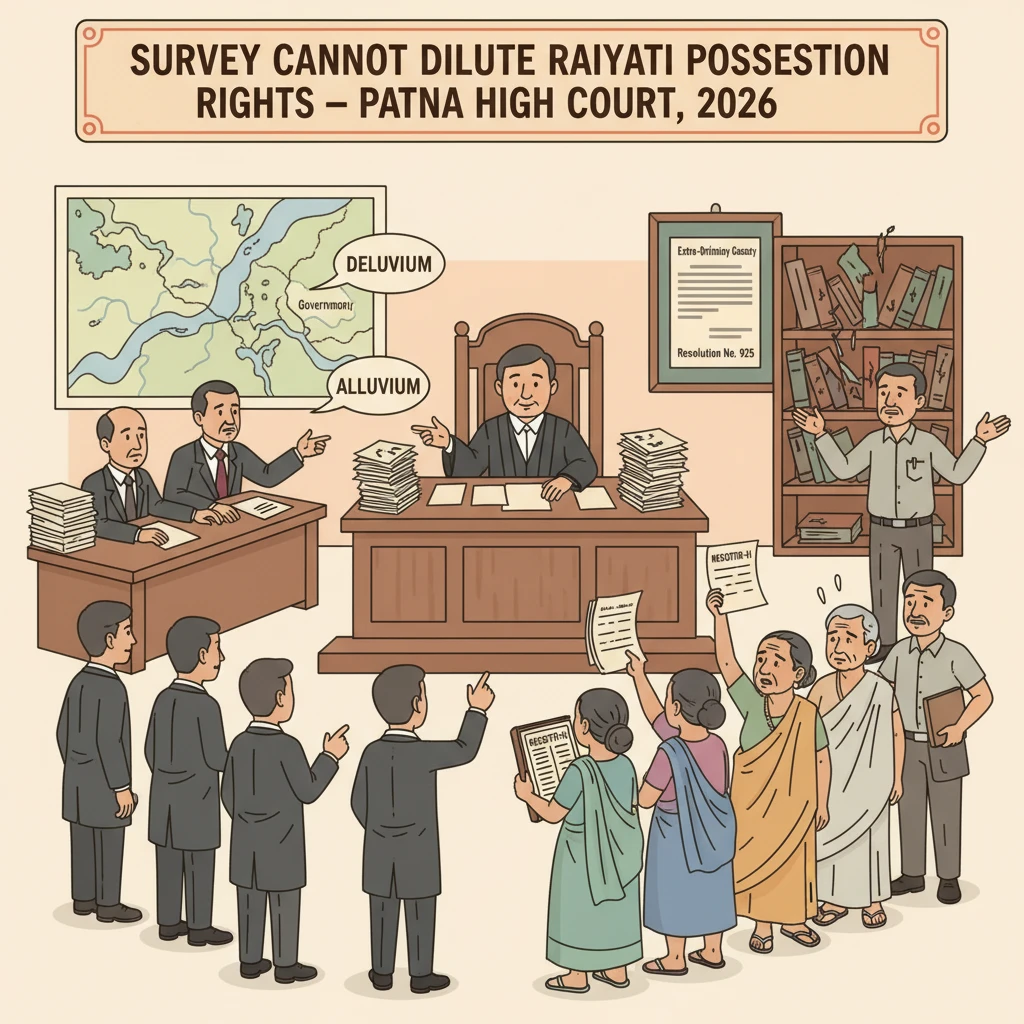
The case arose from Khagaria district, an area heavily affected by rivers, canals and annual floods of the River Koshi. The petitioners are residents of Village Dighaun under Beldaur Anchal in Khagaria. They described themselves as raiyats and Kartas of their Hindu Undivided Families holding agricultural lands in Mauza Dighaun, Thana No. 144, Tauzi No. 525 and other mauzas in Khagaria district.
According to the petitioners, after survey operations conducted in 1887–88, the then Zamindars carried out “Sarvasta” proceedings in 1943–44 and effected settlements before 01.01.1946. On the strength of those settlements, they claimed that raiyati lands were lawfully settled in favour of raiyats, transfer of land through registered sale deeds was recognised, and the Government accepted settlement papers such as Sarvasta Pramangi and related documents.
They stated that the State of Bihar issued rent receipts in respect of these lands and continuously realised land revenue up to the year 2017–18. The lands were said to have been purchased by the petitioners and their family members through valid transactions, duly recorded in Register-II, and they claimed peaceful, continuous possession over several decades.
The present dispute arose when a fresh special survey operation commenced in Bihar under the Bihar Special Survey and Settlement Act, 2011, including in Khagaria district. The petitioners alleged that during this ongoing survey, local officials were following unfair and illegal practices, which threatened their long-standing raiyati rights.
What the Court Examined and Decided
The petitioners approached the Patna High Court by filing Civil Writ Jurisdiction Case No. 20084 of 2025. In paragraph 1 of the writ petition, they sought several reliefs. Primarily, they wanted the gairmajarua khas, baksat and Sarvasta lands claimed by them to be declared raiyati lands in the ongoing survey on the basis of sale deeds, land revenue receipts and Register-II.
They further requested the Court to direct rectification of the digital database by arranging camps at mauza level to ensure fair survey, to direct authorities to consider and redress their claims across different mauzas including Dighaun, Gandharsan, Beldaur, Sanhauli, Khagaria Sadar and Sathma, and to stop the survey until the database was corrected and their grievances were addressed.
The grievance put forward was that despite oral and written representations to various authorities, including the Director, Land Records and Measurement at Gulzarbagh, Patna, and district-level revenue officers, no effective action was taken.
During survey proceedings, local officials allegedly told the petitioners to produce sale deeds executed prior to 01.01.1946 by original Zamindars. The petitioners claimed they could not do so because Register-II and khatiyan records were not available. The In-charge of the District Record Room, according to them, confirmed that such records were either unavailable or in a damaged condition, so certified copies could not be issued.
The petitioners said they pointed the authorities to the Extra-Ordinary Gazette of the State of Bihar dated 14.11.2014 and the rules framed thereunder, but their rights were still ignored. They also submitted detailed representations before the District Magistrate-cum-District Collector, Khagaria and the Additional Collector (Revenue), Khagaria, but to no effect.
Their central fear was that if the survey continued in this arbitrary manner, it would cause irreparable loss to their title, possession and future rights over the lands, particularly since the area is continuously affected by the Koshi river and is prone to deluvium and alluvium.
On behalf of the State, counsel informed the Court that the writ petition was premature because the special survey was still continuing. It was argued that if the petitioners had any grievance with actions taken by authorities during the survey, they were required to follow the mechanism provided under the Bihar Special Survey and Settlement Act, 2011.
Justice Purnendu Singh first addressed the nature of documents that confer title. The Court observed that a sale deed by itself is not a document of title, and similarly, the “Record of Rights” is also not a document of title. However, the Court clarified that preventing a person from getting mutation in the records of right on the strength of a valid transfer or sale deed would be contrary to the Transfer of Property Act, 1882.
To underline the legal position regarding sale deeds and title, the Court relied upon the Supreme Court decision in Mahnoor Fatima Imran v. Visweswara Infrastructure (P) Ltd., reported in 2025 SCC OnLine SC 1062. The Patna High Court quoted paragraphs 16, 22 and 28 of that judgment. The Supreme Court had held that registration of a document only creates a rebuttable presumption and does not give unimpeachable validity to the transaction. It reaffirmed that immovable property can only be legally and lawfully transferred by a registered deed of conveyance and that so-called GPA sales or SA/GPA/will transfers do not by themselves convey title.
At the same time, the Supreme Court also noted that even a registered conveyance cannot create valid title if the vendor himself had no title or if the chain of ownership is defective. The Patna High Court used this precedent to highlight that registration and entries in records are not conclusive proof of ownership, though they are relevant factors.
Next, the Court examined the petitioners’ plea to stop the ongoing survey on the ground that their land is annually affected by floods of the Koshi river. Justice Purnendu Singh referred to an earlier judgment of the Patna High Court in CWJC No. 15963 of 2023 (Shyam Chandra Sharma v. The State of Bihar), which dealt with the Registration Act, 1908 and survey of “topo land” in Chapra Municipality.
In that earlier decision, the Court had observed that a person’s title is not affected by change of his name in municipal records. Title flows from transfer or devolution of holding and can only be finally determined in a properly framed title suit. However, the person in actual possession remains liable to pay holding tax.
Applying that reasoning to the present case, Justice Purnendu Singh noted that the petitioners claimed possessionary rights over lands settled much before 01.01.1946 and in accordance with Resolution No. 925 dated 11.11.2014 of the State Government. The petitioners had, according to the Court, been able to establish their actual and physical possession and statutory vesting of property.
The Court recorded that the right to obtain possession of the property already stood vested with the petitioners, and such right could not be taken away in the garb of an ongoing survey. In other words, survey operations alone cannot dispossess persons who are in long-standing possession and whose rights flow from earlier lawful settlements and government recognitions such as rent receipts.
At the same time, the Court did not grant the prayer to stop the survey across the area. Instead, it balanced the interests of the petitioners and the statutory scheme of survey and settlement.
In paragraph 11 of the judgment, the Court referred to the petitioners’ own pleadings, namely Sub-paragraph xiii of Paragraph 2 of the writ petition and Annexure 3, which contained information from the In-charge, Record Room, Khagaria. Recognising that some records were stated to be unavailable to the petitioners, the Court directed that, if they so desire, they may seek such records from the District Magistrate-cum-Collector, Khagaria.
On the broader dispute of title, the Court clarified that if the State at any stage disputes the title of the petitioners, they would be at liberty to approach the competent civil court. They could file a declaratory suit to claim their rights and possession over the land if the State attempts to treat them as encroachers on government land or takes action on the footing that the land is recorded as government land.
The Court also noted that, so far, no such action had been taken by the State Government. The State had not initiated any process either to record the land as government’s land or to dispossess the petitioners. The Court mentioned that in Shyam Chandra (supra), the stand of the State treating such topo land as government land for survey purposes had already been set aside. That view had been affirmed in LPA No. 562 of 2024 and further affirmed by the Hon’ble Supreme Court in SLA No. 4556 of 2025.
In light of these observations, the Patna High Court did not issue directions to stop the survey or to immediately declare the lands raiyati. Instead, it disposed of the writ petition with the above clarifications and directions, safeguarding the petitioners’ possessionary rights and pointing them to the appropriate remedies if a concrete dispute on title arises.
Why This Judgment Matters
This judgment is important for raiyats and landholders across Bihar who are worried about ongoing special surveys. It clarifies that survey entries, or treatment of land as “topo land” or government land for survey purposes, do not automatically cancel existing rights flowing from lawful settlements and long possession.
For people in flood-affected areas like Khagaria, where old records may be missing or damaged, the Court’s direction allowing them to seek available records from the District Magistrate-cum-Collector is significant. It gives a practical route to support their claims without halting the entire survey process.
The judgment also underlines that true title disputes must be resolved in a properly framed civil suit, not merely through changes in survey or municipal records. At the same time, it reassures that until the State actually initiates steps to treat the land as government property, raiyats in possession retain their rights.
Legal Issues and Answers
- Issue: Can ongoing special survey operations be stopped by writ petition on the ground that raiyats fear loss of rights over Sarvasta and flood-affected lands?
Answer: No. The Patna High Court treated the writ as premature, did not stop the survey, but protected the petitioners’ existing rights and pointed them to statutory and civil remedies. - Issue: Do sale deeds, records of right and municipal or survey entries by themselves conclusively prove title?
Answer: No. The Court held that a sale deed or record of rights is not, by itself, a document of title, though mutation cannot be refused where there is a valid transfer. Final title must be adjudicated in a properly framed civil suit if disputed. - Issue: What recourse do landholders have if the State later disputes their title during or after survey?
Answer: They may seek available records from the District Magistrate-cum-Collector and, if the State disputes title or treats the land as government land, they can file a declaratory suit before the competent civil court.
Cases Cited by the Court
- Mahnoor Fatima Imran v. Visweswara Infrastructure (P) Ltd., 2025 SCC OnLine SC 1062.
- CWJC No. 15963 of 2023, Shyam Chandra Sharma v. The State of Bihar (Patna High Court).
- LPA No. 562 of 2024 (Patna High Court) affirming Shyam Chandra Sharma (supra).
- SLA No. 4556 of 2025 (Supreme Court of India) affirming the decision in Shyam Chandra (supra).
Case Details
Case Number: Civil Writ Jurisdiction Case No. 20084 of 2025
Case Title: Birendra Kumar & Ors. v. The State of Bihar & Ors.
Coram: Hon’ble Mr. Justice Purnendu Singh
Date of Judgment: 06-01-2026
Citation: 2026 (2) PLJR 276
Advocates:
- For the Petitioners: Mr. Pramod Kumar Thakur, Advocate
- For the Respondents/State: Mr. Venkatesh Kirti, Advocate, JC to GA 2
Nature of the Case: Civil writ petition under Article 226 of the Constitution challenging the manner of ongoing special survey and seeking declaration of raiyati rights and protection of possession.
Link to Judgment: Full text of judgment on Patna High Court website
If you found this explanation helpful and wish to stay informed about how legal developments may affect your rights in Bihar, you may consider following Samvida Law Associates for more updates.







