

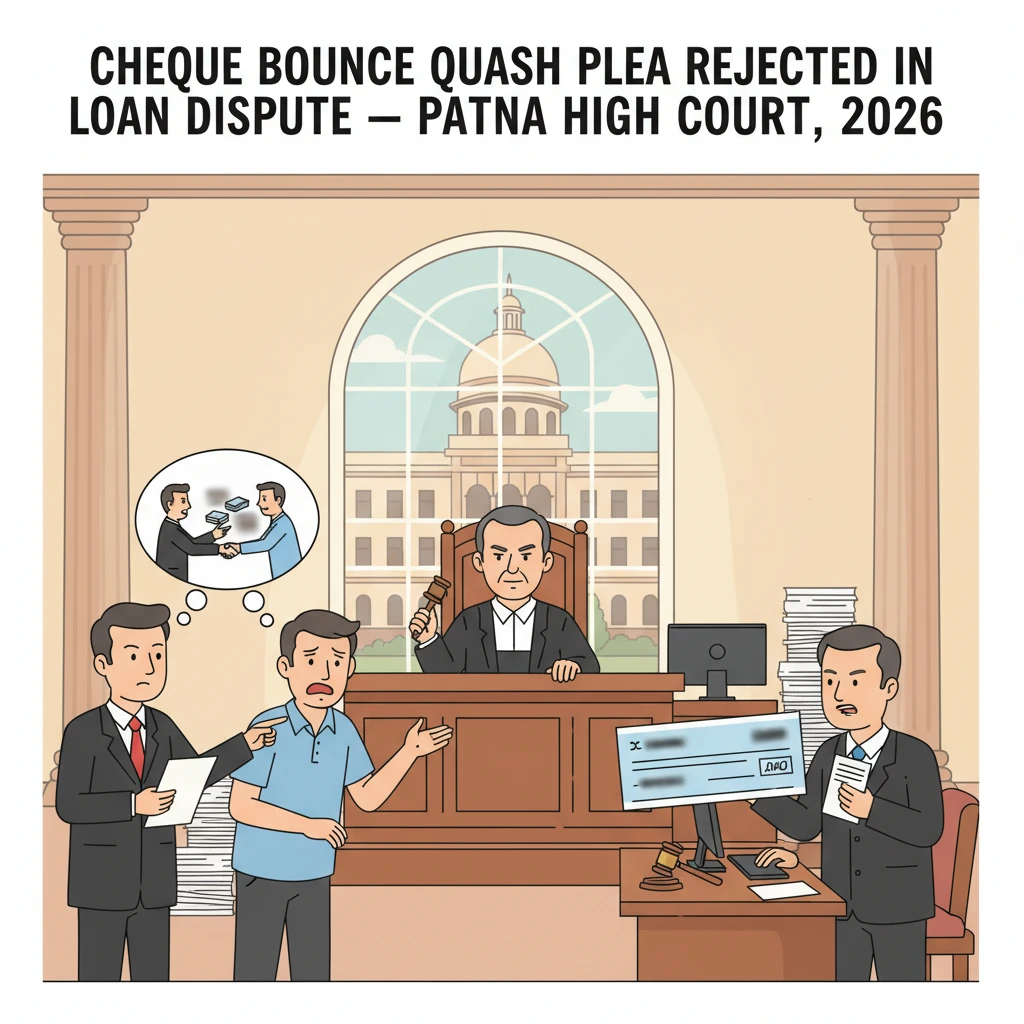
Case Background
This case arises from a private complaint filed by Opposite Party No.2 in Vaishali district. He alleged that on 11.02.2013 the petitioner came to him seeking a loan of Rs.1,00,000.
According to the complaint, Opposite Party No.2 actually advanced Rs.95,000 out of this amount in the presence of witnesses. In alleged discharge of this liability, the petitioner issued a cheque dated 11.03.2013 for Rs.95,000.
When this cheque was presented in the bank, it was allegedly dishonoured due to insufficiency of funds. After the dishonour, Opposite Party No.2 sent a legal notice dated 22.05.2013 to the petitioner, calling upon him to make payment within the statutory period.
The complaint states that despite receiving this notice, the petitioner did not pay the cheque amount within the legal time limit. Opposite Party No.2 then filed Complaint Case No. C1-2065 of 2013 before the Judicial Magistrate 1st Class, Vaishali at Hajipur.
The complainant was examined on oath, and two inquiry witnesses were also examined. On perusal of the record, the Magistrate found sufficient material to proceed, took cognizance for the offence under Section 138 of the Negotiable Instruments Act, 1881, and directed that summons be issued to the petitioner by order dated 14.11.2014.
Feeling aggrieved, the petitioner approached the Patna High Court in Criminal Miscellaneous No.50805 of 2018, seeking quashing of the cognizance order and the entire criminal proceeding.
What the Court Examined and Decided
The Patna High Court, through Hon’ble Mr. Justice Sunil Dutta Mishra, heard the petitioner’s counsel and the learned A.P.P. for the State. The petitioner’s side attacked the very foundation of the complaint and the Magistrate’s order of cognizance.
The main argument from the petitioner was that the mandatory steps required under Section 138 of the Negotiable Instruments Act had not been followed before filing the complaint. It was said that no statutory legal notice was ever served upon the petitioner and that such notice was not filed along with the complaint petition.
The petitioner also pointed out that neither the complaint petition nor the cognizance order specifically showed compliance with issuance and service of notice. On this basis, it was argued that the basic condition for a valid cheque bounce case was missing.
Further, the petitioner alleged that there had been a joint business relationship between him and Opposite Party No.2. Certain cheques belonging to the petitioner were allegedly lying with Opposite Party No.2, and these cheques were said to have been misused to give a criminal colour to what was essentially a civil or business dispute.
The petitioner denied ever receiving any amount from Opposite Party No.2. He also denied issuing the cheque towards discharge of any legally enforceable debt or liability. Based on these assertions, it was submitted that continuance of the criminal case would amount to abuse of the process of the Court, and therefore the cognizance order should be quashed under Section 482 of the Code of Criminal Procedure.
On the other side, the learned A.P.P. for the State supported the Magistrate’s order. He submitted that the order taking cognizance of an offence under Section 138 of the Negotiable Instruments Act did not suffer from any apparent illegality that could justify interference in the High Court’s inherent jurisdiction.
The State argued that, at the stage of taking cognizance, the Magistrate only has to see whether there is a prima facie case based on the complaint and supporting material. A detailed evaluation of evidence is not required and is in fact not permissible at that early stage.
According to the State, the petitioner’s defence — that there was a joint business, that the cheque was misused, that no money was received and no notice was served — all raised disputed questions of fact. Such issues, it was argued, can only be resolved in trial after evidence and cross-examination, not in a quashing petition under Section 482 Cr.P.C.
Before analysing the specific facts, the Court restated the settled law on quashing criminal proceedings. It referred to the well-known judgment of the Hon’ble Supreme Court in State of Haryana v. Bhajan Lal, 1992 Supp (1) SCC 335, which outlines the principles governing when a criminal case can be quashed at the threshold.
The Court also referred to Pradeep Kumar Kesarwani v. State of Uttar Pradesh & Anr., 2025 SCC OnLine SC 1947, reinforcing that at the initial stage the High Court must examine only whether the complaint and the materials on record disclose a prima facie case.
In addition, the Court relied significantly on the Supreme Court’s decision in Sri Om Sales v. Abhay Kumar @ Abhay Patel & Anr., 2025 SCC OnLine SC 2897. In that case, the Supreme Court had clearly held that while exercising powers under Section 482 Cr.P.C., it is not proper for the High Court to test whether the cheque in question was issued for discharge of any debt or liability.
This is because, under Section 139 of the Negotiable Instruments Act, there is a legal presumption that the holder of a cheque received it for the discharge, in whole or in part, of a debt or other liability. This presumption can only be rebutted by evidence led during trial.
The Supreme Court in Sri Om Sales cited earlier decisions such as Maruti Udyog Ltd. v. Narender, Rangappa v. Sri Mohan, Rajeshbhai Muljibhai Patel v. State of Gujarat and Rathish Babu Unnikrishnan v. State (NCT of Delhi). These decisions all emphasise that:
- a presumption must be drawn in favour of the holder of the cheque under Section 139;
- this presumption includes the existence of a legally enforceable debt or liability;
- the presumption is rebuttable, but the accused must raise his defence at trial;
- the High Court should not quash Section 138 complaints by going into disputed facts about the purpose of the cheque.
The Supreme Court had further cautioned that the court should be slow to quash a complaint at a pre-trial stage when there is a legal presumption supporting the complainant. The accused will have a full opportunity during trial to adduce defence evidence and rebut the presumption.
Applying these principles, the Patna High Court closely looked at the complaint petition in this case. It found that the complaint clearly contained specific assertions:
- that a loan was advanced;
- that a cheque was issued towards discharge of that liability;
- that the cheque was dishonoured due to insufficiency of funds;
- that a statutory legal notice was issued within the prescribed period; and
- that the notice was served on the petitioner, who still failed to pay within the statutory time.
These statements, on their face, satisfied the basic requirements for an offence under Section 138 of the Negotiable Instruments Act.
The Court emphasised that, at the stage of cognizance, the Magistrate has only to see whether, taking the allegations at face value, an offence is disclosed. It is not the Magistrate’s role at that stage to examine the truth or falsity of the accused’s defence.
The petitioner’s plea that no legal notice was ever served, or that the cheque was not issued towards a legally enforceable debt, were found to be disputed questions of fact. Such issues, the Court held, cannot be adjudicated in a quashing petition under Section 482 Cr.P.C.
The Court concluded that the complaint disclosed the “foundational facts” necessary for proceeding under Section 138 of the Negotiable Instruments Act. Matters which require evidence and cross-examination — such as the true nature of the transaction, the existence of joint business, alleged misuse of cheques, and service of notice — must be decided only during trial.
On this basis, the Court held that the Magistrate’s order taking cognizance did not suffer from any patent illegality, perversity, or jurisdictional error. Interference by the High Court at this initial stage would amount to stifling a legitimate prosecution at its very inception, which is not permissible in law.
Accordingly, the Patna High Court dismissed the petitioner’s application seeking quashing of the criminal case.
Why This Judgment Matters
This judgment is important for anyone involved in a cheque bounce dispute, especially small traders, self-employed persons and individuals who give or receive hand loans.
The Patna High Court has made it clear that once a complaint under Section 138 of the Negotiable Instruments Act states all the basic facts — loan, cheque, dishonour, notice and non-payment — the case will normally go to trial.
Accused persons cannot expect the High Court to cancel such cases at the start by raising defences like “it was a business transaction”, “the cheque was misused”, or “no money was actually taken”, when these are disputed facts.
The decision also underlines that the legal presumption under Section 139 of the Negotiable Instruments Act is strong. The court will initially presume that the cheque was issued against a legally recoverable amount. It is for the accused to bring evidence during trial to rebut this presumption.
For complainants, the judgment is a reassurance. If they properly follow the legal steps and state all necessary facts in their complaint, their case is likely to reach trial rather than being thrown out at the very beginning.
Legal Issues and Answers
Issue: Can a cheque bounce case under Section 138 of the Negotiable Instruments Act be quashed at the initial stage on the ground that no legal notice was served and the cheque was not issued against any real debt or liability?
Answer: No. Where the complaint itself clearly pleads loan, issuance of cheque, dishonour, statutory notice and non-payment, and these facts are supported by preliminary inquiry, the High Court will not quash the case under Section 482 Cr.P.C. Disputed questions such as service of notice or existence of liability must be decided at trial.
Issue: Is it open to the High Court, while exercising powers under Section 482 Cr.P.C., to examine whether the cheque was actually issued for discharge of any debt or liability?
Answer: No. In view of the presumption under Section 139 of the Negotiable Instruments Act, that question is to be considered at trial. The High Court should avoid detailed enquiry into such factual defences at the pre-trial stage.
Issue: Did the Magistrate commit any illegality in taking cognizance under Section 138 of the Negotiable Instruments Act based on the complaint and inquiry statements?
Answer: No. The High Court held that the Magistrate rightly found a prima facie case and that his order did not suffer from patent illegality, perversity or jurisdictional error, so no interference was called for.
Cases Cited by the Court
- State of Haryana v. Bhajan Lal, 1992 Supp (1) SCC 335
- Pradeep Kumar Kesarwani v. State of Uttar Pradesh & Anr., 2025 SCC OnLine SC 1947
- Sri Om Sales v. Abhay Kumar @ Abhay Patel & Anr., 2025 SCC OnLine SC 2897
- Maruti Udyog Ltd. v. Narender (as referred in Sri Om Sales)
- Rangappa v. Sri Mohan (as referred in Sri Om Sales)
- Rajeshbhai Muljibhai Patel v. State of Gujarat (as referred in Sri Om Sales)
- Rathish Babu Unnikrishnan v. State (NCT of Delhi) (as referred in Sri Om Sales)
Case Details
Case Number: Criminal Miscellaneous No.50805 of 2018 (arising out of Complaint Case No. C1-2065 of 2013)
Case Title: Sanjeev Kumar v. State of Bihar & Sanjay Singh
Coram: Hon’ble Mr. Justice Sunil Dutta Mishra
Date of Judgment: 06.02.2026 (C.A.V.; CAV Date 31.01.2026)
Citation: 2026 (2) PLJR 294
Advocates:
- For the petitioner: Mr. Mahendra Thakur, Advocate
- For the State/Opposite Party: Mr. Pradeep Narain Kumar, A.P.P.
Nature of the Case: Petition under Section 482 of the Code of Criminal Procedure seeking quashing of cognizance order in a complaint case under Section 138 of the Negotiable Instruments Act, 1881.
Link to Judgment: Click here to view the official Patna High Court judgment
If you found this explanation helpful and wish to stay informed about
how legal developments may affect your rights in Bihar,
you may consider following Samvida Law Associates for more updates.







