

Case Background
The Department of Mines and Geology, Government of Bihar, issued tenders for settlement of sand ghats in cluster form in Madhubani and Banka districts. The petitioners, who are mining contractors from Rajasthan, took part in these auctions.
They emerged as highest bidders and were granted settlement of different sand ghat clusters for five years. Letters of Acceptance were issued to them. After this, as required under the tender conditions, each petitioner prepared and submitted a mining plan to the competent authority.
Under the tender terms, no mining could practically begin unless environmental clearance was obtained. Therefore, all petitioners submitted applications before the State Environment Impact Assessment Authority, Bihar (SEIAA) for environmental clearance in respect of the settled sand ghats. The process was governed by EIA Notification No.1533 dated 14.09.2006 issued by the Ministry of Environment and Forest, Government of India.
Within SEIAA, a sub-committee called the State Level Expert Appraisal Committee (SEAC) was required to carry out the “appraisal” stage of the clearance process. Appendix V of the 2006 Notification laid down the procedure for appraisal. Paragraph 5 of Appendix V clearly stated that “the applicant shall be informed at least 15 (fifteen) days prior to the scheduled date of the EAC/SEAC meeting for considering the project proposal”.
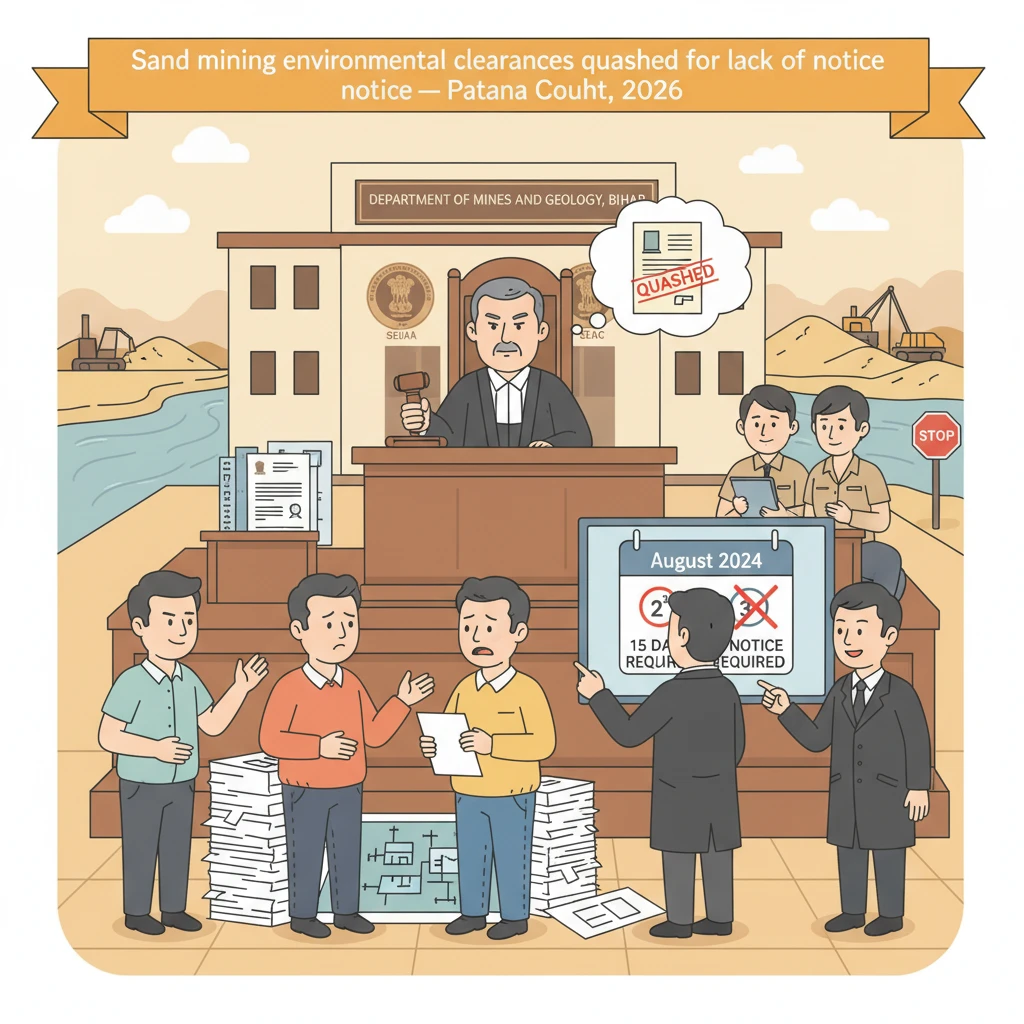
For the petitioners’ sand clusters, SEAC announced on 02.08.2024 that appraisal meetings would be held the very next day, 03.08.2024. The petitioners immediately protested by email, stating that such short notice violated the 15‑day requirement and requested at least 48 hours’ time so that they or their representatives could attend and make submissions.
Despite these protests, SEAC proceeded with the 03.08.2024 meeting, recorded the absence of the petitioners, and still recommended environmental clearance for their projects. SEIAA later accepted these recommendations in its meeting dated 07.01.2025. On that basis, SEIAA issued environmental clearance letters on 17.01.2025 in favour of each petitioner.
Following this, the concerned Mines Development Officers (particularly in Madhubani) issued letters, including Memo No.61/M dated 24.01.2025, asking the petitioners to obtain further clearances such as Consent to Establish (CTE) and Consent to Operate (CTO) from the Bihar State Pollution Control Board.
The petitioners then approached the Patna High Court under Article 226 of the Constitution by filing separate writ petitions, which were heard together because they raised the same issue relating to different sand clusters in Madhubani and Banka.
What the Court Examined and Decided
Justice Sandeep Kumar treated Civil Writ Jurisdiction Case No.5104 of 2025 as the lead matter. The main challenge was not to the idea of environmental clearance itself, but to the manner in which the SEAC and SEIAA had proceeded.
The petitioners argued that paragraph 5 of Appendix V of the EIA Notification required that project proponents be informed at least 15 clear days before the SEAC meeting where their proposals would be considered. Here, SEAC announced the meeting on 02.08.2024 for 03.08.2024, giving only one day’s notice.
They said this deprived them of participation and the chance to present important materials, particularly:
- a letter dated 16.01.2024 issued by the Department of Mines and Geology to various District Collectors; and
- a letter dated 29.12.2023 issued by the Department of Water Resources, Government of Bihar, forwarding a report on 134 silt areas, which included the very sand ghats settled in their favour.
According to the petitioners, these documents showed that the ground situation of the riverbed and silt areas was very different from what was reflected in the tender documents. They claimed that mining might not be possible at many locations as actually advertised, and the authorities were already aware of this from those departmental letters.
However, because the SEAC meeting was held at one day’s notice and in their absence, these points never came before the committee. The petitioners described the SEAC proceedings as “ex parte” and argued that the subsequent environmental clearances were thus based only on old papers and not on the real, updated position.
On law, they relied on decisions of the Supreme Court in:
- State of Jharkhand & Ors. v. Ambay Cements & Anr. (2005) 1 SCC 368;
- Central Coalfields Limited & Anr. v. SLLSML (Joint Venture Consortium) & Ors. (2016) 8 SCC 622;
- Uttar Pradesh Power Transmission Corporation Limited & Anr. v. C.G. Power & Industrial Solutions Limited & Ors. (2021) 6 SCC 15; and
- C.B. Gautam v. Union of India & Ors. (1993) 1 SCC 78.
The core principle from these cases was that when a rule prescribes that something must be done in a particular manner, it has to be done in that manner alone. Further, where an order has civil consequences, affected persons are entitled to a reasonable opportunity of being heard.
On the other hand, SEIAA and SEAC (respondent nos.3 and 4) filed a detailed counter affidavit. They explained the general process for grant of environmental clearance, and raised three main defences.
First, they argued that since environmental clearances had already been granted, the petitioners’ proper remedy was an appeal to the National Green Tribunal under Section 16 of the National Green Tribunal Act, 2010. Therefore, according to them, the High Court should not entertain these writ petitions.
Second, they claimed that the 15‑day notice under Appendix V was only to be used when clarification from the project proponent was needed. In these projects, they said, the applications were complete, EIA reports, public hearing documents, and District Survey Reports were all on record. Hence, no clarification was required and there was allegedly no need to give full 15 days’ notice.
Third, they pointed out that environmental clearances had been issued in favour of the petitioners themselves. According to the authorities, when an order is beneficial to a person who had applied for it, that person cannot complain of breach of natural justice. They further alleged that the petitioners were simply trying to delay commencement of mining, even though settlement processes had been complete since around 2022.
The District Collectors and Mines Development Officers of Madhubani and Banka (respondent nos.5 and 6) also filed separate counter affidavits. They primarily highlighted background facts about the sand ghat settlements and requested that the Court direct the petitioners to comply with tender terms and proceed with mining as per law.
Justice Sandeep Kumar first addressed the objection regarding the so‑called alternative remedy before the National Green Tribunal. Referring to Uttar Pradesh Power Transmission Corporation Limited, he noted that mere availability of an alternative remedy does not bar the High Court from deciding a writ petition, especially where there is failure of natural justice.
He then examined the limited question raised: whether environmental clearances issued in favour of these petitioners were vitiated due to contravention of clause 5 of Appendix V of the EIA Notification dated 14.09.2006.
The Court reproduced clause 5 in full. It clearly required that “the applicant shall be informed at least 15 (fifteen) days prior” to the SEAC meeting where the project proposal would be considered.
To interpret the nature of this requirement, the Court relied on Supreme Court decisions:
- In C.B. Gautam, the Supreme Court held that where an order has adverse civil consequences, courts generally read in a requirement of giving reasonable opportunity of hearing, and tight timelines are not a ground to deny such opportunity.
- In Ambay Cements, the Court explained that where a statute prescribes a manner for doing an act and links non‑compliance with serious consequences, the requirement is mandatory, and the act must be done only in that prescribed manner.
- In Central Coalfields Limited, relying on the classic principle from Nazir Ahmad v. King Emperor, the Supreme Court reiterated that if something is to be done in a certain way, it must be done in that way or not at all.
Applying these principles, Justice Sandeep Kumar held that the 15‑day notice requirement in clause 5 of Appendix V was a mandatory condition, not a mere formality. The language “shall be informed at least 15 (fifteen) days prior” had to be given full meaning and could not be treated as empty or optional.
He noted that in this case, notice of the SEAC meeting was given only one day in advance. This was “totally in contravention” of clause 5 and of the law laid down by the Supreme Court. The fact that environmental clearance was ultimately granted in favour of the petitioners did not cure the defect or remove the prejudice, because:
- the petitioners were denied their clear right to be present and make submissions at the appraisal stage; and
- they were thereby prevented from placing on record important letters dated 29.12.2023 and 16.01.2024 which, in their view, showed that mining was not possible at the sites advertised by the State.
The Court emphasised that when the petitioners themselves had only asked for a minimum of 48 hours to attend the meeting, this limited request should have been accepted. The authorities’ refusal indicated arbitrariness.
Therefore, the Court concluded that the SEAC’s recommendations made in the 44th meeting held on 03.08.2024 were vitiated. It specifically quashed the relevant agenda items of that meeting for each writ petition:
- CWJC No.5104 of 2025 – Agenda Item No.06;
- CWJC No.5118 of 2025 – Agenda Item No.04;
- CWJC No.5112 of 2025 – Agenda Item No.05;
- CWJC No.5147 of 2025 – Agenda Item No.10;
- CWJC No.5746 of 2025 – Agenda Item No.12; and
- CWJC No.5328 of 2025 – Agenda Item No.10.
As a natural consequence, the recommendations for environmental clearance based on those agenda items “do not stand”, and the environmental clearance letters dated 17.01.2025 issued by SEIAA to these petitioners were also quashed and set aside.
The Court directed the authorities to reconsider each petitioner’s project proposal afresh “from the stage of appraisal” in strict accordance with clause 5 of Appendix V. This means they must now give at least 15 days’ prior notice of the SEAC/SEIAA meeting to the project proponents and afford them a reasonable opportunity of hearing and participation.
Recognising that the petitioners could otherwise face coercive action during this fresh process, the Court further restrained the respondents from taking any coercive steps against the petitioners till the reconsideration of their cases is completed.
With these findings and directions, all the writ petitions were allowed.
Why This Judgment Matters
This judgment from the Patna High Court is important for anyone involved in mining, construction, or any project that needs environmental clearance in Bihar.
First, it clarifies that authorities like SEAC and SEIAA cannot bypass the minimum 15‑day notice period fixed in the EIA Notification. Even if the project is apparently in favour of the applicant, the law still requires that the project proponent be properly informed and heard.
Second, the Court has treated the 15‑day notice as a mandatory safeguard, not a flexible guideline. This protects contractors and local stakeholders from “surprise” meetings where decisions affecting their rights are taken without their participation.
Third, the judgment shows that High Courts can intervene even when an appeal to the National Green Tribunal is technically available, where there is clear violation of principles of natural justice.
Finally, by restraining coercive action till fresh appraisal is done, the Court ensures that project proponents are not forced to operate based on possibly impracticable or flawed clearances. This is especially relevant where actual ground conditions, such as silt deposition and river shifts, are very different from old survey data.
Legal Issues and Answers
-
Issue: Whether SEAC and SEIAA could validly appraise and grant environmental clearance for sand mining projects after giving only one day’s notice of the appraisal meeting, despite clause 5 of Appendix V of EIA Notification dated 14.09.2006 requiring at least 15 days’ prior notice to the applicant.
Answer: No. The Patna High Court held that the 15‑day notice requirement is mandatory. Since only one day’s notice was given, the SEAC meeting and its recommendations were vitiated, and the consequent environmental clearances dated 17.01.2025 were quashed. -
Issue: Whether the existence of an appellate remedy before the National Green Tribunal under Section 16 of the NGT Act barred the High Court from entertaining these writ petitions.
Answer: No. Relying on Supreme Court precedent, the Court held that mere availability of an alternative remedy does not prevent the High Court from exercising writ jurisdiction in an appropriate case, particularly where there is failure of natural justice. Here, such failure was evident. -
Issue: What steps the authorities must now follow in dealing with the petitioners’ environmental clearance applications.
Answer: The authorities must reconsider each project proposal from the appraisal stage, give at least 15 days’ prior notice to the petitioners of the relevant meeting in terms of clause 5 of Appendix V, afford them reasonable opportunity to present materials (including departmental letters), and refrain from coercive action till reconsideration is completed.
Cases Cited by the Court
- State of Jharkhand & Ors. v. Ambay Cements & Anr., (2005) 1 SCC 368.
- Central Coalfields Limited & Anr. v. SLLSML (Joint Venture Consortium) & Ors., (2016) 8 SCC 622.
- Uttar Pradesh Power Transmission Corporation Limited & Anr. v. C.G. Power & Industrial Solutions Limited & Ors., (2021) 6 SCC 15.
- C.B. Gautam v. Union of India & Ors., (1993) 1 SCC 78.
Case Details
Case Numbers:
- Civil Writ Jurisdiction Case No.5104 of 2025
- Civil Writ Jurisdiction Case No.5112 of 2025
- Civil Writ Jurisdiction Case No.5118 of 2025
- Civil Writ Jurisdiction Case No.5147 of 2025
- Civil Writ Jurisdiction Case No.5328 of 2025
- Civil Writ Jurisdiction Case No.5746 of 2025
Case Title (lead case): Star Stone Crusher v. The State of Bihar & Ors.
Other Petitioners: Maa Parwati Enterprises; Jai Shiv Shakti Enterprises; Shiva Associates (in different writ petitions).
Coram:
- Hon’ble Mr. Justice Sandeep Kumar
Citation: 2026 (2) PLJR 236
Nature of the Case: Writ petitions under Article 226 of the Constitution challenging environmental clearances and related proceedings concerning settlement of sand ghats and sand mining clusters in Madhubani and Banka districts.
Date of Judgment: 20.01.2026
Advocates (as recorded):
For the Petitioners (in all writ petitions):
- Mr. Gautam Kumar Kejriwal, Advocate
- Mr. Aditya Raman, Advocate
- Mr. Alok Kumar Jha, Advocate
- Mr. Mukund Kumar, Advocate
- Mr. Akash Kumar, Advocate
- Ms. Preety Choudhary, Advocate
For the State / General Respondents:
- S.C.-23, S.C.-24, S.C.-22, S.C.-25, G.P.-2, G.A.-13 (as per respective cases)
For the Mines Department:
- Mr. Naresh Dikshit, Special P.P.
- Mr. Brij Bihari Tiwari, Advocate
- Ms. Shruti Singh, Advocate
For SEIAA / SEAC:
- Mr. Kumar Ravish, Advocate
Link to Full Judgment: Click here to access the Patna High Court judgment
If you found this explanation helpful and wish to stay informed about
how legal developments may affect your rights in Bihar,
you may consider following Samvida Law Associates for more updates.







