

Case Background
The case arises from Forbesganj (Simraha) P.S. Case No. 701 of 2016, District Araria. The criminal case was started on the basis of the fard-beyan of the informant, who is also the appellant in this criminal appeal.
According to the fard-beyan recorded by S.I. Om Prakash, S.H.O., Simraha P.S. on 30.12.2016 at 14:15 hours at Pothia Nahar Pool, the informant’s 18-year-old son Ajay Kumar Yadav had gone to sleep with his grandfather after dinner on the night of 29.12.2016. The family members also went to sleep.
In the early morning at about 5:00 a.m., the informant woke up and did not find his son with his grandfather. The family searched for him in the neighbourhood. When he did not return till around 10–11 a.m., they started asking people in the village.
During this enquiry, they reached the market and heard from people that the head of a person had been found near Pothia Nahar. The informant and his family went to Pothia Nahar Pool. There, from a photograph of the head shown on a mobile phone, as well as from the clothes and chappal, they identified the remains as belonging to his son.
The informant further stated that before this incident his son had been receiving threats on mobile phone from one Ramvilash Sah and his family members. They allegedly suspected the character of the informant’s son, who was studying in the same school as the daughter of Ramvilash Sah. The informant claimed that his son had a love affair with that girl.
On this basis, the informant alleged that his son had been killed by several persons, namely Ramvilash Sah, Avadhesh Sah, Ravi Kumar Sah, Kunal Kumar Sah, Sheela Devi, Parsuram Sah and Upendra Sah, by decapitation with a sharp cutting weapon. He further asserted that the accused were taking away the head to conceal the crime but the vehicle in which it was carried met with an accident, so they fled, leaving the vehicle, the head, a mobile fitted with SIM, chappal, clothes and a knife at the place of occurrence.
After investigation, the police submitted charge-sheet No. 43/17 dated 16.03.2017 against respondents No. 2 to 5 for offences under Sections 302, 201 read with 34 of the Indian Penal Code. Eight witnesses were named in support of the prosecution.
The Magistrate took cognizance on 29.03.2017 and summoned the accused. Finding the offences triable by the Court of Session, the case was committed and registered as Sessions Trial No. 175 of 2017 (CIS No. 175/2017) before the court of the learned Additional District and Sessions Judge-IV, Araria.
Charges under Sections 302/34 and 201/34 IPC were framed on 03.06.2017 against respondents No. 2 to 5, read over and explained to them in Hindi. They pleaded not guilty and claimed trial.
By judgment dated 02.01.2021, the learned Additional District and Sessions Judge-V, Araria, acquitted respondents No. 2 to 5 of all charges. This acquittal judgment is what the informant challenged before the Patna High Court in Criminal Appeal (DB) No. 184 of 2021.
What the Court Examined and Decided
The Division Bench of the Patna High Court, comprising Hon’ble Mr. Justice Rajeev Ranjan Prasad and Hon’ble Mr. Justice Praveen Kumar, heard the appeal. The appellant’s counsel essentially repeated the grounds taken in the memorandum of appeal, questioning the acquittal.
The core task before the Patna High Court was to see whether the trial court had erred in acquitting the accused persons and whether there was any miscarriage of justice due to non-examination of important witnesses like the informant, the doctor and the investigating officer.
The High Court carefully perused the trial court records. It found that during the trial only two prosecution witnesses had actually deposed: Amul Yadav (PW 1) and Ram Kumar Yadav (PW 2). Both were hearsay witnesses.
The trial court had noted that PW 1 and PW 2 did not support the prosecution case against the accused. They did not state who had killed Ajay Kumar Yadav or from whom they came to know about the murder. In other words, they provided no direct or reliable evidence linking the respondents to the crime.
The Patna High Court then examined whether the trial court was at fault for closing the prosecution evidence when other witnesses had not been examined. The record showed that charges were framed on 03.06.2017. Thereafter, when witnesses did not appear on summons, the trial court took step after step to secure their presence.
On 14.03.2019, the court issued bailable warrants. When witnesses still did not come, on 20.05.2019 non-bailable warrants were issued. Later, on 19.07.2019, dasti summons—summons handed over personally for service—were issued. All these orders and dates were properly recorded in the margin of the trial court order-sheets.
Despite these repeated efforts spread over a long period, the prosecution failed to produce its witnesses, including the informant. Faced with this situation, and with only two hearsay witnesses who did not support the prosecution story, the trial court concluded that there was no sufficient evidence against respondents No. 2 to 5 and acquitted them.
In the appeal, the informant-appellant did not allege that he had not been served with summons, bailable warrants or non-bailable warrants. He also did not claim that he was unaware of the ongoing trial. There was no ground taken that the trial court had failed to take proper steps to secure the attendance of the prosecution witnesses.
Instead, the memorandum of appeal only contained a vague allegation that non-examination of the informant, doctor and investigating officer showed non-application of judicial mind by the trial court. The appellant did not challenge the correctness of the trial court order-sheets recording issuance of summons and warrants.
What particularly disturbed the High Court was an important fact that the appellant had completely suppressed in the appeal. The trial court record contained an affidavit sworn by the informant himself.
On perusing this affidavit, the Patna High Court found that the informant had gone into collusion with the defence at the trial stage. In this sworn statement he said that he had lodged the case against the accused persons under some misconception. He declared that he did not wish to proceed with the case. After filing this affidavit, he appears not to have participated further in the trial.
This conduct was crucial. It showed that the informant, who now sought to challenge the acquittal, had earlier chosen to support the defence and withdraw from the prosecution. Yet in his appeal before the Patna High Court he did not disclose this fact at all, nor did he plead any reason like absence of service of summons.
On these facts, the High Court was satisfied that the trial court had not rushed to close the prosecution evidence. It had exhausted all legally available measures to secure the presence of witnesses. Only when witnesses persistently failed to appear, and with no useful evidence emerging from PW 1 and PW 2, did the trial court close the evidence and decide the case.
The High Court accepted the submission of the learned Additional Public Prosecutor that this was essentially a case of “no evidence” against respondents No. 2 to 5. In such a situation, the acquittal could not be said to be illegal or perverse.
The Division Bench held that, in the absence of any ground in the memorandum of appeal suggesting non-service of summons or any irregularity in the trial, there was no error in the trial court’s view that the prosecution had failed to prove the charges beyond reasonable doubt.
Accordingly, the High Court agreed that the accused were rightly acquitted of offences under Sections 302 and 201 read with Section 34 IPC. The appeal was found to be without merit and was dismissed.
However, the Court did not stop there. It strongly criticised the conduct of the informant-appellant. He had first gone on record in the trial court to support the defence through an affidavit and declared that he did not want to pursue the case. Later, he filed this criminal appeal without disclosing that affidavit or even alleging that he was not duly summoned.
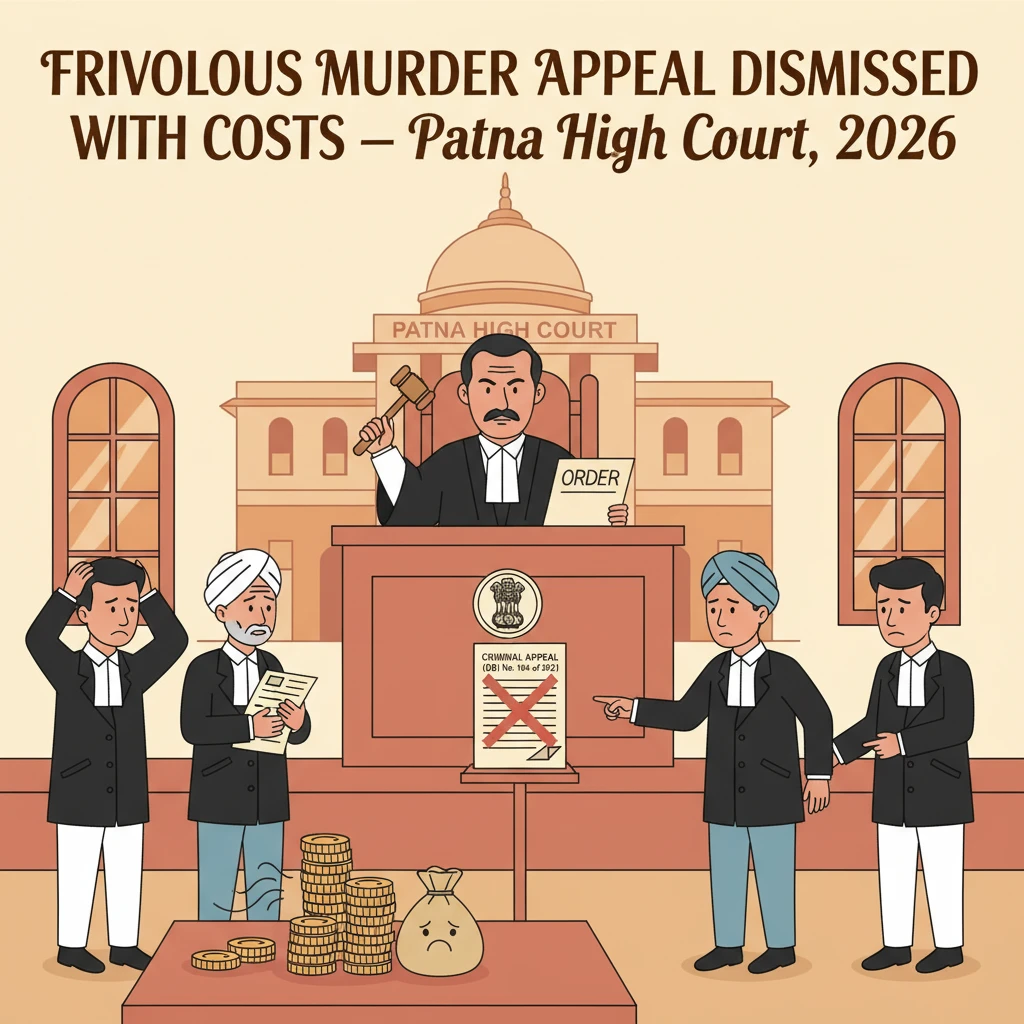
To the Court, this showed that the appeal was completely frivolous and had only wasted judicial time. To deter such misuse of the appellate process, the Patna High Court imposed a cost of Rs. 10,000 on the appellant. He was directed to deposit this amount with the Patna High Court Legal Services Committee within one month from the date of judgment.
Why This Judgment Matters
This judgment is important for families in Bihar and elsewhere who may be involved in serious criminal cases like murder. It shows that once a case is filed and goes to trial, the informant and other witnesses must cooperate with the court.
If witnesses do not appear, even after repeated summons, bailable warrants and non-bailable warrants, the court can close the evidence. Without evidence, the accused will be acquitted, however serious the original allegation may be.
The decision also sends a clear message that a person cannot first support the defence, stay away from trial and then later attack the acquittal without telling the full truth. Suppressing material facts and filing appeals without any real ground can invite monetary costs.
For lawyers and litigants, the Patna High Court has underlined that appellate courts will not interfere with a trial court acquittal in a “no evidence” case, especially where the trial judge has taken all steps required by law to bring witnesses to court.
Legal Issues and Answers
Issue: Did the trial court wrongly acquit the accused when key prosecution witnesses, including the informant, doctor and investigating officer, were not examined?
Answer: No. The Patna High Court held that the trial court had taken all legal steps to secure the presence of witnesses. With only two hearsay witnesses who did not support the prosecution and no challenge to the service of summons or warrants, it was a case of no evidence. The acquittal was upheld.
Issue: Was the criminal appeal by the informant-appellant bona fide?
Answer: No. The Court found the appeal frivolous because the appellant had earlier filed an affidavit in the trial court supporting the defence and expressing his intention not to proceed with the case, yet he suppressed this fact in the appeal. Costs of Rs. 10,000 were imposed.
Cases Cited by the Court
- No prior judgments or case law have been cited or relied upon in the text of this judgment.
Case Details
Case Number: Criminal Appeal (DB) No. 184 of 2021
Case Title: Ram Akbal Yadav @ Ram Ikbal Yadav v. The State of Bihar & Ors.
Trial Court Reference: Sessions Trial No. 175 of 2017 (CIS No. 175/2017), arising out of Forbesganj (Simraha) P.S. Case No. 701 of 2016, District Araria
Citation: 2026 (2) PLJR 206
Coram: Hon’ble Mr. Justice Rajeev Ranjan Prasad and Hon’ble Mr. Justice Praveen Kumar
Date of Patna High Court Judgment: 22.01.2026
Advocates:
- For the Appellant: Mr. Jitendra Kumar, Advocate
- For the Respondent-State: Km. Shashil Bala Verma, Additional Public Prosecutor
Nature of the Case: Criminal appeal (Division Bench) against judgment of acquittal in a sessions trial for offences under Sections 302 and 201/34 IPC
Link to Judgment: Click here to view the official Patna High Court judgment
If you found this explanation helpful and wish to stay informed about
how legal developments may affect your rights in Bihar,
you may consider following Samvida Law Associates for more updates.







