
Case Background
The matter arises out of Complaint Case No. 916 of 2015, Trial No. 3067 of 2015, pending before the Sub Divisional Judicial Magistrate, Gaya.
Opposite Party No. 2, the wife, filed a complaint alleging that she was married to the petitioner. After marriage, according to her, the behaviour of the petitioner and his family members changed.
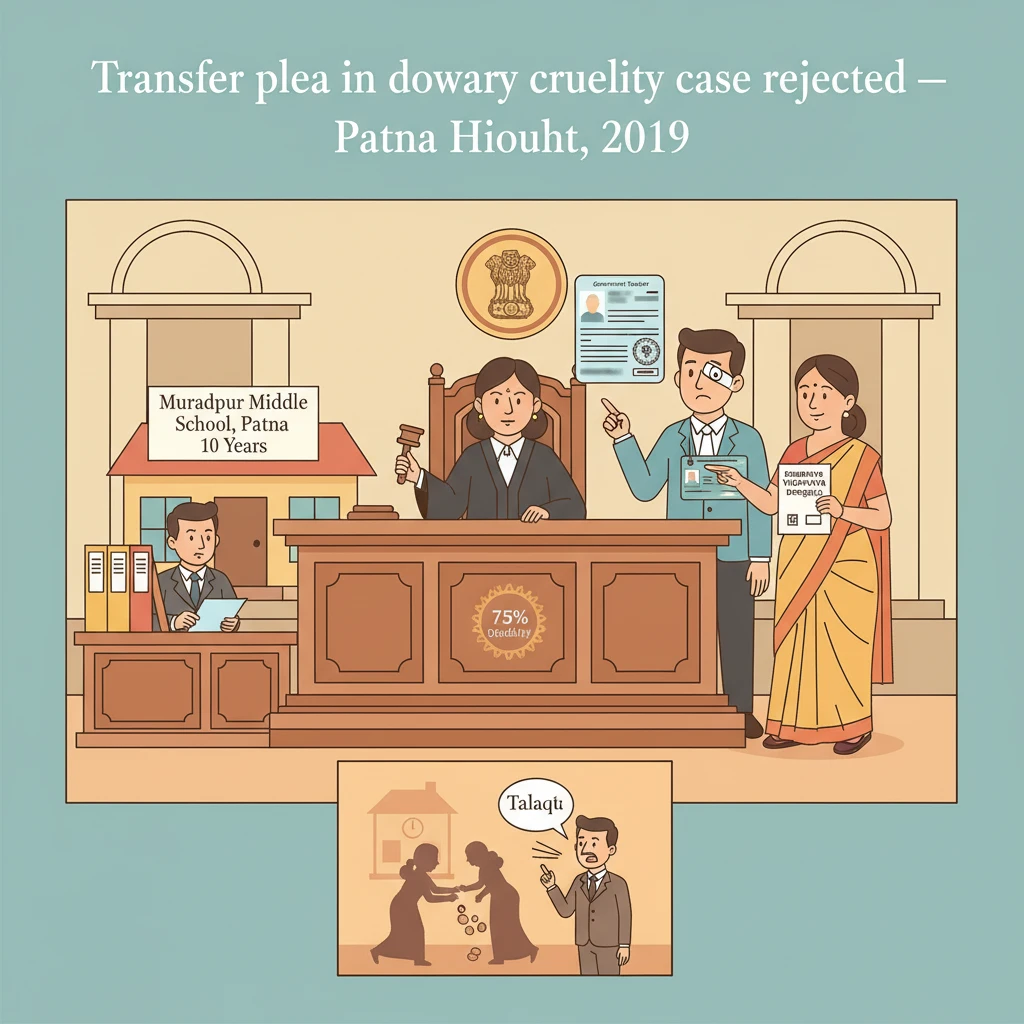
She stated that they started pressurising her to pay Rs. 20 lakhs for purchasing a flat at Patna. For this demand, she alleged that she was brutally assaulted.
She further alleged that she was thrown out of the matrimonial home after being relieved of her ornaments. She was also allegedly threatened that Talaq would be pronounced against her. On these allegations, the criminal complaint for offences under Section 498A of the Indian Penal Code and Section 4 of the Dowry Prohibition Act was filed at Gaya.
Instead of directly contesting the complaint at Gaya, the husband approached the Patna High Court by filing Criminal Miscellaneous No. 65943 of 2018. Through this, he prayed that the complaint case be transferred from the court of the Sub Divisional Judicial Magistrate, Gaya, to a court of competent jurisdiction at Patna.
What the Court Examined and Decided
The Patna High Court, presided over by Hon’ble Mr. Justice Vinod Kumar Sinha, examined only one question: whether there were sufficient grounds to transfer the criminal case from Gaya to Patna.
The petitioner’s main basis for seeking transfer was his alleged physical incapacity due to an eye disease. He claimed that he was suffering from “Herido Macular Degeneration” and was under treatment at Sankara Nethralaya, Chennai.
He further asserted that he had poor visibility and that a Medical Board headed by the Civil Surgeon, Patna, had certified that he suffered from 75% disability. On this basis, he said he found it difficult to travel to Gaya to attend court and participate in the criminal proceedings.
The petitioner added a second ground. He stated that the complainant wife, Opposite Party No. 2, had been transferred to Kendriya Vidyalaya, Deoghar. Therefore, according to him, she would not face any difficulty if the case were transferred to a competent court at Patna or even to Deoghar.
On the other side, counsel for Opposite Party No. 2 appeared and filed a counter affidavit opposing the transfer. She did not dispute the existence of the medical certificates but challenged the way they were being used to avoid the Gaya court.
She pointed out that the petitioner was employed as a government teacher at Muradpur Middle School, Bankipur, Patna. He had been teaching there for 10 years and had never sought assistance from anyone in performing his duties.
To support her stand, Opposite Party No. 2 also filed photographs of the petitioner to show that he had no difficulty in moving about. In her view, the claim of physical incapacity was not genuine enough to justify a transfer.
On her own situation, Opposite Party No. 2 clarified that she had earlier been serving at Jawahar Nagar Kendriya Vidyalaya, Sutihara, Sitamarhi. She had been transferred in November 2017 to Kendriya Vidyalaya, Danapur.
Although now posted near Patna, she stated that she was living alone. She expressed fear of the petitioner, calling him a local resident of Patna. She alleged that he had been misusing legal processes by causing several cases or complaints to be filed against her and her family members, including even her younger brother who lives abroad.
Because of this, she said she would not be comfortable if the case were shifted to Patna. She also pointed out another practical difficulty. All her witnesses belong to Gaya. Transferring the case to Patna would put physical and financial strain on them and on her, as they would all have to travel and bear the cost.
She further submitted that, in any event, the petitioner was not a helpless litigant. According to her, he was actively contesting several cases in the lower courts, the High Court and even the Supreme Court. In these circumstances, she urged that there was no justification for shifting this particular complaint from Gaya.
The High Court heard both sides and perused the record, including the medical documents relied upon by the petitioner. The Court accepted that the petitioner had been certified to have 75% disability and was suffering from an eye disease.
However, the Court also noted that the petitioner did not deny that he had been working as a teacher in Patna for the last 10 years. He was performing his duties without any assistance from others. This showed that, despite his eye disease, he was able to manage daily activities and employment.
The Court observed that the disease was not of such nature that the petitioner was unable to move out of Patna. In other words, while he had a certified disability, there was no material to show that he was practically incapable of travelling to Gaya for court dates.
The Court also considered the position of the complainant wife. Though she had been transferred to Danapur, her witnesses were residents of Gaya. She was residing alone at Patna and had expressed fear of harassment at the hands of the petitioner, who was a local resident there.
The Court recalled the settled principle that, while deciding an application for transfer of a criminal case from one place to another, the convenience of both parties and the convenience of witnesses must be taken into account.
Applying this principle to the present facts, the Court found that the balance of convenience did not support the petitioner. The complainant and her witnesses would face more hardship if the case were shifted away from Gaya.
The Court also took note of the apprehension expressed by Opposite Party No. 2 about harassment if she were required to pursue the case at Patna, where the petitioner resides. This concern was seen as an additional factor against transfer.
In the end, the Patna High Court concluded that the grounds put forward by the petitioner were not strong enough. Despite the medical certificates, his regular employment and active litigation elsewhere showed that he could attend the Gaya court.
Therefore, the Court held that the transfer application was devoid of merit. The prayer to move Complaint Case No. 916 of 2015 from Gaya to Patna was rejected.
Along with dismissing the application, the High Court issued a further direction to the trial court. The learned Sub Divisional Judicial Magistrate, Gaya, was instructed to expedite the trial of the complaint case.
Why This Judgment Matters
This judgment is important for complainants in dowry and cruelty cases who fear that the accused may use transfer petitions to delay proceedings or to shift the case to a place favourable to them.
The Patna High Court has shown that even where an accused produces disability certificates, the Court will look at his actual functioning in daily life. If he is able to work and travel, mere medical papers will not be enough to move a case.
The decision also underlines that the convenience of the complainant and the witnesses is crucial. The Court refused to disturb a case pending at the place where all prosecution witnesses live, especially when the complainant is already residing alone and has expressed fear of the accused in his home town.
For women facing dowry harassment, this judgment offers some assurance that criminal proceedings will generally remain where the alleged offence and witnesses are, unless there are very strong reasons to shift them.
Legal Issues and Answers
-
Issue: Should Complaint Case No. 916 of 2015, pending before the Sub Divisional Judicial Magistrate, Gaya, for offences under Section 498A IPC and Section 4 of the Dowry Prohibition Act, be transferred to a court of competent jurisdiction at Patna on the ground of the husband’s eye disability and the wife’s transfer?
Answer: No. The Patna High Court held that the petitioner’s disability did not prevent him from travelling, he was working as a teacher in Patna without assistance, the complainant and her witnesses were based in Gaya, and she feared harassment at Patna. Considering the overall convenience of parties and witnesses, the Court dismissed the transfer application and directed the trial court at Gaya to expedite the case.
Cases Cited by the Court
- The judgment does not mention or rely upon any specific prior case law by name or citation.
Case Details
Case Number: Criminal Miscellaneous No. 65943 of 2018, arising out of Complaint Case No. 916 of 2015, Trial No. 3067 of 2015, P.S. Case No. 916 of 2015, P.S. Civil Line, District Gaya.
Case Title: Feroze Anwar @ Firoze Anwar @ Firoz Anwar @ Forze Anwar v. The State of Bihar & Shabina Azzhar
Coram: Hon’ble Mr. Justice Vinod Kumar Sinha
Citation: 2019(2) PLJR 996
Advocates: Mr. Pritish Kumar Lal for the petitioner; Dr. Mrityunjaya Kr. Gautam for the opposite party
Nature of the Case: Criminal miscellaneous application seeking transfer of a pending complaint case under Section 498A IPC and Section 4 of the Dowry Prohibition Act from Gaya to Patna
Link to the Judgment: Full text of Patna High Court judgment
If you found this explanation helpful and wish to stay informed about
how legal developments may affect your rights in Bihar,
you may consider following Samvida Law Associates for more updates.







