
Case Background
The case arose from a tax assessment under the Bihar Value Added Tax Act, 2005 concerning a proprietary firm, M/s Ganesh Traders, Munger.
The firm had been registered under the Bihar Value Added Tax Act, 2005 on an application made by the original proprietor, the husband of the present petitioner. A registration certificate was issued in his name on 26.02.2005, bearing Taxpayer Identification No. 10560654035.
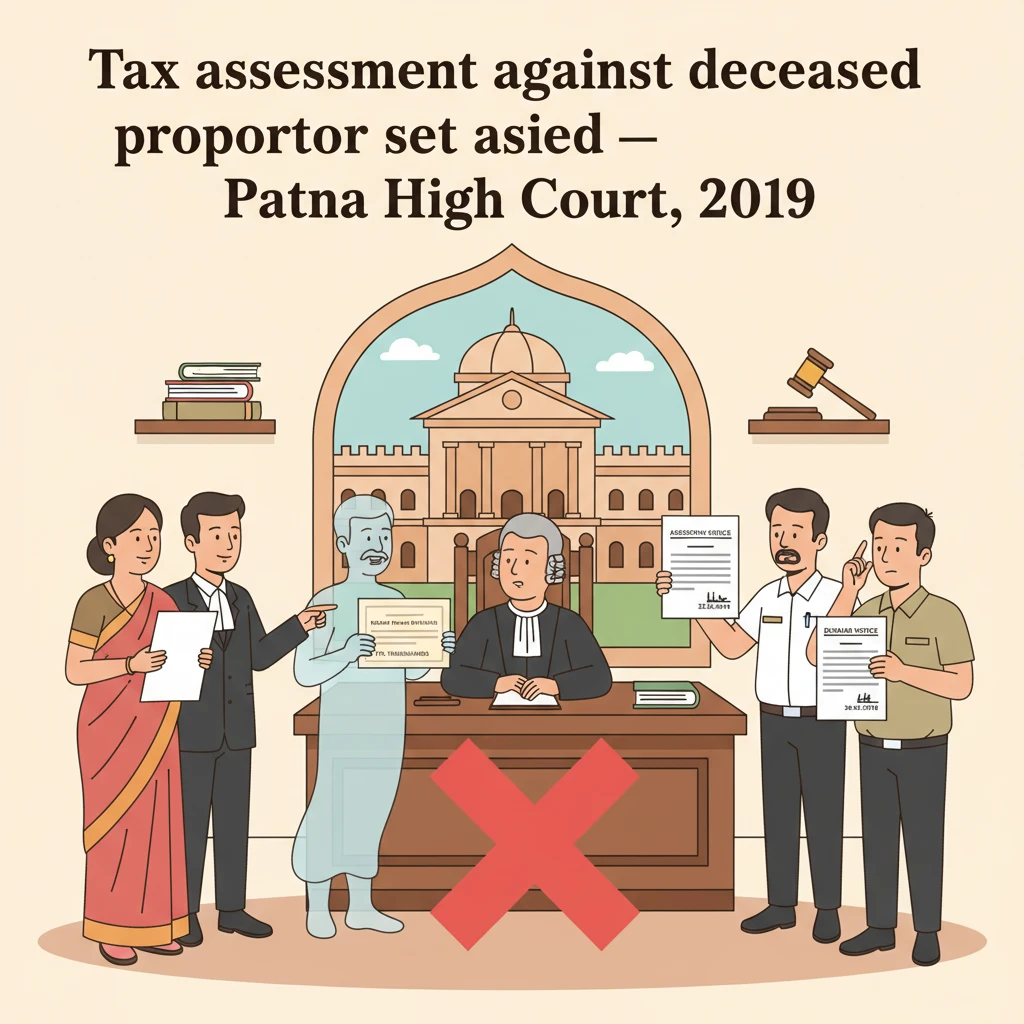
The original proprietor of the firm, Kedar Prasad Keshri, died on 06.10.2017. Despite his death, the tax authorities issued a notice dated 04.12.2017 initiating assessment proceedings. Thereafter, an assessment order was passed on 30.03.2018 by the Commercial Taxes Officer, Munger Circle, Munger under Section 31 of the Bihar Value Added Tax Act, 2005.
On the basis of this assessment, a demand notice dated 22.12.2018 was issued. These documents were placed before the Patna High Court as Annexures 3 and 4 to the writ petition. The reasons recorded by the authority, at Annexure 1 to the writ petition, themselves mentioned that the proprietor had already died on 06.10.2017 and that the assessment order was passed ex parte in his absence.
Aggrieved by the ex parte assessment order and the consequent demand notice issued in the name of her deceased husband, the widow and present proprietor approached the Patna High Court under its civil writ jurisdiction.
What the Court Examined and Decided
The Bench, comprising Hon’ble Mr. Justice Jyoti Saran and Hon’ble Mr. Justice Arvind Srivastava, heard Mr. Jyoti Ranjan Jha for the petitioner and Mr. Vikash Kumar, Standing Counsel 11, for the State.
The Court noted at the outset that, in view of the nature of the order it proposed to pass, it was not necessary to go into the full merits of the tax dispute. Instead, it focused on a basic but critical question: could an assessment order be legally passed against a proprietor who had already died before the notice and assessment?
On behalf of the petitioner, it was submitted that:
First, the registration certificate under Section 19 of the Bihar Value Added Tax Act, 2005 had been granted in the name of the husband on 26.02.2005, with a specific Taxpayer Identification Number.
Second, the notice initiating the assessment, annexed as Annexure 2, was issued on 04.12.2017, about two months after the proprietor’s death on 06.10.2017.
Third, despite being informed in the record that the proprietor had already died, the authority proceeded ex parte and passed an assessment order dated 30.03.2018 in his name and then followed it with a demand notice dated 22.12.2018.
On behalf of the State, Standing Counsel 11 relied on Section 64(2) of the Bihar Value Added Tax Act, 2005. He argued that:
The default, if any, lay with the petitioner, because she should have informed the Commercial Taxes Department about the death of the registered proprietor and taken steps to get the registration amended.
According to him, once a firm files its returns, it admits certain tax liabilities. After assessment under the Act, this liability may increase. If, in the meantime, the assessee dies, the additional liability is to be borne by the legal representatives or heirs of the deceased, in terms of the statutory provision.
He emphasised that, under Section 64(2), the assessing authority is empowered to proceed against the legal representative or heir of a deceased assessee to recover tax dues.
However, he did not dispute the legal position that no order of assessment could have been passed against a deceased proprietor of a firm.
After hearing both sides, the Patna High Court recorded two important points.
First, there is a clear statutory scheme under the Bihar Value Added Tax Act, 2005, particularly Section 64, which allows the assessing authority to proceed against the legal representative or heir of a deceased assessee. Thus, the law does not leave the State without a remedy when an assessee dies; it simply requires the authorities to proceed against the correct person, namely, the legal heir.
Second, in this case, it was undisputed that the impugned assessment order had been passed in the name of the deceased proprietor. Not only had he died before the assessment order, he had also died even before the issuance of the show cause notice dated 04.12.2017.
The Court then examined whether the failure of the widow to promptly inform the department about the death of her husband could save the assessment. The State had tried to place the blame on the petitioner by arguing that she had not fulfilled her duty under Section 64(2) to notify the department and take steps for amendment of registration.
The Court accepted that there might be some default on her part in not informing the department. However, it made it clear that such default could not cure the fundamental defect in the proceedings.
The defect, in the view of the Court, was that the assessment order and demand notice were issued against a person who was no longer alive. Even if one accepted the State’s objection regarding the petitioner’s default, that fact did not give legal sanctity to an order passed against a dead person.
The Court therefore concluded that the assessment order dated 30.03.2018 and the consequential demand notice dated 22.12.2018, being issued against the deceased proprietor, were unsustainable in law.
Instead of leaving the matter there, the Court also ensured that the department would still be able to proceed lawfully to determine any tax dues. It held that the assessing authority was well within its jurisdiction to proceed against the legal representative or heir of the deceased assessee in accordance with Section 64 of the Act.
Accordingly, the Court quashed and set aside the assessment order at Annexure 3 and the demand notice at Annexure 4. It remitted the matter to the Commercial Taxes Officer, Munger Circle, Munger.
The Commercial Taxes Officer was directed to proceed afresh, strictly in accordance with Section 64 of the Bihar Value Added Tax Act, 2005. The Court fixed a specific date and time for the petitioner’s appearance: she was required to appear, either personally or through her representative, on or before 06.05.2019 at 11:00 a.m. On her appearance, the authority was to dispose of the matter in accordance with law and the stipulations indicated in the judgment.
With these directions, the writ petition was allowed.
Why This Judgment Matters
This judgment is important for small traders and family-run proprietorships across Bihar.
First, it clearly states that tax authorities cannot legally pass assessment orders in the name of a person who has already died. Any such order is liable to be set aside.
Second, it confirms that while legal heirs may bear tax liabilities of the deceased under the Bihar Value Added Tax Act, the authorities must follow the proper procedure and proceed specifically against the legal representatives or heirs, not the deceased himself.
Third, the decision shows that even if the legal heir has not promptly informed the department about a death, that omission does not validate an illegal assessment order passed against a dead person. At the same time, the case also indicates that legal heirs should regularise the registration status and cooperate with the department to avoid complications.
Practically, the judgment offers a remedy to families who receive tax notices and demands in the name of deceased traders. It signals that such orders can be challenged before the Patna High Court or the appropriate forum, and that the matter may be remitted to be decided afresh in accordance with law.
Legal Issues and Answers
-
Issue: Can a tax assessment order and demand notice under the Bihar Value Added Tax Act, 2005 be validly passed in the name of a proprietor who died before issuance of notice and completion of assessment?
Answer: No. The Patna High Court held that no order of assessment can be passed against a deceased proprietor. Such an order lacks legal sanctity and must be quashed, though the assessing authority may proceed afresh against the legal representative or heir under Section 64 of the Act. -
Issue: Does the legal heir’s failure to inform the department about the death of the proprietor validate an assessment order passed against the deceased?
Answer: No. Even if the petitioner failed to inform the department of the death, this default does not cure the defect of passing an order against a dead person, nor does it confer validity on such an order.
Cases Cited by the Court
- The judgment does not record reliance on any specific earlier case law. The Court proceeded on the basis of the statutory provisions of the Bihar Value Added Tax Act, 2005.
Case Details
Case Number: Civil Writ Jurisdiction Case No. 5492 of 2019
Case Title: M/s Ganesh Traders, Munger v. The State of Bihar & Ors.
Citation: 2019(2) PLJR 1049
Court: High Court of Judicature at Patna
Coram: Hon’ble Mr. Justice Jyoti Saran and Hon’ble Mr. Justice Arvind Srivastava
Date of Judgment: 15.04.2019
Advocates:
- For the Petitioner: Mr. Jyoti Ranjan Jha, Advocate
- For the Respondents (State): Mr. Vikash Kumar, Standing Counsel 11
Nature of the Case: Writ petition challenging assessment order and demand notice under Section 31 of the Bihar Value Added Tax Act, 2005, with directions regarding proceedings under Section 64 of the Act.
Key Statutory Provisions Involved: Section 31 and Section 64 (including Section 64(2)) of the Bihar Value Added Tax Act, 2005.
Link to Full Judgment: Click here to access the official Patna High Court judgment
If you found this explanation helpful and wish to stay informed about
how legal developments may affect your rights in Bihar,
you may consider following Samvida Law Associates for more updates.







