
Case Background
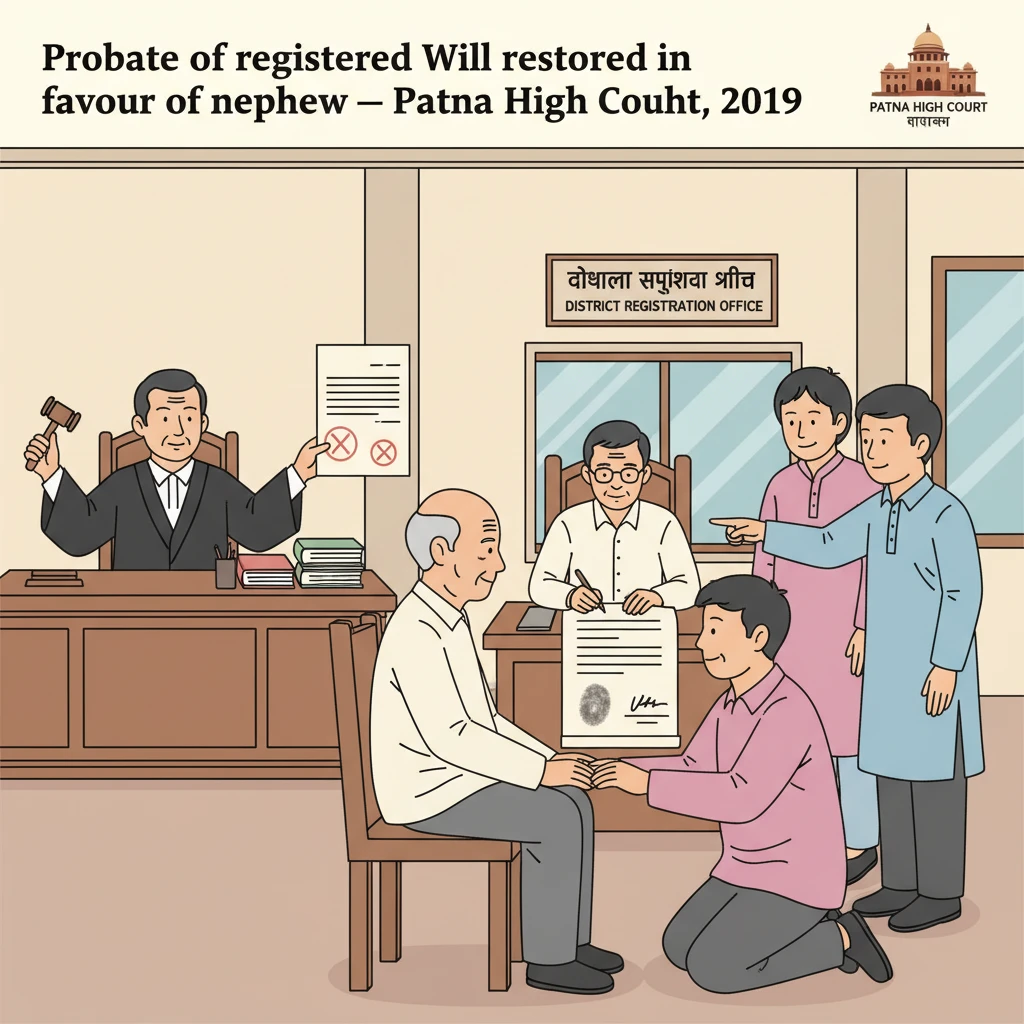
This case came to the Patna High Court as Miscellaneous Appeal No. 307 of 2011 under Section 299 of the Indian Succession Act, 1925. The appellant was Bhulan Mahto, nephew of late Tapeshwar Mahto, the testator whose Will was in dispute.
Tapeshwar Mahto had one full brother, Nageshwar Mahto. The appellant, Bhulan Mahto, is the son of Nageshwar. Tapeshwar’s own son, Chandrika Mahto, died during Tapeshwar’s lifetime, leaving behind his widow, Uma Devi, and minor daughter, Chanpatia Kumari. Uma Devi and Chanpatia were made respondents in the probate proceedings and in this appeal. The State of Bihar through the Collector, Gopalganj, was also arrayed as a respondent.
According to the appellant, after the death of Chandrika, Uma Devi remarried another person and left Tapeshwar’s house. In this situation, the appellant began to look after and care for Tapeshwar. Out of love and affection, Tapeshwar allegedly executed a registered Will on 01.06.1998 in favour of the appellant.
Bhulan Mahto filed Probate Case No. 22 of 2009 before the District Judge, Gopalganj, under Section 276 of the Indian Succession Act, seeking probate of this registered Will. On 28.02.2011, the District Judge dismissed the probate case and refused to grant probate.
Aggrieved by that decision, the appellant filed the present miscellaneous appeal before the Patna High Court. In the High Court, only the appellant appeared through learned senior counsel. No one appeared for the respondents even after valid service of notice, and it was informed that they had not appeared before the trial court either. The appeal therefore proceeded ex parte.
What the Court Examined and Decided
The High Court, through Hon’ble Mr. Justice Birendra Kumar, closely examined why the District Judge had refused probate and whether those reasons were legally sustainable.
Findings of the District Judge
The District Judge had denied probate mainly on three grounds:
First, the court below felt that certain “vital facts” were missing from the pleadings. It observed that while some facts were stated in the affidavits of witnesses, they were not specifically pleaded in the petition. The trial court said there was no averment that Tapeshwar offered to execute the Will in favour of Bhulan and that Bhulan accepted it. It also said there was no pleading that the Shraddh of Tapeshwar was performed by Bhulan, and no pleading that the Will was executed by Tapeshwar of his free will, in good mental and physical health.
Second, the District Judge noted that although Schedule 1 of the probate petition described several plots of land, the Will itself did not mention plot numbers or give detailed description of the property. This, in the court’s view, created doubt whether Tapeshwar actually intended to bequeath those properties through the Will.
Third, after examining the Will, the District Judge doubted its genuineness based on the placement of Tapeshwar’s thumb impressions (L.T.I.). It commented that on the first page, the L.T.I. was at the top of the Will, and on the second page it was on the right side and not at the end of the page. The court also stressed that the scribe of the Will and both attesting witnesses had not been examined. It concluded that mere registration could not prove that the Will was properly executed according to law.
Challenge before the High Court
Learned senior counsel for the appellant argued that the trial court’s findings were contrary to the record and the law. He pointed to paragraph 3 of the probate petition filed under Section 276, which clearly described how the Will was executed and registered.
This paragraph stated that out of love and affection, Tapeshwar executed a deed of Will in favour of the appellant on 01.06.1998 in the presence of witnesses. The Will was scribed by Rajeshwar Prasad, who read out its contents to Tapeshwar. After hearing and understanding the contents, Tapeshwar put his thumb impression on the Will in the presence of witnesses. The execution portion was written by attesting witness Chandrama Prasad (P.W.2). Both attesting witnesses, Chandrama Prasad and Sheo Gobind Bhagat, signed the Will at the instance and in the presence of Tapeshwar. Tapeshwar himself presented the Will before the Sub-Registrar, Gopalganj, and admitted its execution, after which it was duly registered.
Pleading and “missing facts”
The High Court held that this statement in the petition clearly showed that the Will was a free act of Tapeshwar and that it was executed and registered when he was in good mental and physical health. The Court emphasised that technical words used in the statute did not have to be copied word-for-word in the pleadings.
Therefore, the District Judge’s conclusion that there was no pleading about free will or disposing mental condition was termed an “error of record”. The Court also clarified that genuineness of a Will cannot be judged by who performed the Shraddh ceremony of the deceased, and that concepts of “offer and acceptance” like in contracts are irrelevant in matters of Will. Hence, the statement of P.W.2 about Tapeshwar offering and the appellant accepting had no legal importance either way.
Non-mention of property details in the Will
Regarding the absence of plot numbers in the Will, the High Court disagreed with the District Judge’s suspicion. It noted that the petition specifically stated that Schedule 1 properties were self-acquired properties of Tapeshwar, and that sale deeds in his name were produced during the probate proceedings.
The Court observed that the law does not prescribe in detail what a Will must contain, except that it should express the last desire of the testator. Non-mentioning of specific plot numbers in the Will does not, by itself, make it doubtful. Rather, when no specific property is mentioned, it can mean that all properties left by the testator are to go to the person named in the Will, subject to his title.
The High Court therefore held that the District Judge had proceeded on assumption and against the requirement of law by doubting the Will on this ground.
Execution, attestation and registration
The High Court then turned to the legal requirements for execution and proof of a Will. It referred to Section 63 of the Indian Succession Act, 1925, which lays down how an unprivileged Will must be executed and attested. It also referred to Section 68 of the Indian Evidence Act, 1872, which states that at least one attesting witness must be examined to prove a document required by law to be attested, such as a Will.
The Court reaffirmed that the initial burden is on the propounder of a Will to prove due execution and attestation, and that the testator was of sound disposing mind. However, in this case, it noted that the genuineness of the Will and the mental health of Tapeshwar had not been challenged by any party.
The Court examined the evidence of P.W.2, attesting witness Chandrama Prasad. In his deposition, P.W.2 stated that on 01.06.1998, Tapeshwar went to the Registry office in good mental and physical health to execute a registered Will in favour of the appellant. Tapeshwar voluntarily asked his scribe, Rajeshwar Prasad, to write the Will. The scribe read over the contents to Tapeshwar; after finding them correct, Tapeshwar placed his thumb impression on the document in the presence of P.W.2 and the other attesting witness, Sheo Gobind Bhagat.
P.W.2 identified Tapeshwar’s thumb impressions on the Will. He also stated that, on Tapeshwar’s request, both he and Sheo Gobind Bhagat signed as witnesses in Tapeshwar’s presence. Thereafter, Tapeshwar took the document to the Sub-Registrar and admitted execution, whereupon it was registered.
On this basis, the High Court held that the requirements of Section 63 had been complied with and that, under Section 68 of the Evidence Act, examination of one attesting witness (P.W.2) was sufficient to prove the Will. The law does not demand that both attesting witnesses or the scribe must be examined.
Thumb impressions and registration
The High Court also corrected the factual finding of the trial court regarding placement of Tapeshwar’s L.T.I. It held that Tapeshwar had put his thumb impression on each page of the Will, and on the last page he had put it at the end of the page. The District Judge had wrongly recorded that there was no L.T.I. at the end of the last page.
The Court further observed that registration of a Will by the testator himself strengthens the presumption of its genuineness and shows that he was in a sound disposing state of mind, in the absence of contrary evidence. Therefore, the trial court was wrong in doubting the Will merely because the scribe and both attesting witnesses were not examined.
Final decision
After considering the pleadings, evidence and legal provisions, the Patna High Court concluded that:
The Will dated 01.06.1998 executed by late Tapeshwar Mahto in favour of the appellant was duly executed and attested in accordance with Section 63 of the Indian Succession Act. It was also properly proved by examination of one attesting witness as required by Section 68 of the Evidence Act.
The contrary findings of the District Judge suffered from illegality and material irregularity and could not be sustained. Accordingly, the High Court set aside the impugned judgment dated 28.02.2011 in Probate Case No. 22 of 2009, allowed the miscellaneous appeal, and directed that probate be issued in respect of the registered Will executed by late Tapeshwar Mahto.
Why This Judgment Matters
This decision is important for families where property is passed on through a Will and relatives later dispute the Will or raise technical objections. The Patna High Court made it clear that courts should not reject a Will on flimsy grounds such as:
absence of ritual details like who performed Shraddh, or absence of contract-style “offer and acceptance”; or lack of minute property description, when the testator’s properties are otherwise identifiable.
For laypersons, the judgment explains that a registered Will, executed in front of witnesses and presented by the testator himself, carries strong weight. If at least one attesting witness comes to court and confirms the execution and thumb impression or signature, probate should normally be granted unless there is clear evidence of fraud, coercion or unsound mind.
For lawyers and trial courts, the ruling is a reminder to read the pleadings as a whole, not in an overly technical way, and to apply Sections 63 of the Indian Succession Act and 68 of the Evidence Act correctly. It also highlights that factual errors, like misreading where the thumb impression is placed, can wrongly affect substantive rights and must be avoided.
Legal Issues and Answers
-
Issue: Whether the registered Will dated 01.06.1998 executed by late Tapeshwar Mahto in favour of his nephew was duly executed and proved so as to warrant grant of probate.
Answer: Yes. The Patna High Court held that the Will was properly executed and attested under Section 63 of the Indian Succession Act and duly proved through one attesting witness under Section 68 of the Evidence Act. The contrary view of the District Judge was set aside and probate was directed to be issued. -
Issue: Whether absence of detailed property description in the Will and alleged gaps in pleadings could by themselves render the Will suspicious or invalid.
Answer: No. The Court held that law does not require specific plot-wise details in a Will and that the pleadings sufficiently disclosed free and voluntary execution in sound health. The trial court’s doubts based on these grounds were held to be erroneous.
Cases Cited by the Court
- No prior judicial precedents are cited or relied upon in the text of this judgment. The Court proceeds on the basis of statutory provisions alone.
Case Details
Case Number: Miscellaneous Appeal No. 307 of 2011
Case Title: Bhulan Mahto v. The State of Bihar through the Collector, Gopalganj & Ors.
Coram: Hon’ble Mr. Justice Birendra Kumar
Citation: 2019(2) PLJR 1045
Advocates: For the appellant – Mr. Shashi Shekhar Dvivedi, Senior Advocate; Mr. Parth Gaurav, Advocate. For the respondents – None appeared.
Nature of the Case: Miscellaneous appeal under Section 299 of the Indian Succession Act, 1925, against an order of the District Judge, Gopalganj, refusing probate of a Will in Probate Case No. 22 of 2009.
Link to Judgment: Patna High Court official judgment link
If you found this explanation helpful and wish to stay informed about
how legal developments may affect your rights in Bihar,
you may consider following Samvida Law Associates for more updates.







