
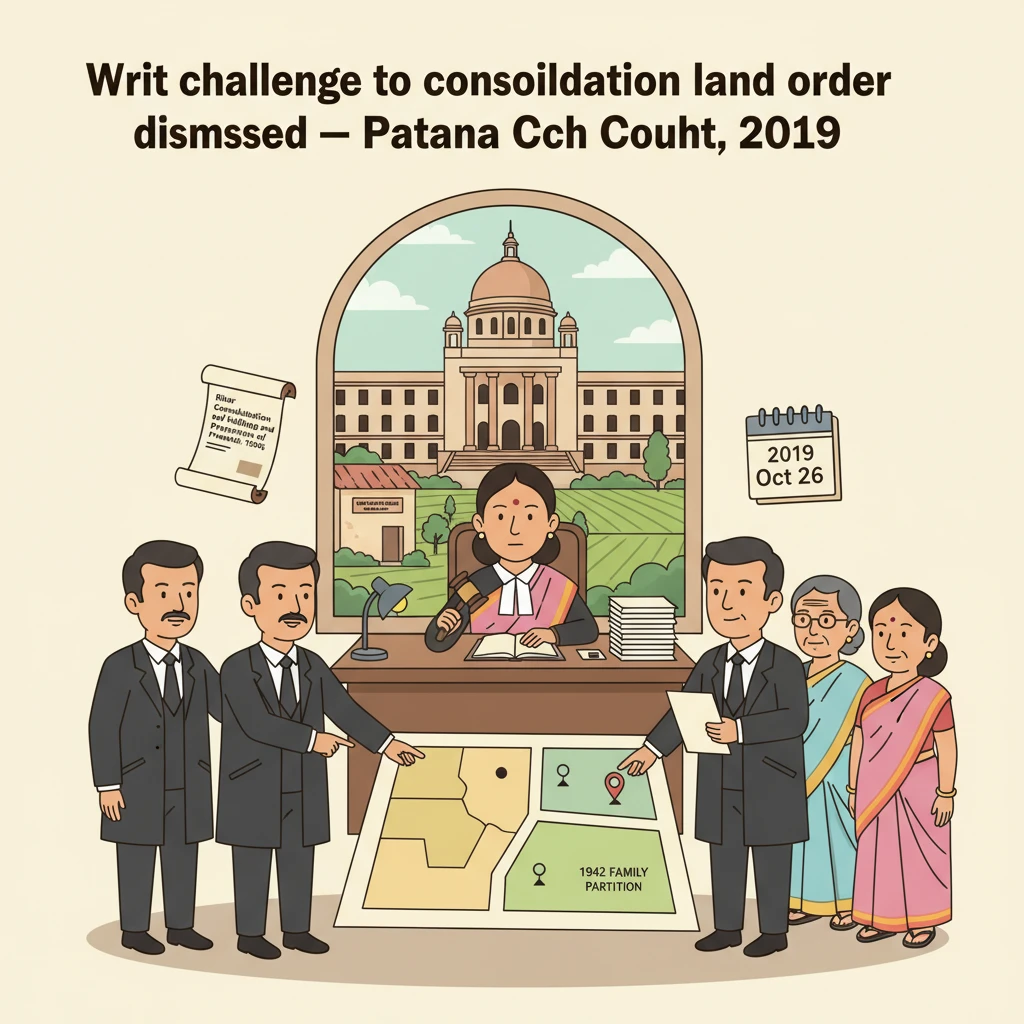
Case Background
The dispute concerns joint family agricultural land in village Ataria, P.S. Durgawati, District Kaimur at Bhabua. The land originally belonged to a common ancestor, Kallu Ahir, and measured a total of 8.71 acres in cadastral survey khata numbers 23 and 24. In the later revisional survey, this land was recorded under khata number 111.
Both petitioners and private respondents are descendants of Kallu Ahir, forming two branches of the same family. According to the petitioners, there had been a family partition in 1942. After that, they claimed to be in peaceful possession of their respective shares and asserted that the revisional survey correctly recorded 5.74 acres in the joint names of Sadho Yadav @ Sadho Ahir and Sitaram Yadav @ Sitaram Ahir.
The dispute arose during consolidation operations under the Bihar Consolidation of Holdings and Prevention of Fragmentation Act, 1956. The area had been duly notified for consolidation. During these proceedings, Sitaram Yadav @ Sitaram Ahir, ancestor of respondent no. 5, approached the Consolidation Officer at Durgawati. He alleged that, due to a mistake, more area had been recorded in the petitioners’ branch and less in his branch, contrary to what they were entitled to from the family property.
On 20.09.1989, the Consolidation Officer dismissed Sitaram’s petition, holding that no change in the revisional survey entries was necessary. Sitaram then filed an appeal before the Assistant Director of Consolidation, Rohtas at Sasaram. In Appeal Case No. 1218 of 1989–90, the Assistant Director partly allowed the appeal by order dated 28.11.1991. He directed that one more acre be entered in favour of the respondents’ branch by deducting it from the petitioners’ portion while forming chaks.
Both sides felt aggrieved. The petitioners filed Revision Case No. 691 of 1994, and the respondents filed Revision Case No. 260 of 1994, both under Section 35 of the Consolidation Act before the Director of Consolidation, Bihar, Patna. Meanwhile, respondent Kesho Yadav had also filed Partition Suit No. 3 of 1989 before the civil court. That suit could not proceed because Section 4 of the Consolidation Act bars civil court jurisdiction during consolidation operations.
On 26.10.1997, the Director of Consolidation disposed of both revision cases by a common order. He found that the respondents’ branch was entitled to more land than what was shown in the revisional survey and directed that 1.69¼ acres be given to them in addition to the 19 decimals already recorded. This is the order challenged before the Patna High Court in these writ petitions.
Civil Writ Jurisdiction Case No. 15404 of 2004 was filed on 08.12.2004, more than seven years after the Director’s order. Later, the same petitioners filed Civil Writ Jurisdiction Case No. 8077 of 2008, again challenging the same 1997 order on the ground that it dealt with two separate revisions. Both writ petitions were heard together and decided by a common judgment dated 07.05.2019.
What the Court Examined and Decided
The single judge, Hon’ble Mr. Justice Chakradhari Sharan Singh, heard Mr. Rajesh Kumar Singh and Mr. Vivekanand Singh for the petitioners, Mr. Surendra Prasad Singh for respondent no. 5, and the State counsel. The Court first noted the long delay in approaching the High Court. The first writ was filed after more than seven years from the 1997 revisional order, and the second writ after another three and a half years.
In CWJC No. 15404 of 2004, the petitioners’ only explanation for delay, as recorded in paragraph 16 of that writ petition, was that they allegedly had no information about the disposal of the revision and came to know of it only later. They then applied for a certified copy, which they received on 07.10.2004, and after that they filed the writ. The Court found this explanation neither justified nor convincing for such an extraordinary delay in invoking its writ jurisdiction under Article 226 of the Constitution.
However, before finally deciding on delay and laches, the Court examined the factual findings of the consolidation authorities. The Director of Consolidation had already recorded that the total family land from Khata Nos. 23 and 24 was 8.71 acres and that both branches descended from the common ancestor, Kallu Ahir. The genealogical table relied on in the impugned order was not in dispute between the parties.
On the petitioners’ side, it was argued that there had been a partition in 1942, after which the parties were in separate possession. They contended that:
- Sitaram Yadav @ Sitaram Ahir had sold a substantial part of his share through several sale deeds.
- Sadho Yadav @ Sadho Ahir, ancestor of the petitioners, had not sold any part of his share.
- Because of this, it was natural that Sadho held more land than Sitaram, even though both names appeared jointly in the revisional khata.
The petitioners also tried to rely on an alleged “bazidawa” (a written relinquishment) said to have been executed by Sitaram Yadav in favour of the petitioners, to argue that he had surrendered his share and therefore the survey entries in favour of the petitioners were correct.
The Director of Consolidation, however, examined the evidence led by both sides during the consolidation proceedings. He found that Sitaram Yadav had sold 2.47¼ acres of land through four sale deeds. After deducting this area from his half share of the original joint family property, Sitaram’s branch was still entitled to half of the remaining property. On this calculation, the respondents’ side was entitled to hold 1.88¼ acres of land.
But the revisional survey records showed them in possession of only 19 decimals—3 decimals in Khesra No. 537 and 16 decimals in Khesra No. 320. Therefore, the Director concluded that they had a valid claim to an additional 1.69¼ acres over and above the recorded 19 decimals.
The petitioners argued before the revisional authority that, during the 1942 family partition, the land allotted to them was of lower value, so they had received more area to balance the value. Based on this plea, the Director fashioned an equitable solution. He directed the petitioners to allow the respondents to take possession of 1.69½ acres (rounded figure) of land of minimum value, to be chosen by the petitioners according to their own conscience and consent, within one month. The Consolidation Officer, Durgawati, was directed to record this land in the respondents’ names.
As a result, Revision Case No. 260 of 1994 (filed by the respondents) was allowed and Revision Case No. 691 of 1994 (filed by the petitioners) was disposed of accordingly by the order dated 26.10.1997.
In the High Court, the petitioners launched several attacks on this order. They claimed that:
- The fact that Sitaram had executed sale deeds showed that partition had already taken place in 1942 and could not be questioned.
- As the revisional survey entries were never challenged under Sections 103 or 106 of the Bihar Tenancy Act, 1885, those entries could not be disturbed in consolidation proceedings.
- The respondents’ revision (Case No. 260 of 1994) before the Director was time-barred, as it was filed nearly three years after the Assistant Director’s order, and there was no separate order condoning the delay.
- The consolidation authorities had failed to properly consider oral and documentary evidence to show that Sitaram had sold more property and had executed a bazidawa in favour of the petitioners.
The High Court rejected these submissions. On limitation, the Court held that the petitioners were estopped from raising this plea because they themselves had filed a revision after the respondents’ revision and participated in that proceeding. Further, in their first writ petition (CWJC No. 15404 of 2004), filed seven years after the revisional order, they had not even taken any plea about limitation or absence of condonation. They raised this argument for the first time about eleven years after the order, in the second writ petition of 2008. The Court found this conduct unacceptable.
Regarding the correctness of survey entries, the Court held that the argument that entries could not be questioned in consolidation proceedings merely because no case had been filed earlier under the Bihar Tenancy Act was without substance. The Court noted that while entries in the record-of-rights enjoy a presumption of correctness, they do not themselves create title. The presumption is rebuttable, and the consolidation authorities are competent to examine evidence of actual rights and shares.
On the alleged bazidawa and claims of larger sales by Sitaram, the Court observed that the petitioners had not been able to show that they had produced convincing evidence before the consolidation authorities that Sitaram had transferred more than 2.47 acres or that the petitioners had acquired any self-acquired properties justifying their holding of extra land. The Director’s factual findings, therefore, could not be termed perverse or illegal.
The Court emphasized that there was a concurrent factual finding by the Assistant Director and the Director of Consolidation that, in the survey records, more area of the joint family land was recorded in the petitioners’ names than what they were actually entitled to. The Director’s order, passed in exercise of powers as a court under the Consolidation Act, was within jurisdiction.
On the question of delay and laches in filing the writs, the Judge relied on Supreme Court judgments, including Karnataka Power Corporation Limited v. K. Thangappan (2006) 4 SCC 322 and earlier cases like Durga Prashad v. Chief Controller of Imports and Exports (1969) 1 SCC 185. Those decisions stress that writ jurisdiction under Article 226 is discretionary and that courts must consider delay and laches, especially where the relief sought is effectively time-barred under the law of limitation.
The High Court also quoted the classic exposition on laches from Lindsay Petroleum Company v. Prosper Armstrong Hurd (1874) 5 P.C. 221, as approved in Moon Mills Ltd. v. Industrial Courts and Maharashtra State Road Transport Corporation v. Balwant Regular Motor Services. These authorities explain that where a party, by its conduct and neglect, puts the other side in a difficult position, the court may deny relief on grounds of equity.
Finally, the Court underlined the limited scope of judicial review in writ petitions. Citing Supreme Court cases like Nirmala J. Jhala v. State of Gujarat (2013) 4 SCC 301, Zora Singh v. J.M. Tandon (1971) 3 SCC 834, Tata Cellular v. Union of India (1994) 6 SCC 651, and Royal Medical Trust v. Union of India (2017) 16 SCC 605, the Court reiterated that a writ court does not sit as an appellate court to reappreciate evidence or question the sufficiency of material relied upon by a subordinate authority. Its role is supervisory, confined to examining legality, jurisdiction, and perversity.
After considering all these aspects, the Court concluded that there was no perversity, illegality, or jurisdictional error in the Director’s order. Coupled with the unexplained delay of over seven years in approaching the High Court, there was no ground to exercise writ jurisdiction.
Both CWJC No. 8077 of 2008 and CWJC No. 15404 of 2004 were therefore dismissed. No order as to costs was made.
Why This Judgment Matters
This judgment is significant for families involved in land disputes during consolidation proceedings in Bihar. It shows that once consolidation authorities have carefully examined evidence and decided on the correct share and area of each branch, the High Court will be very slow to interfere in writ jurisdiction.
The decision also warns litigants against sleeping over their rights. Waiting for seven years or more before challenging an order, without a strong and specific reason, can lead to dismissal of the case, even if some arguable points exist. Courts expect parties to be vigilant and to act promptly after an order affects their land.
For people relying on survey records, the case clarifies that entries in khata or khesra may carry a presumption of correctness but are not final proof of title. If evidence shows that one branch is entitled to a larger share, consolidation officers and higher authorities can correct the records, even if no earlier case was filed under the Bihar Tenancy Act.
Lastly, the judgment reminds readers that the High Court in its writ power does not re-try the case. It does not call witnesses or re-check each document. If the lower authority has applied the law properly and considered evidence, the High Court will normally uphold that decision.
Legal Issues and Answers
Issue: Whether the Patna High Court should interfere under Article 226 with the Director of Consolidation’s 1997 order reallocating land shares between two branches of a joint family.
Answer: No. The Court held that the Director’s order was within jurisdiction, based on proper appreciation of evidence, and disclosed no perversity or illegality.
Issue: Whether the long delay of more than seven years in filing the first writ petition justified refusal of relief on grounds of laches.
Answer: Yes. The Court held that the explanation for delay was unsatisfactory and, following Supreme Court guidance on laches, treated delay as an important ground for declining to exercise writ jurisdiction.
Issue: Whether revisional survey entries unchallenged under Sections 103/106 of the Bihar Tenancy Act could still be questioned in consolidation proceedings.
Answer: Yes. The Court held that records-of-rights enjoy only a rebuttable presumption of correctness and do not create title, so consolidation authorities could re-examine and correct entries based on evidence.
Issue: Whether the respondents’ revision before the Director was barred by limitation and hence not maintainable.
Answer: The Court refused to entertain this objection, holding that the petitioners were estopped after themselves filing a revision and that they had not raised such a plea in the first writ petition filed in 2004.
Cases Cited by the Court
- Karnataka Power Corporation Limited through its Chairman and Managing Director and Others v. K. Thangappan and Another, (2006) 4 SCC 322
- Durga Prashad v. Chief Controller of Imports and Exports, (1969) 1 SCC 185
- Lindsay Petroleum Company v. Prosper Armstrong Hurd etc., (1874) 5 P.C. 221
- Moon Mills Ltd. v. Industrial Courts, AIR 1967 SC 1450
- Maharashtra State Road Transport Corporation v. Balwant Regular Motor Services, AIR 1969 SC 329
- Nirmala J. Jhala v. State of Gujarat, (2013) 4 SCC 301
- State of T.N. v. S. Subramaniam, (1996) 7 SCC 509
- R.S. Saini v. State of Punjab, (1999) 8 SCC 90
- Government of A.P. v. Mohd. Nasrullah Khan, (2006) 2 SCC 373
- Zora Singh v. J.M. Tandon, (1971) 3 SCC 834
- Tata Cellular v. Union of India, (1994) 6 SCC 651
- Royal Medical Trust v. Union of India, (2017) 16 SCC 605
Case Details
Case Numbers: Civil Writ Jurisdiction Case No. 8077 of 2008; Civil Writ Jurisdiction Case No. 15404 of 2004
Case Title: Budhu Yadav & Ors v. State of Bihar & Ors (in both writ petitions, with common parties)
Citation: 2019 (2) PLJR 1206
Coram: Hon’ble Mr. Justice Chakradhari Sharan Singh
Advocates:
- For the Petitioners: Mr. Rajesh Kumar Singh, Advocate; Mr. Vivekanand Singh No.-1, Advocate
- For Respondent No. 4: Mr. Surendra Prasad Singh, Advocate
- For the State (in CWJC No. 8077 of 2008): G.P.-6
- For the State (in CWJC No. 15404 of 2004): G.P.-7
Nature of the Case: Writ petitions under Article 226 of the Constitution challenging a common revisional order passed under Section 35 of the Bihar Consolidation of Holdings and Prevention of Fragmentation Act, 1956, relating to correction of land records and allocation of shares during consolidation proceedings.
Date of Patna High Court Judgment: 07.05.2019
Impugned Order: Common order dated 26.10.1997 passed by the Director of Consolidation, Bihar, in Revision Case No. 260 of 1994 and Revision Case No. 691 of 1994
Link to Judgment: Patna High Court Judgment – CWJC No. 8077 of 2008 with CWJC No. 15404 of 2004
If you found this explanation helpful and wish to stay informed about
how legal developments may affect your rights in Bihar,
you may consider following Samvida Law Associates for more updates.







