
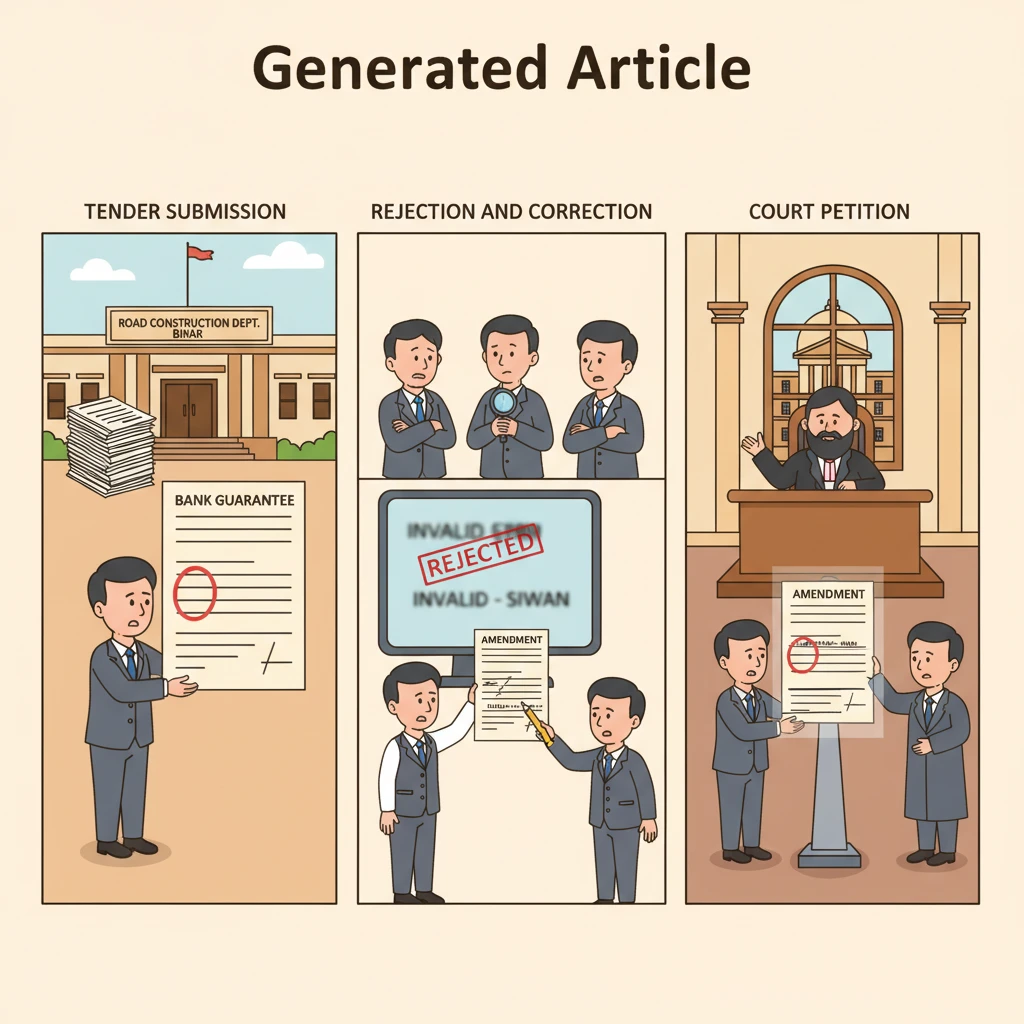
The Patna High Court held that this minor error could not be used to reject the contractor’s technical bid.
The Court ordered the authorities to open and evaluate the contractor’s technical bid, and if eligible, to also open the financial bid.
The issue of alleged blacklisting was kept open for later, if needed.
Case Background
The case arose from a Notice Inviting Tender (NIT) No.19/2018-19/RCD/Purnia dated 05.01.2019 issued by the Executive Engineer, Road Construction Department, Road Division, Purnia. The work was for widening and strengthening the Dhamdahad (Nehru Chowk) to Bihariganj Border via Barhara Kothi road from KM 0.00 to 20.25, with an estimated cost of Rs. 9268.91702 lakhs.
The petitioner, a private limited company engaged in execution of works contracts in several States including Bihar, submitted its bid. For the earnest money deposit (EMD), it furnished a bank guarantee of Rs. 1,02,70,000 dated 08.02.2019 issued by Axis Bank, Siliguri. The guarantee was meant to be in favour of the Executive Engineer, Road Construction Department, Road Division, Purnia.
When the technical bids were opened, the petitioner discovered from the Road Construction Department’s website that its bid had not been accepted. The website recorded the reason: the bank guarantee had been pledged in favour of the Executive Engineer, Road Construction Department, Road Division, Siwan, so the EMD was treated as not valid.
On learning this, the petitioner immediately approached the Principal Secretary of the Department and the Executive Engineer, Road Division, Purnia on 13.02.2019. It pointed out that in the first two pages of the bank guarantee, the beneficiary was correctly shown as Executive Engineer, Road Division, Purnia, and that only on the third page, due to a typographical error, “Road Division, Siwan” was printed instead of “Road Division, Purnia”.
On the same date, Axis Bank issued an amendment letter addressed to the Executive Engineer, Road Division, Purnia, clarifying that the words “Road Division, Siwan” in page 2, paragraph 2, line 8 of the guarantee should be read as “Road Division, Purnia”. All other terms and conditions of the original guarantee remained unchanged.
Despite these clarifications, the authorities did not authorise opening of the petitioner’s technical bid. Aggrieved, the petitioner moved the Patna High Court under its civil writ jurisdiction.
What the Court Examined and Decided
The petitioner asked for directions to treat its EMD as valid, to declare its disqualification illegal and arbitrary, and to open its financial bid along with other bidders if it was otherwise qualified. The central grievance was that a mere typing error committed by the bank was being used to shut the petitioner out of the tender process.
On 15.02.2019, during the pendency of the writ, the Court passed an interim order. Recognising that the discrepancy had been corrected by the bank and appeared to be a typographical error, the Court directed that, subject to the final result of the writ application, the petitioner’s financial bid should also be opened and considered by the State authorities.
After this, the petitioner filed an interlocutory application to amend the relief portion, specifically seeking a declaration that the rejection or non-consideration of its technical bid on the ground of a technical defect in the EMD was illegal and arbitrary.
The State respondents, in their counter affidavit, defended the rejection. They said that when the EMD document uploaded with the e-tender was examined, it appeared that the bank guarantee had not been pledged in favour of the Executive Engineer, Road Division, Purnea, and therefore was not in terms of the NIT. As a result, the petitioner’s bid was “not authorised” and its technical bid was not opened. They further argued that in the e-tender system, uploaded documents cannot be rectified after the last date of uploading.
The State also filed a supplementary counter affidavit stating that no steps had been taken to open the financial bids and that the process was on hold awaiting further directions from the Court. An interlocutory application was moved for modification or recall of the interim order dated 15.02.2019.
Justice Rajeev Ranjan Prasad then examined the bank guarantee in detail. He found that:
• The covering letter of the bank guarantee clearly stated that the guarantee was issued “in your favour” and was addressed to the Executive Engineer, Road Division, Purnea.
• The first page of the guarantee deed, printed on a stamp paper of Rs.100, was also correctly addressed to the Executive Engineer, RCD, Road Division, Purnea, and bore the same guarantee number as the covering letter.
• The only mistake appeared in paragraph 2 on page 2 of the deed, where the District name of the division was mentioned as “Siwan” instead of “Purnea”.
The Court observed that this discrepancy was clearly a typing error while entering the name of the beneficiary. The name of the work mentioned in the guarantee was the very same work for which the tender had been issued.
In the Judge’s view, this kind of error did not render the bank guarantee invalid or unexecutable. The covering letter’s use of the phrase “in your favour” and consistent reference to the Executive Engineer, Road Division, Purnea, along with the clear description of the work, showed the bank’s binding commitment to pay the guaranteed sum to that specific beneficiary.
The Court noted that the petitioner had acted promptly. As soon as it saw the rejection reason on the website screenshot, it submitted representations to both the Executive Engineer and the Principal Secretary on 13.02.2019, along with the amendment letter issued by Axis Bank correcting the error.
Importantly, it was an admitted position that financial bids of none of the tenderers had been opened till then. Therefore, the Court saw no prejudice to the tender process if the petitioner’s technical bid was now opened and evaluated on merits.
The Judge relied on two key Supreme Court decisions.
First, in Tata Cellular v. Union of India (AIR 1996 SC 11), the Supreme Court had laid down that even in contractual matters like government tenders, courts can exercise judicial review to prevent arbitrariness, favouritism or Wednesbury unreasonableness. The Patna High Court reproduced extensive passages explaining that a court can interfere where a public authority has ignored relevant factors, considered irrelevant ones, or arrived at a decision that no reasonable authority could reach.
Second, in Poddar Steel Corporation v. Ganesh Engineering Works (1991) 3 SCC 273, the Supreme Court held that all tender conditions are not of the same type. Some are “essential conditions of eligibility” that must be strictly enforced. Others are “ancillary or subsidiary” conditions where minor technical irregularities may be waived if the main object of the condition is fulfilled. In Poddar Steel, the Court accepted a certified cheque of a bank other than State Bank of India as sufficient earnest money, because the basic purpose of securing payment had been achieved.
Applying these principles, the Patna High Court reasoned that:
• The basic purpose of the EMD condition is to secure the State against default, by ensuring there is a valid and enforceable bank guarantee in favour of the correct authority for the specific work.
• In this case, that purpose was fully met. The guarantee number, description of work, and the addressee on the covering letter and first page all clearly pointed to the Executive Engineer, Road Division, Purnea. The error on page 2 was of “little or no significance” in terms of enforceability.
The Court was also not convinced by the State’s reliance on technical limitations of the e-tender system. It observed that no electronic system can be allowed to stand in the way of correcting an inadvertent human error, especially where hard copies of tender documents are still required and available.
The Judge emphasised that the electronic system is only a tool created by humans to facilitate work, not to defeat justice. A reasonable approach should be adopted so that clear typographical errors, which do not make a document ineffective, can be corrected within the period available before opening of technical bids. The Court quoted the saying “law bends before justice” to underline this approach.
On an additional point, the State argued that the petitioner had been debarred by the National Highways and Infrastructure Development Corporation Ltd. (NHIDCL), and that under the NIT conditions, debarred or blacklisted contractors were not eligible. The petitioner relied on a Patna High Court decision in HCL Infosystems v. Bihar State Electricity Board (2013(2) PLJR 753), where it was held that, without constitutional or statutory power, a public body’s blacklisting order should not automatically bind other public authorities.
However, Justice Prasad considered this issue premature. He clarified that this question would arise only if, at a later stage, the petitioner’s technical bid was rejected on the ground of blacklisting. In the present writ, the only operative reason for non-opening of the technical bid was the error in the bank guarantee. Hence he confined his decision to that point alone.
In the end, the Court allowed the writ petition. It directed the respondent authorities to open the petitioner’s technical bid. If the petitioner qualifies in the technical bid, its financial bid must be opened along with other qualified bidders. The earlier interim arrangement was thus confirmed through a final order.
Why This Judgment Matters
This judgment is important for contractors and government departments involved in public tenders, especially in Bihar. It shows that a bidder should not be disqualified merely because of a minor typing error made by a bank or another agency, if the real intention and legal effect of the document are clear.
The Patna High Court has made it clear that electronic tender systems and rigid technicalities cannot override fairness and reason. Where no prejudice is caused and the basic requirements of a tender are met, authorities should adopt a practical and just approach.
For small and medium contractors who often depend on banks and other professionals to prepare documents, this decision offers some protection: a genuine, promptly corrected mistake should not automatically cost them the chance to compete for government work.
Legal Issues and Answers
Issue: Can a government department reject a bidder’s technical bid solely because of a typographical mistake in the bank guarantee for EMD, when the mistake is later corrected and the guarantee is otherwise clearly in favour of the correct authority for the correct work?
Answer: No. The Patna High Court held that such a minor, obvious typographical error, which does not affect the validity or enforceability of the guarantee and is promptly corrected by the bank, cannot be a valid ground to refuse opening the technical bid.
Issue: Does the e-tender system prevent correction of such inadvertent errors once documents are uploaded?
Answer: No. The Court rejected this defence, holding that no electronic system can stand in the way of correcting an inadvertent error, and that a reasonable approach must be taken when hard copies and bank confirmations are available.
Issue: Was it necessary for the Court to decide, at this stage, whether an earlier debarment by another public body disqualified the petitioner from this tender?
Answer: No. The Court treated this as a premature question, to arise only if the petitioner’s technical bid is later rejected on the ground of blacklisting. The present decision is confined to the bank guarantee issue.
Cases Cited by the Court
- Tata Cellular v. Union of India, AIR 1996 SC 11 (on judicial review of government contracts and Wednesbury unreasonableness)
- Poddar Steel Corporation v. Ganesh Engineering Works and others, (1991) 3 SCC 273 (on essential and non-essential tender conditions and waiver of minor irregularities)
- HCL Infosystems v. Bihar State Electricity Board and others, 2013(2) PLJR 753 (referred to on the issue of blacklisting, though not decided in this case)
Case Details
Case Number: Civil Writ Jurisdiction Case No. 2991 of 2019
Case Title: Aarpee Infra Projects (P) Ltd. v. The State of Bihar & Ors.
Citation: 2019 (2) PLJR 1180
Coram: Hon’ble Mr. Justice Rajeev Ranjan Prasad
Date of Judgment: 29.03.2019 (CAV; CAV date 28.03.2019)
Advocates:
- For the Petitioner: Mr. Alok Kumar Agrawal, Advocate
- For the Respondents (State of Bihar and officials of Road Construction Department): Mr. Raj Ballabh Pd. Yadav, AAG-11
Nature of the Case: Writ petition (civil) challenging rejection/non-consideration of technical bid in an e-tender for road construction on the ground of alleged defect in EMD bank guarantee.
Link to Judgment: View full judgment on Patna High Court website
If you found this explanation helpful and wish to stay informed about
how legal developments may affect your rights in Bihar,
you may consider following Samvida Law Associates for more updates.







