
Case Background
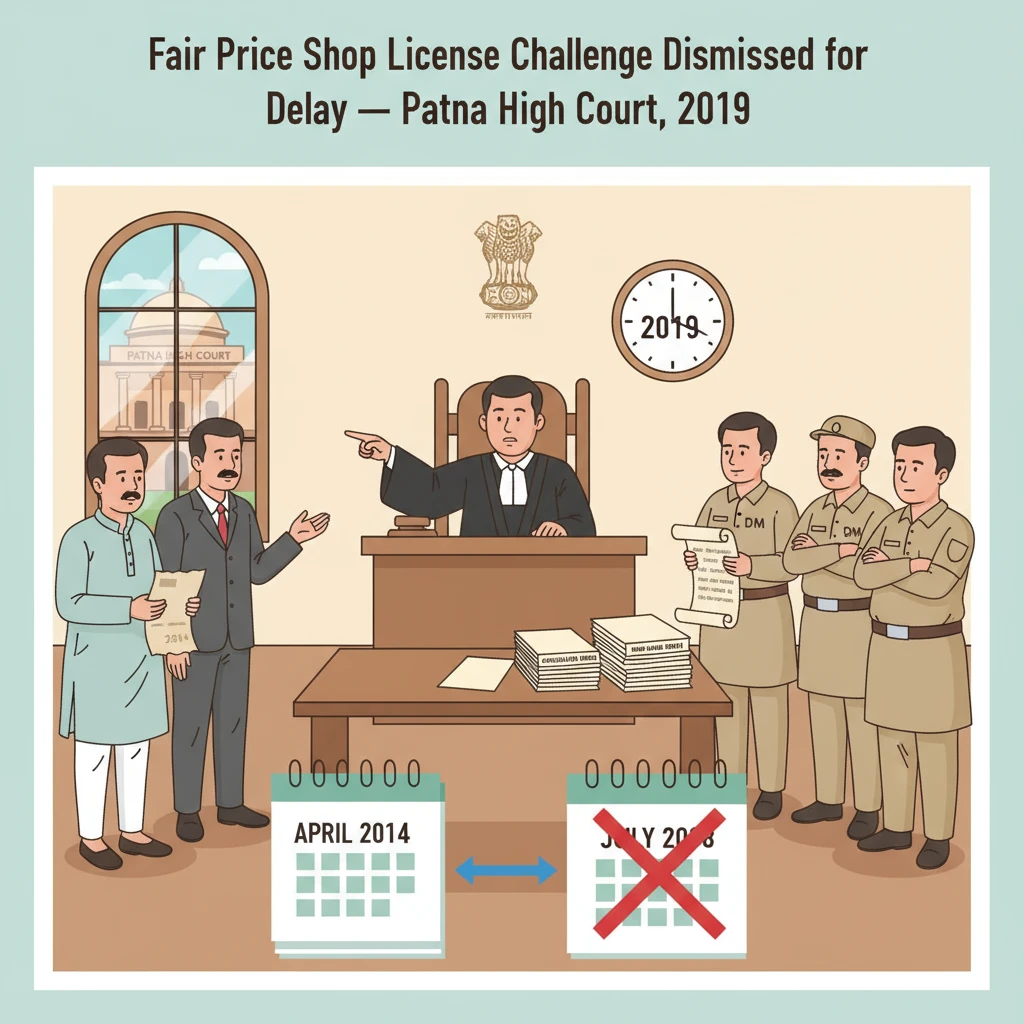
The appellant was a licence holder running a fair price shop under the Public Distribution System (PDS) in Maner, District Patna. An inspection was conducted and, after that, he was issued a show-cause notice and heard. On the basis of this process, the authorities cancelled his PDS licence by an order dated 3 April 2014.
Instead of immediately challenging the cancellation through the appeal provided under the PDS control orders, the appellant remained silent for years. Only after more than four years did he file a writ petition under Article 226 of the Constitution before the Patna High Court. That writ petition was dismissed by a learned Single Judge on the ground of laches, meaning the petition was filed after an unreasonable and unexplained delay.
The appellant then preferred the present Letters Patent Appeal (LPA No. 1050 of 2018) against the order of the learned Single Judge. The LPA came up before a Division Bench comprising Hon’ble the Chief Justice and Hon’ble Justice Smt. Anjana Mishra and was decided on 4 April 2019.
What the Court Examined and Decided
The Division Bench first recorded the appellant’s basic grievance. He claimed that his fair price shop licence was cancelled after an inspection, but the show-cause notice allegedly did not disclose the contents of the enquiry report. According to him, this failure violated the principles of natural justice. On this basis, he argued that the licence cancellation order itself was bad in law.
The appellant’s counsel tried to overcome the objection of delay by stressing procedure and fairness. He submitted that when an order is passed in violation of natural justice, courts should not dismiss a challenge only on the ground of laches. In simple terms, his argument was that a fundamentally unfair order remains illegal, no matter when it is challenged.
On the other side, the learned counsel for the State focused on the remedies already available to the appellant under the statutory scheme governing PDS licences in Bihar. He pointed out that Clause 15(i) of the Bihar Public Distribution System Control (Amendment) Order, 2011 provided a clear appeal remedy. Under this clause, a dealer aggrieved by cancellation of licence could file an appeal before the District Magistrate within 30 days from the date of receipt of the order.
The State’s stand was that if the appellant was genuinely aggrieved by the cancellation order of 3 April 2014, he should have used this statutory appeal within the 30 days’ time. By not doing so and then waiting more than four years to approach the High Court under Article 226, he showed clear negligence. The State argued that the extraordinary writ jurisdiction should not be used to help a party who has ignored an effective statutory remedy and allowed limitation to expire without any explanation.
The Court then considered changes in the legal framework. It was brought to the notice of the Bench that the 2011 Control Order had been superseded with the coming into force of the Bihar Targeted Public Distribution System Control Order, 2016 with effect from 14 March 2016. Clause 34 of the 2016 Order repealed earlier departmental notifications, including the 2011 notification.
However, the important point, as highlighted by the State and noted by the Court, was that even the 2016 Order continued to provide an appellate remedy. Under Clause 32 of the 2016 Control Order, an appeal lies before the District Magistrate. Thus, throughout, the statute provided an internal appeal mechanism against cancellation orders.
The Division Bench accepted the State’s submission that the appellant had allowed the period of limitation for this appeal to expire “without any demur”. This meant there was no protest or action on his part within the legally allowed time. In these circumstances, the Court held that the extraordinary remedy under Article 226 could not be invoked after four years, particularly in the absence of any valid explanation for such delay.
The Bench carefully examined whether there was any material on record showing why the appellant did not file an appeal in time. It found none. The judgment specifically notes that the appellant had “nowhere explained” why he chose not to file any appeal and waited for four years to directly approach the High Court. The absence of any reason for delay weighed heavily against him.
The Court also looked at another important fact appearing in the State’s counter affidavit. Paragraph 14 of that affidavit disclosed that an FIR had been lodged against the appellant, being Maner P.S. Case No. 59 of 2014, for an alleged offence under Section 7 of the Essential Commodities Act. This indicated that, besides departmental action of cancelling the licence, there were also criminal proceedings in relation to alleged irregularities concerning essential commodities.
By referring to this FIR, the Court observed that the overall picture showed serious allegations against the appellant regarding misuse or mismanagement under the PDS. In such a situation, where (a) there was a specific appellate forum provided by law, (b) the appellant did not use that forum within time, and (c) an FIR under the Essential Commodities Act was also pending, the Court found no justification for entertaining a stale writ petition.
The Division Bench agreed with the learned Single Judge that, because of laches, the writ petition was not maintainable. It further added its own reasoning that the existence and non-use of the statutory remedy was an additional and independent ground to refuse relief. Thus, even if one ignored the question of delay, the appellant’s failure to exhaust the statutory appeal was itself fatal to his case.
In effect, the Bench held that an aggrieved licence holder must first file an appeal before the District Magistrate within the period prescribed under the relevant PDS Control Order. Only in rare cases, where there are compelling reasons, can a party directly come to the High Court. Here, no such reason was shown. The plea of violation of natural justice, without any prompt action or explanation for long inaction, was not enough.
On this analysis, the Division Bench concluded that the appeal “lacks merit” and dismissed it. The order of the learned Single Judge, which had refused to interfere with the cancellation order due to laches, therefore stood confirmed. The cancellation of the appellant’s fair price shop licence remained in force.
Why This Judgment Matters
This decision is significant for all fair price shop dealers and other licence holders under the Public Distribution System in Bihar. It clearly shows that if a person’s licence is cancelled, he or she must act quickly and use the appeal provided in the PDS Control Orders.
The Patna High Court has reinforced that waiting for years and then approaching the High Court is not acceptable, especially when a clear statutory appeal is available. Even a claim of violation of natural justice will not rescue a case that suffers from unexplained delay and non-use of the proper remedy.
For ordinary citizens and small shopkeepers, the message is straightforward: when an authority cancels or suspends your licence, immediately check the law for the appeal provision and file within the allowed time. Courts are reluctant to reopen old matters where the person has slept over his or her rights.
Legal Issues and Answers
-
Issue: Can a licence holder, whose fair price shop licence was cancelled in 2014, directly approach the Patna High Court under Article 226 after more than four years without using the statutory appeal remedy?
Answer: No. The Court held that because a statutory appeal lay to the District Magistrate under the PDS Control Orders and the appellant allowed the limitation period to expire without explanation, the writ petition, filed after four years, was barred by laches and not maintainable. -
Issue: Does an allegation of violation of natural justice in the cancellation process automatically override delay and laches in filing a writ petition?
Answer: No. The Court did not accept this argument. In the absence of any prompt challenge or explanation for the long delay, and where a statutory appeal was available but not used, the plea of breach of natural justice alone could not justify entertaining the writ petition.
Cases Cited by the Court
- No earlier judgments are expressly cited or relied upon in the text of this decision.
Case Details
Case Number: Letters Patent Appeal No. 1050 of 2018 in Civil Writ Jurisdiction Case No. 11180 of 2018
Case Title: Deo Sahay Singh v. The State of Bihar and Ors
Citation: 2019(2) PLJR 1064
Coram: Hon’ble the Chief Justice Amreshwar Pratap Sahi and Hon’ble Justice Smt. Anjana Mishra
Advocates: Mr. Mukul Prasad, Advocate for the appellant; Mr. S. Raza Ahmed, A.A.G. 5 for the respondents (State)
Nature of the Case: Letters Patent Appeal against dismissal of a writ petition under Article 226 challenging cancellation of a fair price shop licence under the Public Distribution System
Relevant Statutory Framework: Bihar Public Distribution System Control (Amendment) Order, 2011 (Clause 15(i)); Bihar Targeted Public Distribution System Control Order, 2016 (Clauses 32 and 34); Article 226 of the Constitution of India; Essential Commodities Act, 1955 (Section 7)
Link to Full Judgment: Patna High Court Judgment
If you found this explanation helpful and wish to stay informed about
how legal developments may affect your rights in Bihar,
you may consider following Samvida Law Associates for more updates.







