
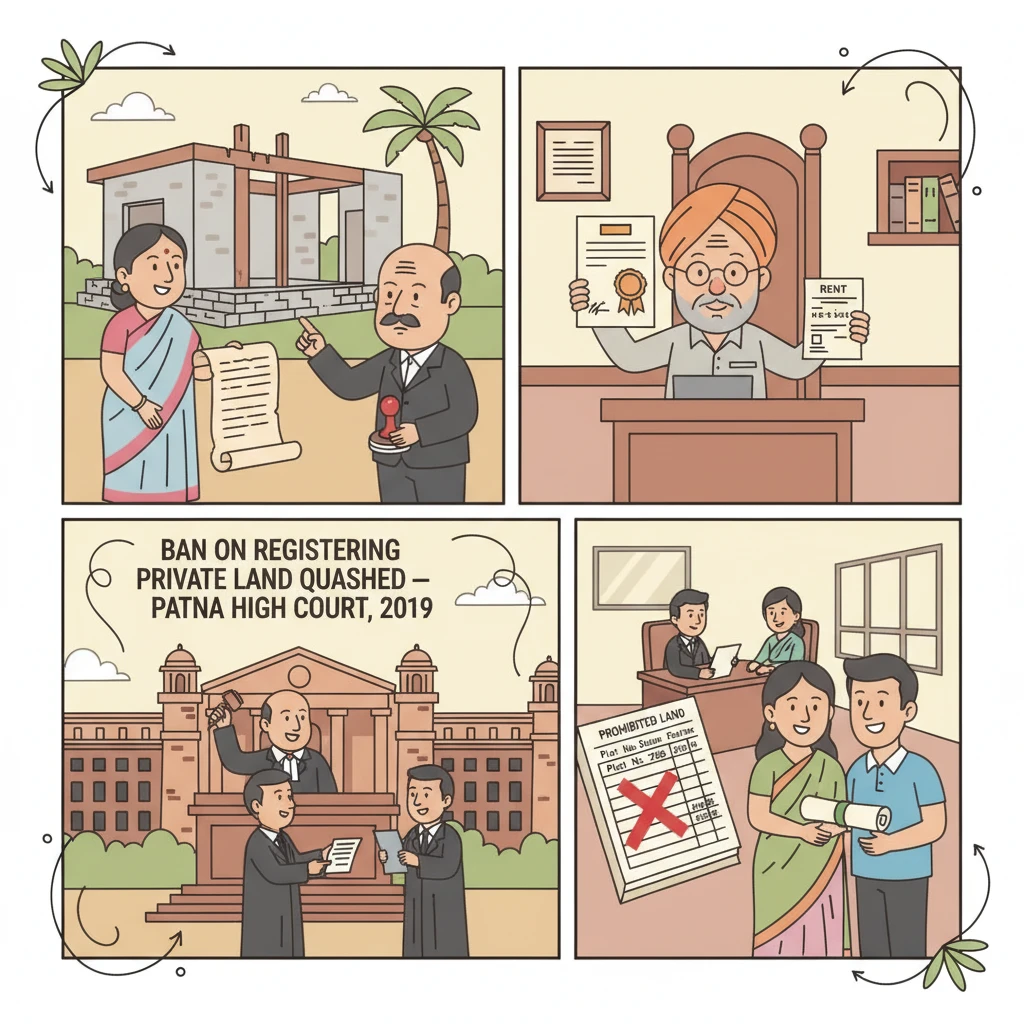
Case Background
The dispute arose over two plots of land, Plot Nos. 266 and 267, Khata No. 97, Touzi No. 929, Thana No. 198, measuring 3 katha 10 dhur in Mohalla Bahadurpur, District Samastipur.
The ancestors of the petitioners had long been in possession of these plots. In 1950, when they applied to the local Municipality for permission to construct a house, the Municipality refused. The refusal was based on an old decree in Title Suit No. 394/434 of 1939 and an alleged delivery of possession in 1942.
After learning of this old decree and “showy delivery of possession,” the ancestors filed Title Suit No. 32 of 1911/51 of 1953. They sought declaration of their title, confirmation of possession and, if needed, recovery of possession over the same land.
The civil court decreed the suit in favour of the ancestors of the petitioners. The appeal, Title Appeal No. 257 of 1954, was also dismissed, and the trial court judgment was upheld.
On 25.09.1991, relying on this decree and appeal decision, the father of petitioner no. 1 and others applied before the Circle Officer, Samastipur, for rent fixation. After issuing notice and following the legal procedure, the authority fixed rent for the land, treating it as raiyati land of the petitioners’ family.
According to the petitioners, their family has been in possession of the land for more than 50 years.
Despite this background, the land later came to be included in a government list of “prohibited land for transfer” maintained by the revenue authorities. When the petitioners tried to transfer the land by a registered sale deed, the registering authority refused permission because of this entry.
The petitioners first approached the Additional Collector, Samastipur, asking for correction of the register of “prohibited for transfer land” so that their plots would be released. Instead of ordering correction, the Additional Collector passed Memo No. 4073 dated 27.10.2018, directing an enquiry into the revenue records.
Aggrieved, the petitioners filed Civil Writ Jurisdiction Case No. 21840 of 2018 before the Patna High Court. Their original prayer was to get their land released from the notification (Annexure-3) listing it as prohibited for transfer and to allow registration of their sale deed.
During the pendency of the writ, the Additional Collector constituted a three-member committee comprising the Sub-Divisional Officer, LRDC and Circle Officer, Samastipur. This committee submitted a report on 28.11.2018 (letter no. 1672, Bhu. Su.), stating that Plot No. 266 (area 11 decimals) was recorded as “Gair Majarua Khas” in the Anchal register. It also claimed that, after zamindari abolition, such land vested in the State and that the old Title Suit and Appeal judgments were not binding on the State because the State was not a party in those cases.
In response, the petitioners filed I.A. No. 1 of 2019 to amend the writ petition. They sought quashing of the committee’s report dated 28.11.2018 and the Panji entry relating to Plot No. 266 in Halka No. 8, both reflected in Annexure-3.
What the Court Examined and Decided
The Patna High Court, through Hon’ble Mr. Justice Anil Kumar Upadhyay, examined both the long civil litigation history and the subsequent revenue actions.
The petitioners argued, through senior counsel Mr. J.S. Arora, that the revenue and registering authorities had acted without jurisdiction. Their key points were:
First, the civil court in the Title Suit and the appellate court in the Title Appeal had already declared the right, title and interest of their ancestors over the land, and had confirmed their possession. The rent fixation order in 1991, passed after notice and enquiry, further recognised their raiyati status. Therefore, the revenue authorities could not treat the land as government “Gair Majarua Khas” and could not ignore binding civil court decrees.
Second, they contended that the State was neither a necessary nor a proper party to the old Title Suit because it was not a case of fraudulent transfer where special powers like Section 4(h) of the Bihar Land Encroachment Act might be used. Even if the State felt aggrieved, its remedy lay in approaching the civil court under the Code of Civil Procedure, not in the revenue officers branding the decrees as nullities.
Third, they submitted that the decision to include their land in the “prohibited land for transfer/registration” list was taken without giving them any notice or hearing. Such action, which seriously affects civil rights, violated basic principles of natural justice and fair play.
Fourth, they argued that the Additional Collector had no authority to reopen the issue by directing an enquiry after rent fixation and mutation had been completed in their favour years ago.
Finally, they argued that the Sub-Registrar or registering authority has no power to go into questions of title. Once a document is presented with the required formalities, registration cannot be refused on suspicions about ownership.
In support, they relied on:
1. The Division Bench judgment in Bihar Deed Writers Association and others vs. State of Bihar and others, AIR 1989 Patna 144, where it was held that the registering authority is bound to register documents presented in due form and is not authorised to investigate the transferor’s title.
2. The Supreme Court judgment in Satyapal Anand vs. State of Madhya Pradesh and others, (2016) 10 SCC 767, particularly para 41, where the Court clarified that the Registering Officer’s function is administrative. He may check compliance with procedural requirements of the Registration Act, 1908 but cannot evaluate title or irregularities in the document. Title disputes must be left to civil courts.
3. The Supreme Court decision in Sultan Sadik vs. Sanjay Raj Subha and others, AIR 2004 SC 1377, cited for the principle that even an order alleged to be invalid remains effective until set aside by a competent court. Administrative authorities cannot unilaterally treat a court decree as a nullity.
The State, through the Circle Officer and learned AAG, argued that according to the three-member committee report, Plot No. 266 was recorded as Gair Majarua Khas. They contended that after vesting of zamindari such land vested in the State of Bihar and therefore the civil court decrees based on earlier records were not binding on the State, which had not been a party.
The respondents also referred to a Revenue Department letter No. 8 dated 25.08.1990 issued by the Land Reforms Commissioner. This circular dealt with protection and conservation of Aam/Khas plots and expressed concern that, with the connivance of revenue staff, Gair Majarua Aam, Khas and Kaisare Hind lands were being wrongly shown as raiyati land. It directed enquiries to check fraud, though it also stated in paragraph 10 that registers of such lands can be corrected on the basis of orders passed by competent civil courts.
After considering these materials, the High Court framed four specific issues:
(i) Whether including the petitioners’ land in the “Prohibited land for Registration” list (Annexure-3) was justified.
(ii) Whether the authorities could take such action under cover of the 25.08.1990 letter.
(iii) Whether the State was a necessary party in the earlier Title Suit and Appeal and, even if it was not a party, whether the respondents could treat those decrees as nullities.
(iv) Whether the registering authority could refuse registration when all formalities had been completed.
On the first and second issues, the Court held that there was no justification in including the petitioners’ land in the prohibited category. The Revenue Department’s own circular admitted that entries regarding Gair Majarua Aam, Gair Majarua Khas and Kaisare Hind lands can be corrected based on civil court orders. Here, civil courts had already decreed the petitioners’ title over Plot No. 266, and the rent fixation authority had acted on that basis. The revenue officers could not, in the name of the 25.08.1990 letter, sit in appeal over those judicial decisions.
On the third issue, the Court rejected the State’s argument that the civil decrees were not binding because the State was not a party. Relying on the principle from Sultan Sadik, it held that even if an order is alleged to be invalid, it continues to produce legal effects until set aside by a competent court. The revenue authorities cannot themselves declare a civil court’s decree to be a nullity.
Regarding natural justice, the Court observed that there was no material to show that any notice or hearing was given to the petitioners before their land was entered into Annexure-3. Since such inclusion visited them with serious civil consequences, the failure to provide an opportunity of hearing violated basic principles of natural justice and fair play.
On the fourth issue, about registration, the Court accepted the petitioners’ submissions based on the Division Bench and Supreme Court precedents. It held that the registering authority is not competent to examine the title of the transferor at the time of registration. Its role is confined to checking whether the deed presented is otherwise in order under the Registration Act. If someone disputes the transferor’s title, that person must approach the competent civil court for appropriate declaratory relief.
The Court also disapproved the Additional Collector’s decision directing a fresh enquiry (Annexure-7) after rent fixation and long-standing possession. It found no legal basis for reopening the matter in this manner.
In the end, the Court concluded that:
• The inclusion of the petitioners’ land in the “prohibited land for registration” list (Annexure-3) was illegal, without jurisdiction and violative of natural justice.
• The enquiry order dated 27.10.2018 (Annexure-7) and the committee’s report dated 28.11.2018 (Annexure-B/letter no. 1672) could not stand.
• The refusal by the registering authority to register the petitioners’ document merely because of the “prohibited” entry was also illegal.
Accordingly, the writ petition was allowed. Annexure-3, Annexure-B dated 28.11.2018 and Annexure-7 dated 27.10.2018 were all quashed. The Court expressly declared that, after quashing these, there would be no legal impediment in registration of the petitioners’ sale deed.
Why This Judgment Matters
This decision is important for landowners whose private land is suddenly marked as “prohibited for registration” in government records.
First, it confirms that once a civil court has declared someone’s title over land, revenue officials cannot ignore or override that decision. They must respect court decrees unless and until a higher court sets them aside.
Second, it protects citizens from secret changes in land records. The Patna High Court made it clear that the government cannot put someone’s land into a “prohibited” list without giving that person a chance to be heard.
Third, it reassures buyers and sellers that the Sub-Registrar’s job is limited. He cannot stop registration just because he doubts the title or because revenue records are disputed. Title disputes must be resolved in civil courts, not at the registration office.
For ordinary landholders in Bihar, this judgment provides a clear remedy: if their land is wrongly treated as government land or “non-registerable” despite a civil court decree in their favour, they can challenge such action in the High Court.
Legal Issues and Answers
- Issue: Could the authorities lawfully include the petitioners’ land in the “prohibited land for registration” list and refuse registration of their sale deed?
Answer: No. The Patna High Court held that this inclusion and the consequent refusal of registration were without jurisdiction, violated natural justice and ignored binding civil court decrees, and therefore had to be quashed. - Issue: Could revenue officers treat old civil court decrees as a nullity on the ground that the State was not a party and that the land was recorded as Gair Majarua Khas after zamindari abolition?
Answer: No. The Court held that revenue authorities cannot sit in appeal over civil court judgments. Even allegedly invalid orders remain effective until set aside by a competent court, and the State must seek remedy through proper civil proceedings. - Issue: Does the registering authority have power to examine and decide questions of title before registering a document?
Answer: No. Relying on earlier Patna High Court and Supreme Court judgments, the Court reaffirmed that the Registering Officer’s role is administrative. He can verify formal compliance but cannot adjudicate title disputes and must register a document that is otherwise in order.
Cases Cited by the Court
- Sultan Sadik vs. Sanjay Raj Subha and others, AIR 2004 Supreme Court 1377.
- Bihar Deed Writers Association and others vs. State of Bihar and others, AIR 1989 Patna 144.
- Satyapal Anand vs. State of Madhya Pradesh and others, (2016) 10 SCC 767.
- Vijay Kumar Prasad vs. The State of Bihar and others, 2017 (1) PLJR 818 (distinguished).
- Maya Devi and others vs. The State of Bihar and others, 2014 (3) PLJR 584 (held not applicable).
Case Details
Case Number: Civil Writ Jurisdiction Case No. 21840 of 2018
Case Title: Uma Shankar Prasad Singh & others vs. The State of Bihar & others
Citation: 2019 (2) PLJR 1077
Court: High Court of Judicature at Patna
Coram: Hon’ble Mr. Justice Anil Kumar Upadhyay
Date of Judgment: 16.04.2019
Advocates:
- For the petitioners: Mr. J.S. Arora, Senior Advocate; Mr. Uma Shankar Prasad Singh (in person).
- For the respondents: Mr. Md. Khurshid Alam, AAG-12.
Nature of the Case: Writ petition (civil) challenging inclusion of private land in list of “prohibited land for transfer/registration” and refusal of registration.
Link to Full Judgment: Click here to read the Patna High Court judgment
If you found this explanation helpful and wish to stay informed about how legal developments may affect your rights in Bihar, you may consider following Samvida Law Associates for more updates.







