
Case Background
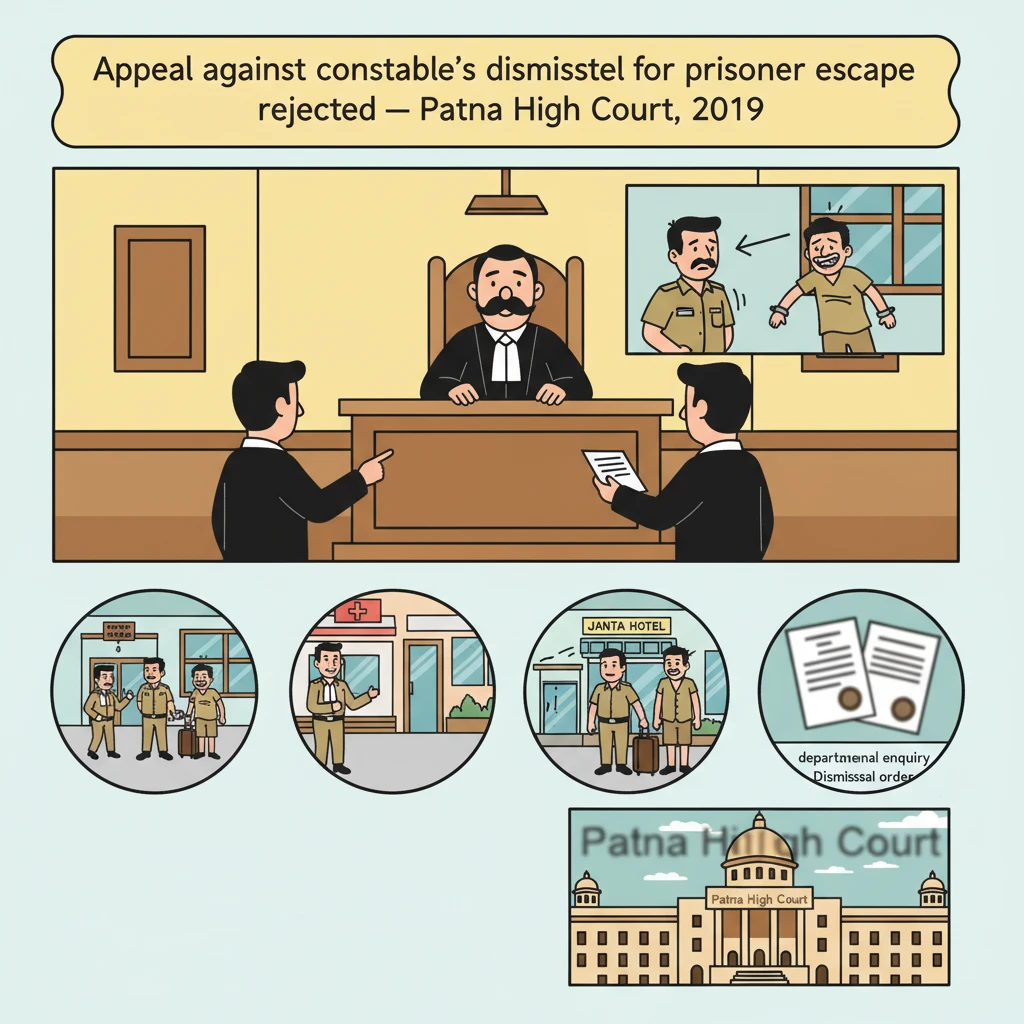
The appellant was serving as a Constable in the Bihar Police. He was entrusted with the custody of an undertrial prisoner, named in the judgment as Amit Mandal, for taking him to Patna Medical College and Hospital.
The prisoner was taken to the hospital and received outdoor treatment. However, he was not admitted as an indoor patient. Instead of taking him back to jail or to any authorised place of custody, the appellant arranged for his stay in Janta Hotel on G.M. Mitra Road, Patna.
During the enquiry that followed, it came on record that rooms in the hotel had been booked in advance. The mother and wife of the undertrial prisoner were also lodged in the same hotel. The bookings had been made even before the prisoner arrived at the hotel.
The stay of the undertrial prisoner in the hotel was admitted to have continued from 8 June 2011 to 16 June 2011. On 16 June 2011, at about 3 p.m., it was alleged that the undertrial escaped from the hotel and absconded. The authorities were informed only the next day, on 17 June 2011.
After this incident, a departmental enquiry was initiated against the appellant. A show cause notice was issued to him, and he submitted a detailed reply, which was placed on record as Annexure-6 to the writ petition.
Upon consideration of the enquiry report and the appellant’s defence, the competent authority passed an order dated 12 January 2013, dismissing him from service. His departmental appeal before the Deputy Inspector General of Police was also dismissed.
Thereafter, the appellant filed a memorial before the Director General of Police, Bihar, which also failed. He then approached the High Court in Civil Writ Jurisdiction Case No.10321 of 2014. A learned Single Judge of the Patna High Court dismissed the writ petition by judgment dated 13 December 2017, upholding the orders of dismissal.
Aggrieved by that decision, the appellant preferred the present Letters Patent Appeal No.83 of 2018 before a Division Bench of the Patna High Court.
What the Court Examined and Decided
The Division Bench, speaking through the Hon’ble Chief Justice, heard the learned counsel for the appellant and examined the impugned judgment of the Single Judge, the departmental record, and the nature of the appellant’s defence.
The core question before the Court was whether the appellant’s dismissal from service was vitiated by procedural irregularities or unfairness, and whether the finding of negligence against him was sustainable.
First, the Court noted the undisputed factual backdrop. The undertrial was not kept in any authorised lock-up or guarded premises after his outdoor treatment. Instead, he was lodged in a hotel. The stay continued for eight days, from 8 June 2011 to 16 June 2011.
The Court emphasised that the appellant did not inform his superior authorities about lodging the undertrial prisoner in the hotel. This lack of intimation was central to the finding of negligence.
In his reply to the show cause notice, the appellant had taken several defences. He argued that there was no negligence on his part. He contended that since there was no provision for admitting an undertrial prisoner as an indoor patient after outdoor treatment, he had to make arrangements to bring the prisoner back, and in the meantime, due to unavailability of any accommodation, the undertrial was lodged in the hotel.
The appellant further submitted that if he had any intention to help the undertrial to escape, he could have done so earlier and need not have waited for eight days. He also claimed that the undertrial had previously escaped, but no warning about this background was given to him by his superiors.
After the departmental proceedings, the undertrial was later apprehended from Delhi. However, the Court focused primarily on the appellant’s conduct during the crucial period when the undertrial was in his custody.
On the procedural side, the appellant raised several legal objections before the Division Bench. He argued that certain documents, particularly those relating to communications about the incident, were not supplied to him, and that witnesses were not examined in accordance with law. According to him, this amounted to a violation of procedural fairness and vitiated the enquiry.
He also invoked paragraph 573 of the Bihar Police Manual, saying that in a case of escape of an undertrial where negligence is alleged, action should first be taken against higher officials. He argued that attributing negligence only to him, a constable, was unfair and contrary to this provision.
Another important limb of his defence was that, in an earlier incident where the same undertrial had escaped, the concerned police officer had not been subjected to such a harsh punishment. Therefore, he contended that the extreme penalty of dismissal in his case was disproportionate and unwarranted.
The appellant also claimed that no Presenting Officer was appointed in the enquiry. He said that because of this, the enquiry was not properly conducted, and he could not effectively present his case.
The Patna High Court considered all these submissions. It observed that the defence of the appellant had been “categorically considered” by the authorities. The Court formed the opinion that the appellant had been given full and fair opportunity to defend himself in the enquiry and that he was able to raise all possible defences.
The Court found that the appellant’s own reply to the show cause notice showed that he was fully aware of the facts and the legal provisions. His reply contained an “excellent way of presentation of facts” and even quoted the relevant Rules. This, the Court said, demonstrated that the absence of a Presenting Officer did not cause him any prejudice.
On the question of negligence, the Division Bench disagreed with the appellant’s attempt to shift responsibility to others, such as the Havaldar who was said to be accompanying the undertrial. The Court stressed that the undertrial had been allowed to enjoy hotel accommodation for eight days without any information to the higher authorities about this arrangement.
The Court held that lodging the undertrial in a hotel, without authorisation and without reporting it, was in violation of the Rules and beyond the appellant’s competence. According to the Court, these facts clearly justified attributing negligence to the appellant.
The Court also took note of the surrounding circumstances. The undertrial had a history of earlier escape. During the present incident, he made a second attempt and succeeded in escaping, allegedly with the help of his family members who were staying in the same hotel. The rooms in the hotel had been booked in advance. In this background, the Court held that it could not arrive at a conclusion different from that of the disciplinary authorities or the learned Single Judge.
As to the plea regarding paragraph 573 of the Bihar Police Manual and the alleged need to proceed first against higher officials, the Court did not find this argument persuasive enough to interfere with the disciplinary action taken against the appellant. Nor did it accept the plea of disproportionate punishment, despite the reference to a previous incident involving the same undertrial.
The Court concluded that the enquiry was not vitiated on any procedural ground and that the findings of negligence were supported by the material on record. Hence, it saw no justification to interfere with the penalty of dismissal imposed on the appellant.
In clear terms, the Division Bench held that there was no merit in the Letters Patent Appeal. The appeal was accordingly dismissed, affirming the judgment of the learned Single Judge and the departmental orders.
Why This Judgment Matters
This judgment is significant for police personnel and other public servants who are entrusted with the custody of undertrial prisoners. It shows that keeping an undertrial in an unauthorised place, such as a private hotel, without informing superiors, can be treated as serious negligence.
The Patna High Court underlines that a long, unauthorised stay of a prisoner outside official custody, especially in the company of family members, creates a strong presumption of negligence. If an escape happens in such circumstances, the responsible officers may face the strictest penalties, including dismissal.
The decision also clarifies that a disciplinary enquiry will not be set aside lightly on technical grounds. Where the delinquent employee has been given a fair chance to reply, and is able to present a detailed defence, the Court is reluctant to interfere, even if certain alleged procedural lapses are claimed.
For undertrial escort duty and custody arrangements across Bihar, the case reinforces the need to follow the Bihar Police Manual and other rules strictly, and to keep superiors fully informed of every movement and place of lodging of prisoners.
Legal Issues and Answers
- Issue: Whether the disciplinary enquiry and dismissal of the constable for allowing an undertrial prisoner to escape were vitiated by procedural violations, including non-supply of documents, improper examination of witnesses, non-appointment of a Presenting Officer, and alleged non-compliance with paragraph 573 of the Bihar Police Manual.
Answer: The Patna High Court held that the appellant had full and fair opportunity to defend himself, that his detailed show cause reply showed clear understanding of the facts and law, and that no prejudice was caused by the alleged procedural lapses. The enquiry was found valid. - Issue: Whether the finding of negligence and the penalty of dismissal from service were justified in the facts of the case.
Answer: The Court held that the appellant’s act of lodging the undertrial in a hotel for eight days without informing superiors, in violation of the Rules and beyond his competence, coupled with the escape of the undertrial, amounted to clear negligence. The penalty of dismissal was upheld as justified and not interfered with.
Cases Cited by the Court
- The judgment does not record any specific precedent or prior case law cited or relied upon by the Court.
Case Details
Case Number: Letters Patent Appeal No.83 of 2018 in Civil Writ Jurisdiction Case No.10321 of 2014
Case Title: Parmeshwar Paswan v. The State of Bihar & Ors.
Citation: 2019(3) PLJR 275
Coram: Hon’ble the Chief Justice Amreshwar Pratap Sahi and Hon’ble Justice Smt. Anjana Mishra
Date of Judgment: 23-04-2019
Advocates: Mr. Ashok Kumar Chaudhary, Advocate; Mr. Binit Kumar, Advocate; Mr. Ashutosh Ankit, Advocate for the appellant. Mr. Manish Dhari Singh, AC to AG, for the respondents.
Nature of the Case: Letters Patent Appeal against dismissal of writ petition challenging departmental dismissal order of a constable.
Link to Full Judgment: Click here to read the full judgment on the Patna High Court website
If you found this explanation helpful and wish to stay informed about how legal developments may affect your rights in Bihar, you may consider following Samvida Law Associates for more updates.







