
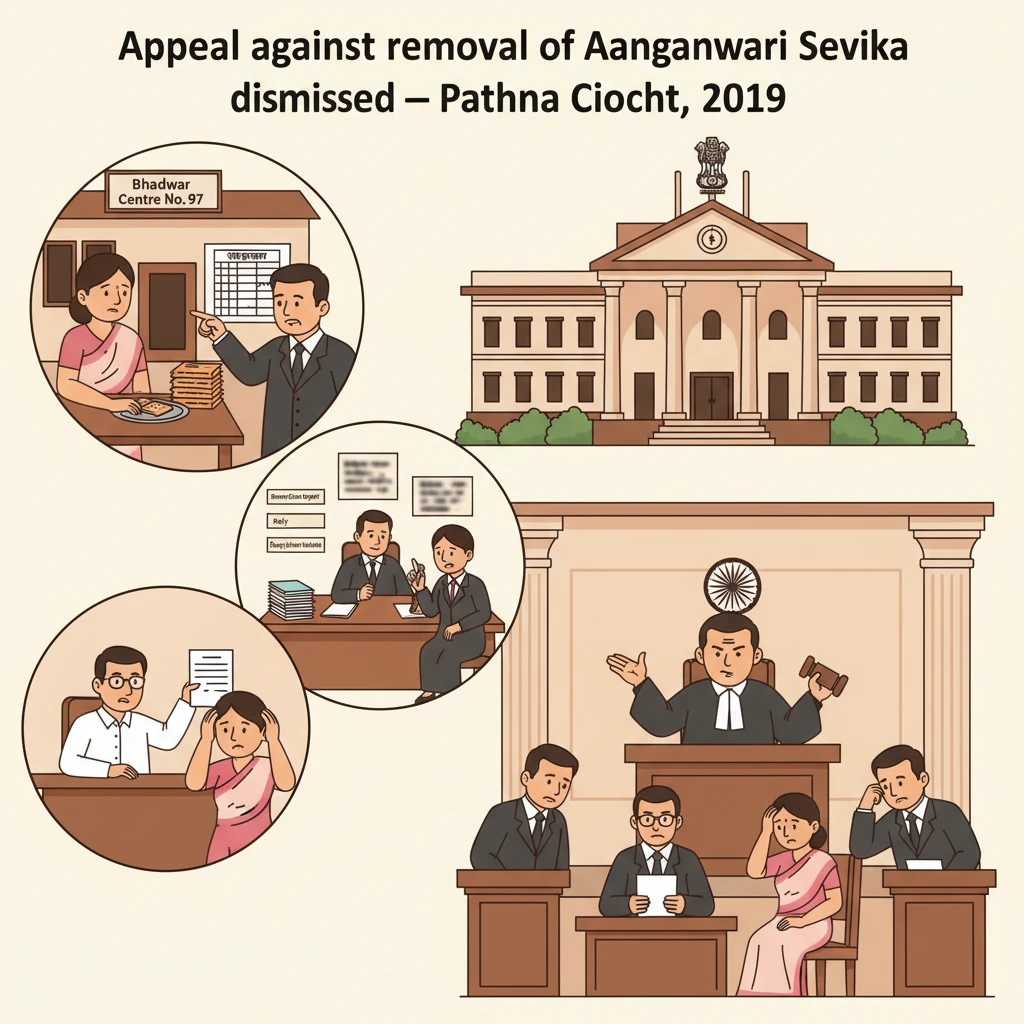
Case Background
The appellant was working as an Aanganwari Sevika at Bhadwar Center No. 97 in Bhojpur district. On 10.12.2011, a State Level Inspection Team inspected this Aanganwari Centre.
During this inspection, the team found several irregularities in implementation of the Posahar Scheme. These irregularities related to alleged misappropriation of money under the scheme and issues connected with attendance of children.
After the inspection, a show cause notice was issued to the appellant. She submitted her reply explaining her position. The District Programme Officer, Bhojpur at Ara, was not satisfied with her reply.
By order dated 13.02.2012, the District Programme Officer cancelled the appellant’s selection as Aanganwari Sevika for Centre No. 97. The appellant challenged this order before the Appellate Authority by filing Aanganwari Appeal No. 51/11-12.
The Appellate Authority, namely the Deputy Director, Welfare, Patna Division, Patna, dismissed the appeal by order dated 26.03.2014. The appellant then filed Civil Writ Jurisdiction Case No. 11364 of 2014 questioning this appellate order.
The learned Single Judge of the Patna High Court dismissed the writ petition by judgment dated 11.12.2017. Aggrieved by that judgment, the appellant filed the present Letters Patent Appeal No. 59 of 2018 before a Division Bench of the Patna High Court.
What the Court Examined and Decided
The Division Bench, consisting of Hon’ble the Chief Justice and Hon’ble Mr. Justice Partha Sarthy, considered the challenge to the dismissal of the writ petition and to the orders of the District Programme Officer and the Appellate Authority.
On behalf of the appellant, it was argued that no adverse remarks had been made by any Panchayat official about her conduct. It was contended that both the District Programme Officer’s order dated 13.02.2012 and the Appellate Authority’s order dated 26.03.2014 were contrary to the materials on record.
The core grievance of the appellant was that her selection as Aanganwari Sevika had been cancelled despite the absence of any complaint from local Panchayat officials and that the authorities had not properly appreciated her explanation to the show cause notice.
On the other hand, the State authorities, particularly respondents 4, 5 and 6, supported the orders passed against the appellant. They submitted that the State Level Inspection Team had, during the inspection conducted on 10.12.2011, detected several irregularities at Centre No. 97 where the appellant was working.
These irregularities included misappropriation of money under the Posahar Scheme. According to the respondents, after the inspection report was submitted, the appellant was given full opportunity to defend herself through a show cause notice and her reply was duly considered.
The Division Bench carefully went through the records of the case. The Court noted first that there was indeed an inspection on 10.12.2011 at the Aanganwari Kendra where the appellant was posted. The inspection report recorded several irregularities relating to misappropriation of funds and other issues.
Based on this report, the authorities issued a show cause notice to the appellant. She submitted her reply. The District Programme Officer then examined her explanation and the inspection findings.
After this consideration, the District Programme Officer, Bhojpur at Ara, passed the order dated 13.02.2012 cancelling her selection as Aanganwari Sevika. The Division Bench observed that this order was passed only after giving her a chance to respond to the allegations.
The Court further noted that the appellant had availed the remedy of appeal. In Aanganwari Appeal No. 51/11-12, the Appellate Authority, namely the Deputy Director, Welfare, Patna Division, Patna, again examined the case.
The judgment records that in the appeal proceedings, the Appellate Authority not only considered the documents and submissions available on the record but also heard the parties. Only thereafter was the order dated 26.03.2014 passed, rejecting the appeal.
From these steps, the Division Bench concluded that the appellant had been given “full opportunity” to present her case before both the original authority and the appellate authority. Her reply to the show cause notice had been taken into account, and her contentions had been heard in appeal.
The Court therefore approached the matter from the angle of whether any illegality or procedural unfairness had occurred in cancelling the appellant’s selection. It did not re-evaluate the factual findings of misappropriation recorded by the inspection team and accepted by the authorities.
In paragraphs 7 and 8 of the judgment, the Court clearly records that after submission of the enquiry report, notices were issued, opportunity to reply was given and availed, and orders were passed only after considering the appellant’s submissions.
On this basis, the Division Bench held that there was no illegality in the order dated 13.02.2012 of the District Programme Officer, Bhojpur, or in the appellate order dated 26.03.2014 passed by the Deputy Director, Welfare, Patna Division, in Aanganwari Appeal No. 51/11-12.
The Court then considered whether the appellant had shown any ground for interference with the judgment of the learned Single Judge. It held that she had failed to make out any such case.
Thus, the Letters Patent Appeal was found to be without merit. The Court dismissed the appeal and affirmed the orders of the departmental authorities as well as the judgment of the Single Judge.
For Aanganwari workers and similar government scheme functionaries, this judgment shows that once an inspection report points to irregularities and the authorities have followed a fair process of issuing notice and considering replies, the High Court will be slow to interfere with their decision in intra-court appeal.
The focus of the Division Bench remained on ensuring that the appellant had received a fair hearing at each stage rather than re-examining the factual correctness of the allegations of misappropriation in the Posahar Scheme.
Why This Judgment Matters
This judgment is important for Aanganwari Sevikas and other grassroot workers engaged under government welfare schemes in Bihar. It highlights that their continuation in service depends not only on performance, but also on compliance with scheme norms during inspections.
Where an inspection team finds irregularities such as misappropriation of funds or problems with attendance, authorities can cancel a selection or engagement. If, however, the worker is given notice, allowed to file a reply, and heard in appeal, the Patna High Court may not interfere merely because the worker disputes the findings.
The decision reinforces that the Court’s role in such cases is limited. The Court mainly checks whether the decision-making process was fair and whether principles of natural justice were followed, rather than deciding whether the worker is actually guilty of the irregularities.
For government departments, the case underlines the importance of documenting inspection reports, issuing proper show cause notices and giving sufficient opportunity to reply. Such procedural compliance strengthens their decisions if challenged in court.
Legal Issues and Answers
-
Issue: Whether the cancellation of the appellant’s selection as Aanganwari Sevika and the dismissal of her departmental appeal suffered from illegality or violation of natural justice.
Answer: No. The Patna High Court held that an inspection found irregularities, a show cause notice was issued, the appellant replied, and both the original and appellate authorities considered her submissions before passing orders. Therefore, there was no illegality or denial of opportunity, and no interference was warranted. -
Issue: Whether any ground was made out to interfere with the judgment of the learned Single Judge dismissing the writ petition.
Answer: No. The Division Bench found no error in the Single Judge’s decision and dismissed the Letters Patent Appeal as being without merit.
Cases Cited by the Court
- No earlier judgments or precedents are cited or relied upon in the text of this decision.
Case Details
Case Number: Letters Patent Appeal No. 59 of 2018 in Civil Writ Jurisdiction Case No. 11364 of 2014
Case Title: Punam Kumari v. The State of Bihar & Ors.
Citation: 2019 (3) PLJR 272
Court: High Court of Judicature at Patna
Coram: Hon’ble the Chief Justice; Hon’ble Mr. Justice Partha Sarthy (CAV Judgment per Hon’ble Mr. Justice Partha Sarthy)
Date of Judgment: 23.04.2019 (CAV date 19.04.2019)
Advocates: For the appellant – Mr. Ram Chandra Prasad Bharti, Advocate; For the respondents – Mr. Manish Kumar, AC to AAG 6
Parties: Appellant – Aanganwari Sevika of Bhadwar Centre No. 97, Bhojpur; Respondents – State of Bihar through Principal Secretary, Department of Social Welfare and other departmental officers
Nature of Case: Intra-court Letters Patent Appeal against judgment of Single Judge in writ petition concerning cancellation of selection/engagement as Aanganwari Sevika following inspection-based enquiry.
Link to Judgment: View full judgment of Patna High Court
If you found this explanation helpful and wish to stay informed about how legal developments may affect your rights in Bihar, you may consider following Samvida Law Associates for more updates.







