
Case Background
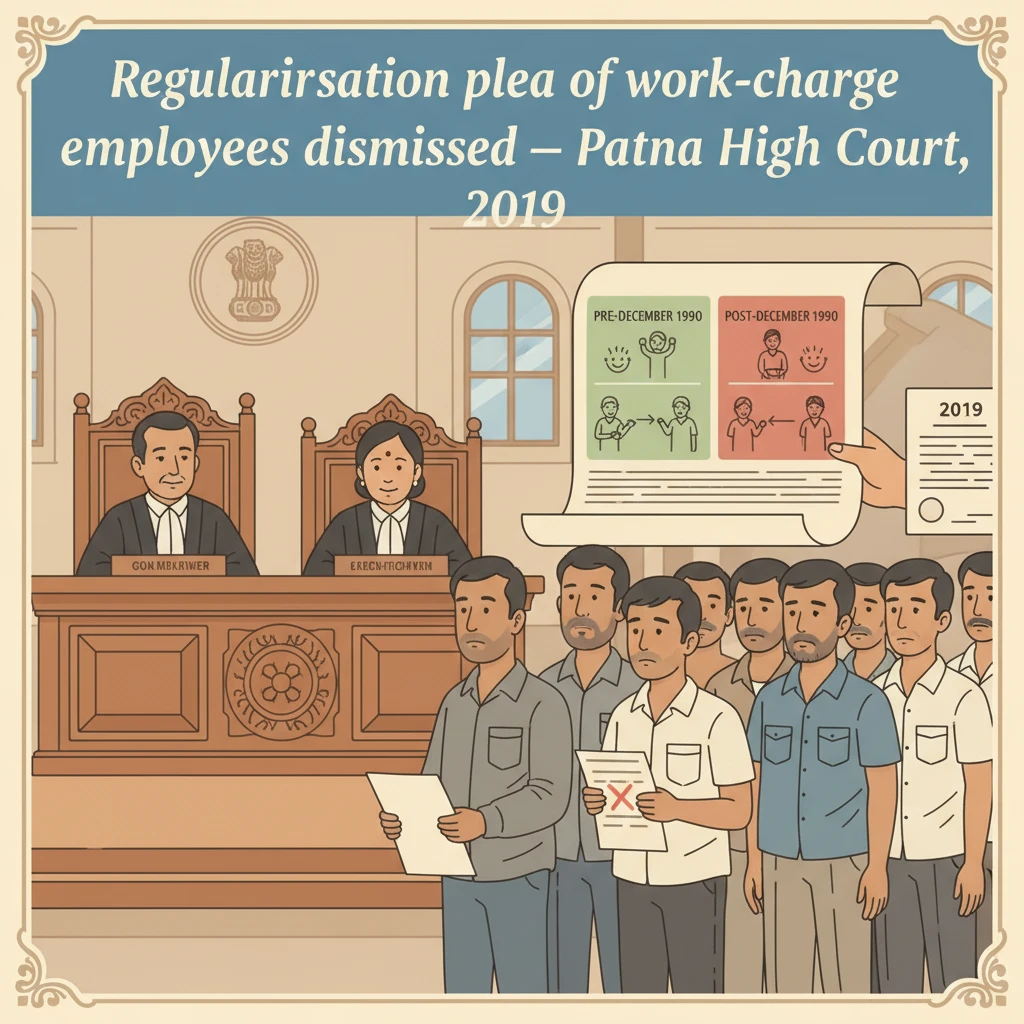
The case concerned 17 employees working in different divisions of the Rural Works Department (RWD) at Supaul, Saharsa and Madhepura. They were road roller drivers, khalashis, jeep drivers, godown staff and watchmen. All of them were on the “work charge establishment”.
As recorded in the judgment, these workers were inducted on work charge basis between June and December 1992. They were not appointed against regular sanctioned posts. Instead, they were engaged to work on specific works and paid out of the funds of those works.
Later, these employees approached the Patna High Court by filing Civil Writ Jurisdiction Case No.16115 of 2014. They asked the Court to direct the State to regularise their services and treat them as regular permanent employees of the Rural Works Department.
The writ petition was heard by a learned Single Judge. By judgment dated 22 December 2017, the Single Judge rejected their claim. The Court held that under the State’s policy and applicable law, the petitioners were not entitled to absorption or regularisation.
Aggrieved by this decision, the workers filed a Letters Patent Appeal (L.P.A. No.114 of 2018) before a Division Bench of the Patna High Court. They wanted the Division Bench to set aside the single judge’s order and grant them regularisation in government service.
What the Court Examined and Decided
The Division Bench, consisting of Hon’ble the Chief Justice and Hon’ble Justice Smt. Anjana Mishra, delivered an oral judgment on 23 April 2019. The Bench examined both the facts of the case and the legal position on regularisation of work-charge and daily wage employees.
First, the Court noted the key factual point: all the appellants were part of the work charge establishment and had been engaged between June and December 1992. This timing was crucial in light of the State Government’s policy.
The Court referred to Resolution No.10710 (filed as Annexure-C to the State’s counter affidavit in the writ petition). This government resolution clearly fixed a cut-off date for considering work-charge employees for absorption or regularisation.
Under this policy, only those employees who had been appointed before 11 December 1990 could be considered for regularisation. The resolution further provided that employees who were placed on work charge establishment after 11 December 1990 “should be removed.”
In other words, the State had chosen to extend the benefit of regularisation only to employees who had been appointed before 11 December 1990. Those who came in later were not covered and were, in fact, liable to be removed from the work charge establishment.
The learned Single Judge, whose decision was now under appeal, had already taken note of this factual and policy background. The Single Judge had also discussed the law on regularisation of daily wagers and work-charge staff, relying on several earlier judgments.
The Division Bench recorded that the Single Judge had referred to:
(i) Durganand Jha & Ors. vs. State of Bihar & Ors., 2007 (4) PLJR 259, and
(ii) State of Bihar & Ors. vs. Bimli Devi, 2016 (1) PLJR 452,
along with other decisions on the same subject. In these cases, the Patna High Court had already declined similar claims for regularisation made by employees who did not satisfy the State’s policy criteria.
The Division Bench observed that these precedents clearly went against the appellants’ claim. The earlier cases had held that where the State has framed a scheme giving regularisation benefits only up to a particular date, persons appointed after that date cannot claim the same benefit as a matter of right.
There was also an argument based on certain guidelines of the year 1949. These guidelines had been relied upon by some employees in other matters to support claims of regularisation or similar benefits.
The Division Bench pointed out that these 1949 guidelines had already been examined by a Full Bench of the Patna High Court in Mobina Khatoon vs. State of Bihar & Ors., 2019 (2) BLJ 9. The Full Bench had held that these guidelines could not be used to extend any regularisation benefit to employees on the work charge establishment.
Therefore, the attempt to rely on the old 1949 guidelines did not help the appellants. The law declared by the Full Bench was binding and had closed that route.
The Division Bench then considered the wider legal position on regularisation of irregular or ad hoc appointees. It specifically referred to the Constitution Bench judgment of the Supreme Court in Secretary, State of Karnataka & Ors. vs. Uma Devi (3) and others, (2006) 4 SCC 1.
In Uma Devi, the Supreme Court had laid down that public employment must comply with constitutional requirements, including proper advertisement, equal opportunity and selection through prescribed procedures. Irregular or back-door appointments cannot be legalised by courts beyond what any specific, one-time scheme of the government may allow.
The Division Bench noted that, in the present case, the State Government had already taken “some steps of regularisation” in respect of employees appointed prior to 11 December 1990. This was in tune with the limited window permitted by Uma Devi for regularising certain long-serving employees who had been appointed in an irregular manner but against available vacancies.
However, in view of Uma Devi, no such “further benefit” could be extended to those who were appointed after the cut-off date fixed by the Government in its policy. Extending the benefit beyond that point would violate the law laid down by the Supreme Court as well as the State’s own resolution.
The Division Bench, therefore, concluded that the appellants’ claim “was not in conformity with the policy of the Government with regard to regularization of work charge employees.” The policy clearly restricted regularisation to those appointed before 11 December 1990, while the appellants had been appointed between June and December 1992.
The Court also found no “legal infirmity” in the impugned judgment of the Single Judge. The Single Judge had correctly appreciated both the factual position (appointment dates and work charge status) and the legal framework (State resolution, prior High Court decisions and the Uma Devi ruling).
Consequently, the Division Bench held that there was no ground to interfere with the Single Judge’s decision. The Letters Patent Appeal was not entertained and was dismissed.
At the same time, the Court slightly softened the outcome by adding an important clarification. It stated that dismissal of this appeal would “not preclude the State Government from taking any decision otherwise that may be permissible in law in respect of the claim of the appellants.”
This means that while the Court could not direct regularisation, the State Government remains free, within the limits of law, to consider any other steps or decisions regarding these employees, if it so chooses.
Why This Judgment Matters
This judgment is significant for work-charge and daily wage employees in Bihar, especially in departments like the Rural Works Department where such appointments are common.
First, it reinforces that the State’s policy on regularisation, including any cut-off date, is decisive. If a worker was appointed after the cut-off date mentioned in the government resolution, courts are unlikely to grant regularisation.
Second, the judgment shows that earlier High Court and Supreme Court rulings, including the Uma Devi case, strongly limit regularisation of irregular appointments. Regularisation is not an automatic right, even after many years of service.
Third, it clarifies that old administrative guidelines, like the 1949 guidelines, cannot override or expand present government policy or the law declared by higher courts. Employees cannot rely on such outdated instruments to claim regular posts when binding precedents say otherwise.
Finally, for affected employees, the judgment leaves a small window open: the State Government can still take a lawful policy decision on their situation. However, any such decision must fit within the constitutional and legal framework laid down by the courts.
Legal Issues and Answers
- Issue: Whether work-charge employees of the Rural Works Department, appointed between June and December 1992, were entitled to be regularised and treated as regular permanent employees despite the State policy restricting regularisation to appointments made before 11 December 1990.
Answer: No. The Patna High Court held that since the appellants were appointed after 11 December 1990, they were outside the scope of the State’s regularisation policy, and in view of earlier case law and the Supreme Court’s decision in Uma Devi, no further benefit of regularisation could be extended.
Cases Cited by the Court
- Durganand Jha & Ors. vs. State of Bihar & Ors., 2007 (4) PLJR 259
- State of Bihar & Ors. vs. Bimli Devi, 2016 (1) PLJR 452
- Mobina Khatoon vs. State of Bihar & Ors., 2019 (2) BLJ 9 (Full Bench)
- Secretary, State of Karnataka & Ors. vs. Uma Devi (3) and others, (2006) 4 SCC 1
Case Details
Case Number: Letters Patent Appeal No.114 of 2018 in Civil Writ Jurisdiction Case No.16115 of 2014
Case Title: Nand Kishore Sharma & Ors. vs. The State of Bihar & Ors.
Coram: Hon’ble the Chief Justice Amreshwar Pratap Sahi; Hon’ble Justice Smt. Anjana Mishra
Citation: 2019 (3) PLJR 271
Advocates: Mr. Ashok Kumar Mishra, Advocate and Ms. Kalpana Kushum, Advocate for the appellants; Mr. Ravinder Kumar, AC to AAG-6 for the respondents
Nature of the Case: Letters Patent Appeal against dismissal of writ petition seeking regularisation and reinstatement as regular permanent employees in the Rural Works Department
Date of Judgment: 23 April 2019
Court: High Court of Judicature at Patna
Link to Judgment: https://patnahighcourt.gov.in/viewjudgment/MyMxMTQjMjAxOCMxI04=-wI3bvYXw4WA=
If you found this explanation helpful and wish to stay informed about
how legal developments may affect your rights in Bihar,
you may consider following Samvida Law Associates for more updates.







