
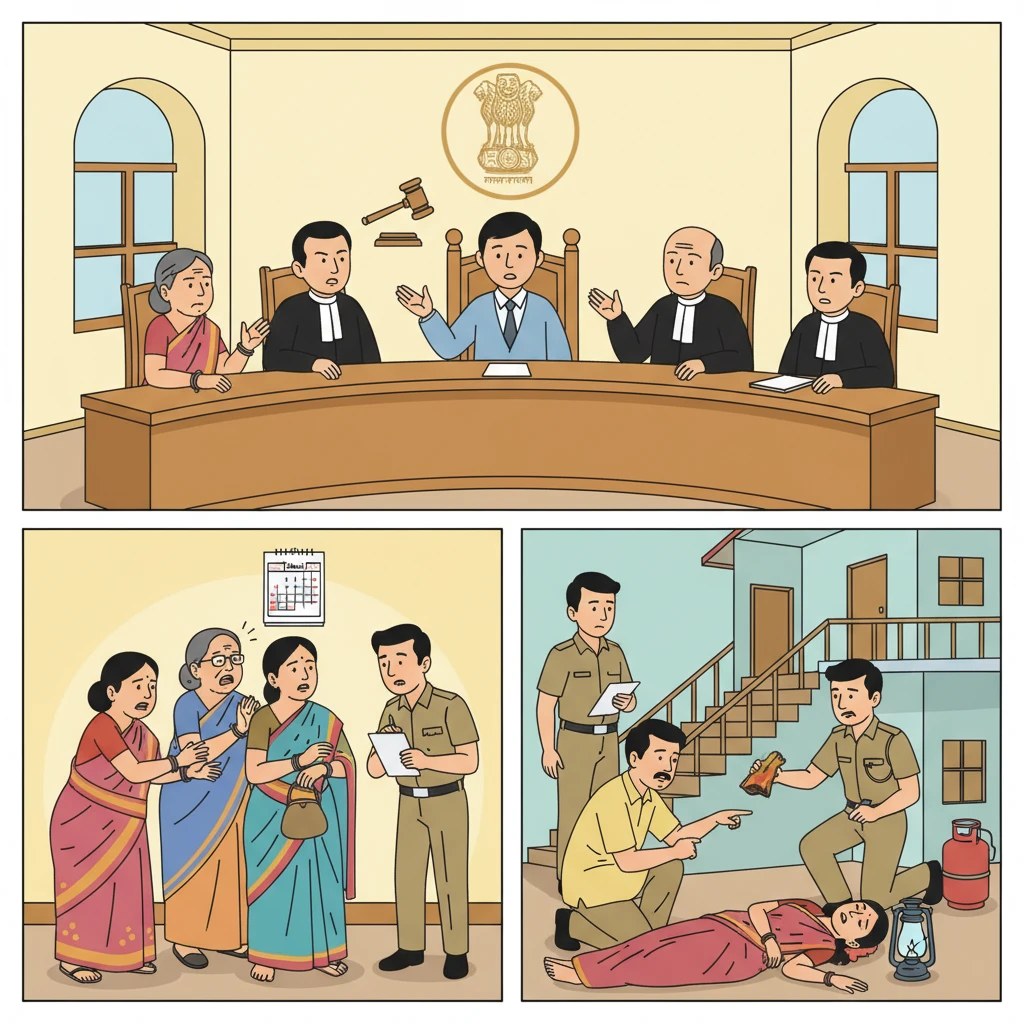
Case Background
This case arises from the death of a 21‑year‑old woman, Mamta Devi, at her matrimonial home in Banka district on 17.11.2010. She had been married about three years earlier to appellant Pankaj Sah @ Pankaj Kumar Gupta.
According to her father, Awadh Bihari Sah (P.W.5), the marriage was performed as per Hindu rites and he had given gifts “to the best of his capacity” at the time of marriage. After marriage, Mamta lived in her sasural for about one year. Over time, her husband, father‑in‑law and mother‑in‑law allegedly began to demand more dowry and to torture her when their demand for money was not met.
Due to this torture, Mamta once left her matrimonial home and came to her parental house at village Gadi Devali, P.S. Jama, district Dumka (Jharkhand). After some time, her husband came, assured that he would not assault her further, and requested that she be sent back. Her bidai took place just before Diwali, and she stayed in her sasural from Diwali to Chhath in 2010.
On the evening of 17.11.2010 at about 6 p.m., Mamta’s mother‑in‑law rang P.W.5 and informed him that Mamta had died due to a gas cylinder burst. The same information was also given by the husband and father‑in‑law. Shocked, the father rushed to Banka along with his relatives.
On reaching the matrimonial home, he found the police already there but none of Mamta’s in‑laws present. He saw his daughter’s naked, burnt body lying near the staircase on the first floor, with injuries on her head, clothes stuffed in her mouth and a smell of kerosene in the area. He suspected that she had been assaulted and killed, and that her body was then burnt to destroy evidence.
His detailed statement (fardbeyan) was recorded the same night at 9.35 p.m. at the house of appellant Pankaj by the Investigating Officer (P.W.6), which formed the basis of Banka P.S. Case No. 410 of 2010 under Sections 304B, 498A and 201/34 of the Indian Penal Code.
After investigation, the police submitted charge‑sheet on 22.01.2011 against all three accused: the husband, his father and his mother. The Chief Judicial Magistrate, Banka, took cognizance on 27.01.2011 and committed the case to the Court of Sessions on 03.02.2011. Charges under Sections 304B, 498A, 201/34 IPC were framed jointly on 28.03.2011 in Sessions Trial No. 119 of 2011.
The Ad hoc Additional Sessions Judge IV, Banka, by judgment dated 12.03.2013, convicted all three accused for dowry death, cruelty for dowry and causing disappearance of evidence. By order dated 15.03.2013, the husband was sentenced to life imprisonment under Section 304B IPC, and to additional rigorous imprisonment of two years each with fines under Sections 498A and 201 IPC. The mother‑in‑law Rekha Devi received ten years’ rigorous imprisonment under Section 304B, plus two years each with fines under Sections 498A and 201 IPC. Sentences were to run concurrently.
Both the husband and mother‑in‑law filed criminal appeals under Section 374(2) Cr.P.C. before the Patna High Court. The father‑in‑law, Ram Charitra Sah, also appealed but died during pendency; his appeal was declared abated on 23.04.2019. The remaining two appeals were heard together and decided by this common judgment dated 29.04.2019.
What the Court Examined and Decided
The Division Bench of Hon’ble Mr. Justice Rakesh Kumar and Hon’ble Mr. Justice Anil Kumar Sinha (authoring the oral judgment) examined the entire trial record, including the testimony of nine prosecution witnesses, the investigation, and the medical evidence.
The main defence arguments were:
First, that P.W.1, P.W.2 and P.W.3 were hearsay witnesses and their evidence should not be relied upon.
Second, that the doctor who had physically conducted the post‑mortem was not examined; only P.W.9, another doctor present at the time, proved the report. Defence claimed that without examining the “main” doctor, the cause of death was uncertain.
Third, relying on a part of P.W.3’s cross‑examination, defence argued that the marriage was a “model marriage” without dowry, and therefore the case could not be treated as a dowry death. On this basis, they sought benefit of doubt and acquittal.
The Additional Public Prosecutor, however, argued that prosecution evidence was consistent and strong enough to prove the charges beyond reasonable doubt. He supported the trial court’s findings.
The High Court first scrutinised the evidence of P.W.5, the informant and father of the deceased. He clearly described the history of dowry demand and assault by the husband and in‑laws. He stated that after about one year of marriage, the husband started pressurising Mamta to bring money from her parents; quarrels and assault followed, forcing her to return to her parental house. She went back only after an assurance of no further assault.
P.W.5’s account of what he saw on 17.11.2010 was detailed: the police presence, absence of in‑laws, Mamta’s burnt naked body on the stairs, injury at the back of her head, blood clotting, cloth stuffed in her mouth, and the smell of kerosene. He also stated that the story of a gas cylinder burst was false. His cross‑examination did not shake his testimony; instead, he reiterated that the cloth in Mamta’s mouth was burnt on the outer side, supporting the allegation of post‑mortem burning.
P.W.2, P.W.3 and P.W.4, all relatives who accompanied P.W.5 to the house of the appellants on the date of occurrence, deposed in a similar manner about what they saw there. The Court found their evidence consistent and corroborative of P.W.5. P.W.2 further deposed that Mamta had herself told him about the torture for dowry. This directly connected the cruelty to the demand for money.
P.W.1, a neighbour of the accused, confirmed that Mamta had married Pankaj about three years earlier and that their houses were adjacent. She narrated that after the incident, two young children of Mamta were found crying near a neighbour’s house and were taken in, before being handed over later at night to their grandmother. This supported the fact that the in‑laws had left the house, leaving the children behind.
P.W.7 and P.W.8 were inquest witnesses who proved their signatures on the inquest report. P.W.8 stated that he saw cloth stuffed in the mouth of the deceased.
The Investigating Officer, P.W.6, confirmed that he recorded P.W.5’s fardbeyan at the matrimonial house the same night. He testified that the dead body was lying near the staircase, badly burnt and naked, with a wound at the back of the head and cloth stuffed in the mouth. He also clearly stated that there was no sign of any gas cylinder burst at the spot and no smell of gas. This directly contradicted the version earlier given by the in‑laws to the victim’s family.
P.W.6 opined that it appeared the deceased had been killed first and then her dead body burnt. He prepared the inquest report and inspected the place of occurrence. In cross‑examination, nothing could be brought out to weaken his version.
On the crucial question of medical evidence, P.W.9, Dr. Madan Kumar Pathak, was examined. On 18.11.2010, he was posted as Medical Officer, Sadar Hospital, Banka, and was present with the doctor who actually conducted the post‑mortem on Mamta’s body. He proved the post‑mortem report (Exhibit‑6).
The report recorded singeing of scalp hair, blackening of the skin over the whole body, smell of kerosene, and superficial burns over the whole body except deep burns over part of the left shoulder and arm. Importantly, there was no blistering or redness usually associated with ante‑mortem burns. The face was swollen and there was tight‑packed cotton cloth in the mouth. There were abrasions on the right arm and right leg above the ankle.
Internally, there was no skull fracture or extradural haemorrhage, no soot particles in the nose, mouth, larynx or trachea (which would be expected if the person was alive and inhaling smoke during a fire), and no laryngeal oedema. The heart was filled with blood on the right side and empty on the left. The doctor concluded that the cause of death was cardio‑respiratory arrest due to asphyxia and specifically stated, “This is a case of post‑mortem burn.”
The High Court carefully read this medical evidence and held that it clearly showed Mamta was already dead when her body was burnt. The stuffing of cloth in her mouth and absence of soot in respiratory passages supported death by asphyxia (suffocation), not by burns or gas cylinder explosion. Thus the defence story of an accidental death in a gas cylinder blast was rejected.
The Court then considered whether the case satisfied the requirements of dowry death under Section 304B IPC and the presumption under Section 113B of the Evidence Act. It noted that Mamta died within seven years of her marriage and that her death was unmistakably unnatural. She died in the matrimonial home, and the evidence showed continuous demands for dowry and torture by the husband and in‑laws.
The Court reproduced Section 113B and observed that once it is shown that “soon before her death” the woman was subjected to cruelty or harassment for or in connection with dowry demand, the Court must presume that the accused caused the dowry death. The evidence of P.W.5 and others showed that just before Diwali, Mamta had been taken back after earlier torture, and within a short span, by 17.11.2010, she was dead. The proximity between renewed bidai and death, combined with the history of dowry‑linked cruelty, was enough to trigger this presumption.
The appellants failed to provide any convincing explanation for how Mamta died in their house or to rebut the statutory presumption. On the contrary, they gave a false explanation of a gas cylinder burst, which was completely demolished by the Investigating Officer’s inspection and the post‑mortem findings.
After analysing both oral and medical evidence, the High Court concluded that the prosecution had proved the charges under Sections 304B, 498A and 201 IPC against both surviving appellants beyond reasonable doubt. It held that the trial court had rightly convicted and sentenced them and found no reason to interfere.
Accordingly, the Court affirmed the judgment of conviction dated 12.03.2013 and the sentence order dated 15.03.2013, and dismissed both criminal appeals (D.B.) No. 601 of 2013 and No. 294 of 2013. Since Rekha Devi had been on bail pursuant to an earlier order dated 12.04.2013, the High Court cancelled her bail bond and directed her to surrender immediately before the trial court to serve the remaining sentence, authorising the trial court to take necessary steps to secure her presence if she failed to do so.
Why This Judgment Matters
This judgment shows how the Patna High Court approaches dowry death cases where in‑laws claim an “accident” inside the house. The Court insists on matching their version with physical and medical evidence. Here, the staged narrative of a gas cylinder blast fell apart because there was no damage or smell of gas, but there was clear proof of suffocation and post‑mortem burning.
For families facing similar situations, the decision highlights the importance of promptly recording a detailed statement, preserving the scene, and relying on forensic evidence. It also underlines that if a young married woman dies unnaturally in her sasural and there is a history of dowry demand and cruelty, the law places a strong presumption against the in‑laws under Section 113B of the Evidence Act.
The ruling further clarifies that even if the doctor who physically conducts the post‑mortem is not examined, another doctor present and able to prove the report can provide reliable medical evidence, so long as the defence cannot show any serious doubt about its correctness.
Legal Issues and Answers
-
Issue: Whether the prosecution proved beyond reasonable doubt that Mamta Devi’s death was a dowry death under Section 304B IPC, accompanied by cruelty under Section 498A IPC and an attempt to destroy evidence under Section 201 IPC, so as to justify upholding the convictions.
Answer: Yes. The Court held that the death occurred within seven years of marriage in the matrimonial home, was homicidal and followed sustained dowry‑related torture. The statutory presumption under Section 113B of the Evidence Act applied and was not rebutted. The convictions and sentences were affirmed. -
Issue: Whether the failure to examine the doctor who actually conducted the post‑mortem made the cause of death doubtful.
Answer: No. The Court accepted the testimony of P.W.9, a medical officer who was present and proved the post‑mortem report. The report clearly indicated asphyxia and post‑mortem burns, which, read with other evidence, left no reasonable doubt about the cause and manner of death. -
Issue: Whether the appellants were entitled to benefit of doubt on the ground that some witnesses were allegedly hearsay and the marriage was described as a “model marriage” without dowry by one witness.
Answer: No. The Court found the core witnesses, especially the father and uncles, consistent and credible. Their testimony regarding continued dowry demands and cruelty, together with the surrounding circumstances and medical evidence, far outweighed isolated statements in cross‑examination.
Cases Cited by the Court
- No prior judicial decisions or case laws were expressly cited or relied upon in the text of this judgment.
Case Details
Case Number: Criminal Appeal (DB) No. 601 of 2013 with Criminal Appeal (DB) No. 294 of 2013; arising out of Banka P.S. Case No. 410 of 2010; G.R. No. 1764 of 2010; Sessions Trial No. 119 of 2011.
Case Title: Pankaj Sah @ Pankaj Kumar Gupta vs. The State of Bihar; Rekha Devi vs. The State of Bihar.
Citation: 2019 (3) PLJR 59.
Court: High Court of Judicature at Patna.
Coram: Hon’ble Mr. Justice Rakesh Kumar and Hon’ble Mr. Justice Anil Kumar Sinha.
Advocates: For the appellants in both appeals – Sri Achintya Anand, Advocate, assisted by Sri Ashok Kumar Verma (also spelt as Sri Ashok Kumr Verma) Advocate. For the State – Sri Ajay Mishra, Additional Public Prosecutor.
Date of High Court Judgment: 29.04.2019.
Impugned Trial Court Judgment and Order: Judgment of conviction dated 12.03.2013 and order of sentence dated 15.03.2013 passed by Shri N.K. Lall, Ad hoc Additional Sessions Judge‑IV, Banka, in Sessions Trial No. 119 of 2011.
Nature of Case: Criminal appeals (Division Bench) under Section 374(2) Cr.P.C. against conviction and sentence for offences under Sections 304B, 498A and 201 IPC, arising out of an alleged dowry death.
Final Outcome: Both criminal appeals dismissed; trial court’s conviction and sentences confirmed; bail bond of appellant Rekha Devi cancelled with direction to surrender and serve remaining sentence.
Link to Full Judgment: Click here to read the official Patna High Court judgment.
If you found this explanation helpful and wish to stay informed about how legal developments may affect your rights in Bihar, you may consider following Samvida Law Associates for more updates.







