
Case Background
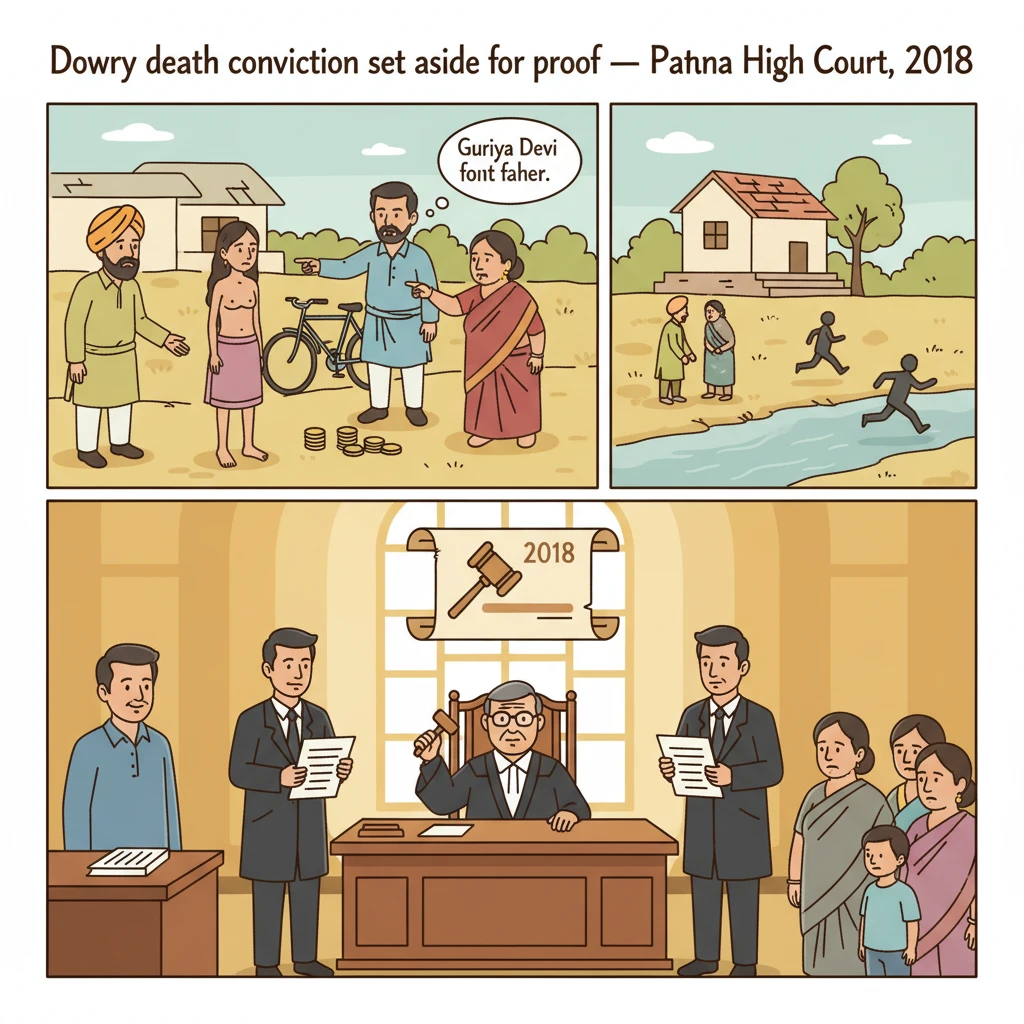
The case started with Tekari P.S. Case No. 255 of 2009 in the district of Gaya. The informant, father of the deceased woman, gave a written report to the police. He stated that his daughter had been married to the appellant about ten months before her death.
According to the report, the daughter had come back to her parental home after marriage. Around four months before the incident, she had gone back to her marital home with the appellant. About 15–20 days before the incident, the appellant again took her to his house.
The informant alleged that the appellant and his mother used to demand a cycle and money from him as dowry. On his failure to meet this demand, they allegedly tortured his daughter. The daughter is said to have informed him of this torture, after which he visited her matrimonial home and tried to persuade his daughter and son-in-law.
On 23.11.2009, at about 7:30 a.m., the informant claims he received information that his daughter was unwell. He rushed to her marital home but found it empty. Local people allegedly told him that the appellant and his mother had poisoned his daughter during the night of 22/23.11.2009 and had taken the dead body to the river for cremation. When the informant and his brother reached the river, the accused allegedly fled, leaving the body behind.
On this written report, the police registered the case under Sections 304B/328/34 of the Indian Penal Code (IPC) against the appellant and his mother.
After investigation, the Investigating Officer submitted chargesheet only against the appellant under Sections 304B and 328/34 IPC, keeping investigation against the mother-in-law pending. The Magistrate took cognizance and committed the matter to the Court of Sessions. The case ultimately came before the Ad hoc Additional Sessions Judge-V, Gaya, as Sessions Trial No. 72 of 2011/46 of 2012.
The trial court framed charges against the appellant under Sections 304B and 328/34 IPC. The appellant pleaded not guilty and claimed trial.
What the Court Examined and Decided
During the trial, the prosecution examined nine witnesses. These included relatives of the deceased, neighbours, and the doctor who conducted the post-mortem. One witness turned hostile. The defence examined three witnesses. The appellant, in his statement under Section 313 CrPC, denied all allegations and claimed innocence.
The trial court, relying on the prosecution evidence, convicted the appellant for dowry death under Section 304B IPC and for administering poison under Section 328/34 IPC. He was sentenced to life imprisonment for dowry death, and rigorous imprisonment for five years with fine for the offence under Section 328/34. Sentences were to run concurrently.
The appellant filed Criminal Appeal (DB) No. 956 of 2012 before the Patna High Court, challenging both conviction and sentence. The main question before the High Court was whether the prosecution had proved the necessary ingredients of dowry death beyond reasonable doubt.
The amicus curiae for the appellant argued that there was no clear and consistent evidence of any dowry demand. The original written report only mentioned “cycle and money” without specifying the amount of money. In court, different prosecution witnesses mentioned different items like cash, motorcycle, scooter and “vehicle”, creating contradictions about what was allegedly demanded.
It was also argued that very few witnesses supported the allegation that the deceased was tortured for dowry. Even those who did speak of cruelty did not specify when and how often such cruelty occurred, or whether it took place soon before the death, which is a key requirement under Section 304B IPC.
The State, on the other hand, supported the trial court’s judgment. The Additional Public Prosecutor submitted that the informant and other important witnesses had supported the prosecution case, and that medical evidence—showing death by poisoning—supported the allegation of unnatural death in the matrimonial home.
The Patna High Court first set out the legal requirements for a conviction under Section 304B IPC. The prosecution must prove:
(a) the death of a woman was caused by burns, bodily injury, or occurred otherwise than under normal circumstances;
(b) such death occurred within seven years of her marriage;
(c) she was subjected to cruelty or harassment by her husband or his relatives;
(d) such cruelty or harassment was in connection with a demand for dowry; and
(e) such cruelty or harassment took place “soon before her death”.
Only when these ingredients are proved can the presumption under Section 113B of the Evidence Act operate, allowing the court to presume that the husband or relatives caused the dowry death.
On the first two ingredients, the Court found the facts in favour of the prosecution. It was admitted that the death occurred within about one year of marriage. It was also not disputed that the cause of death was poisoning. The appellant had claimed that the death took place in the deceased’s maternal home, but the Court found that he failed to prove this. On the contrary, the evidence of the informant and witnesses Malti Devi (P.W.3), Saryu Paswan (P.W.6) and Lalsa Devi (P.W.7) showed that the death occurred in the marital home.
The crucial dispute was about the other ingredients: demand of dowry, cruelty or harassment for that demand, and whether such cruelty occurred soon before the death.
On the alleged dowry demand, the Court closely examined the statements of the prosecution witnesses. The written report mentioned demand of cycle and money, with no amount specified and no time period stated. However, in his deposition, the informant (P.W.9) changed his version and spoke of a demand for Rs. 50,000 and a motorcycle by the appellant and his mother.
Malti Devi (P.W.3), the aunt of the deceased, initially claimed that the accused demanded Rs. 50,000 from the deceased. But in cross-examination she said she only knew about seeing the dead body and was ignorant of other aspects. This weakened her earlier statement.
Saryu Paswan (P.W.6), the grandfather, said that the appellant demanded Rs. 50,000 and a vehicle after marriage in his presence and in front of three other persons. However, none of those three persons were examined to support his version.
Lalsa Devi (P.W.7), the deceased’s sister who lived only two houses away from the marital home, stated that the accused demanded a motorcycle in dowry. Ganesh Paswan (P.W.8), the uncle of the deceased, spoke of demand of a scooter.
Because the witnesses spoke of different items—cycle and money, Rs. 50,000 and motorcycle, Rs. 50,000 and vehicle, motorcycle, and scooter—and did not say clearly when and where the demands were made, the Court found their evidence contradictory and unreliable. It held that the prosecution had “utterly and miserably failed” to prove consistent, trustworthy demand of dowry by the appellant and his mother.
On the issue of cruelty or harassment for dowry, the written report alleged that the appellant and his mother used to torture the deceased for non-fulfilment of dowry demand. The informant repeated this in his testimony but without stating specific dates or incidents. His evidence was described as “shaky”. Ganesh Paswan (P.W.8) said the accused used to beat the deceased for dowry, again without any details of when this happened.
On the other hand, several close relatives did not support the allegation of cruelty. Malti Devi (P.W.3), Umesh Singh (P.W.4), Saryu Paswan (P.W.6) and Lalsa Devi (P.W.7) did not say that the deceased was tortured or harassed for dowry. In fact, P.W.7 stated in her examination-in-chief that her sister used to live “comfortably” in her marital home after marriage.
P.W.7 also said she had visited the marital home twice before the death and that no demand was made in her presence. She did not claim that the deceased had complained to her about dowry harassment. The informant (P.W.9) said he had visited the appellant’s house twice after marriage, sometimes with other persons, but those accompanying witnesses were not examined to support any allegation of dowry demand or torture in their presence.
P.W.7 further stated that she had been told about a quarrel between the deceased and the accused two months before the death, but she did not disclose who told her this. She also admitted she did not report this quarrel to the police. The informant did not support her story of receiving such information from her. The Court found that this alleged quarrel was not proved and was therefore not admissible.
Considering all this, the Patna High Court concluded that the prosecution had failed to establish that the deceased was subjected to cruelty or harassment for dowry, particularly “soon before her death”. Without this, the key ingredients of Section 304B IPC were missing and the statutory presumption under Section 113B of the Evidence Act could not be used against the appellant.
The Court then referred to two judgments of the Supreme Court. In Major Singh and Another v. State of Punjab, (2015) 5 SCC 201, the Supreme Court held that in the absence of evidence of dowry demand and harassment “soon before death”, conviction under Section 304B IPC cannot stand. It stressed the need for a live and proximate link between cruelty for dowry and the death.
In Baijnath and Others v. State of Madhya Pradesh, (2017) 1 SCC 101, the Supreme Court held that merely proving unnatural death in the matrimonial home within seven years of marriage is not enough for Section 304B. The prosecution must first prove beyond doubt that the woman was subjected to cruelty or harassment in connection with dowry demand soon before her death; only then can the presumption under Section 113B arise.
Relying on these principles, the Patna High Court held that, as the prosecution had failed to prove these essential ingredients, the burden never shifted to the appellant to prove his innocence. The conviction and sentence therefore could not be sustained.
The Court set aside the judgment and order of conviction and sentence passed by the trial court. It acquitted the appellant of all charges and directed that he be released from jail forthwith, if not wanted in any other case. The criminal appeal was allowed.
Why This Judgment Matters
This judgment is important for families facing dowry-related criminal cases in Bihar and elsewhere. It shows that while dowry deaths are taken very seriously, courts will not uphold a conviction unless clear legal requirements are met.
The Patna High Court underlined that simply alleging “dowry demand” and “torture” is not enough. Witnesses must give consistent statements about what was demanded, when and how it was demanded, and how the woman was harassed, especially in the period just before her death.
For victims’ families, the decision highlights the need to report specific incidents of harassment promptly and ensure that witnesses who actually saw or heard such incidents come forward. For those accused, it shows that if the prosecution evidence is weak, contradictory, or vague, higher courts can and do overturn wrongful convictions.
The ruling also reinforces Supreme Court guidance on Section 304B IPC and Section 113B of the Evidence Act, helping trial courts in Bihar apply these provisions correctly in future dowry death cases.
Legal Issues and Answers
Issue: Did the prosecution prove beyond reasonable doubt that the deceased was subjected to cruelty or harassment for dowry by the appellant, soon before her death, so as to attract Section 304B IPC and the presumption under Section 113B of the Evidence Act?
Answer: No. The Court held that the evidence of dowry demand and harassment was contradictory, vague and unsupported by key relatives and neighbours. Therefore, the necessary ingredients of dowry death were not proved and the presumption under Section 113B could not be invoked.
Issue: Could the conviction for dowry death and poisoning based largely on the fact of an unnatural death in the matrimonial home within one year of marriage be sustained?
Answer: No. The Court, following Supreme Court precedents, held that mere unnatural death in the matrimonial home is insufficient; without proof of cruelty or harassment for dowry soon before death, conviction under Section 304B IPC and related provisions cannot stand.
Cases Cited by the Court
- Major Singh & Another v. State of Punjab, (2015) 5 Supreme Court Cases 201
- Baijnath & Others v. State of Madhya Pradesh, (2017) 1 Supreme Court Cases 101
Case Details
Case Number: Criminal Appeal (DB) No. 956 of 2012; arising out of Tekari P.S. Case No. 255 of 2009; Sessions Trial No. 72 of 2011/46 of 2012
Case Title: Satyendra Paswan v. The State of Bihar
Citation: 2019 (3) PLJR 254
Court: High Court of Judicature at Patna
Date of Judgment: 30-01-2018 (uploaded on 08.03.2018)
Coram: Hon’ble Dr. Justice Ravi Ranjan; Hon’ble Mr. Justice Prakash Chandra Jaiswal (oral judgment by Hon’ble Mr. Justice Prakash Chandra Jaiswal)
Advocates: Mr. Ranbir Singh, Amicus Curiae for the appellant; Mr. S.N. Prasad, A.P.P. for the State
Nature of the Case: Criminal appeal (Division Bench) against conviction and sentence under Sections 304B and 328/34 of the Indian Penal Code in a dowry death case
Statutory Provisions Involved: Sections 304B and 328/34 IPC; Section 313 CrPC; Section 113B of the Evidence Act
Final Outcome: Appeal allowed; conviction and sentence set aside; appellant acquitted and ordered to be released, if not wanted in any other case.
Link to Judgment: Click here to access the full judgment of the Patna High Court
If you found this explanation helpful and wish to stay informed about
how legal developments may affect your rights in Bihar,
you may consider following Samvida Law Associates for more updates.







