
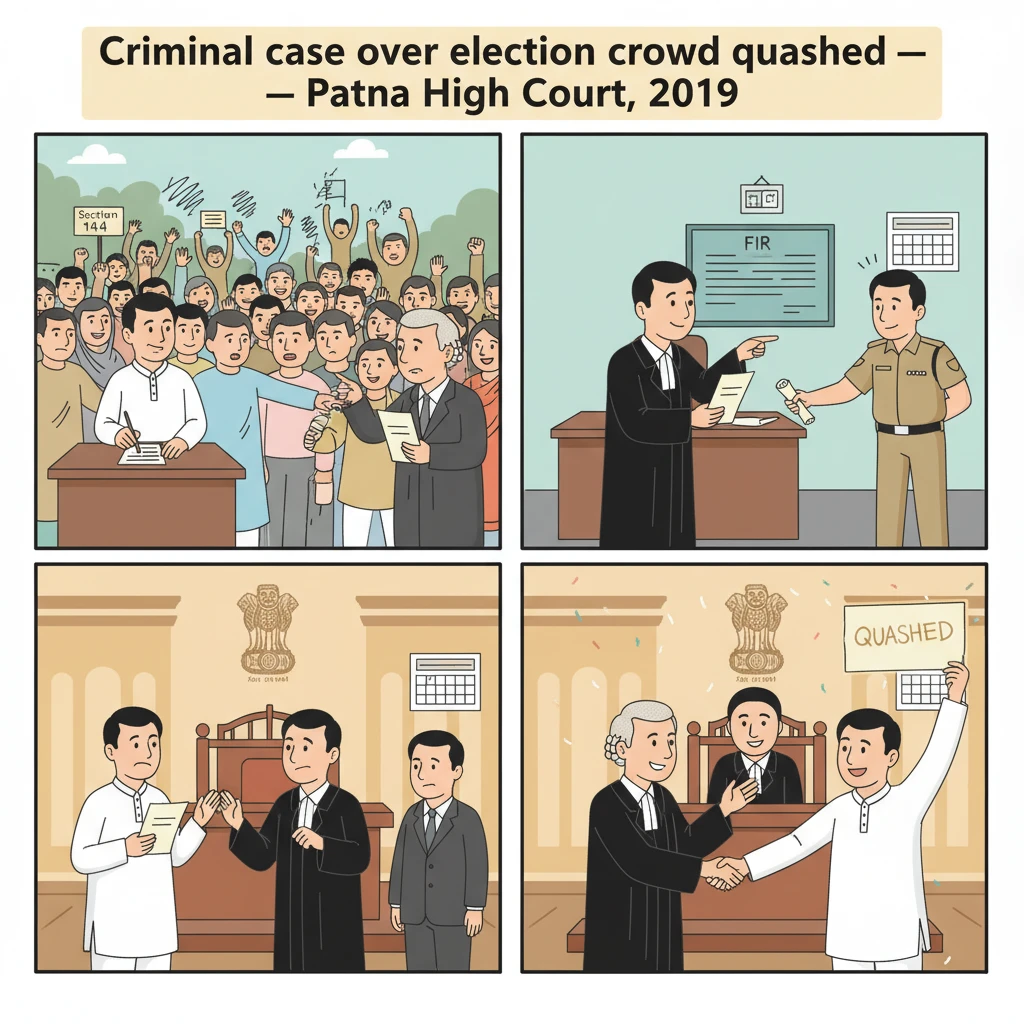
The Patna High Court held that the complaint and investigation were not legally valid.
The Court quashed the cognizance order and the entire criminal case against the petitioner.
No further criminal trial will continue against him in this matter.
Case Background
The matter arose from the Bihar Assembly elections in 2010. The petitioner was a candidate for the 148, Alauli Vidhan Sabha seat.
On 12.10.2010 at about 1:10 p.m., he went to file his nomination papers. According to the complaint, a crowd of his supporters gathered and raised slogans.
The Anchal Adhikari (Circle Officer), Khagaria, lodged a written complaint with the Officer Incharge of Chitragupta Nagar Police Station. He alleged that the crowd and slogan shouting violated the Model Code of Conduct and an order under Section 144 of the Code of Criminal Procedure, 1973.
On this basis, Khagaria (Chitragupta Nagar) P.S. Case No. 459 of 2010 was registered. The case was numbered as G.R. No. 1625 of 2010 in the court of the Chief Judicial Magistrate, Khagaria.
On 05.03.2011, the Chief Judicial Magistrate took cognizance in the case. The matter later came before the Magistrate, Sri Anjani Kumar Gond.
The petitioner then approached the Patna High Court under Section 482 of the Code of Criminal Procedure. He sought quashing of the cognizance order dated 05.03.2011 and the entire criminal proceeding arising out of the said police case.
What the Court Examined and Decided
The Patna High Court, through Hon’ble Mr. Justice Ahsanuddin Amanullah, heard the petitioner and the State. The central question was whether the criminal case, based on alleged violation of Section 144 and Model Code of Conduct, had been validly instituted and continued.
The petitioner first argued that an order under Section 144 of the Code can be passed only by a Sub Divisional Magistrate and not by an officer below that rank. He submitted that if such an order is violated, only the officer who issued the order, or his superior, can validly lodge a complaint.
According to him, a subordinate officer cannot maintain such a complaint. In this case, the complaint was made by the Anchal Adhikari (Circle Officer), Khagaria, who was not the authority that issued the prohibitory order under Section 144.
The petitioner relied on a judgment of the Patna High Court in Surendra Prasad Yadav v. State of Bihar, reported in 2007 (4) PLJR 533. There, the Court had discussed who is competent to file a complaint when an order under Section 144 is allegedly violated.
He further argued that for an offence under Section 188 of the Indian Penal Code, mere breach of an order is not enough. Disobedience must either cause, or have a tendency to cause, obstruction, annoyance or injury, or must involve a risk of such harm to a person lawfully employed.
The petitioner relied on another Patna High Court judgment in Pratik Sinha v. State of Bihar, reported as 2016 (4) PLJR 274. In that case, the Court held that in the absence of allegations showing such consequences or tendencies, and in the absence of a written complaint from the concerned public servant, prosecution under Section 188 cannot be maintained.
He pointed out that in his case there was no clear allegation that the alleged crowd and slogans had any such harmful effect or tendency. There was also no written complaint by the public servant who had actually issued the prohibitory order.
The learned Additional Public Prosecutor, appearing for the State, in view of these authorities, did not seriously contest the legal or factual position put forward by the petitioner.
After hearing both sides, the Patna High Court held that a clear case for interference had been made out.
First, the Court accepted the petitioner’s contention that the Anchal Adhikari lacked competence to lodge the complaint that formed the basis of the case. Relying on the earlier decisions in Surendra Prasad Yadav and Pratik Sinha, the Court held that the complaint itself was not maintainable in law because it was not made by the officer who issued the Section 144 order, nor by his superior.
Secondly, the Court found another “glaring legal infirmity” in the prosecution. It noted that the mandatory provisions of Section 195(1) of the Code of Criminal Procedure had not been complied with.
Section 195(1)(a) of the Code prevents any court from taking cognizance of offences under Sections 172 to 188 of the Indian Penal Code, including Section 188, except on a “complaint in writing” by the concerned public servant or by another public servant to whom he is administratively subordinate.
The Court emphasised that a “complaint” under Section 195 must be a complaint as defined in Section 2(d) of the Code — that is, an allegation made orally or in writing to a Magistrate with a view to his taking action, and it does not include a police report. Therefore, police cannot on their own register an FIR and investigate an offence under Section 188 IPC.
To support this understanding, the Court referred extensively to a previous Patna High Court decision in Parveen Amanullah v. The State of Bihar, reported as 2017 (3) PLJR 101. That judgment had analysed Section 195 in detail and had relied on several Supreme Court decisions, including:
- M.S. Ahlawat v. State of Haryana & Anr., (2000) 1 SCC 278, where the Supreme Court held that the provisions of Section 195 are mandatory and no court can take cognizance without the required written complaint.
- Daulat Ram v. State of Punjab, AIR 1962 SC 1206, where cognizance taken on a police report, without a complaint from the public servant concerned, was held to be without jurisdiction and the trial was declared void ab initio.
- State of U.P. v. Mata Bhikh & Ors., explaining that Section 195 aims to protect people from vexatious prosecutions initiated without adequate material and that a written complaint by the public servant is a sine qua non for proceedings under Section 188 IPC.
- C. Muniappan & Ors., summarising that non-compliance with Section 195 makes the prosecution and all consequential orders void ab initio.
Parveen Amanullah had also referred to earlier Patna High Court decisions, including Pratik Sinha and other unreported cases, to stress that registration of an FIR under Section 188 IPC is not permitted and that only a proper complaint before the Magistrate by the concerned public servant can set the law in motion.
In this case, the Patna High Court found that the police had registered an FIR and carried out an investigation under Section 188 IPC based only on a letter/complaint by a Circle Officer, who was neither the issuer of the prohibitory order nor the appropriate superior officer.
Because the mandatory route under Section 195(1) had not been followed, the Court held that the investigation itself was “without jurisdiction”. Once the foundation of jurisdiction was missing, the entire criminal proceeding, including the cognizance order of the Magistrate, became unsustainable.
The Court also took note of the broader principles guiding the exercise of inherent powers under Section 482 of the Code, as discussed in Parveen Amanullah with reference to precedents such as R.P. Kapoor v. State of Punjab, State of Karnataka v. L. Muniswamy & Ors., Madhaorao J. Scindhia v. Sambhaji Rao, and State of Haryana v. Bhajan Lal. These decisions lay down that where there is an express legal bar to the proceedings, or continuance of the prosecution would be an abuse of the process of the court, the High Court must step in to quash the case.
Applying these settled principles, the Patna High Court concluded that continuing the prosecution against the petitioner would be nothing but an abuse of the process of the Court. This was because:
- the person who lodged the complaint was not legally competent under Section 195;
- the police lacked jurisdiction to register an FIR and investigate an offence under Section 188 IPC; and
- the Magistrate took cognizance in disregard of these mandatory legal requirements.
In the final operative part of the judgment, the Court allowed the petitioner’s application. It quashed the entire criminal proceeding arising out of Khagaria (Chitragupta Nagar) P.S. Case No. 459 of 2010, G.R. No. 1625 of 2010, pending before the court at Khagaria, including the order dated 05.03.2011 by which cognizance had been taken, insofar as it related to the petitioner.
Why This Judgment Matters
This judgment is important for anyone facing criminal cases for alleged violation of Section 144 orders or the Model Code of Conduct during elections in Bihar.
The Patna High Court has made it clear that for an offence under Section 188 IPC, the normal FIR-and-police-investigation route cannot be used. Only a proper complaint by the concerned public servant, or his superior, can start such a case.
If a Circle Officer, Revenue Karamchari or other subordinate official files a case without being the authority who issued the prohibitory order, and without the required complaint to the Magistrate, the entire prosecution can be challenged as illegal.
The judgment also reminds Magistrates that they must carefully check whether legal conditions like Section 195(1) are satisfied before taking cognizance. Taking cognizance mechanically, without such scrutiny, can lead to wrongful prosecution and later quashing.
For citizens, especially during elections, this decision shows that while lawful orders must be obeyed, criminal action for breach has to follow strict legal safeguards. If those safeguards are ignored, the High Court can step in to protect individual liberty using its inherent powers under Section 482 Cr.P.C.
Legal Issues and Answers
-
Issue: Could a criminal case for alleged violation of a Section 144 order and Model Code of Conduct, based on a complaint by the Anchal Adhikari and investigated by the police under Section 188 IPC, be legally maintained?
Answer: No. The Patna High Court held that the Anchal Adhikari was not competent to lodge the complaint, Section 195(1) Cr.P.C. had not been complied with, the police investigation was without jurisdiction, and therefore the entire proceeding and the cognizance order stood quashed as against the petitioner.
Cases Cited by the Court
- Surendra Prasad Yadav v. State of Bihar, 2007 (4) PLJR 533
- Pratik Sinha v. State of Bihar, 2016 (4) PLJR 274
- Parveen Amanullah v. The State of Bihar, 2017 (3) PLJR 101
- M.S. Ahlawat v. State of Haryana & Anr., (2000) 1 SCC 278
- Daulat Ram v. State of Punjab, AIR 1962 SC 1206
- State of U.P. v. Mata Bhikh & Ors.
- C. Muniappan & Ors.
- Dharmesh Prasad Verma v. The State of Bihar, Cr. Misc. No. 41702 of 2015 (unreported)
- Anirudh Prasad Yadav @ Sadhu Yadav v. The State of Bihar, Cr. Misc. No. 33259 of 2013 (unreported)
- R.P. Kapoor v. State of Punjab, AIR 1960 SC 866
- State of Karnataka v. L. Muniswamy & Ors., (1977) 2 SCC 699
- Madhaorao J. Scindhia v. Sambhaji Rao, AIR 1988 SC 709
- State of Haryana & Others v. Bhajan Lal & Others, 1992 Supp (1) SCC 335
- Pepsi Foods Ltd. & Another v. Special Judicial Magistrate & Others, (1998) 5 SCC 749
- Fakhruddin Ahmad v. State of Uttaranchal & Another, (2008) 17 SCC 157
Case Details
Case Number: Criminal Miscellaneous No. 9927 of 2015; arising out of Khagaria (Chitragupta Nagar) P.S. Case No. 459 of 2010, G.R. No. 1625 of 2010
Case Title: Pashupati Kumar @ Pashupati Kumar Paras v. The State of Bihar & Anr.
Coram: Hon’ble Mr. Justice Ahsanuddin Amanullah
Date of Judgment: 13.05.2019
Citation: 2019(3) PLJR 75
Advocates:
- For the Petitioner: Mr. Din Bandhu Mishra, Advocate
- For the State: Mr. Jharkhandi Upadhyay, APP, with Mr. Ram Bachan Singh, APP
Nature of the Case: Petition under Section 482 Cr.P.C. seeking quashing of cognizance order and entire criminal proceeding under Section 188 IPC relating to alleged violation of Section 144 Cr.P.C. and Model Code of Conduct.
Link to Judgment: Click here to read the full Patna High Court judgment
If you found this explanation helpful and wish to stay informed about
how legal developments may affect your rights in Bihar,
you may consider following Samvida Law Associates for more updates.







