
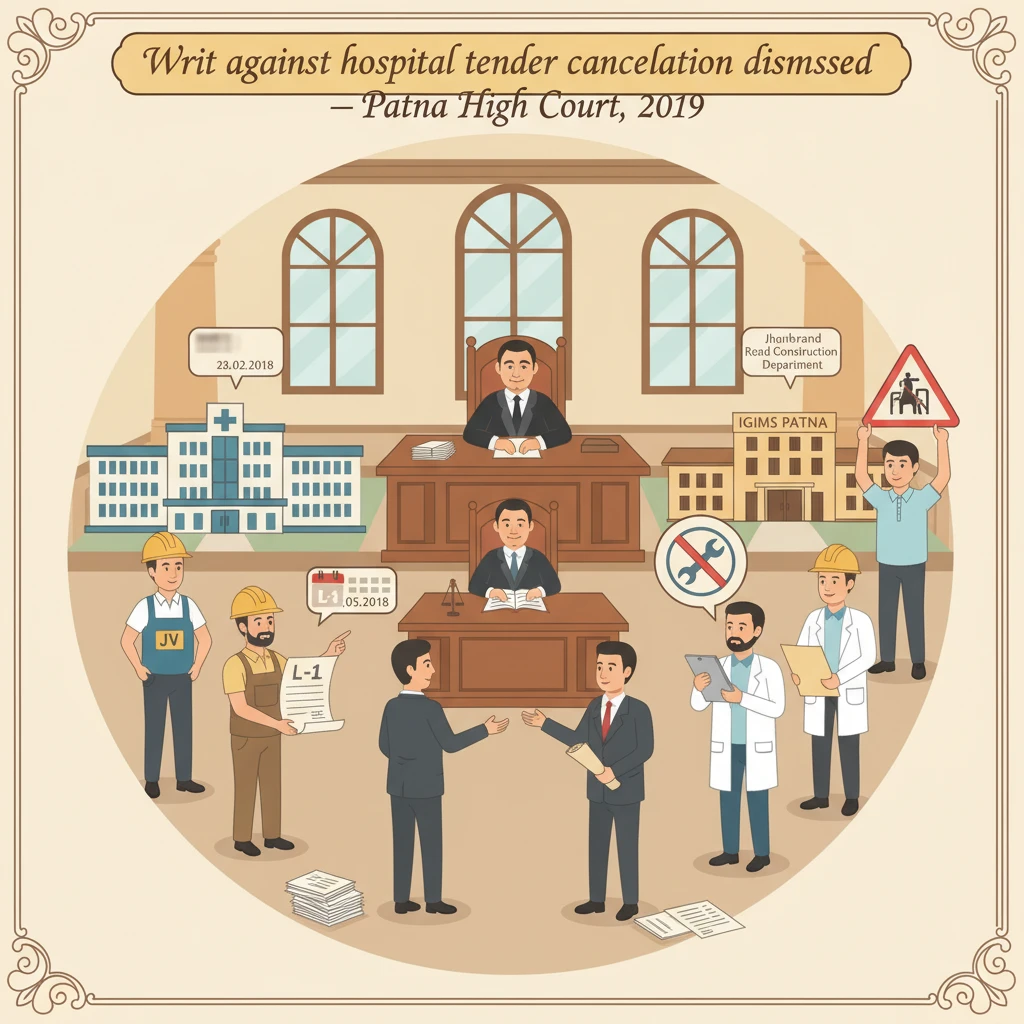
Case Background
The dispute arose out of a major construction project at Indira Gandhi Institute of Medical Sciences (IGIMS), Sheikhpura, Patna. IGIMS issued a notice inviting tender for construction of a 500-bedded hospital building in its campus.
The petitioner, a joint venture construction company, found itself eligible and submitted its bid. As part of the tender process, bidders had to file an affidavit in a prescribed format. In this affidavit, they had to clearly state whether their firm had ever been blacklisted, debarred, or had abandoned any work in any government department in India, or whether any such contract had been rescinded.
The petitioner filed this affidavit on 05.04.2018, declaring that it had never been blacklisted or debarred and had not abandoned any government work in India.
After opening of the technical bids, only two bidders, including the petitioner, were found technically qualified. Twenty-one days later, on 22.05.2018, the financial bids were opened. IGIMS informed the petitioner that its bid was the lowest (L-1). The Tender Committee called the petitioner to justify its quoted rates.
The petitioner submitted detailed rate analysis. A negotiation meeting was held on 23.05.2018. After this, on 24.05.2018, the petitioner wrote to IGIMS offering a lump sum discount of Rs. 55 lakhs on its quoted price.
At this stage, a complaint reached IGIMS by email. The complaint stated that the Road Construction Department, Government of Jharkhand, had debarred the petitioner from participating in any further tenders of that department until completion of a particular road work. This debarment order was dated 28.02.2018.
IGIMS took this complaint seriously because, only a few weeks later, on 05.04.2018, the petitioner had sworn its affidavit denying any debarment by any government department in India. The Superintending Engineer of IGIMS, therefore, issued a letter (Annexure-8 series) calling upon the petitioner to clarify the position regarding debarment by the Jharkhand Road Construction Department.
The petitioner replied by letter dated 28.05.2018 (Annexure-9). It admitted the existence of the Jharkhand letter dated 28.02.2018, but tried to explain that this was only a restriction to participate in future tenders of that particular department till completion of the ongoing work. The petitioner argued that such a restriction could not be treated as “blacklisting” or “debarment” in the sense used in the IGIMS affidavit format and that other authorities should not rely on it to disqualify it from their tenders.
Meanwhile, IGIMS sought legal opinion from the Advocate General and placed the matter before its Board of Governors. In its 100th (Extraordinary – Special) meeting held on 01.06.2018, the Board decided that re-tendering should be done for the project.
On 08.06.2018, IGIMS issued an office order canceling the earlier re-tender in which the petitioner had emerged as L-1. Soon after, a fresh re-tender notice dated 13.06.2018 was issued for the same 500-bedded hospital project.
The petitioner approached the Patna High Court under Article 226 of the Constitution. It sought to quash the office order dated 08.06.2018, to compel IGIMS to award it the work, and to restrain IGIMS from proceeding with the fresh re-tender dated 13.06.2018.
What the Court Examined and Decided
The Patna High Court, through Hon’ble Mr. Justice Rajeev Ranjan Prasad, carefully examined the tender terms, the affidavit format, the Jharkhand debarment order, and the conduct of the petitioner.
Clause 7.6 (J) of the notice inviting tender required bidders to submit an affidavit in a prescribed format. The clause stated that the affidavit had to be on Rs. 1000 non-judicial stamp before a 1st Class Magistrate, “regarding black listed, debar or rescined of their work on the format annex with the Bid.”
The Court reproduced the exact affidavit format. The key part was paragraph 2, where the bidder had to certify that its firm had neither been blacklisted/debarred nor had abandoned any work “in any government department, India” and that no contract for such works had been rescinded till date.
On facts, the Court found that the Road Construction Department, Government of Jharkhand, had already issued its order on 28.02.2018. By that order, the petitioner company was debarred from participating in fresh tenders of that department until it completed the specified road work and obtained a completion certificate. Until that time, the petitioner would be treated as unfit or ineligible for that department’s tenders.
This meant that on 05.04.2018, when the petitioner swore its affidavit before the magistrate for IGIMS, the debarment order from Jharkhand was very much in existence. Yet, the affidavit declared that the company had never been blacklisted or debarred in any government department in India.
The petitioner’s main defence in the High Court was twofold.
First, it argued that the Jharkhand letter of 28.02.2018 was not really a debarment or blacklisting order in the legal sense but only a limited restriction relating to that particular department. Therefore, it claimed that it had made a correct statement in its affidavit.
Second, it argued that the affidavit format used by IGIMS referred to “Government Department, India” which, according to the petitioner, should be read as “Department of Government of India” and not State Government Departments. On this reading, it claimed that it was not obliged to disclose the Jharkhand order.
The petitioner also relied on later developments in Jharkhand. It pointed out that a Single Judge of the Jharkhand High Court, by orders dated 07.06.2018 and 08.06.2018 in W.P. (C) No. 2701 of 2018, had already held that the 28.02.2018 order would apply only to the Road Construction Department of Jharkhand. Later, a Division Bench in L.P.A. No. 312 of 2018, by judgment dated 25.06.2018, quashed the very letter dated 28.02.2018 and imposed costs on the State of Jharkhand. On this basis, the petitioner said that IGIMS had wrongly cancelled the tender.
The respondents (IGIMS and its Engineer) replied that the tender terms demanded full and frank disclosure of any blacklisting or debarment in any government department in India. They stressed that the words “any government department, India” were broad and clearly covered State Government departments as well.
They pointed out that the petitioner never said, in its written clarification dated 28.05.2018, that it was confused by the wording of the affidavit format. Instead, the petitioner only tried to argue that the Jharkhand order was not “blacklisting” by the “Registering Authority” and could not be used by other departments. This showed that the petitioner understood the question properly but chose to withhold the fact of debarment.
On this basis, IGIMS contended that the petitioner had suppressed a material fact at the time of filing the affidavit. Once this suppression came to light and only two bidders were left in the field, the Board of Governors had no option but to cancel and re-tender; otherwise, it would become a single-bidder situation.
The respondents also invoked well-settled Supreme Court case law on judicial review in tender matters. They relied on decisions such as Air India Limited vs. Cochin International Airport Ltd. (2000) 2 SCC 617, Raunaq International Ltd. vs. IVR Construction Ltd. (1999) 1 SCC 492, Jagdish Mandal vs. State of Orissa (2007) 14 SCC 517 (cited in the judgment as (2001) 2 SCC 451), Michigan Rubber (India) Ltd. vs. State of Karnataka (2012) 8 SCC 216, and Siemens Public Communication Networks (P) Ltd. vs. Union of India (2008) 16 SCC 215. These cases emphasise that courts should interfere in tender decisions only where there is arbitrariness, mala fides or violation of public interest, and not merely because a bidder raises a legal argument.
After analysing the affidavit and the Jharkhand order, the Patna High Court rejected the petitioner’s interpretation. The Court held that the phrase “any work in any Government Department, India” clearly covered any department of any government in India, not just the Union Government. There was no ambiguity. If the petitioner had any doubt, it could have asked for clarification in the pre-bid meeting on 26.03.2018, but it did not.
The Court noted that, in its clarification letter (Annexure-9), the petitioner never claimed that it misunderstood the words of the affidavit. It only tried to minimise the effect of the Jharkhand order by arguing that it was not a formal blacklisting. Thus, the plea of confusion was raised for the first time during oral argument in the Patna High Court and could not be accepted.
The Court concluded that when the deponent for the petitioner swore the affidavit on 05.04.2018, he deliberately did not disclose the existing debarment order. This non-disclosure was a serious matter because the very purpose of the affidavit was to allow IGIMS to assess the bidder’s eligibility and reliability.
Regarding the later quashing of the Jharkhand debarment by the Jharkhand High Court, the Patna High Court held that this later event could not cure the defect in the petitioner’s affidavit or invalidate IGIMS’s decision. On the date of the affidavit and on 01.06.2018, when the Board of Governors decided to go for re-tendering, the debarment order was in force. The law requires the decision-making process to be judged on the facts existing at that time, not on subsequent developments.
Applying the Supreme Court precedents, the Court held that IGIMS’s decision to cancel the tender and re-tender was taken bona fide, in public interest, and in line with the tender conditions. The decision aimed to maintain the integrity of the process and avoid proceeding with an L-1 bidder who had not made a true disclosure about a debarment by another government department.
Therefore, the Court found no arbitrariness, mala fides, or illegality in the decision-making process. It held that interference under Article 226 would not be justified merely because the petitioner could point to legal arguments about the meaning of debarment or the later quashing of the Jharkhand order.
As a result, the writ petition was dismissed. The connected interlocutory application (I.A. No. 01 of 2019) for vacating interim orders was held to have become infructuous.
Before closing, the Court made an important observation. It recorded that construction of the 500-bedded hospital had already been delayed because of this litigation. The Court stressed that larger public interest demanded that the hospital’s construction should start immediately. It appealed to business entities seeking such contracts to avoid unnecessary litigation that delays vital public health infrastructure, particularly for patients with critical diseases who depend on timely medical care. The Court reminded that every business entity has certain social responsibilities to fulfil.
Why This Judgment Matters
This judgment has practical implications for contractors and government bodies involved in public works, especially in Bihar and Jharkhand.
First, it makes clear that when a tender requires disclosure of blacklisting or debarment “in any government department, India,” bidders must disclose all such actions by any central or state government department. Narrow or technical interpretations will not be accepted later.
Second, it shows that non-disclosure or suppression of a debarment, even if later quashed by another court, can justify cancellation of a tender. The key question is what facts existed when the affidavit was sworn and when the authority took its decision, not what happened afterwards.
Third, the Patna High Court strongly reaffirmed that judicial review in tender matters is limited. Courts will not protect a private bidder’s interest at the cost of public interest, especially when a crucial public project like a large hospital is involved.
Finally, the judgment sends a message that litigation over tenders should not unduly delay essential public projects. Contractors are reminded that they also carry social responsibility when they participate in public infrastructure works.
Legal Issues and Answers
- Issue: Was IGIMS justified in cancelling the tender and going for re-tendering after discovering that the lowest bidder had been debarred by another government department, despite the bidder’s affidavit denying any such debarment?
Answer: Yes. The Patna High Court held that the affidavit format clearly required disclosure of any debarment in any government department in India. The petitioner had suppressed the existing Jharkhand debarment order. In these circumstances, and following Supreme Court guidance on limited judicial review in tender matters, IGIMS’s decision to cancel and re-tender was lawful and in public interest. - Issue: Did the later quashing of the Jharkhand Road Construction Department’s debarment order affect the legality of IGIMS’s earlier decision to cancel the tender?
Answer: No. The Court held that the decision-making process must be judged on the facts as they stood when the affidavit was sworn and when the Board of Governors decided to re-tender. On both those dates, the Jharkhand debarment order was in force. Its later quashing did not render IGIMS’s earlier decision invalid. - Issue: Should the High Court exercise its writ jurisdiction under Article 226 to interfere with the tender process in this case?
Answer: No. Relying on Supreme Court precedents, the Patna High Court held that courts should interfere in tender decisions only to prevent arbitrariness, mala fides or violations of public interest. Here, the decision was bona fide and in furtherance of public interest, particularly given the urgent need to construct a 500-bedded hospital.
Cases Cited by the Court
- Raunaq International Ltd. vs. IVR Construction Ltd. and Others, (1999) 1 SCC 492
- Jagdish Mandal and Another vs. State of Orissa & Others, (2007) 14 SCC 517 (referred to in the judgment as (2001) 2 SCC 451)
- Air India Limited vs. Cochin International Airport Ltd. & Others, (2000) 2 SCC 617
- Siemens Public Communication Networks (P) Ltd. vs. Union of India, (2008) 16 SCC 215
- Michigan Rubber (India) Ltd. vs. State of Karnataka & Others, (2012) 8 SCC 216 (via Jharkhand High Court judgment in Chhatisgarh Distilleries Ltd. vs. State of Jharkhand & Others, W.P. (C) No. 5056 of 2014)
Case Details
Case Number: Civil Writ Jurisdiction Case No. 12330 of 2018
Case Title: M/s N P C C – P S K – J V vs. The Indira Gandhi Institute of Medical Science & Anr.
Coram: Hon’ble Mr. Justice Rajeev Ranjan Prasad
Citation: 2019 (3) PLJR 69
Date of Judgment: 14.03.2019
CAV Date: 08.03.2019
For the Petitioner: Mr. P. K. Shahi, Senior Advocate; Mr. Vikas Kumar, Advocate
For the Respondents: Mr. Sunil Kumar Singh, Advocate
Nature of the Case: Writ petition under Article 226 challenging cancellation of tender and issuance of fresh re-tender notice for construction of 500-bedded hospital building at IGIMS, Patna.
Link to Judgment: Click here to read the full judgment of the Patna High Court
If you found this explanation helpful and wish to stay informed about how legal developments may affect your rights in Bihar, you may consider following Samvida Law Associates for more updates.







