
Case Background
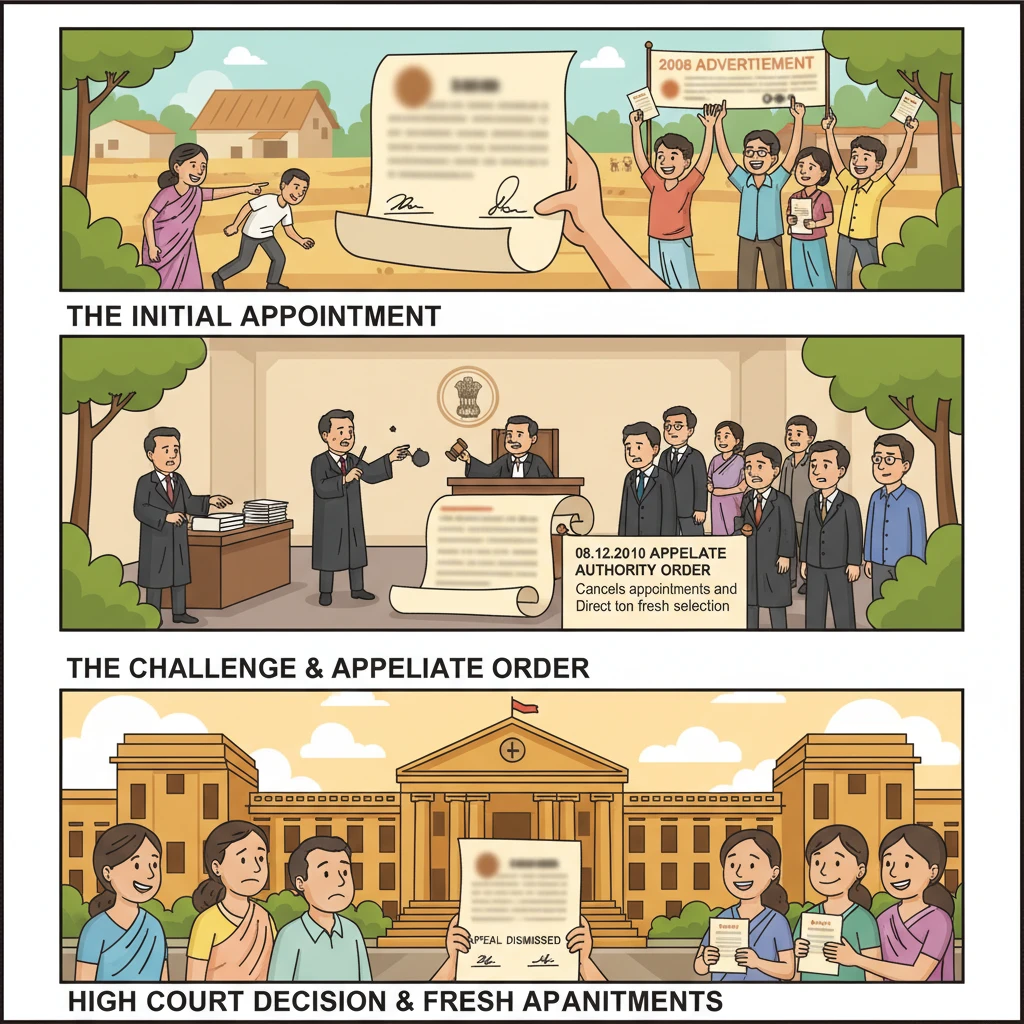
The dispute relates to appointment of Panchayat Teachers under Gram Panchayat Raj, Matiaria, in Gaunaha Block, West Champaran district. An advertisement was issued in 2008 inviting applications for 13 posts of Panchayat Teachers.
Counselling for selection was first fixed on 28.02.2009. Because of a general stay order issued by the State Government, this date was postponed and fresh dates were fixed. Counselling was ultimately held on 14.08.2010.
According to the writ petitioners, who later became the contesting respondents in the appeal, they participated in the counselling on 14.08.2010. This participation was denied by the present appellants. The writ petitioners claimed that, after counselling, a consent letter was prepared and the names of four candidates—Dipraj Mahto, Azimuddin, Mamta Kumari and Ritu Kumari—were sent by the appointing authority as per merit.
The writ petitioners further alleged that, in the meantime, the husband of the then Mukhiya of the Gram Panchayat abducted the Panchayat Secretary. A forged merit list of 13 persons was then prepared, containing the names of the present appellants, and forged appointment letters were issued in their favour by forcibly obtaining the Panchayat Secretary’s signatures. The appellants joined their respective schools on this basis.
Some aggrieved persons challenged these appointments before the District Teachers Appointment Appellate Authority, West Champaran, Bettiah. This gave rise to Case No. 541 of 2010.
On 08.12.2010, the Appellate Authority set aside the appointments of the appellants and others. It directed that appointments be made afresh, strictly on the basis of respective merit and roster clearance, in the presence of the Sub-Divisional Education Officer, Bettiah.
The appellants then approached the Patna High Court by filing CWJC No. 194 of 2011. They challenged the Appellate Authority’s order mainly on the ground that no notice had been given to them before their appointments were cancelled, thereby denying them an opportunity of hearing.
Meanwhile, in compliance with the Appellate Authority’s order dated 08.12.2010, the Sub-Divisional Officer, Bettiah, proceeded to fix a date for fresh selection. On 07.01.2011, the High Court, while hearing CWJC No. 194 of 2011, passed an interim order that any appointment made pursuant to the Appellate Authority’s order would be subject to the final decision in the writ case.
According to the writ petitioners (later respondents 2nd set), a meeting of the appointment committee of Gram Panchayat Matiaria was held on 29.01.2011. This meeting, they say, took place in the presence of the Sub-Divisional Education Officer, Bettiah, and the Block Development Officer, Gaunaha.
They claim that a merit list, prepared as per the approved roster, led to the appointment of respondent No. 13 as an untrained general teacher in male category against an unreserved post, and respondent No. 12 as a general teacher in male category under Backward Class category. They were directed to join as Assistant Teachers in Government Primary School, Tahkul. The appellants, however, disputed the fact that such appointments of respondents Nos. 12 and 13 ever took place.
CWJC No. 194 of 2011 was finally allowed on 09.04.2012. The High Court quashed the Appellate Authority’s order dated 08.12.2010 in Case No. 541 of 2010 solely on the ground that the appellants had not been given notice or a hearing, even though the order had the civil consequence of removing them from service.
The Court remanded the matter back to the Appellate Authority with directions to fix an appropriate date, hear all parties, and decide the matter afresh. Importantly, the Court also observed that the Appellate Authority “would make endeavour to see that the adjudication is made with due co-operation of one and all within a period of three months thereafter.” Respondents Nos. 12 and 13 had intervened in that writ proceeding, asserting that they had been selected and appointed in the selection held on 29.01.2011 pursuant to the Appellate Authority’s earlier order.
What the Court Examined and Decided
After the remand order dated 09.04.2012 in CWJC No. 194 of 2011, the District Teachers Appointment Appellate Authority registered a fresh proceeding as Case No. 18 of 2012. In this new case, the present respondents 2nd set also presented their claims.
They asserted that they had higher merit points than the appellants and therefore had a better right to be appointed as Panchayat Teachers in Gram Panchayat Matiaria. However, the Appellate Authority refused to consider their case on merits.
The Authority held that the claims of respondents 2nd set were barred by limitation. The reasoning was that these candidates had not filed any objection against the appointment of the appellants during the earlier proceedings in Case No. 541 of 2010, even though the selection and appointment process had been completed on 14.08.2010. On this sole ground—that they had not objected in 2010—the Authority rejected their claims as time-barred by its order dated 18.07.2012.
Aggrieved, the said candidates (respondents 2nd set) approached the High Court in CWJC No. 3389 of 2013. A learned Single Judge examined how the Appellate Authority had handled the matter in Case No. 18 of 2012.
The Single Judge noted that the Authority had unnecessarily mixed up the cases of several persons instead of dealing with the claims of respondents 2nd set and others separately. It was observed that, if the Authority felt it needed to look at the original records relating to selection and appointment of respondents Nos. 12 to 16, the concerned government authorities were duty-bound to produce those records.
The Single Judge accordingly quashed the Appellate Authority’s order dated 18.07.2012 and remanded the matter back. Directions were issued to the Collector, West Champaran, to ensure production of all relevant records before the Appellate Authority within the time to be fixed by that Authority. The expectation was clearly recorded that whatever issues were raised by either side would be examined and decided in accordance with law expeditiously.
The present Letters Patent Appeal (LPA No. 1360 of 2014) was filed under Clause 10 of the Letters Patent against this Single Judge order dated 06.05.2014 in CWJC No. 3389 of 2013.
Before the Division Bench, the appellants argued primarily on the issue of delay and laches. Their counsel, Mr. Y. V. Giri, Senior Advocate, contended that respondents Nos. 12 to 13 had failed to file objections against their non-selection within a reasonable time. It was submitted that these respondents did not raise any challenge either before the selection committee or before the Appellate Authority immediately after the appellants’ appointments in 2010.
According to this argument, the first time respondents 2nd set raised any grievance was only after the High Court’s remand order dated 09.04.2012, when Case No. 18 of 2012 was initiated. On this basis, the appellants argued that the Appellate Authority had rightly rejected their claims as time-barred and that the Single Judge erred in interfering.
In support of their contention on delay and laches, the appellants relied upon Supreme Court decisions reported in 2009 (2) PLJR 929 (Alok Kumar v. State of Bihar), (2011) 5 SCC 607 (S. Co-operative Housing Society Ltd. v. M Prabhakar & Ors), and (2012) 7 SCC 610 (Vijay Kumar Kaul & Ors v. Union of India & Ors). These decisions emphasise that courts, especially under Article 226, should not ordinarily entertain stale or belated claims.
The appellants also referred to a counter affidavit (Annexure-2 to the writ application in CWJC No. 194 of 2011) said to have been filed on behalf of the Mukhiya of Matiaria Gram Panchayat. That affidavit denied the allegation that the husband of the then Mukhiya had used force on the Panchayat Secretary to obtain signatures on appointment letters.
The Division Bench, however, found that this affidavit was actually filed by a defeated Mukhiya of the Gram Panchayat, not by the sitting Mukhiya who was a party in the earlier case. Since the deponent was not the Mukhiya on the date of filing, the Court held that the affidavit had no sanctity.
On the other side, counsel for respondents 2nd set, Mr. Ajay Kumar Thakur, supported the Single Judge’s order. He argued that it was an admitted position that these respondents had more merit points than the appellants for appointment as Panchayat Teachers in the concerned Gram Panchayat.
He submitted that whether they had participated in the counselling could only be established from the original records. He further argued that respondents 2nd set acquired a right to be heard after they were found selected by the appointment committee in its meeting dated 29.01.2011 and appointment letters were issued to them.
It was also pointed out that these respondents had already intervened in CWJC No. 194 of 2011. Therefore, according to them, the Appellate Authority, when acting under the remand order dated 09.04.2012, ought not to have refused to consider their claims in Case No. 18 of 2012.
The Division Bench examined the earlier order of the Appellate Authority dated 08.12.2010. It noted that the Appellate Authority had set aside the appellants’ appointments after finding serious irregularities in the selection process. It had then ordered preparation of a fresh merit list as per the approved roster in the presence of the Sub-Divisional Education Officer, Bettiah, to ensure purity and transparency in appointments.
The Bench further observed that the High Court’s remand order of 09.04.2012 in CWJC No. 194 of 2011 had set aside this earlier order only on a technical ground—lack of notice and hearing to the appellants. The dispute was sent back to the Appellate Authority for fresh decision. The Court highlighted the line that the Appellate Authority “would make endeavour to see that the adjudication is made with due co-operation of one and all.”
In the opinion of the Division Bench, this remand order was widely worded. The Appellate Authority was required to reconsider “the matter in its entirety,” not just the narrow challenge by the appellants. In that context, the claims of respondents 2nd set became “more important and relevant” because they asserted that, in the presence of the Sub-Divisional Officer, Bettiah, the appointment committee had selected and appointed them on 29.01.2011.
Against this backdrop, the Bench held that the Single Judge was correct in quashing the Appellate Authority’s order dated 18.07.2012, which had refused to take up the cases of respondents 2nd set as time-barred. The Division Bench found that the authorities could not ignore these claims merely on limitation when the High Court had directed a fresh, wide-ranging adjudication involving “one and all.”
Regarding the reliance on Supreme Court precedents about delay and laches, the Bench stated that those decisions deal with self-imposed restrictions that superior courts, including High Courts under Article 226, follow while exercising discretionary jurisdiction. They guide when a court should refuse to entertain a delayed petition. However, in the present case, the question was about the scope of a remand before a statutory Appellate Authority, not about the High Court’s own discretion to entertain or reject a writ petition.
The Bench therefore held that the cited decisions were not applicable in the facts and circumstances of this case.
Ultimately, the Division Bench concluded that there was no ground to interfere with the Single Judge’s order dated 06.05.2014 in CWJC No. 3389 of 2013. The Letters Patent Appeal was dismissed, and no order as to costs was passed.
Why This Judgment Matters
This judgment is important for candidates involved in Panchayat Teacher recruitments and similar local body appointments in Bihar. The Patna High Court made it clear that, when a case is remanded for fresh consideration, the Appellate Authority cannot sideline affected candidates on a narrow technicality of “delay” if the Court has directed that all concerned should be heard.
For aspirants who claim higher merit, the decision shows that their grievances must be examined on the basis of official records, especially where serious allegations of irregularity or forged merit lists are made. Authorities cannot dismiss such claims simply because the candidates did not challenge the initial appointments at an earlier stage, particularly when subsequent events, like a fresh selection, may have given them a new or stronger claim.
For government officers and Panchayat officials, the judgment reinforces the need to maintain proper records of counselling, merit lists, meetings of appointment committees, and appointment letters. When disputes arise, courts will insist that these records be produced before the Appellate Authority to uncover the truth.
Overall, the decision strengthens transparency and fairness in teacher appointments and signals that appellate bodies must conduct a full and careful inquiry when directed by the Patna High Court.
Legal Issues and Answers
-
Issue: Could the District Teachers Appointment Appellate Authority refuse to consider the claims of higher-merit candidates as time-barred after the High Court had remanded the matter for fresh adjudication involving all concerned?
Answer: No. The Patna High Court held that its remand order was widely worded and required the Appellate Authority to consider the entire matter, including the claims of respondents 2nd set. The Authority was wrong in rejecting their claims solely on limitation. -
Issue: Were Supreme Court rulings on delay and laches applicable to uphold the rejection of the respondents 2nd set’s claims?
Answer: No. The Court held that those decisions address the High Court’s self-imposed limits under Article 226 when entertaining belated writ petitions and were not applicable to the present factual context of a remand before the Appellate Authority.
Cases Cited by the Court
- 2009 (2) PLJR 929 (Alok Kumar v. the State of Bihar) – cited by appellants on delay and laches.
- (2011) 5 SCC 607 (S. Co-operative Housing Society Ltd. v. M Prabhakar & Ors) – cited by appellants.
- (2012) 7 SCC 610 (Vijay Kumar Kaul & Ors v. Union of India & Ors) – cited by appellants.
- The Division Bench held that these decisions on delay and laches were not applicable to the facts of this case.
Case Details
Case Number: Letters Patent Appeal No. 1360 of 2014 in Civil Writ Jurisdiction Case No. 3389 of 2013
Case Title: Madhurendra Kumar Verma & Ors v. The State of Bihar & Ors
Citation: 2019(3) PLJR 103
Coram: Hon’ble Mr. Justice I. A. Ansari and Hon’ble Mr. Justice Chakradhari Sharan Singh
Date of Judgment: 24.06.2015
Advocates:
- For the Appellants: Mr. Y. V. Giri, Senior Advocate; Mr. Nikhil Kumar Agrawal, Advocate
- For Respondents 1 to 8 and 11 (State and authorities): Mr. Mritunjay Singh, AC to SC 23
- For Respondents 9 and 10 (Mukhiya and Panchayat Secretary): Mr. Umesh Chandra Verma, Advocate
- For Respondents 12, 13, 14 (private contesting respondents): Mr. Ajay Thakur, Advocate; Mr. Imteyaz Ahmad, Advocate; Mr. Nilesh Kumar, Advocate
Nature of the Case: Intra-court appeal (Letters Patent Appeal) against a Single Judge’s order in a writ petition concerning Panchayat Teacher appointments and the scope of remand to the District Teachers Appointment Appellate Authority.
Link to Judgment: Click here to view the full judgment on the Patna High Court website
If you found this explanation helpful and wish to stay informed about
how legal developments may affect your rights in Bihar,
you may consider following Samvida Law Associates for more updates.







