
Case Background
The petitioner was appointed as a Khalasi in the Water Resources Department in 1989.
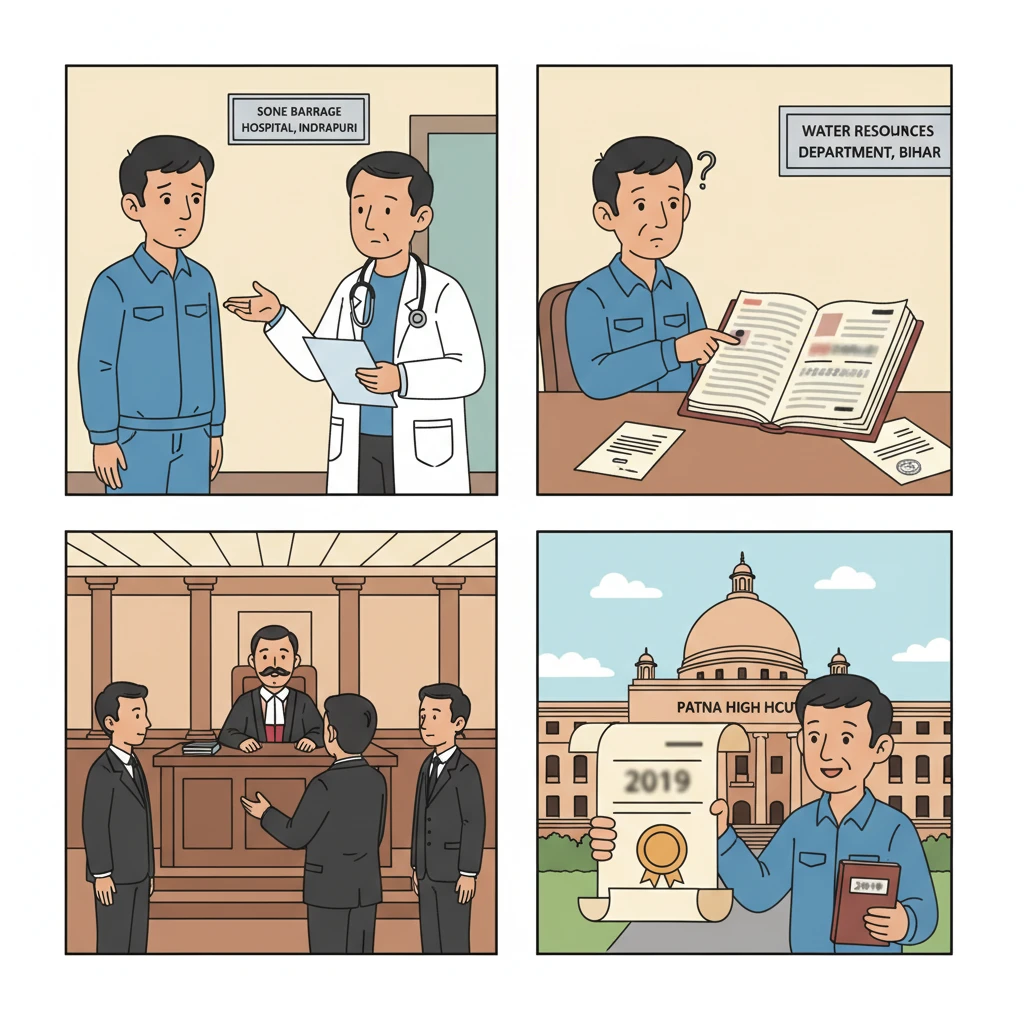
At the time of his appointment, he was medically examined at the Sone Barrage Hospital, Indrapuri. On 26.05.1989, the Medical Officer determined his age to be 30 years on the basis of his appearance and his own statement. This meant that, for service purposes, his year of birth was treated as 1959.
According to the judgment, the department later verified this medical certificate and accepted it as genuine. Thus, the employer itself accepted that he was 30 years old as on 26.05.1989.
However, when his service book was prepared, his date of birth was wrongly recorded. This wrong entry was not in line with the age determined in the medical certificate at the time of appointment.
When the petitioner noticed this discrepancy in his service book, he approached the Executive Engineer, Sone Barrage Division, Indrapuri, requesting rectification. Instead of correcting the mistake, the Superintending Engineer, Sone Canal Modernization Circle, Dehri, rejected his request by order dated 20.02.2015.
The authority relied on Rules 96 and 97 of the Bihar Financial Rules, saying that any request to change date of birth has to be made within ten years of appointment. Because the petitioner’s application was made more than ten years after his appointment in 1989, the department refused to make any correction.
Facing retirement based on the wrong date of birth and denial of correction, the petitioner approached the Patna High Court under its civil writ jurisdiction challenging the order dated 20.02.2015.
What the Court Examined and Decided
The Patna High Court, through Hon’ble Mr. Justice Madhuresh Prasad, heard both the petitioner and the State.
The central dispute was simple but crucial for the petitioner: whether he was asking for a “change” of date of birth, or only for correction of a mistake made by the department in recording what was already accepted at the time of appointment.
The department argued that Rules 96 and 97 of the Bihar Financial Rules prevented them from entertaining his request. These rules say that an employee cannot seek correction of date of birth beyond ten years from the date of his appointment, especially where the employee seeks a date of birth different from what he had given earlier.
The Court examined how the petitioner’s age had been determined at the time of his appointment in 1989. Annexure 2/2, the medical certificate dated 26.05.1989 issued by the Medical Officer, Sone Barrage Hospital, Indrapuri, was crucial.
This certificate recorded that the petitioner was 30 years of age on 26.05.1989. The certificate was based both on his physical appearance and his own submission regarding his age. The respondent authorities later verified the certificate and found it to be genuine.
From this, the Court drew an “irresistible conclusion” that the petitioner’s year of birth was assessed as 1959 at the time of his appointment. The Court also recorded that this assessment stood admitted by the authorities.
In these circumstances, the Court held that the petitioner was not trying to introduce any new or different date of birth from what had already been accepted at the time of appointment. Instead, he was only pointing out a mistake in how the date of birth was recorded in his service book.
The Court then considered the scope of Rule 96 of the Bihar Financial Rules. It observed that this rule applies to claims where an employee seeks correction of date of birth on a different basis from what he had stated at the time of entry into service. It is meant for situations where an employee later attempts to change his date of birth to a new one, usually to extend service.
In the present case, there was no such new claim. The petitioner was consistent with what had been accepted by the employer in 1989. The problem lay not in his claim but in the department’s recording of his date of birth.
The Court reasoned that using Rules 96 and 97 to deny correction in such a scenario would be unjust and inequitable. It would allow the authorities to hide behind a technical rule even when the mistake was entirely theirs. The employee should not suffer loss of service or benefits because of an error in the office records when the correct date of birth is supported by contemporaneous documents from the time of appointment.
The Court therefore held that the bar under Rule 96 of the Bihar Financial Rules should not be allowed to create a situation where the employer cannot rectify its own mistake in the service book, when the same date of birth was accepted at the time of appointment and is supported by original documents like the medical certificate.
On this reasoning, the Patna High Court quashed the order dated 20.02.2015 of the Superintending Engineer which had rejected the petitioner’s request for correction.
The Court directed the respondents to pass a fresh order correcting the date of birth of the petitioner in his service book. This correction was to be done within four weeks from the date of the judgment.
The Court then considered the consequence of the wrong recording of date of birth on the petitioner’s service and retirement. It was submitted before the Court that, if the date of birth was corrected in line with the 26.05.1989 medical certificate, the petitioner would have retired in May 2019.
Instead, because of the wrong entry in the service book, he had been treated as retired from May 2015. Thus, he had been kept out of service for about four years.
The Court observed that, as the petitioner had wrongly been kept out of service from May 2015 till the date of judgment, the authorities should also consider his monetary dues for this period.
The Court held that if the petitioner filed an affidavit stating that he was not gainfully employed during this period, the respondents would consider the issue and pay him 50% of the salary dues for that period, in case it is found that he was not gainfully employed.
Further, the Court clarified that the petitioner would be entitled to count his length of service continuously up to the corrected date of retirement as per the date of birth determined by the medical certificate dated 26.05.1989. This continuity would apply for all benefits, such as pension and other service-related entitlements, which depend on length of service.
In the end, the writ petition was allowed. The Court’s directions ensured both correction of records and partial compensation, subject to verification that the petitioner had no other gainful employment during the disputed period.
Why This Judgment Matters
This judgment is important for government employees in Bihar, especially those in lower posts, whose service records often contain clerical mistakes.
The Patna High Court made it clear that the ten-year bar in Rule 96 of the Bihar Financial Rules cannot be used to deny correction when the employee is not asking for a new date of birth but only wants the department’s own mistake rectified based on original records of appointment.
For workers who discover such errors late in their career, this decision shows that courts can intervene to protect them from being forced to retire early because of an office error.
The decision also signals that when an employee is wrongly kept out of service due to such a mistake, authorities should consider paying at least part of the salary for the lost period, subject to proof that the employee was not earning elsewhere.
Legal Issues and Answers
-
Issue: Can the State refuse to correct a wrongly recorded date of birth in a government servant’s service book after ten years of appointment, when the employee relies on the same documents that were accepted at the time of appointment?
Answer: No. The Patna High Court held that the ten-year bar under Rule 96 of the Bihar Financial Rules does not apply where the employee is not claiming a new or different date of birth but only seeks correction of an error committed by the authorities, supported by contemporaneous records from the time of appointment. -
Issue: What relief is appropriate when an employee has been prematurely retired due to such an incorrect date of birth?
Answer: The Court directed correction of the service book within four weeks, recognition of continuity of service up to the correct date of retirement, and consideration of payment of 50% salary for the period the employee was wrongly kept out of service, subject to an affidavit and verification that he was not gainfully employed.
Cases Cited by the Court
- No earlier judgments are cited or relied upon in the text of this decision.
Case Details
Case Number: Civil Writ Jurisdiction Case No. 6563 of 2015
Case Title: Jai Nath Tiwari v. The State of Bihar & Ors.
Coram: Hon’ble Mr. Justice Madhuresh Prasad
Citation: 2019(3) PLJR 57
Advocates:
- For the petitioner: Mr. Vishwanath Rai, Advocate; Mr. Ajay Kumar, Advocate
- For the State: Mr. Pawan Kumar, AC to GA 1
Nature of the Case: Writ petition under civil writ jurisdiction challenging rejection of request to correct date of birth in service book and consequential premature retirement.
Date of Judgment: 02.04.2019
Court: High Court of Judicature at Patna
Link to Judgment: Click here to read the full judgment on the Patna High Court website
If you found this explanation helpful and wish to stay informed about
how legal developments may affect your rights in Bihar,
you may consider following Samvida Law Associates for more updates.







