
Case Background
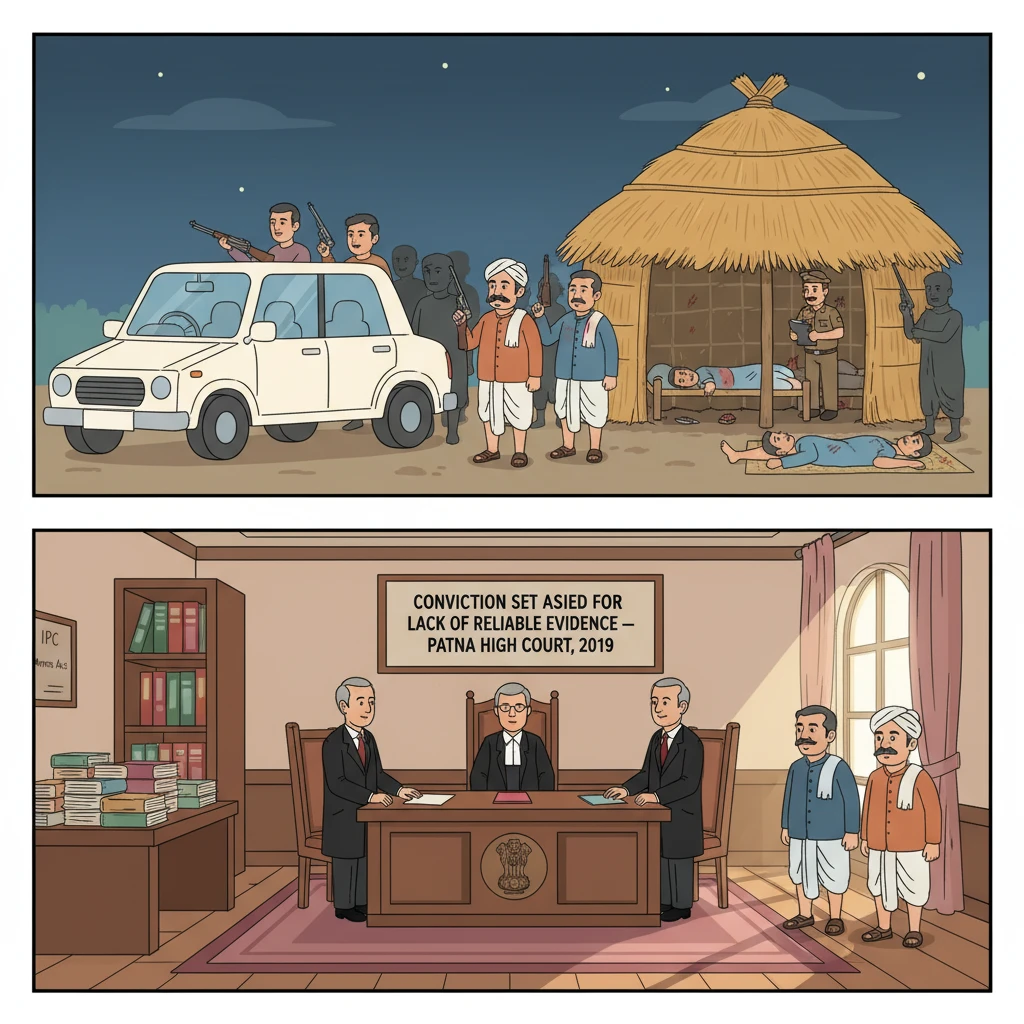
This case arose from an early morning firing incident on 11.01.1991 near Barbigha, District Sheikhpura. According to the prosecution, several men were sitting in a thatched hut when armed assailants arrived in a white car and opened fire, killing and injuring multiple persons.
On the same morning, around 05:15 AM, the police recorded a fardbeyan of the informant, Rajesh Kumar, in his thatched hut. On its basis, Barbigha Police Station Case No. 06 of 1991 was registered under Section 302 of the Indian Penal Code read with Section 27(i) of the Arms Act, against named accused including the present appellants and several others along with 5–6 unknown persons.
During investigation, inquest was conducted on the bodies of four deceased persons and post mortem examinations were performed. Eventually, a charge sheet (No. 101 of 2008) was submitted under Sections 302/307/149 of the Indian Penal Code and Section 27(i) of the Arms Act against six persons, including both appellants. Except Vijay Kumar Singh, others were shown as absconders at that stage.
Cognizance under Sections 302, 307, 324, 452 and 120B/34 IPC and Section 27 of the Arms Act was taken by the Sub Divisional Judicial Magistrate, Munger on 20.07.1991/27.07.1991. The case was committed to the Sessions Court on 15.11.2008 and transferred on 22.12.2008 to the Court of the 1st Adhoc Additional Sessions Judge, Sheikhpura.
Initially, only appellant Vijay Kumar Singh was tried in Sessions Case No. 1094 of 2008. Later, by order dated 07.04.2009, Sessions Trial No. 197 of 2009 relating to appellant Bhuna Singh was amalgamated with Sessions Case No. 1094 of 2008, and both appellants were tried together.
The trial court framed charges against Vijay Kumar Singh under Section 302 IPC and Section 27(i) of the Arms Act on 19.01.2009, and against Bhuna Singh under Section 307/149 IPC and Section 27(i) on 07.03.2009. Subsequently, on 24.09.2012, a further charge under Section 302 IPC was framed against Bhuna Singh. Both appellants pleaded not guilty.
By judgment dated 20.09.2013, the trial court convicted both appellants under Section 302 IPC and Section 27(i) of the Arms Act. On 23.09.2013, each was sentenced to life imprisonment and a fine of Rs. 10,000/- under Section 302 IPC, and rigorous imprisonment for three years and fine of Rs. 1,000/- under Section 27(i) of the Arms Act, with default sentence and directions that sentences run concurrently.
Aggrieved, both convicts filed Criminal Appeal (DB) No. 974 of 2013 and Criminal Appeal (DB) No. 980 of 2013 before the Patna High Court. These appeals were heard together and decided by a common judgment dated 14.05.2019.
What the Court Examined and Decided
The Patna High Court, speaking through Hon’ble Mr. Justice Anil Kumar Sinha (with Hon’ble Mr. Justice Rakesh Kumar agreeing), closely examined both oral and documentary evidence. The central question was whether the prosecution had proved beyond reasonable doubt that the appellants were among the assailants responsible for the deaths.
The Court first considered the medical evidence through PW 10, Dr. Rabindra Kumar Gupta. He conducted the post mortem on deceased Sunil Kumar Singh on 12.01.1991 and found a firearm entry wound on the left side of the chest, with multiple pellets lodged in the heart and lungs. In his opinion, death was due to shock and haemorrhage caused by firearm injury. He also identified the post mortem report of deceased Alakhdeo Singh, prepared by his late colleague Dr. S.P. Jha. The medical findings, including blackening around the entry wound of Sunil Kumar Singh, showed that he was shot from close range.
The Court noted that the medical findings were not disputed by either side and clearly established that Sunil Kumar Singh’s death was homicidal.
The crucial issue, however, was whether the appellants were rightly identified as shooters.
Among the 11 prosecution witnesses, the Court found that several were formal or hearsay witnesses. PW 2 simply proved the formal FIR. PW 4 and PW 9 were hearsay witnesses who had only “heard” of the murders and did not disclose the source of their information. PW 5 and PW 8 were seizure-list witnesses; PW 8 admitted signing at the police station without knowing the contents.
The prosecution mainly relied on PW 1 (Jata Shankar Singh) and PW 7 (Rajesh Kumar @ Karu Singh, the informant) as alleged eyewitnesses. PW 3 (Masudan Singh) and PW 6 (Rajendra Singh, an injured person) were also named by others as eyewitnesses, but their own depositions did not support that claim.
PW 7 stated that on 11.01.1991 at about 04:45 AM, he was in his thatched hut with several persons including the deceased and some future prosecution witnesses, and that a lamp was burning. He claimed that a white car stopped near the hut; from this, the accused including both appellants and others alighted with firearms, joined by 5–7 more persons. According to him, Vijay Singh ordered to shoot and then fired at Sunil Singh, Siddhi Singh fired at Neel Singh, Uday Singh at Dhala Singh, Bhuna Singh at Alakhdeo Singh, Anil Singh at Rajendra Singh, Mantu Singh at PW 1, and Arun Singh at Bajrangi Singh. He claimed Anil Singh also fired at him, but he escaped by hiding in a heap of straw.
In cross-examination, PW 7 admitted that in January the sun rises after 6 AM and it was still somewhat dark at 04:45 AM. He said he identified the accused when they were getting down from the car, which was 10–15 hands away from the hut. He further stated that police did not take the lamp or bedding from the place of occurrence, and that Masudan, Bhola and Arun were not injured. He added that Vijay Singh fired at Sunil Singh from a distance of 10–12 steps and that he saw the bullets one by one hitting the prosecution side.
PW 1, another claimed eyewitness, also narrated that around 04:45 AM a white car came, several named accused including the appellants alighted with arms, Vijay Singh ordered to shoot, and they fired at the persons sitting in or near the thatched hut, leading to death of three on the spot and later death of Alakhdeo Singh. He claimed that he himself was hit by a bullet fired by Mantu Singh and was sent to Patna, and that the motive was a land dispute between him and Vijay Singh.
In cross-examination, PW 1 admitted that there was a Section 144 CrPC proceeding concerning the land where the hut stood and that the land was “very costly”. He stated that light comes only after 6 AM in January and that his own statement under Section 161 CrPC was recorded by police but he could not say after how many days. He also claimed that many others, including several prosecution witnesses (PW 3, PW 6, PW 7, PW 8, PW 9) and some not examined at trial, had witnessed the occurrence.
However, PW 3 clearly said in court that although he was near the place of occurrence, he had not seen the incident and only knew that 3–4 persons received bullet injuries and some died on the way. He only proved his signatures on two inquest reports.
PW 6, one of the injured, said he was sleeping in the hut and on hearing firing he got up, was hit on the left leg by a bullet, fell down and became unconscious. He regained consciousness in Patna Medical College and Hospital and then came to know about the deaths. He explicitly stated that he did not know who shot him. He was declared hostile by the prosecution.
PW 8, whom PW 1 had named as an eyewitness, did not support that claim. He only deposed about signing a seizure list after the occurrence and admitted that he had signed at the police station without knowing its contents.
PW 9 also did not claim to have seen the incident and only stated that he had heard of a carnage in which 3–4 persons were killed.
The High Court placed importance on these contradictions. It noted that PW 1’s statement under Section 161 CrPC, though he claimed to be an injured eyewitness, was recorded belatedly on 23.01.1991, nearly 12 days after the incident of 11.01.1991, without any satisfactory explanation. No medical evidence of PW 1’s alleged injury was produced. This, according to the Court, created serious doubts about his version.
The Court also highlighted inconsistency between the oral account and the medical evidence. Both PW 1 and PW 7 consistently stated that shots were fired from a distance of 10–12 yards. But the doctor (PW 10) found blackening around the entry wound on Sunil Kumar Singh, indicating that the shot was fired from close range. This mismatch undermined the prosecution story about how the firing took place.
A further key concern was the possibility of identification in the prevailing darkness. All witnesses agreed that the occurrence took place at about 04:45 AM in January, when it is still dark and sunrise is after 6 AM. The prosecution did not bring on record any clear, reliable source of light enabling identification of the assailants from a distance of 10–15 yards. The claim of a lamp burning inside the thatched hut was considered insufficient. The Court observed that it is “impracticable; rather impossible” for a person sitting in light inside a hut to identify persons coming from the dark side at that hour, especially at such distance.
Moreover, the persons whom PW 1 said were co-eyewitnesses (PW 3, PW 6, PW 8, PW 9, and others not examined) either turned hostile, denied witnessing the incident, or were not examined, providing no independent support to his version. This seriously dented his credibility.
Considering all this, the High Court held that merely because some witnesses have given a seemingly consistent story, their statements cannot be relied upon if they are contradicted by medical evidence and not corroborated by independent evidence. The Court found that the prosecution had “miserably failed” to prove the charges beyond reasonable doubt.
Consequently, the conviction and sentences imposed on both appellants by the trial court were set aside. The appellants were acquitted of all charges under the benefit of doubt and, being in custody, were directed to be released forthwith unless required in any other case.
Why This Judgment Matters
This judgment from the Patna High Court shows how seriously appellate courts scrutinise murder convictions, especially where the entire case rests on a few “eye-witnesses”.
The Court emphasised that when identification is made in darkness and there is no clear source of light, courts must be very cautious. If the prosecution does not prove how the witnesses could actually see the accused, their statements may not be trusted.
The decision also underlines that medical evidence cannot be ignored. If eyewitness accounts about distance or manner of firing clash with post mortem findings, the court may doubt the prosecution story and extend benefit of doubt to the accused.
For families of victims, this can be hard to accept. But criminal law requires proof “beyond reasonable doubt”. If there are gaps—like delayed recording of statements, missing medical records of alleged injuries, and non-examination of important witnesses—the court cannot uphold a conviction, even in serious crimes.
Legal Issues and Answers
Issue: Did the prosecution prove beyond reasonable doubt that the appellants participated in the firing and caused the deaths, justifying conviction under Section 302 IPC and Section 27(i) of the Arms Act?
Answer: No. The Patna High Court found serious doubts in the eyewitness accounts, lack of corroboration, contradiction with medical evidence, and failure to prove reliable identification in darkness. The appellants were acquitted on benefit of doubt.
Issue: Could the trial court rely mainly on PW 1 and PW 7 as eyewitnesses despite inconsistencies and lack of independent support?
Answer: No. The High Court held that their testimonies were unreliable owing to delayed recording, absence of injury proof for PW 1, contradictions regarding who witnessed and who was injured, and inconsistency with the doctor’s findings.
Cases Cited by the Court
- The judgment text does not mention or rely on any specific earlier case law. The Court decided the matter on appreciation of evidence without citing precedents.
Case Details
Case Number: Criminal Appeal (DB) No. 974 of 2013 with Criminal Appeal (DB) No. 980 of 2013; arising out of Barbigha P.S. Case No. 06 of 1991; Sessions Case No. 1094 of 2008/Trial No. 17 of 2011; Sessions Trial No. 197 of 2009 (amalgamated).
Case Title: Bhuna Singh v. State of Bihar; Vijay Kumar Singh v. State of Bihar.
Citation: 2019 (3) PLJR 144.
Court: High Court of Judicature at Patna.
Coram: Hon’ble Mr. Justice Rakesh Kumar and Hon’ble Mr. Justice Anil Kumar Sinha.
Judgment Date: 14.05.2019 (CAV; CAV date 23.04.2019).
Advocates: For the appellants: Mr. Surendra Kumar Singh, Senior Advocate; Mr. Ashwani Kumar Singh; Mr. Himanshu Kumar Akela; Mr. Praveen Prakash. For the State (respondent): Mr. Ajay Mishra, Additional Public Prosecutor.
Nature of Case: Criminal appeals (Division Bench) against conviction and sentence for offences under Section 302 of the Indian Penal Code and Section 27(i) of the Arms Act, arising from a multiple-homicide case.
Final Outcome: Appeals allowed; conviction and sentences set aside; appellants acquitted on benefit of doubt and ordered to be released unless wanted in any other case.
Link to Judgment: Patna High Court Judgment PDF
If you found this explanation helpful and wish to stay informed about
how legal developments may affect your rights in Bihar,
you may consider following Samvida Law Associates for more updates.







