
Case Background
The matter arose from a complaint filed by the victim’s father on 22 February 2011 before the court of the Additional Chief Judicial Magistrate, Naugachia. He alleged that his daughter Mamta Devi had been married to one of the appellants on 27 February 2009 according to Hindu rites.
The complainant claimed that soon after marriage, his daughter stayed at her matrimonial home for about five days and then returned to her parental house with her husband. After about 15 days, she again went to her in-laws’ house and stayed there continuously for about one year.
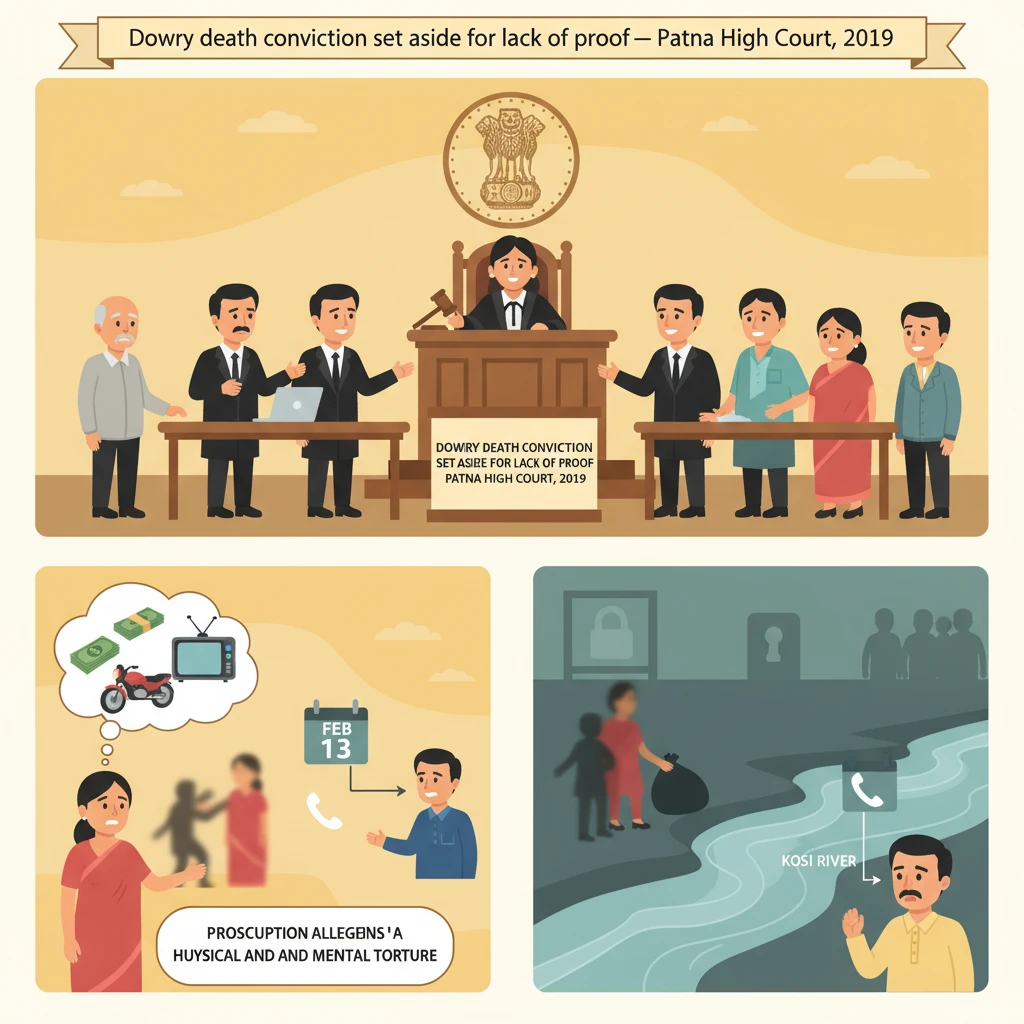
According to the complaint, during this period the in-laws demanded Rs. 1,00,000 in cash, a colour television and a motorcycle. It was alleged that, because the complainant’s family said they had already spent heavily on the marriage and could not meet this demand, the daughter was regularly tortured, not given proper food or clothes, and assaulted by her husband, brother-in-law, mother-in-law and father-in-law.
The complainant stated that, on 2 December 2010, he went with his father-in-law and brother-in-law to the matrimonial house to persuade the accused to stop the harassment, but the accused allegedly repeated their dowry demand. The daughter allegedly told him that the accused were planning to kill her for dowry and had beaten her several times.
He further alleged that on 15 January 2011 his daughter telephoned him to say that she had been assaulted and tortured by one of the brothers-in-law. On 13 February 2011, the husband allegedly called and threatened that if the dowry demand was not met, the daughter would be killed, her body thrown away and he would marry again.
The complaint says that on 14 February 2011 at about 4:00 p.m., all the accused sprinkled kerosene oil on his daughter, set her on fire, killed her, wrapped the dead body in a sand-filled bag and threw it into the Kosi river. The complainant claimed that neighbours had seen the incident. He also alleged that one of the accused telephoned him after the incident, told him about the killing and threatened him not to file a case.
On receiving this information, the complainant said he rushed from Delhi to the matrimonial village but found the house locked, his daughter missing and the accused absconding. He claimed that he informed the local police station and senior officers, but no case was registered.
Because of an advocates’ strike from 15 to 21 February 2011, he said he could file the complaint only on 22 February 2011. On the same day, the Magistrate referred the complaint to the Kharik Police Station under Section 156(3) CrPC for registration and investigation.
On 14 March 2011, Kharik Police Station registered a formal FIR as Kharik P.S. Case No. 50 of 2011 under Sections 304B, 498A, 201, 120B IPC and Sections 3 and 4 of the Dowry Prohibition Act against the four appellants and another accused. The investigation led to a chargesheet initially against one accused, showing others as absconding.
The case was committed to the Court of Sessions as Sessions Trial No. 692 of 2011 and, after the surrender of the remaining accused, a connected Sessions Trial No. 692A of 2011 was also instituted. The two trials were amalgamated on 21 March 2012. All four appellants faced charges under Sections 304B, 498A, 201, 120B IPC and Sections 3/4 of the Dowry Prohibition Act.
After trial, the 4th Additional Sessions Judge, Naugachia convicted all four. One appellant was sentenced to life imprisonment under Section 304B read with Section 120B IPC, and the others to ten years’ rigorous imprisonment under the same provision. All were further sentenced under Section 201 IPC.
The appellants challenged these convictions before the Patna High Court in three connected criminal appeals.
What the Court Examined and Decided
The Patna High Court, speaking through Hon’ble Mr. Justice Rakesh Kumar and concurred by Hon’ble Mr. Justice Prakash Chandra Jaiswal, carefully reviewed the entire evidence placed by the prosecution. Only five witnesses had been examined: the victim’s parents (P.W.2 and P.W.3), two neighbours (P.W.1 and P.W.4) and the investigating officer (P.W.5).
The Court first looked closely at the testimony of P.W.1 Umesh Yadav, an alleged eye-witness. He stated that on 14 February 2011, at about 4:00 p.m., while he was teaching at his house, he heard a commotion and came to know that there was fire in the house of one of the appellants. When he reached there, he claimed to have seen smoke coming out and the daughter-in-law of the house in flames. Around 25 women were gathered outside who reportedly told him that she had been set on fire for non-payment of dowry of Rs. 1,00,000, a colour TV and a motorcycle.
P.W.1 further said that the male accused prevented him from entering the house and that he smelled kerosene. He also deposed that after about one and half hours a vehicle came, the accused loaded the victim and took her away, and that the dead body had not been recovered till date.
However, during cross-examination, his earlier statement to the police under Section 161 CrPC was put to him and later confirmed by the investigating officer. The IO clearly stated that P.W.1 had never told him that he saw the victim burning, that he was prevented from entering the house, or that the accused carried the body away in a vehicle. Because of these material omissions and improvements, the High Court found P.W.1’s evidence unreliable.
Next, the Court analysed the evidence of the complainant, P.W.3 Kailash Poddar. He repeated the allegations from the complaint: frequent dowry demands, torture, and threats. Importantly, he also claimed that on the evening of 14 February 2011 he received a mobile call from one accused who openly confessed that the family had sprinkled kerosene on his daughter, burnt her to death and thrown her body in the river, and also threatened him.
He stated that, after this information, he travelled from Delhi to Bhagalpur, reached the matrimonial village, found the house locked and then went to Kharik Police Station on 17 February 2011 to give an oral report, but no case was registered. He admitted that he did not lodge any written complaint before higher police officers and did not make any effort to search the body in the Kosi river, despite being told that the body had been thrown there in a sand-filled bag.
The complainant also accepted in cross-examination that although his daughter had allegedly been informing them about dowry demands and torture, he had never earlier complained to anyone or any authority. The High Court noted these omissions and found them significant in judging the credibility of the prosecution story.
P.W.2 Dharamshila Devi, the victim’s mother, supported her husband generally but added a new dimension: about a month before the incident, her daughter allegedly told her that one of the brothers-in-law was trying to establish an illicit relationship with her, and that this was the reason for assault. She admitted during cross-examination that she had been living in Delhi for five years, that her son-in-law had stayed in her house for about 15 days without making any dowry demand, and that when her daughter first returned from her in-laws’ house she did not mention dowry demand.
Crucially, P.W.2 admitted she had no evidence of dowry demand and no case had been lodged earlier. The investigating officer confirmed that in her original police statement she had not mentioned the alleged mobile confession about sprinkling kerosene and killing her daughter, thus treating this as an improvement made during trial.
P.W.4, another villager, could only say that the victim’s marriage had taken place two years earlier and that she died in her in-laws’ house. He openly admitted that he had not seen the occurrence.
The investigating officer, P.W.5 Subodh Kumar, gave further details that raised doubts. He stated that although the complaint alleged a serious incident on 14 February 2011, neither the village chowkidar nor any local person informed the police station at that time. When he visited the house on 14 March 2011, a month later, he found the front door locked and had to enter from a back door with neighbours’ help. He did not find any body and did not prepare any seizure list of any incriminating articles from the house.
He confirmed that no prior complaint regarding dowry harassment had been made by the informant. The IO also candidly stated that he did not record the statement of any of the accused persons and did not take any steps to search for the alleged dead body in the Kosi river or elsewhere.
After examining this evidence, the High Court noted a crucial gap: the prosecution had not proved that the daughter was actually dead. There was no dead body, no post-mortem report, and no direct witness whose testimony could safely be relied upon. P.W.1’s alleged eye-witness account was found to be an afterthought and contradicted by his police statement. P.W.4 had not seen anything. P.W.2 and P.W.3 were not present at the place of occurrence.
In addition, the requirement for dowry death under Section 304B IPC—that the woman was subjected to cruelty or harassment “soon before her death” in connection with dowry demand—was not established. The Court observed that the allegations of demanding Rs. 1,00,000, a colour TV and a motorcycle were vague and not supported by concrete, consistent evidence. There was also the separate allegation of a brother-in-law trying to establish illicit relations, which was not linked to dowry demand.
The Court further found it hard to believe, on the evidence, that any accused would telephone the victim’s father and openly confess to killing her and throwing her body into the river. The father’s own conduct in not promptly searching for the body or insisting on registration of an FIR, and in not approaching higher authorities, was treated as inconsistent with the normal reaction of a parent in such a grave situation.
In this background, the Patna High Court held that the prosecution had “miserably failed” to prove its case beyond reasonable doubt. It found that the trial court had erred in treating the case as a proved dowry death when basic facts such as death and causation were not established.
The Court therefore extended the benefit of doubt to all appellants. It set aside the judgment of conviction dated 6 August 2013 and the order of sentence dated 20 August 2013 in Sessions Trial Nos. 692 and 692A of 2011. The appellants were acquitted of all charges. One appellant, who was in custody, was ordered to be released forthwith if not required in any other case; others, who were on bail, were discharged from their bail bonds.
Why This Judgment Matters
This decision from the Patna High Court is important for anyone involved in dowry-related litigation, whether as victim family or as accused. It shows that, even in serious cases like alleged dowry death, the Court will insist on solid, consistent evidence.
The judgment underlines that criminal conviction cannot rest on suspicion, emotional allegations, or improved stories in court. The prosecution must prove basic facts, such as death of the victim, link with the accused, and dowry-related cruelty immediately before the death. Absence of a body or medical evidence, unexplained delay in lodging FIR, and failure to conduct proper investigation can all weaken a case.
For investigating officers, the case highlights the duty to promptly search for a missing or dead body, record statements of the accused, seize material evidence from the place of occurrence and explore the version from both sides. A casual or incomplete investigation can lead to acquittal even in grave offences.
For complainants, the ruling is a reminder that early reporting, consistent statements, and cooperation in investigation are vital. Courts may look with suspicion at long delays, lack of prior complaints despite alleged longstanding torture, and failure to take basic steps like searching for the body or approaching senior police officers.
Legal Issues and Answers
- Issue: Did the prosecution prove beyond reasonable doubt that the victim died due to dowry-related cruelty, so as to sustain conviction under Section 304B IPC and allied offences?
Answer: No. The Patna High Court held that the prosecution failed to prove the death itself, failed to show dowry-related cruelty “soon before” the alleged death, and relied on unreliable and improved testimonies. - Issue: Could the conviction under Section 201 IPC (causing disappearance of evidence of offence) stand in the absence of proof of the underlying offence and recovery of the body?
Answer: No. Since the prosecution did not establish that a homicidal death occurred or that the appellants disposed of any dead body, the conviction under Section 201 IPC was also unsustainable.
Cases Cited by the Court
- The judgment does not refer to or rely upon any other reported case law. No precedents are cited in the text.
Case Details
Case Number: Criminal Appeal (DB) No. 953 of 2013 with Criminal Appeal (DB) No. 874 of 2013 and Criminal Appeal (DB) No. 918 of 2013; arising out of Kharik P.S. Case No. 50 of 2011; Sessions Trial No. 692 of 2011 and Sessions Trial No. 692A of 2011.
Case Title: Ajit Poddar v. The State of Bihar; Shankar Poddar & Anr. v. The State of Bihar; Sujeet Poddar v. The State of Bihar.
Citation: 2019 (3) PLJR 136.
Coram: Hon’ble Mr. Justice Rakesh Kumar and Hon’ble Mr. Justice Prakash Chandra Jaiswal.
Advocates: For the appellants – Mr. Ajit Kumar Ojha, Advocate; Ms. Nutan Mishra, Advocate; Mr. Pranjal Kumar, Advocate. For the State – Mr. Ajay Mishra, A.P.P.
Nature of the Case: Criminal appeals (Division Bench) against conviction and sentence in a Sessions trial for alleged dowry death under Sections 304B/120B/201 IPC and allied provisions.
Link to Judgment: Full judgment of Patna High Court
If you found this explanation helpful and wish to stay informed about
how legal developments may affect your rights in Bihar,
you may consider following Samvida Law Associates for more updates.







