
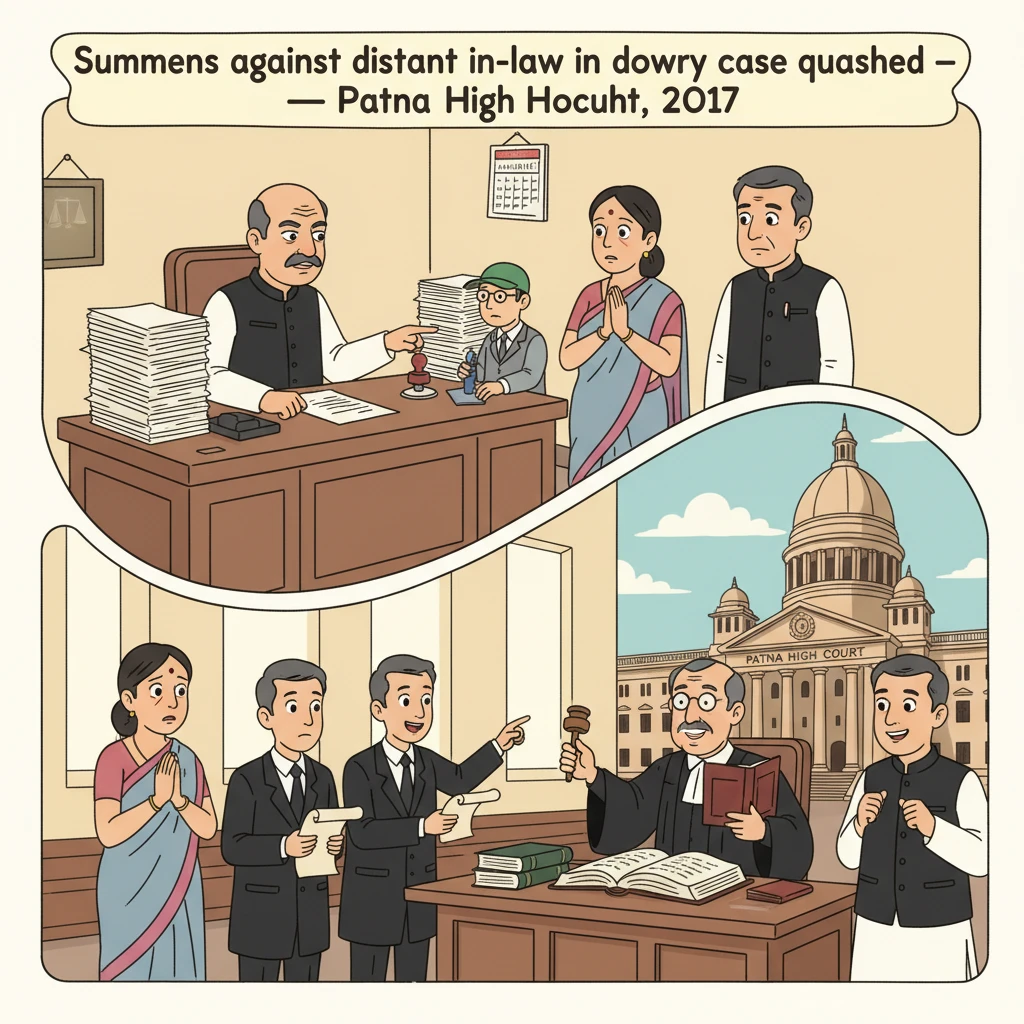
Case Background
This matter arose from Complaint Case No. 1824 of 2013, connected with Sitamarhi police station case, in which the complainant, a married woman, had alleged cruelty and dowry-related offences after her marriage.
The marriage between the complainant and her husband was solemnized on 18.04.2012. Before the marriage, on 25.12.2011, there had been negotiation of the marriage in which the present petitioner took part.
The petitioner is described as the “Bahnoi” of the complainant’s husband, meaning he is the husband of the younger sister of the complainant’s husband. Thus, he is a close relative, but not a member of the immediate matrimonial household.
In the complaint, it was stated that, for the purpose of expenses in the marriage, the complainant’s father deposited a sum of Rs. 4,00,000/- in the account of the petitioner. Thereafter the marriage took place.
Later, the complainant alleged that after marriage, there was demand of dowry and torture, particularly by her husband. Based on the complaint, the learned Sub Divisional Judicial Magistrate, Sitamarhi, took cognizance of the offences under Section 498A of the Indian Penal Code read with Section 4 of the Dowry Prohibition Act and issued summons against several persons, including the present petitioner.
Aggrieved by the order dated 14.03.2014 taking cognizance and issuing summons to him, the petitioner approached the Patna High Court in Criminal Miscellaneous No. 50747 of 2014 seeking quashing of the order in so far as it related to him.
What the Court Examined and Decided
The Patna High Court, through Hon’ble Mr. Justice Rajeev Ranjan Prasad, heard learned counsel for the petitioner, learned counsel for the complainant (opposite party no. 2) and the learned A.P.P. for the State.
The main grievance of the petitioner was that, although he had been summoned for serious offences under Section 498A IPC and Section 3/4 of the Dowry Prohibition Act, there was no specific allegation in the complaint that he ever committed any act of cruelty, torture, or dowry demand against the complainant after the marriage.
Counsel for the petitioner drew the Court’s attention to the complaint petition itself. He pointed out that the only allegation touching the petitioner was that, during the negotiation of the marriage, he had accompanied the complainant’s would-be husband on 25.12.2011 to her house.
It was also mentioned in the complaint that the complainant’s father had deposited Rs. 4,00,000/- in the account of the petitioner for the purpose of meeting marriage expenses. The defence submission was that this transaction, described by the complainant herself as “for purpose of expenses in the marriage,” could not be treated as a dowry demand or dowry taking by the petitioner.
Crucially, the petitioner argued that after the marriage was solemnized on 18.04.2012, the complaint did not attribute any act or omission to him which could constitute cruelty or dowry demand under Section 498A IPC or Sections 3 and 4 of the Dowry Prohibition Act.
The Court then examined the latter part of the complaint petition, which dealt with the period after the marriage. This later portion contained allegations of post-marriage demand of dowry and torture.
On a plain reading, this part of the complaint was found to be directed specifically against the complainant’s husband. It talked about the conduct and acts of the husband after marriage, in connection with dowry demand and cruelty.
The learned counsel representing the complainant–opposite party no. 2 before the High Court accepted the factual position that emerged from the complaint petition and which had been noted on behalf of the petitioner. In other words, she did not dispute that the complaint, as drafted, did not allege any post-marriage act of cruelty or dowry demand against the petitioner.
Further, the complainant’s counsel accepted that, according to her own case, the amount of Rs. 4,00,000/- was deposited towards expenses in the marriage. The Court recorded that this would not attract the provisions of Section 3 or 4 of the Dowry Prohibition Act so far as the petitioner was concerned.
On this basis, the High Court found that there was “no allegation at all of committing any act or omission which may constitute an offence under Section 498A I.P.C.” against the petitioner.
Once the Court reached this finding, it examined whether the learned Sub Divisional Judicial Magistrate, Sitamarhi, had correctly applied his mind while taking cognizance and issuing summons to the petitioner under Section 498A IPC read with Section 3/4 of the Dowry Prohibition Act.
The High Court held that the Magistrate had not applied himself correctly. Even though the complaint did not contain material allegations of cruelty or dowry demand against the petitioner, the Magistrate had still taken cognizance and issued summons.
In the High Court’s view, when a complaint itself discloses that a particular person’s role is limited to participating in marriage negotiation and receiving money specifically for marriage expenses, and when there is no allegation of post-marital cruelty or dowry demand against that person, it is not proper to drag such a person into a criminal trial for offences under Section 498A IPC and the Dowry Prohibition Act.
The Court also took into account the submission that the petitioner appeared to have been implicated simply because of his close relationship with the husband of the complainant and because he participated in the marriage talks.
Such implication of distant relatives, without clear and specific allegations, can lead to unnecessary harassment and misuse of criminal law. Though the Court did not use elaborate doctrinal language, this reasoning underlies its conclusion that the order taking cognizance against the petitioner could not be sustained.
Accordingly, the High Court held that the impugned order issuing summons to the present petitioner was fit to be quashed. The order dated 14.03.2014 in Complaint Case No. 1824 of 2013 (Trial No. 3381 of 2014), in so far as it related to the petitioner, was quashed.
The criminal miscellaneous application was allowed to that extent. The judgment makes it clear that the quashing was only in respect of this petitioner; the proceedings as against others, such as the husband, were not the subject of the present order and thus were unaffected.
Why This Judgment Matters
This decision is important for many families facing criminal cases arising out of dowry and cruelty complaints.
First, the Patna High Court has underlined that criminal law cannot be used loosely against every relative of the husband. There must be clear, specific allegations of wrongful conduct against each accused person.
Second, the judgment clarifies that, when the complainant herself describes money as being given “for expenses in marriage,” without alleging that it was demanded as dowry or misused, such a statement alone is not enough to start a case under Sections 3 and 4 of the Dowry Prohibition Act against a person like the petitioner.
Third, it shows that the High Court will intervene where a Magistrate has taken cognizance without properly considering whether the complaint actually discloses the basic ingredients of the offences against each accused. This provides some protection against unnecessary criminal trials for relatives whose only role was to assist in marriage negotiation or logistics.
For victims and complainants, the judgment is also a reminder that, to bring a successful case, they need to clearly narrate who did what, when, and how, in relation to both cruelty and dowry demand. For accused relatives, it highlights that they can seek quashing if the complaint does not truly allege any wrongful act by them.
Legal Issues and Answers
- Issue: Whether criminal proceedings under Section 498A IPC read with Sections 3/4 of the Dowry Prohibition Act could continue against a distant in-law when the complaint lacked specific allegations of cruelty or dowry demand against him.
Answer: No. The Patna High Court held that, in absence of any allegation of post-marriage cruelty or dowry demand and where money was stated to be for marriage expenses, the Magistrate had not applied his mind correctly in taking cognizance against the petitioner. The summons against him were quashed.
Cases Cited by the Court
- The judgment text provided does not mention or rely upon any cited case law.
Case Details
Case Number: Criminal Miscellaneous No. 50747 of 2014; arising out of Complaint Case No. 1824 of 2013 (Trial No. 3381 of 2014)
Case Title: Rakesh Tiwary v. The State of Bihar & Anr.
Coram: Hon’ble Mr. Justice Rajeev Ranjan Prasad
Citation: 2019 (3) PLJR 565
Advocates:
For the Petitioner: Mr. Bindhyachal Singh, Advocate; Mr. Sachin Kumar, Advocate.
For the State: Mr. G.S. Gupta, A.P.P.
For the Opposite Party No. 2 (Complainant): Ms. Madhubala Verma, Advocate.
Nature of the Case: Criminal miscellaneous petition seeking quashing of cognizance order and summons in a complaint alleging offences under Section 498A IPC and Section 4 of the Dowry Prohibition Act.
Date of High Court Judgment: 13.10.2017
Link to Judgment: https://patnahighcourt.gov.in/viewjudgment/NiM1MDc0NyMyMDE0IzEjTw==-SFcmaho2r9s=
If you found this explanation helpful and wish to stay informed about
how legal developments may affect your rights in Bihar,
you may consider following Samvida Law Associates for more updates.







