
Case Background
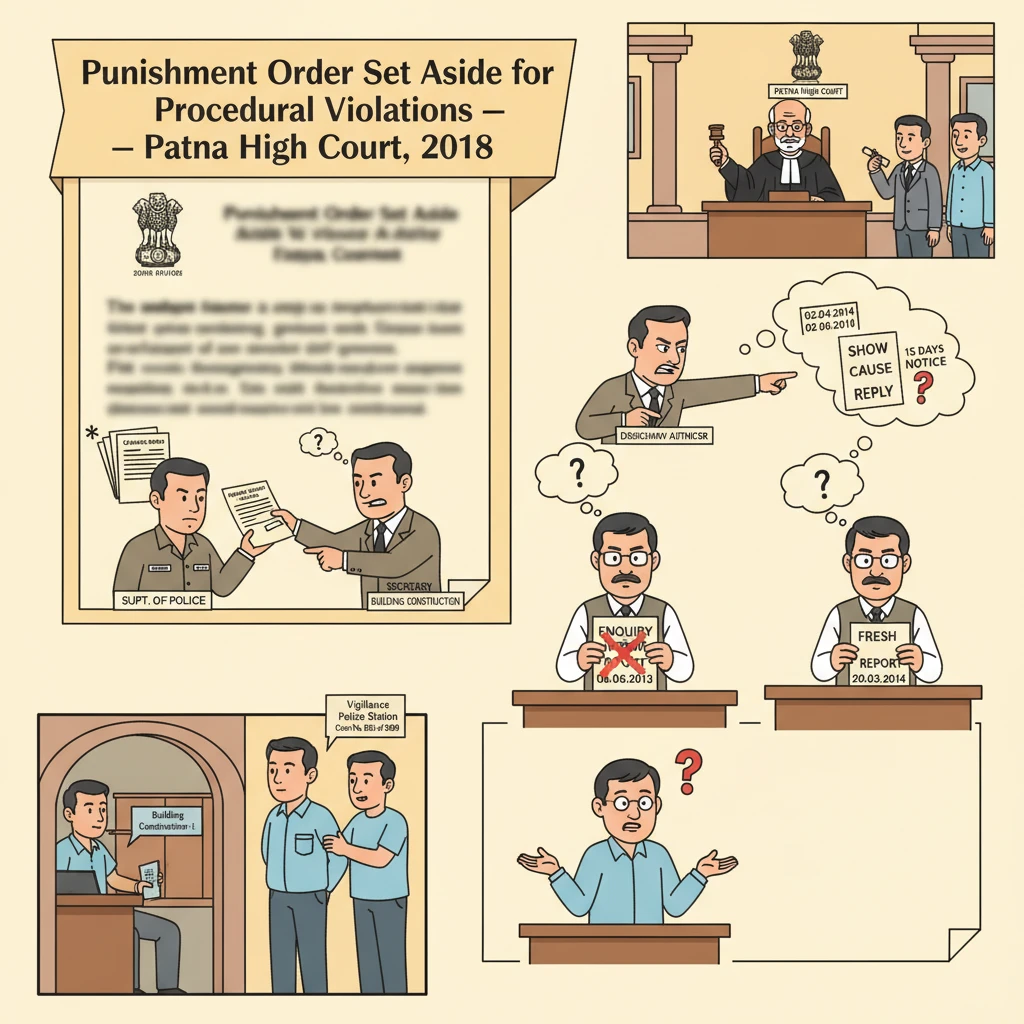
The petitioner was working as a Junior Engineer in the Building Construction Department of the State of Bihar. A vigilance case, Vigilance Police Station Case No. 026 of 2009, was registered against him. He was arrested in connection with that criminal case.
On the basis of the vigilance materials, a departmental proceeding was initiated. A charge memo dated 21.05.2010 was issued to the petitioner. The charge memo relied on several vigilance documents, including the pre-trap and post-trap memorandums, the First Information Report, the complaint, the verification report and other documents forming part of the criminal case.
These documents were forwarded under a covering letter dated 25.03.2009 from the Superintendent of Police, Vigilance, to the Secretary, Building Construction Department. As noted by the petitioner, that covering letter itself stated that the authenticity of those documents was subject to the outcome of the ongoing investigation.
Despite this, the departmental authorities proceeded with the enquiry. An Enquiry Officer was appointed, and evidence was taken in the departmental proceeding against the petitioner, based on the same vigilance materials.
What the Court Examined and Decided
The Patna High Court, through Hon’ble Mr. Justice Madhuresh Prasad, examined mainly the manner in which the disciplinary authority dealt with the enquiry reports and the second show cause notice issued to the petitioner, in light of Rule 18 of the Bihar Government Servants (Classification, Control and Appeal) Rules, 2005 (Bihar CCA Rules, 2005).
The first stage of the enquiry culminated in an enquiry report dated 06.06.2013. In that report, the Enquiry Officer recorded that the charges against the petitioner were not proved. This finding was favourable to the petitioner.
However, the disciplinary authority did not accept that first report. Purporting to exercise powers under Rule 18(1) of the Bihar CCA Rules, 2005, the disciplinary authority directed the Enquiry Officer to conduct the enquiry afresh. This direction was issued through a communication dated 11.07.2013.
After the fresh enquiry, a second enquiry report dated 20.03.2014 was submitted. Even in this second report, the Enquiry Officer did not record any clear finding that the charges against the petitioner were proved. The Hindi extract noted in the judgment shows that the Enquiry Officer did not wish to give a final opinion on guilt and proposed that the matter be decided by the competent authority.
Thus, after two enquiries, there was still no finding in the enquiry report that the petitioner was guilty of the charges levelled against him.
At this stage, the disciplinary authority took two parallel steps on the same date, 02.04.2014.
First, by letter dated 02.04.2014 (Annexure 13), the disciplinary authority wrote to the Enquiry Officer asking for an explanation as to why a report with clear and definite findings had not been submitted. This showed that the authority itself recognised that the second enquiry report lacked clear findings.
Secondly, on the very same day, the disciplinary authority issued a notice described as a second show cause notice to the petitioner (Annexure 14). This notice proposed to proceed towards imposition of punishment.
The Court carefully examined this second show cause notice. It found that the notice did not contain any point of disagreement with the findings of the Enquiry Officer. It did not spell out any tentative conclusions of guilt by the disciplinary authority. It simply called upon the petitioner to show cause within 15 days.
Under Rule 18(2) of the Bihar CCA Rules, 2005, where the disciplinary authority disagrees with the findings of the Enquiry Officer, it must record its reasons for such disagreement and must communicate those reasons and its tentative findings to the delinquent employee. Only then can the employee be asked to show cause against the proposed punishment.
In this case, there were several problems. Firstly, there was no finding of guilt in the enquiry report at all. Secondly, the disciplinary authority did not record or communicate any clear point of disagreement or tentative finding in the second show cause notice. The Court observed that the notice was, therefore, not in accordance with Rule 18(2).
The Court further noted that this conduct indicated a predetermined mind on the part of the disciplinary authority. Even before properly considering the enquiry report, the authority had chosen to issue a second show cause notice proposing punishment, while simultaneously questioning the Enquiry Officer for not giving clear findings.
Another important aspect was the time allowed to the petitioner for replying to the second show cause notice. The notice dated 02.04.2014 gave the petitioner 15 days’ time from the date of issuance of the notice to submit his reply. It did not say that the 15 days would run from the date of receipt.
The petitioner’s specific case was that he actually received this second show cause notice on 15.04.2014. He then submitted his reply to the second show cause on 24.04.2014. This was within 15 days from the date of his receipt of the notice.
On the other hand, the State contended that since the notice itself allowed 15 days from the date of issuance, the reply had to be filed by 17.04.2014. As per the State, the reply filed on 24.04.2014 was belated and could validly be ignored.
The Court rejected this technical argument. It found that the petitioner’s reply, dated 24.04.2014, had been received by the departmental authorities four days before the punishment order was passed. The punishment order was dated 28.04.2014 (Annexure 18).
Despite being in possession of the petitioner’s reply at the time of passing the punishment order, the disciplinary authority did not consider it. The order of punishment was passed without any reference to the contents of the reply.
The Court held that the specific right of the petitioner to have his response considered could not be denied on such a mere technicality about dates. Since the reply was actually with the departmental authorities before the punishment order was issued, it was incumbent upon the disciplinary authority to consider it while taking a decision.
The Court therefore reached two key conclusions.
First, the second show cause notice dated 02.04.2014 itself did not comply with Rule 18(2) of the Bihar CCA Rules, 2005. It failed to set out points of disagreement with the Enquiry Officer’s report or any tentative finding of guilt, thereby depriving the petitioner of a meaningful opportunity to contest those points.
Second, even otherwise, the punishment order dated 28.04.2014 suffered from the serious defect of non-consideration of the petitioner’s reply to the second show cause, which had been received by the authorities before the order was passed.
Considering both these violations of procedure and natural justice, the Patna High Court held that the order of punishment dated 28.04.2014 could not be sustained. It quashed the punishment order.
However, the Court did not stop the disciplinary proceedings altogether. It directed that the disciplinary authority may proceed afresh from the stage after submission of the second enquiry report dated 20.03.2014. This further action must be taken strictly in accordance with Rule 18 of the Bihar CCA Rules, 2005.
The Court clarified that, as a result of the quashing of the punishment order, the petitioner would be deemed to be under suspension. The disciplinary proceeding may continue from the stage of the second enquiry report, but only after giving due consideration to the petitioner’s reply to the second show cause notice dated 02.04.2014, which had been received on 24.04.2014.
The writ petition was accordingly allowed to the extent indicated in the judgment.
Why This Judgment Matters
This judgment of the Patna High Court is important for government employees facing departmental action, especially in cases linked with vigilance or criminal investigations.
It emphasises that the disciplinary authority must follow the procedure laid down in the Bihar CCA Rules, 2005. If an enquiry report does not clearly hold the employee guilty, the authority cannot jump straight to punishment without recording and sharing its own tentative findings and reasons.
The decision also shows that even where a notice puts a fixed time from the date of issuance, the real test is whether the authority actually received the reply before deciding the case. If the reply is on record, it must be considered. Ignoring it on a technical calculation of days violates basic fairness.
For employees, the case provides assurance that courts will protect their right to a fair hearing. For departments, it is a reminder that any punishment order passed without properly dealing with the enquiry report and the employee’s reply can be struck down and the process ordered to restart.
Legal Issues and Answers
-
Issue: Whether the second show cause notice dated 02.04.2014 complied with Rule 18(2) of the Bihar CCA Rules, 2005 when it did not record points of disagreement or tentative findings against the petitioner.
Answer: The Court held that the notice did not comply with Rule 18(2) because it did not communicate any disagreement with the Enquiry Officer’s report or any tentative findings, thereby denying the petitioner a proper opportunity to show cause. -
Issue: Whether the punishment order dated 28.04.2014 could stand when the petitioner’s reply to the second show cause, received on 24.04.2014, was not considered by the disciplinary authority.
Answer: The Court held that the punishment order was invalid as it was passed without considering the petitioner’s reply, even though it was received four days before the order, and therefore his right to a fair hearing was violated. -
Issue: What further course should be followed in the departmental proceeding after quashing the punishment order.
Answer: The Court directed that the disciplinary authority may proceed from the stage after the second enquiry report dated 20.03.2014, treating the petitioner as under suspension, and must conclude the proceedings in accordance with law after considering his reply to the second show cause.
Cases Cited by the Court
- No previous judgments or case law have been expressly cited in the text of this judgment.
Case Details
Case Number: Civil Writ Jurisdiction Case No. 1625 of 2015
Case Title: Abid Iqbal v. The State of Bihar & Ors.
Coram: Hon’ble Mr. Justice Madhuresh Prasad
Citation: 2019(3) PLJR 475
Advocates: For the petitioner: Mr. Arun Kumar, Advocate. For the respondents/State: Mr. Nagendra Prasad Yadav, SC 23, assisted by Ms. Vijaya Laxmi Srivastava, Advocate.
Nature of the Case: Writ petition challenging a departmental punishment order in service/disciplinary proceedings.
Link to the Judgment: Click here to view the official Patna High Court judgment
If you found this explanation helpful and wish to stay informed about
how legal developments may affect your rights in Bihar,
you may consider following Samvida Law Associates for more updates.







