
Case Background
The petitioner is a resident of Khagaria and a practicing advocate at the Khagaria Civil Court. An encroachment proceeding was initiated against him under the Bihar Public Land Encroachment Act. In that proceeding, the Circle Officer treated the petitioner as an encroacher on public land.
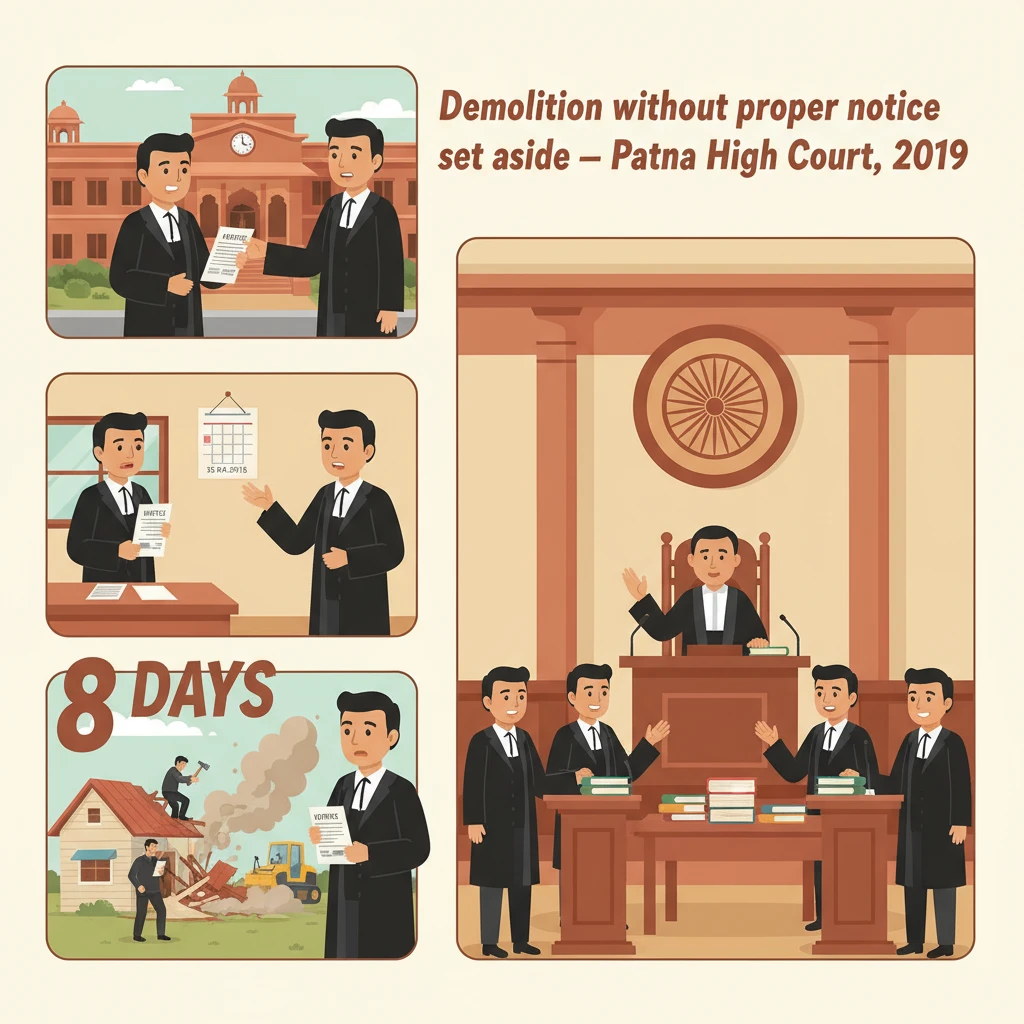
According to the record noted by the Patna High Court, a notice in the encroachment proceeding was issued to the petitioner on 9.4.2015. This notice was issued under Section 3 of the Bihar Public Land Encroachment Act, which lays down the procedure for initiating such proceedings. As per the petitioner, the notice was also served on him on the same date.
On 15.4.2015, within a few days of receiving the notice, the petitioner approached the Circle Officer and filed an application seeking some time. Despite this, on 17.4.2015, the Circle Officer went ahead and demolished the petitioner’s structure.
Feeling aggrieved by this demolition, which took place even before the expiry of the minimum statutory period under Section 3, the petitioner approached the Patna High Court under Article 226 of the Constitution of India by way of a writ petition.
What the Court Examined and Decided
The Patna High Court, through Hon’ble Mr. Justice Anil Kumar Upadhyay, heard the counsel for the petitioner, the counsel for the State of Bihar, and the counsel for the private respondent, who was the Principal of Kosi College, Khagaria.
At the outset, the Court made a strong observation about how State authorities sometimes treat constitutional guarantees as a mere formality. The Court commented that the Circle Officer had behaved as if he were above the law, despite the clear mandate of statutory provisions.
The Court recorded an undisputed factual position: a notice in the encroachment proceeding was issued on 9.4.2015, the petitioner filed an application for time on 15.4.2015, and the Circle Officer demolished the structure on 17.4.2015. There was thus a very short gap between notice and demolition.
The key statutory provision discussed by the Court was Section 3 of the Bihar Public Land Encroachment Act. The Court reproduced the relevant portion of Section 3, which states that when it appears to the Collector that a person has made or is responsible for encroachment on public land, the Collector may cause to be served upon such person a notice in the prescribed form requiring him to appear on a date “which shall not be less than two weeks from the date of service of notice” to show cause.
The Court emphasized that the legislature had, in its wisdom, prescribed a particular procedure to be followed for removal of encroachment. This procedure is not optional. The requirement that the date fixed for appearance must not be less than two weeks from the date of service of notice is a mandatory safeguard.
The Court further held that the Collector under the Act is obliged to strictly adhere to the prescribed procedure. He cannot fix a date before the expiry of the two-week minimum from the date of service of notice. In the case before the Court, although the notice was issued on 9.4.2015 and served on the same date as per the petitioner’s counsel, the structure was demolished on 17.4.2015, clearly before the expiry of the mandatory two-week period.
The Circle Officer, in his order, discussed many points, but the Court refrained from commenting on those aspects, focusing instead on the core issue of non-compliance with Section 3. The Court underlined that in a system governed by rule of law, everyone, including government officers, is bound by law. The Supreme Court has repeatedly stated that rule of law is a basic feature of the Constitution, yet the Court found that authorities often behave as though the law is a matter of convenience for them.
On behalf of the State, Mr. Ajay, learned Government Advocate, argued that even though Section 3 speaks of not less than two weeks’ notice period, this should be understood merely as a requirement to give an opportunity of hearing. Since the petitioner had appeared on 15.4.2015, before the expiry of two weeks, counsel argued that the mandatory notice period should be treated as waived.
The Court rejected this argument. It held that the statutory language “not less than two weeks” is mandatory and cannot be diluted or waived merely because the person appears earlier. The provision fixes a minimum time between service of notice and the date of appearance, and this procedural safeguard cannot be bypassed.
Similarly, counsel for the private respondent, Mr. Surendra Kishore Thakur, contended that since the petitioner had appeared in the proceeding, he could not complain that provisions of the Act were not followed. The Court did not accept this line either, as it did not cure the basic defect of violating the mandatory time requirement under Section 3.
Both counsel for the State and the private respondent also argued that the writ petition under Article 226 was not maintainable because an alternative statutory remedy by way of appeal was available under the Act. They submitted that the petitioner ought to have availed the appellate remedy instead of approaching the High Court directly.
The Court then examined the law on alternative remedy. It referred to the Constitution Bench judgment in The State of Uttar Pradesh vs Mohammad Nooh, AIR 1956 SC 86. In that decision, the Supreme Court carved out three main exceptions to the rule that a writ petition should not be entertained when an alternative remedy exists: first, where the order is passed without jurisdiction; second, where there is violation of the principles of natural justice; and third, where there is infringement of a fundamental right.
The Court noted that this judgment continues to hold the field and has been reiterated many times. The Court also referred to the decision of Justice Subba Rao in Dwarika Nath vs Income-Tax Officer, AIR 1966 SC 81, where it was held that Article 226 is couched in the most comprehensive phraseology and is designed to reach wherever injustice is found.
The Patna High Court observed that in view of these principles, the present case was a clear example of injustice, calling for exercise of writ jurisdiction. The Court clarified that the rule about alternative remedy is only a self-imposed restriction on the High Court’s powers under Article 226, and it does not exclude or take away that jurisdiction.
Further, the Court relied on the seven-judge Bench decision in L. Chandra Kumar vs Union of India and Others, (1997) 3 SCC 261, which held that the power of judicial review under Article 226 is part of the basic structure of the Constitution. Thus, the existence of an alternative remedy cannot bar the Court from intervening where necessary.
On this basis, the Court held that all objections regarding the maintainability of the writ petition were misconceived and rejected them.
Coming back to Section 3 of the Bihar Public Land Encroachment Act, the Court read the mandatory words “not less than two weeks” and concluded that the law requires that at least two weeks must pass from the date of service of notice before any further coercive action is taken. In this case, the Circle Officer’s action, taken within eight days of the notice, was in clear violation of that requirement.
The Court held that the entire action of the Circle Officer was a nullity because it was taken in the teeth of the mandatory statutory provisions. The Court further noted that such arbitrary action had led to prolonged litigation, with the case remaining pending since 2015, an unnecessary burden for both the citizen and the justice system.
In these circumstances, the Court declared that the action of the Circle Officer was totally without jurisdiction and per se illegal and arbitrary. Consequently, the order passed by the Circle Officer in the encroachment proceeding was quashed.
The Court then turned to the question of relief. Observing that a citizen like the petitioner should be compensated for the arbitrary acts of State instrumentalities, the Court held that he was entitled to compensation. While allowing the writ petition, the Court directed the District Magistrate, Khagaria, to pay compensation of Rs. 5,00,000/- (five lakhs) to the petitioner within thirty days from the date of receipt or production of a copy of the judgment.
In addition to monetary compensation, the Court also directed the respondents to reconstruct the demolished structure within a period of four months. Thus, the relief was both compensatory and restorative in nature.
With these directions and observations, the writ petition was allowed and disposed of.
Why This Judgment Matters
This judgment is important for all residents of Bihar who may face encroachment proceedings under the Bihar Public Land Encroachment Act. It makes clear that government officers must strictly follow the procedure laid down by law, especially when it involves demolishing a person’s house or structure.
The Patna High Court has emphasized that the minimum two-week notice period under Section 3 is not a formality. It is a mandatory safeguard. Even if a person appears earlier, the authorities cannot shortcut this time requirement and rush into demolition.
The judgment also reassures citizens that when government officers misuse their power or ignore statutory protections, the High Court can step in under Article 226, even if an appeal is otherwise available. The Court has underlined that rule of law applies equally to officers and ordinary citizens.
Finally, by awarding compensation of Rs. 5,00,000/- and ordering reconstruction of the demolished structure, the Court has signaled that arbitrary official action has financial and legal consequences for the State. This serves as a warning to officers who act as if they are above the law.
Legal Issues and Answers
- Issue: Whether the Circle Officer could demolish the petitioner’s structure under the Bihar Public Land Encroachment Act before expiry of the mandatory two-week period after service of notice under Section 3.
Answer: No. The Court held that Section 3 requires a minimum of two weeks from the date of service of notice, and action taken before that is in violation of the Act, without jurisdiction, illegal, and arbitrary. - Issue: Whether the petitioner’s appearance in the proceeding before the expiry of two weeks or the availability of a statutory appeal barred the writ petition under Article 226 of the Constitution.
Answer: No. The Court held that early appearance does not waive the mandatory notice period, and alternative remedy does not bar writ jurisdiction where there is lack of jurisdiction, violation of statutory mandate, and injustice. - Issue: Whether the petitioner was entitled to compensation and restoration for the unlawful demolition.
Answer: Yes. The Court directed payment of Rs. 5,00,000/- as compensation by the District Magistrate, Khagaria, and ordered reconstruction of the demolished structure within four months.
Cases Cited by the Court
- The State of Uttar Pradesh vs Mohammad Nooh, AIR 1956 SC 86
- Dwarika Nath vs Income-Tax Officer, AIR 1966 SC 81
- L. Chandra Kumar vs Union of India and Others, (1997) 3 SCC 261
Case Details
Case Number: Civil Writ Jurisdiction Case No. 7312 of 2015
Case Title: Shailesh Kumar vs The State of Bihar & Others
Citation: 2019(3) PLJR 472
Court: High Court of Judicature at Patna
Coram: Hon’ble Mr. Justice Anil Kumar Upadhyay
Date of Judgment: 14.05.2019
Nature of the Case: Writ petition under Article 226 of the Constitution of India challenging action taken under the Bihar Public Land Encroachment Act
Advocates:
- For the petitioner: Mr. Dronacharya, Advocate
- For the State: Mr. Ajay, GA-12
- For respondent no. 6: Mr. Surendra Kishore Thakur, Advocate
Link to Judgment: Click here to read the full judgment of the Patna High Court
If you found this explanation helpful and wish to stay informed about
how legal developments may affect your rights in Bihar,
you may consider following Samvida Law Associates for more updates.







